
Commuting from Northridge — A Complete Guide to LA Work Zones
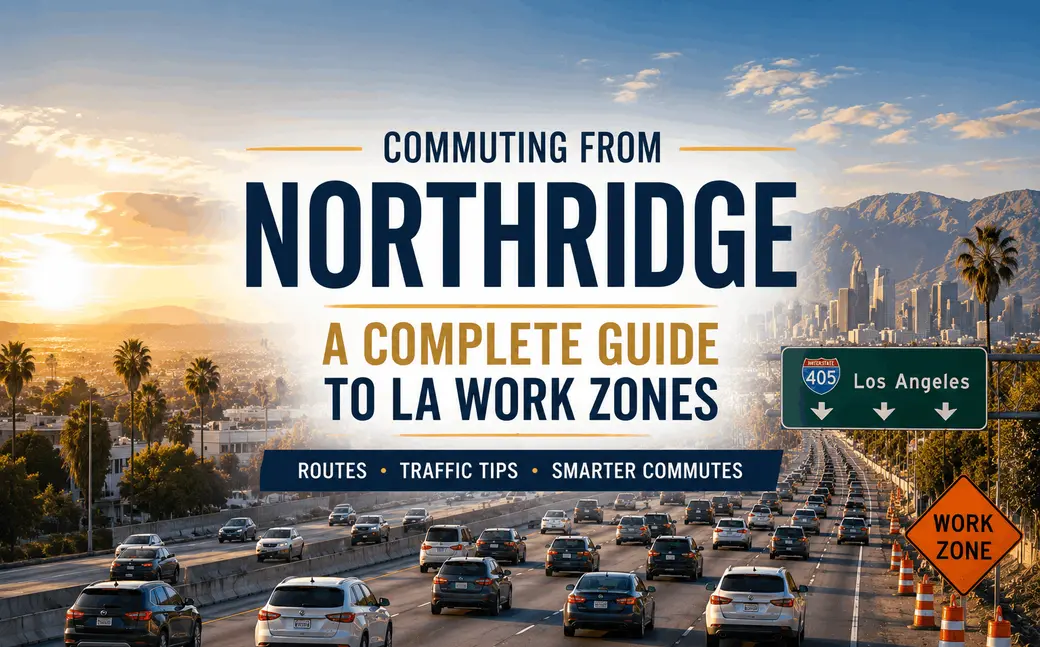
Northridge 91324 and 91325 occupies a specific position in the San Fernando Valley commute landscape — one that is genuinely excellent for a defined set of workplace destinations and genuinely challenging for others, with the distinction between the two being the difference between a manageable daily commute and one that accumulates to 8–12 hours of additional driving per week.
The Northridge commute story begins with what is unique about this neighborhood: the California State University Northridge campus is directly adjacent to 91324, making it the only major SFV employer reachable from its surrounding neighborhood by bicycle, by walking, or by car in under 10 minutes under virtually any traffic conditions. Northridge Hospital Medical Center 91325 is 8–14 minutes from most 91324 residential streets. Warner Center 91367 — the SFV's largest commercial employment hub — is 18–25 minutes. These three destinations alone account for a meaningful share of Northridge's professional workforce, and for households whose primary earner works at one of them, the commute from Northridge is among the most efficient in the SFV.
Beyond these proximate destinations, the Northridge commute calculus becomes more complex. The 405/101 interchange in Sherman Oaks 91403 — the SFV's most direct Westside access — is 18–25 minutes from most Northridge addresses by surface streets or freeway. Downtown Los Angeles is 35–55 minutes in peak conditions. The Westside's Century City and Santa Monica corridor is 50–75 minutes in peak morning conditions. Understanding these commute realities — with specific route options, specific departure time sensitivities, and specific employer-zone assessments — is the foundation of the honest Northridge commute guide.
1. 🎓 The CSUN and Northridge Hospital Commute — Where Northridge Excels
No SFV neighborhood has the commute advantage that Northridge 91324/91325 delivers for CSUN-affiliated and Northridge Hospital-affiliated professionals — and this advantage is the specific purchase motivation that drives a meaningful share of Northridge's professional household buyer pool.
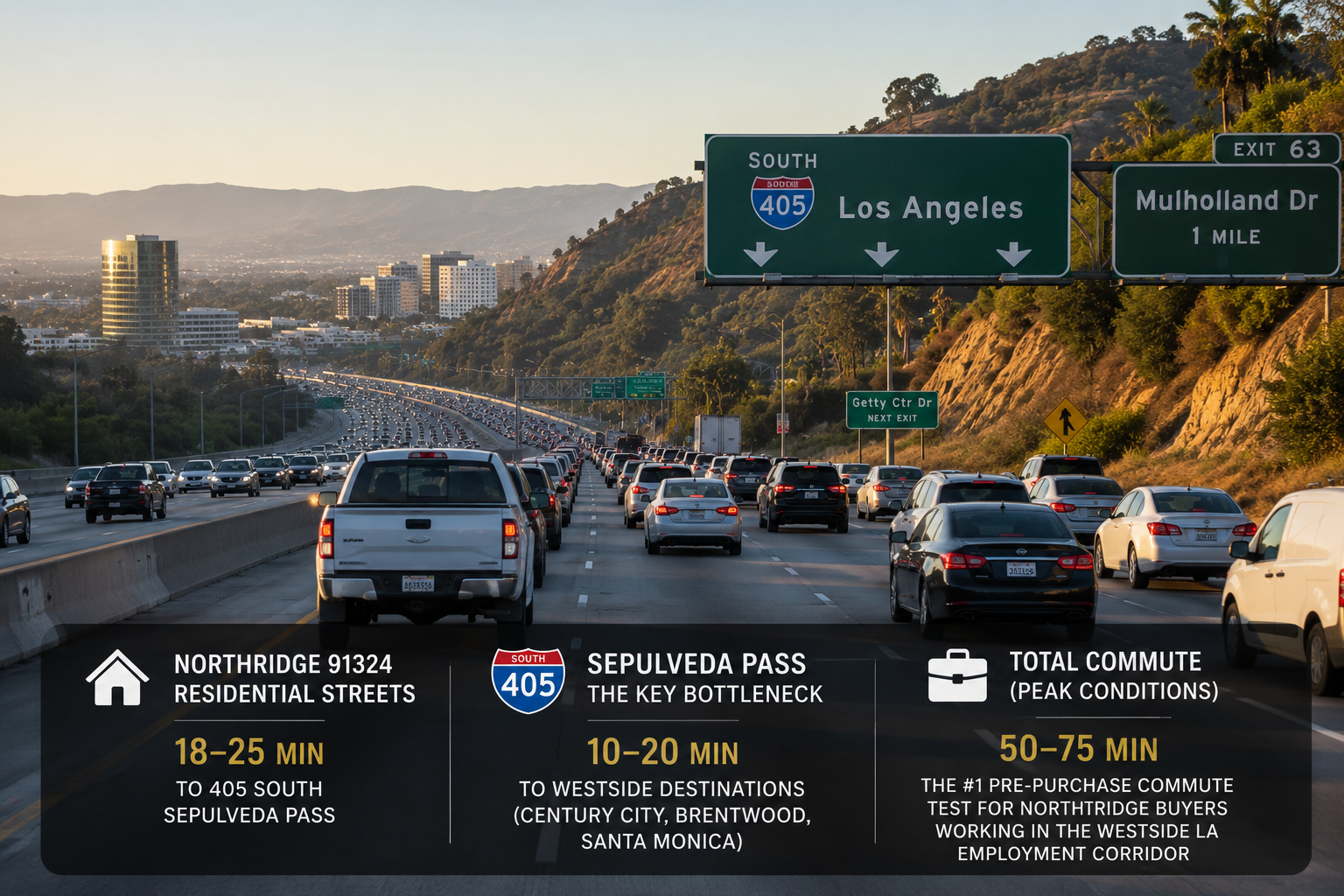 CSUN from a Northridge 91324 residential street — the most specific commute advantage available in any SFV neighborhood. The CSUN faculty member, staff employee, or administrator who lives in the adjacent 91324 residential sub-neighborhoods is commuting to work in 5–10 minutes by car or 15–25 minutes by bicycle — an urban luxury that most Los Angeles professionals measure in the 45–70 minutes that defines the typical LA professional commute.
The CSUN commute (91330):
CSUN's 356-acre campus occupies the northern portion of the 91330 zip code, directly adjacent to the 91324 residential grid. The commute from most 91324 residential streets:
- → 🚗 By car (closest sub-neighborhoods): 5–8 minutes. Nordhoff Street bisects the campus-adjacent residential zone; the northbound surface street drive to the campus entrance is essentially without traffic at any hour.
- → 🚗 By car (most 91324 residential streets): 8–12 minutes. The CSUN parking structure capacity and the campus's multiple entrance points mean even peak-hour commutes don't materially extend the drive.
- → 🚗 By car (91325 eastern Northridge sub-neighborhoods): 12–18 minutes — slightly extended for the sub-neighborhoods approaching Granada Hills 91344, but still dramatically shorter than any other SFV employment commute.
- → 🚲 By bicycle: The CSUN campus is bikeable from most 91324 sub-neighborhoods — 15–25 minutes on the surface street network. The proximity makes Northridge the most bicycle-commute-viable neighborhood in the SFV for CSUN-affiliated professionals.
- → 🚶 On foot: From the closest 91324 sub-neighborhoods directly adjacent to the campus boundary: genuinely walkable — 20–35 minutes on foot for the professional whose daily schedule is flexible enough to accommodate a morning walk.
For CSUN faculty and staff households:
The CSUN commute advantage quantified: a faculty member who commutes 10 minutes from a 91324 home saves approximately 60 minutes/day (assuming a 40 minute average alternative commute) versus a Sherman Oaks 91403 or Encino 91316 commute. Over a 200-day academic year: 200 hours annually — the equivalent of 25 full 8-hour workdays returned to the household every year. The daily quality-of-life and career productivity value of this commute compression is the specific Northridge purchase motivation that no other SFV market can replicate for CSUN-affiliated professionals.
The Northridge Hospital Medical Center commute (91325):
Northridge Hospital Medical Center — the acute care hospital serving the central northern SFV — is located within 91325, making it the second proximate major employer within the Northridge residential market's immediate commute range.
- → 🚗 From 91324 core sub-neighborhoods: 8–14 minutes via Reseda Boulevard southbound to the 91325 hospital campus
- → 🚗 From 91325 sub-neighborhoods (approaching the hospital): 5–10 minutes
- → ✅ For healthcare professional households: The nurse, physician, medical administrator, or allied health professional whose primary employer is Northridge Hospital experiences a commute from 91324/91325 that is among the shortest available from any SFV residential address — the specific purchase motivation that makes Northridge consistently attractive to healthcare professional households at all income levels.
Adjacent healthcare employer access:
- → 🏥 Providence Cedars-Sinai Tarzana Medical Center (91356): 18–25 minutes via Reseda Boulevard south to Ventura Boulevard
- → 🏥 West Hills Hospital and Medical Center (91307): 20–28 minutes via the 118 or surface streets
- → 🏥 UCLA Medical Center (90095): 50–70 minutes via 405 South — manageable for the healthcare professional with a flexible schedule but challenging for the nurse on a 6:00 AM shift start
2. 🏢 The Valley Employment Corridor — Warner Center, Woodland Hills, and Adjacent Employers
Beyond CSUN and Northridge Hospital, the SFV's primary commercial employment corridor — Warner Center 91367, Woodland Hills 91364, and the broad Valley business park and commercial district network — is accessible from Northridge with commutes that range from manageable to genuinely convenient.
Warner Center (91367):
Warner Center is the SFV's largest concentration of commercial office employment — financial services, healthcare administration, insurance, professional services, and technology companies whose employees make up a significant share of the central and western Valley's working professional population.
- → 🚗 Route 1 — Nordhoff Street west to Valley Circle Boulevard south (surface streets, 24–32 minutes peak morning): The most direct surface street route from most 91324 sub-neighborhoods to Warner Center's eastern edge. Less freeway-dependent and more predictable than freeway routes in peak conditions.
- → 🚗 Route 2 — 118 West to Valley Circle Boulevard south (freeway, 18–28 minutes off-peak; 22–35 minutes peak morning): The 118 Freeway westbound from Nordhoff provides faster travel when traffic allows but is subject to the 118's peak-hour congestion near De Soto and Valley Circle.
- → 🚗 Route 3 — Reseda Boulevard south to 101 West (freeway, 22–32 minutes peak morning): The 101 provides Warner Center access via the Topanga Canyon Boulevard exit — competitive with the 118 route depending on 101 westbound conditions.
- → ⏰ Departure time sensitivity: The Warner Center commute from Northridge has a 12–15 minute swing between a 6:45 AM departure (22–28 minutes) and an 8:30 AM departure (32–42 minutes). The Northridge professional commuting to Warner Center who departs before 7:15 AM has a consistently manageable commute; the 8:30 AM departure is routinely longer.
Woodland Hills business corridor (91364/91367):
The professional services, medical, and corporate office employment in the Woodland Hills/Calabasas corridor:
- → 🚗 18–28 minutes via 118 West to Ventura Boulevard or 101 West: Accessible and consistently manageable for the professional with any departure flexibility
- → ✅ For Northridge-to-Woodland Hills commuters: One of the most underappreciated commute pairs in the SFV — the Northridge resident whose employer is in the Woodland Hills commercial corridor has a commute of 18–28 minutes that many Woodland Hills residents themselves experience from the hillside sub-neighborhoods.
Chatsworth (91311) and West Hills (91307) industrial/commercial:
- → 🚗 20–32 minutes via 118 West: The manufacturing, industrial, and commercial employers of the western corridor are accessible with consistent drive times that the 118's relatively uncongested western segment supports.
Van Nuys (91401/91405/91406) and North Hollywood (91601/91605):
- → 🚗 Van Nuys (91401): 18–25 minutes via surface streets or 405 North
- → 🚗 North Hollywood (91601): 22–35 minutes via 405 South to Lankershim or via surface streets through the Valley
- → ✅ For central Valley employment: Northridge's central Valley position makes it one of the best-positioned neighborhoods for the professional whose workplace is anywhere in the Van Nuys to Woodland Hills corridor — the geographic center that minimizes commute time across the Valley employment arc.
3. 🎬 The Entertainment Industry Commute — Studios, Networks, and Production Companies
The entertainment industry employer cluster — the studios, networks, streaming companies, and production facilities that represent a secondary but meaningful segment of the Northridge buyer population — is accessible from Northridge with commutes that are longer than the Valley employment corridor but shorter than the Westside alternatives.
Burbank entertainment corridor (91505/91502):
The Burbank studio complex — NBC Universal, Warner Bros., Walt Disney Studios, Nickelodeon, and the supporting production and post-production ecosystem — is the primary entertainment industry employment destination accessible from Northridge without the 405 Sepulveda Pass.
- → 🚗 Route — 118 East to I-5 South to Buena Vista exit (32–45 minutes peak morning): The most direct Northridge-to-Burbank freeway route. The 118 eastbound from Reseda Boulevard to the I-5 southbound interchange at San Fernando Road, then I-5 South to Burbank.
- → 🚗 Alternative — Reseda Boulevard south to 101 East to Hollywood Way (35–50 minutes peak morning): A route through the Valley that avoids the 118/5 interchange complexity but adds distance.
- → ⏰ Departure time: A 6:30 AM departure from 91324 to Burbank reaches 32–38 minutes. An 8:00 AM departure reaches 42–55 minutes. The Burbank entertainment commute from Northridge rewards early departure significantly.
- → ✅ For Burbank-commuting entertainment professionals: Northridge is more competitive for Burbank commutes than Sherman Oaks, Encino, or Tarzana suggest — the 118 East to I-5 South route avoids the 101/405 interchange congestion that defines the Westside-focused entertainment commute and produces a Northridge-to-Burbank time that often matches or beats the Sherman Oaks or Studio City alternative.
Universal City/Studio City entertainment corridor (91608/91604):
- → 🚗 28–42 minutes via 405 South to 101 East or via Ventura Boulevard: The commute to Universal, Universal City Walk employers, and the Studio City production community that is accessible but not as efficient as the Burbank route.
The streaming company Westside cluster (Santa Monica 90401, Culver City 90232, Century City):
Amazon (Santa Monica), Apple TV+ (Culver City), and the streaming and tech-adjacent entertainment employers that have established Westside offices represent the most challenging commute destination for the Northridge entertainment professional.
- → 🚗 50–75 minutes via 405 South Sepulveda Pass in peak morning: The Northridge-to-Westside-entertainment commute is the specific route that pre-purchase testing is most important for — the difference between a 6:45 AM departure (52 minutes) and an 8:30 AM departure (72–80 minutes) is real and daily.
4. 🌊 Downtown and the Westside — Northridge's Honest Commute Challenge
The honest presentation of the Northridge commute requires clear-eyed assessment of the destinations where the commute is genuinely challenging — and none is more important to evaluate honestly than the Westside and downtown LA corridor that defines many professional commuters' primary workplace destinations.
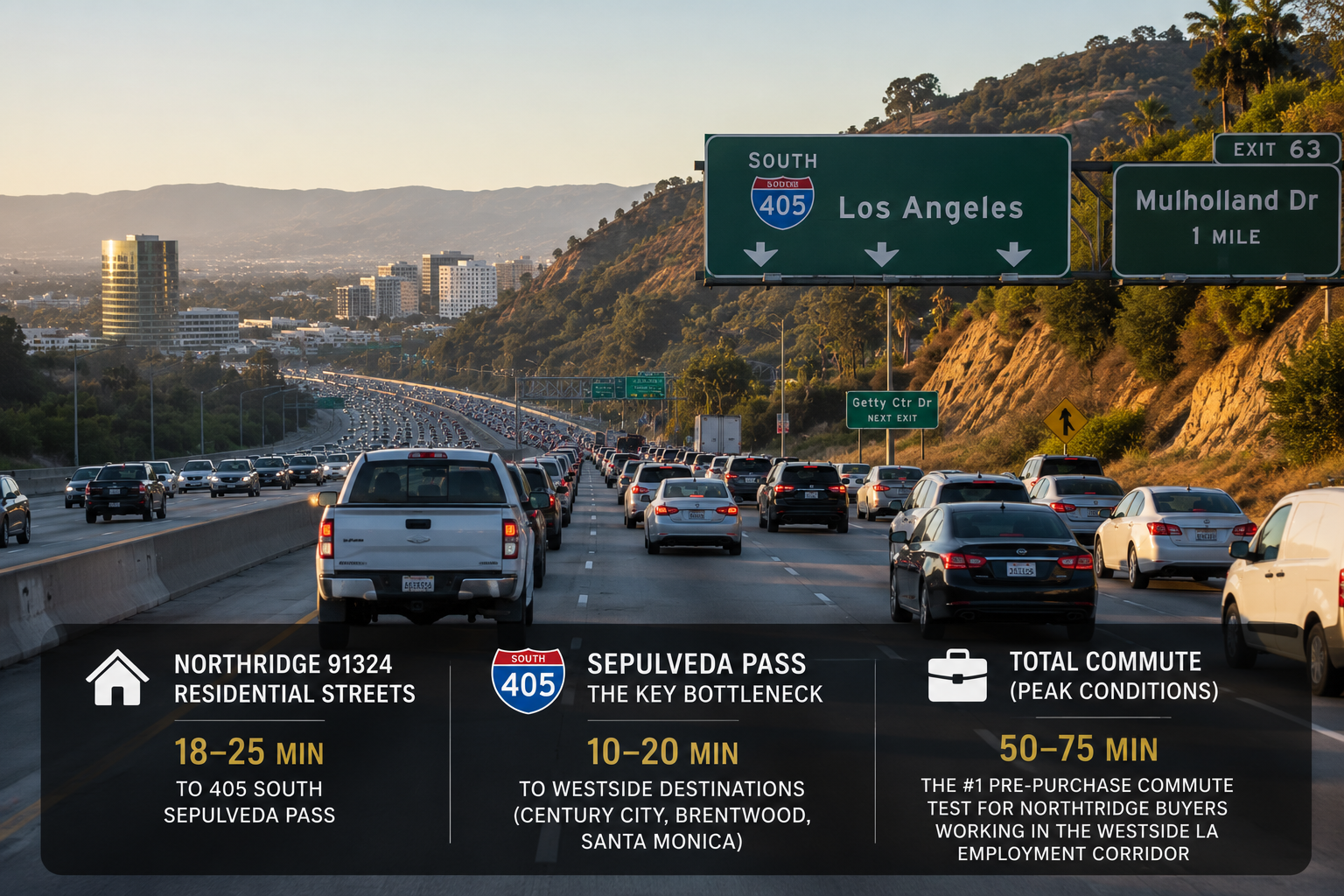 The 405 South Sepulveda Pass — the Northridge commuter's specific challenge for Westside employment. The pass is 18–25 minutes from most Northridge 91324 residential streets and then 10–20 minutes to Century City, Brentwood, or Santa Monica on the far side. The total commute of 50–75 minutes in peak conditions is the most important pre-purchase commute test for any Northridge buyer whose workplace is in the Westside LA employment corridor.
The 405 South commute from Northridge:
The Northridge-to-Westside commute requires the 405 South via the Sepulveda Pass — the SFV's primary Westside freeway connection and one of the most consistently congested freeway segments in Los Angeles. The Northridge commuter reaches the 405 South via:
Route A — Reseda Boulevard south to 405 on-ramp at Nordhoff (most efficient for most 91324 addresses):
- → Drive time from 91324 residential street to 405 on-ramp: 12–18 minutes depending on sub-neighborhood
- → 405 South Sepulveda Pass to Wilshire Boulevard exit: 18–35 minutes depending on departure time
- → Wilshire to Century City/Beverly Hills/UCLA: additional 5–12 minutes
- → Total Northridge to Century City peak morning (8:00 AM departure): 55–70 minutes
- → Total Northridge to Century City off-peak (6:45 AM departure): 40–52 minutes
Route B — 118 East to 405 South (for eastern 91324/91325 sub-neighborhoods):
- → Slightly longer to access the 405 but avoids surface street congestion for eastern sub-neighborhoods
The honest Westside commute assessment:
At a 7:30 AM departure, the Northridge-to-Westside commute is approximately 48–58 minutes — challenging but manageable for the professional who builds the commute time into their schedule and who uses the drive time productively (podcast, audio book, phone calls).
At an 8:30 AM departure, the Northridge-to-Westside commute is 65–80+ minutes — the specific commute time that accumulates to 130–160 minutes daily (round trip) and 650–800 minutes per 5-day week — approximately 11–13 hours per week of commute time. For the professional who specifically values their time, this commute level requires an honest quality-of-life assessment before the purchase.
The reverse commute advantage:
The Northridge-to-Westside commute is challenging in the morning peak. The return commute (Westside to Northridge, 5:30–7:00 PM) runs 35–55 minutes — meaningfully shorter than the morning direction because the 405 North over the Sepulveda Pass is less congested than the southbound direction at most times.
The hybrid-work calculation:
For the professional with a 2–3 day weekly commute to the Westside, the Northridge commute calculus changes dramatically. At 2 Westside commute days per week (versus 5 in the pre-pandemic norm), the weekly commute time drops from 650–800 minutes to 260–320 minutes — a level that many professionals find acceptable in exchange for the value proposition Northridge delivers. The hybrid work arrangement specifically transforms the Northridge commute from a daily frustration into a 2-day-per-week managed cost.
Downtown Los Angeles (90012/90017/90071):
- → 🚗 38–55 minutes via 405 South to 10 East or via 118 East to 5 South: More variable than the Westside commute because multiple routes are viable
- → 🚗 118 East to 210 East to 5 South to downtown (sometimes faster in peak conditions): The freeway combination that avoids the 405 Sepulveda Pass on high-congestion days
- → ✅ Transit option: The Metro G Line (formerly Orange Line) with a drive to the Reseda or Balboa station and a bus-rapid-transit connection to North Hollywood, then Metro connections to downtown — a viable option for the professional whose downtown destination is near a Metro station
5. 🚌 Transit, Alternative Commute, and Departure Time Optimization
The Northridge commuter who maximizes their daily quality of life uses a combination of departure time optimization, route selection based on real-time conditions, and — for specific destinations — transit and alternative commute options that reduce the car dependency and commute stress that peak-hour driving accumulates.
The Metro G Line (formerly Orange Line) — Northridge's primary transit resource:
The Metro G Line is a Bus Rapid Transit (BRT) line running along the former Southern Pacific railroad right-of-way through the SFV, connecting to the Metro Red/Orange Line at North Hollywood Station. The G Line's relationship to Northridge:
- → 📍 Closest stations to 91324: Reseda Station (approximately 12–18 minutes by car from most 91324 sub-neighborhoods) and Balboa Station (approximately 10–15 minutes)
- → 🚌 G Line to North Hollywood: Approximately 30–35 minutes from Reseda Station
- → 🚇 North Hollywood to Downtown (Metro B Line): Approximately 22–28 minutes
- → 📊 Total transit commute Northridge to Downtown: Approximately 65–80 minutes including the drive to the G Line station
- → ✅ Best use case for Northridge transit: The downtown professional who works near a Metro station and who wants to eliminate the variable driving stress of the 405/5 freeway commute. The predictability of the Metro commute (not subject to freeway accidents that produce 90-minute commutes on bad days) is the specific transit value that some Northridge downtown commuters specifically choose.
- → ⚠️ Not practical for: Westside destinations (no direct transit), studio/Burbank destinations (require car for the final leg), or any destination without Metro station proximity.
Departure time optimization — the Northridge commuter's most impactful tool:
The departure time sensitivity from Northridge is more significant than from neighborhoods with direct freeway geometry to major employment centers. The specific departure time improvements:
To Westside (Century City, Santa Monica):
- → 🌅 6:30 AM departure: 38–45 minutes
- → ⏰ 7:00 AM departure: 45–55 minutes
- → ⏰ 7:30 AM departure: 50–62 minutes
- → ⏰ 8:00 AM departure: 60–72 minutes
- → ⏰ 8:30 AM departure: 70–85 minutes
- → 💡 The Northridge commuter's rule: Every 30 minutes of later departure adds approximately 10–15 minutes of commute time to Westside destinations. The professional who can build their employer schedule around a 7:00 AM or earlier departure saves 25–40 minutes daily — approximately 2–3 hours per week.
To Burbank studios:
- → 🌅 6:30 AM departure: 28–35 minutes
- → ⏰ 8:00 AM departure: 42–55 minutes
- → ⏰ 9:00 AM departure: 38–48 minutes (post-peak, faster than 8:00 AM)
To Warner Center:
- → 🌅 6:45 AM departure: 20–28 minutes
- → ⏰ 8:30 AM departure: 30–42 minutes
Navigation app strategy:
Waze and Google Maps provide real-time routing that navigates the Northridge commuter's freeway combination options — the I-405 South versus the 118 East to I-5 South for Burbank, the direct Reseda Boulevard surface route versus the freeway for Warner Center. The professional who uses the navigation app daily rather than defaulting to a fixed route consistently saves 8–15 minutes per day in avoidable peak-hour congestion.
🚫 What NOT to Overdo
Don't test the Northridge-to-Westside commute on a Sunday afternoon before purchasing. The specific instruction that the Calabasas and Encino commuting guides established applies equally to Northridge — but with even higher stakes because the Northridge-to-Westside commute is specifically sensitive to peak-hour conditions. A Sunday afternoon drive from 91324 to Santa Monica runs 35 minutes. The Monday morning 8:15 AM drive runs 70 minutes. Visit on a Tuesday or Wednesday at your actual departure time before purchasing. This single test prevents the most common Northridge buyer commute regret.
Don't assume the 118 Freeway's off-peak efficiency applies to peak-hour conditions. The 118 Freeway is among the SFV's more free-flowing freeway segments in off-peak conditions — and can be meaningfully congested between Reseda Boulevard and the I-405 interchange during peak morning hours. The professional who models their Northridge commute based on the uncongested 118 experience and then discovers the peak-hour reality has made the most consistent Northridge commute estimation error. Test at peak hour.
Don't underestimate the CSUN commute advantage's compounding daily quality-of-life value. The CSUN faculty member who describes their 8-minute commute as "convenient" is dramatically understating its quality-of-life significance. 8 minutes versus a typical LA professional's 45-minute commute is 74 minutes saved daily, 370 minutes per week, approximately 300 hours annually. For the CSUN-affiliated professional evaluating Northridge, this time return — invested in research, family, exercise, or any alternative — is the most specific and most valuable feature of the 91324 residential position and should be explicitly quantified in the purchase decision.
Don't overlook the reverse commute advantage for Westside-commuting professionals. The Northridge-to-Westside morning commute is 50–75 minutes in peak conditions. The Westside-to-Northridge evening commute is 35–52 minutes — meaningfully shorter because the 405 North Sepulveda Pass is less congested than the southbound direction at most times. For the professional who specifically needs to be home early for family reasons, the asymmetric commute (harder going, easier returning) may be specifically more acceptable than the symmetric commute of a closer Westside neighborhood.
Don't rely on fixed departure times year-round. Los Angeles peak commute hours shift seasonally — school year starts in August/September produce materially worse peak conditions than the same commutes during the summer break period. The CSUN fall semester beginning in late August adds the campus-adjacent traffic load to the Northridge commute that summer conditions don't produce. Build seasonal adjustment into commute planning rather than assuming the August test drive applies to November conditions.
🏠 Real-World Scenario — Northridge 91324
A couple — a CSUN associate professor of engineering and a registered nurse at Northridge Hospital Medical Center 91325 — purchased in Northridge 91324 after five years renting in Encino 91316. Their Encino rental had positioned them centrally in the SFV, but their commutes had been adding up:
- → Professor's commute from Encino to CSUN: 22–35 minutes via surface streets — not terrible, but consistent daily friction
- → Nurse's commute from Encino to Northridge Hospital: 28–40 minutes — the specific commute that a 6:00 AM shift start made daily before the sun came up
Their combined annual commute time from Encino: approximately (30 min × 2 × 200 days for professor) + (35 min × 2 × 230 days for nurse) = 120 hours + 270 hours = 390 hours annually — approximately 16 full days of driving.
After purchasing in Northridge 91324:
- → Professor's commute to CSUN: 9 minutes
- → Nurse's commute to Northridge Hospital: 11 minutes
Combined annual commute from Northridge: approximately (9 min × 2 × 200 days) + (11 min × 2 × 230 days) = 60 hours + 84.7 hours = 144.7 hours annually — approximately 6 full days of driving.
The commute time saved: 390 - 144.7 = 245.3 hours annually — approximately 10 full days returned to the household every year through the Northridge purchase.
The professor's assessment one year in: "I used to commute to CSUN from Encino every day. Now I commute from Northridge. I've used the 245 hours I recovered this year to finish two grant applications and spend 60 more hours with my kids. The house is also $280,000 less expensive than the Encino equivalent would have been. The commute time savings alone justified the purchase."
The nurse's: "I do 6:00 AM shift starts. From Encino that meant leaving at 5:15 AM. From Northridge, I leave at 5:45 AM and have a 3-minute margin. I've gotten 30 minutes more sleep on every early shift for the past year. That compounds."
🏠 Real-World Scenario — Northridge 91324
A single buyer — a 35-year-old financial analyst at a Century City financial services firm, evaluating Northridge specifically for the value proposition — had a specific question before purchasing: was the Northridge-to-Century City commute genuinely manageable or was it the commute that would eventually produce the regret that Westside-transplant Northridge buyers sometimes describe?
We provided the honest answer before the purchase.
The specific commute test:
We scheduled the buyer to drive from a specific Northridge 91324 address (in the core CSUN-adjacent sub-neighborhood he was considering) to his Century City office building at 8:00 AM on a Tuesday morning.
Results:
- → Northridge residential street to 405 South on-ramp (Reseda Boulevard): 14 minutes
- → 405 South Sepulveda Pass to Wilshire/Beverly Hills off-ramp: 28 minutes
- → Wilshire to Century City parking structure: 8 minutes
- → Total: 50 minutes door-to-door
We also had him drive the return on the same Tuesday, departing Century City at 6:00 PM:
- → Century City to 405 North on-ramp: 9 minutes
- → 405 North Sepulveda Pass to Reseda Boulevard exit: 24 minutes
- → Reseda Boulevard to Northridge residential street: 12 minutes
- → Return total: 45 minutes
His honest assessment: "50 minutes going, 45 minutes coming back. 95 minutes daily. 475 minutes per week — about 8 hours. That's real. I need to decide if the $320,000 savings versus Encino is worth 8 hours per week."
We added one more data point: his current Santa Monica rental to Century City was 22 minutes in the morning, 28 minutes in the evening. His current weekly commute: 250 minutes — versus the projected 475 minutes from Northridge.
The analysis: Northridge added 225 minutes per week of commute versus Santa Monica (approximately 3.75 hours weekly). The purchase price difference: $890,000 (Northridge 91324 renovated 3-bedroom) versus $1,210,000 (comparable Santa Monica entry). The $320,000 price difference at current rates translated to approximately $2,182/month lower PITI from Northridge.
The buyer's calculation: was 3.75 additional hours per week worth $2,182/month? His answer, after specifically evaluating the commute rather than assuming: "At my income level and with a podcast habit, 3.75 hours a week of commuting is actually productive time I'm already spending. $2,182/month is real money I'm saving. I'm buying in Northridge."
He purchased in Northridge 91324 at $888,000. Year one: "I've listened to 46 books on the commute. I've saved $26,184 in mortgage payments versus Santa Monica. I know exactly what I traded and I made the right call for my situation."
The pre-purchase commute test — conducted specifically and honestly — produced the confident purchase rather than the post-close regret. The buyer who tests and accepts the commute owns it; the buyer who doesn't test and discovers it later resents it.
❓ FAQ
How far is Northridge from downtown Los Angeles? Northridge 91324/91325 to downtown Los Angeles: approximately 22–25 miles by freeway. Drive time varies significantly by route and departure time: ✓ 118 East to I-5 South to downtown (6:30 AM departure): 38–45 minutes. ✓ 405 South to I-10 East (8:00 AM departure): 52–65 minutes. ✓ Surface streets via Van Nuys Boulevard and Sepulveda: 50–70 minutes peak. The 118-to-5 route is typically faster than the 405 South route for downtown destinations, particularly at peak hours. Transit option via Metro G Line from Reseda Station to downtown: approximately 65–80 minutes total.
How is the commute from Northridge to Burbank? The Northridge-to-Burbank commute is one of the more efficient studio-district commutes available from the SFV: ✓ 118 East to I-5 South to Burbank (6:30 AM departure): 28–35 minutes. ✓ Same route at 8:00 AM departure: 42–52 minutes. ✓ 101 East to Hollywood Way alternative: 35–50 minutes peak. For entertainment industry professionals commuting to Warner Bros., Disney, NBC Universal, or the broader Burbank studio complex, Northridge produces a commute that is competitive with Sherman Oaks and Studio City alternatives — particularly for professionals whose schedule allows earlier departures.
Can I commute from Northridge to the Westside? Yes — but with accurate expectations about commute time. The Northridge-to-Westside commute (Century City, Brentwood, Santa Monica): ✓ 6:30 AM departure: 38–48 minutes. ✓ 7:30 AM departure: 50–62 minutes. ✓ 8:30 AM departure: 68–82 minutes. The 405 South Sepulveda Pass is the primary route — accessed from Northridge via Reseda Boulevard south (12–18 minutes to the 405 on-ramp). Test your specific route at your actual departure time before purchasing. The Northridge-to-Westside commute is manageable for the professional with early departure flexibility or a 2–3 day hybrid schedule; it is genuinely burdensome for the professional who must depart at 8:30 AM daily.
Is CSUN walkable from Northridge homes? From the residential streets immediately adjacent to the CSUN campus in 91324: yes — genuinely walkable in 20–35 minutes. By bicycle: 15–25 minutes. By car: 5–12 minutes. The walkability and bicycle-commute viability is specific to the closest 91324 sub-neighborhoods; residents of 91325 or the more distant 91324 sub-neighborhoods have car commutes of 8–18 minutes that are not walking-distance convenient. The CSUN adjacency is the most proximate major employer-to-residential relationship in the SFV — a daily commute advantage that no other PEP coverage area neighborhood replicates with a major employer.
What freeway is Northridge near? Northridge 91324/91325 has access to multiple freeways: ✓ 118 (Ronald Reagan) Freeway: The primary Northridge freeway — accessible from Reseda Boulevard, Balboa Boulevard, and Nordhoff Street. Provides east (toward Burbank/downtown via I-5) and west (toward Simi Valley, Chatsworth) access. ✓ 405 (San Diego) Freeway: Accessible via Reseda Boulevard south (12–18 minutes) or Balboa Boulevard south — the primary Westside and LAX access route. ✓ 101 (Ventura) Freeway: Accessible via Reseda Boulevard south or Topanga Canyon Boulevard south (18–22 minutes from most 91324 sub-neighborhoods) — the Hollywood, Burbank, and Eastside route. The 118/405/101 freeway access triangle that Northridge's central SFV position enables makes it more connected than most SFV neighborhoods to the full Los Angeles freeway network.
What is the commute from Northridge to Warner Center? Warner Center 91367 to Northridge 91324: 18–28 minutes via surface streets (Nordhoff or Saticoy westbound) or 20–32 minutes via 118 West to Valley Circle or De Soto. The Warner Center commute from Northridge is one of the most underappreciated commute advantages in the SFV — the proximity to the Valley's largest commercial employment hub without the premium real estate pricing of the Woodland Hills 91364/91367 residential addresses that are closest to Warner Center. For the Warner Center employee, Northridge produces a commute that is 5–12 minutes longer than a Woodland Hills 91367 address at approximately 20–30% lower cost.
🎯 Bottom Line
The Northridge commute story is honest in both directions — genuinely excellent for CSUN (5–12 minutes), Northridge Hospital (8–14 minutes), Warner Center (18–28 minutes), and the central SFV employment corridor; genuinely challenging for the Westside (50–75 minutes) and requiring specific pre-purchase testing for the Burbank studio district and downtown LA destinations.
The Northridge buyer who evaluates the commute honestly — who drives their specific route at their specific departure time before purchasing rather than modeling it from a map — makes the purchase decision with the information they need to own the commute rather than regret it. The CSUN faculty member, the Northridge Hospital nurse, the Warner Center financial professional, and the hybrid-schedule Westside commuter who specifically evaluated the 2-day-per-week commute time — all of these buyers found Northridge specifically right for their situation because they evaluated it specifically rather than generically.
At Parkway Estate Properties, Liana's buyer representation across Northridge 91324/91325, Sherman Oaks 91403/91423, Encino 91316/91436, Tarzana 91356, Granada Hills 91344, and the broader SFV means every Northridge buyer conversation includes the honest commute assessment for their specific workplace destination — because the neighborhood that fits your daily commute is the only neighborhood worth purchasing in.
📩 Want a Personalized Commute Assessment for Your Specific Northridge Target Address and Workplace Destination?
Tell us your workplace address and your typical departure time — and we'll give you the specific commute time, the best route, and the departure time sensitivity analysis before you've scheduled a single showing.
Contact Liana Shersher at Parkway Estate Properties: 📧 liana@parkwayestate.com · 📞 (818) 208-5881 · 🌐 parkwayestate.com 15021 Ventura Blvd., Ste. 510, Sherman Oaks, CA 91403
About the Authors
Liana Shersher is a licensed real estate agent with Parkway Estate Properties Inc. and an Accredited Buyer's Representative (ABR) serving the San Fernando Valley — with a focus on Sherman Oaks, Encino, Tarzana, Woodland Hills, and Northridge (DRE# 02164224). Liana guides first-time homebuyers through every step of the purchase, from the first showing to the keys in hand, and represents move-up and repeat buyers across the Valley. For sellers, she builds the pricing and marketing strategy that positions a home to sell for top dollar, fast. Buyers and sellers work with Liana for clear communication, sharp local knowledge, and an agent who treats their goals like her own.
Roman Shersher is the broker-owner of Parkway Estate Properties Inc. and a real estate investor with 18 years of experience in the San Fernando Valley (DRE# 01855095). Roman has personally led or co-led renovations on dozens of properties across the Valley, including recent projects in Northridge (91324) and Woodland Hills (91364). That hands-on renovation and investment experience shapes every pricing conversation and days-on-market strategy at Parkway — sellers get a realistic read on what improvements actually return at resale, and buyers get an expert eye on a home's true condition and upside.
Parkway Estate Properties, Inc. · 15021 Ventura Blvd., Ste. 510, Sherman Oaks, CA 91403 · (818) 208-5881 · parkwayestate.com · Broker License #: 01873092 Equal Housing Opportunity. Information herein is general and not legal, tax, or financial advice. Consult qualified professionals for your specific situation.
Categories
Recent Posts











Broker | Realtor ® License ID: 01873092
+1(818) 208-5881 | info@parkwayestate.com