
Lake Balboa Home Price Trends — Last 5 Years

Lake Balboa 91406 and 91411 has produced one of the central San Fernando Valley's most specific and most instructive five-year appreciation stories — a trajectory shaped by three forces that adjacent markets like Reseda 91335 and Northridge 91324/91325 felt differently and that together explain both the strength of the Lake Balboa run-up and the specific character of the correction that followed.
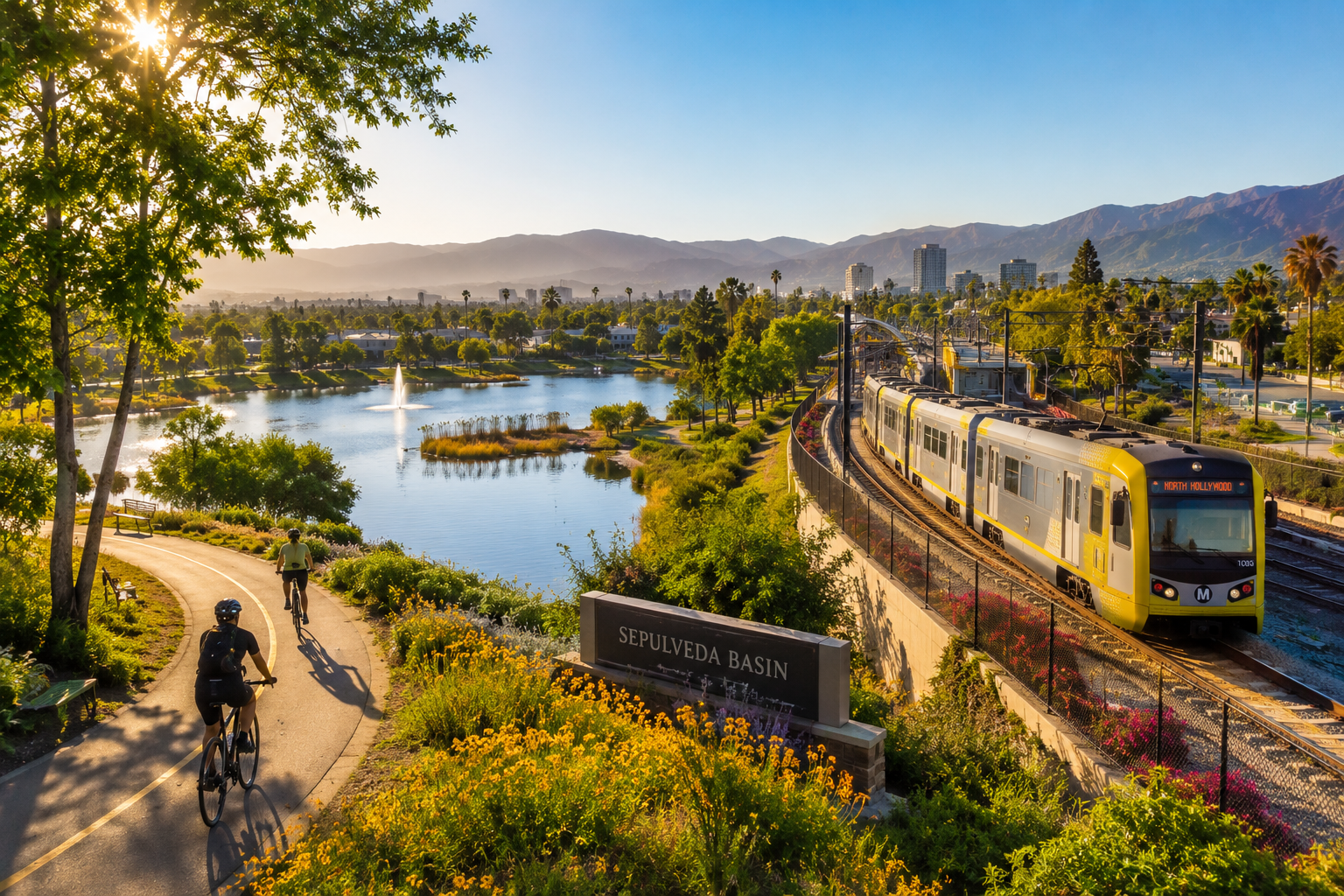
The first force was the COVID-era outdoor access premium. The Sepulveda Basin Recreation Area's 2,000 acres of open outdoor space — the cycling paths, the Balboa Lake fishing, the model airplane field, the wildlife reserve — became specifically valuable in a way that was difficult to quantify before March 2020 and extremely visible in listing price premiums and DOM compression afterward. The buyer who had previously chosen Northridge 91324/91325 for its price-per-square-foot advantage specifically reconsidered Lake Balboa's Sepulveda Basin proximity when outdoor space became the defining residential quality variable.
The second force was the ADU boom. Starting in 2020 and accelerating through 2022–2023 with state-level ADU legislation expanding garage conversion rights, Lake Balboa's residential fabric — primarily 1950s–1970s SFR construction with attached or detached garages on standard lots — proved to be among the central Valley's most ADU-conversion-ready inventory. The ADU-enhanced Lake Balboa home entering the resale market from 2022 onward introduced a new comp category that specifically expanded the ceiling above the standard SFR comp set.
The third force was the BRRRR investor acquisition pattern. Lake Balboa's January investor window — the annual period of maximum negotiating leverage for the acquisition-focused BRRRR buyer — produced January comp sets that were systematically below spring owner-occupant comp sets, creating the most specific intra-year price variation in any central Valley market and making the "average Lake Balboa price" figure less meaningful than the season-specific comp analysis.
1. 📈 2021–2022 — The Outdoor Access Run-Up
The Lake Balboa 91406/91411 price trajectory from 2021 through mid-2022 was the central Valley's most Sepulveda Basin-specific appreciation event — producing a steeper run-up than adjacent Reseda 91335 precisely because the Basin's specific outdoor amenity value was directly adjacent to Lake Balboa's residential fabric in a way that Reseda's eastern position from the Basin specifically wasn't.
 The Sepulveda Basin Recreation Area — the 2,000-acre outdoor asset that specifically amplified the Lake Balboa COVID-era appreciation beyond what comparable central Valley markets without this amenity produced. The buyer who recognized that the Basin's cycling paths, fishing lake, and open space had become the central Valley's most valued residential proximity advantage paid the 2021–2022 premium confidently; the buyer who didn't recognize it missed the most specific and most durable appreciation driver in Lake Balboa's market.
The 2021 baseline:
Entering 2021, Lake Balboa 91406/91411 pricing reflected the pre-COVID central Valley standard:
- → 91406 original condition 3-bedroom: $575,000–$635,000
- → 91406/91411 improved condition 3-bedroom: $640,000–$710,000
- → 91406/91411 renovated 3-bedroom: $710,000–$775,000
- → Sepulveda Basin premium above comparable Reseda 91335: approximately 6–10% — modest, reflecting awareness but not urgency about the Basin's proximity
The COVID outdoor access revaluation (2020–2021 into 2022):
The pandemic-era revaluation of outdoor access produced a specific and measurable Lake Balboa premium expansion:
- → ✅ The remote work amplifier: The Lake Balboa household whose members worked remotely from home specifically valued the Sepulveda Basin's walking and cycling access as a daily lifestyle feature — the 30-minute Basin loop that replaced the commute became a daily routine that buyers actively sought rather than passively appreciated
- → ✅ The inventory constraint amplifier: Lake Balboa's total annual transaction volume — typically 180–240 SFR transactions per year across both zip codes — is thin enough that meaningful demand increases produce rapid price movement without the inventory depth that larger markets use to absorb demand increases more gradually
- → 📊 The specific Basin premium expansion: By mid-2022, the Sepulveda Basin proximity premium above comparable Reseda 91335 inventory had expanded from 6–10% to approximately 12–18% — the outdoor access revaluation specifically captured in the comp differential
2022 peak pricing:
- → 91406 improved condition 3-bedroom: $820,000–$900,000 — a 28–32% increase from the 2021 baseline
- → 91406/91411 renovated 3-bedroom: $890,000–$985,000
- → ADU-enhanced (early ADU completions entering the market): $950,000–$1,050,000
- → DOM at the 2022 spring peak: 8–16 days for correctly priced improved and renovated condition — among the shortest DOM on record for the 91406/91411 market
The 91406 vs. 91411 divergence beginning in 2021:
The two zip codes — while often treated as a unified Lake Balboa market — began showing distinct appreciation patterns in 2021:
- → 📊 91406 (western Lake Balboa, more residential, closer to the Basin's eastern edge): Stronger appreciation through 2022 — approximately 34–38% from 2019 baseline to peak — reflecting the more direct Basin proximity and the more purely residential character
- → 📊 91411 (eastern Lake Balboa, closer to Balboa/Van Nuys Boulevard commercial corridor and Metro G Line Balboa Station): Approximately 28–34% from 2019 baseline to peak — commuter access premium partially offset by the more mixed commercial adjacency character
2. 📉 Mid-2022 Through 2023 — The Rate Shock Correction
The Lake Balboa correction from the mid-2022 peak through 2023 was specifically shaped by the FHA buyer pool's rate sensitivity — more than in premium markets like Sherman Oaks 91403/91423 or Encino 91316/91436 where the jumbo buyer's higher income provides more rate absorption capacity.
Why the rate shock hit Lake Balboa specifically:
At the 2022 spring peak, a Lake Balboa improved-condition 3-bedroom at $860,000 required:
- → 3.5% down FHA at 3.5%: monthly PITI + MIP approximately $3,920/month
- → Qualifying income at 32% front-end: approximately $147,000/year
- → This income threshold was accessible to a meaningful share of the central Valley working-professional dual-income household
By October 2022, with 30-year mortgage rates exceeding 7.0%:
- → Same $860,000 FHA at 7.0%: monthly PITI + MIP approximately $6,450/month
- → Qualifying income at 32%: approximately $242,000/year
- → The income threshold had increased by $95,000/year in 7 months — eliminating a significant share of the previously active buyer pool
The correction mechanics:
- → 📊 Peak-to-trough decline (91406/91411 standard SFR): approximately 10–13% from the mid-2022 peak
- → 📊 Correction low (late 2023): Improved condition 3-bedroom at $740,000–$815,000 (from the $820,000–$900,000 peak)
- → 📊 DOM at the correction trough: 38–62 days — a dramatic lengthening from the 8–16 day spring peak
- → ✅ The correction floor support: The BRRRR investor buyer — specifically active at the January acquisition window — provided a price floor through the correction. While the owner-occupant FHA buyer was rate-shocked out of the market, the BRRRR investor's investment loan underwriting (based on cap rate and ARV rather than standard DTI income qualification) remained active throughout the rate increase — absorbing the original-condition inventory that the owner-occupant pool wasn't purchasing
The ADU-enhanced home's correction behavior:
A specific and important finding from the Lake Balboa correction: ADU-enhanced homes demonstrated shallower correction depth than standard SFR inventory:
- → ✅ ADU-enhanced correction depth: approximately 6–9% from peak — compared to 10–13% for standard SFR
- → Why: The ADU rental income ($1,450–$1,900/month) partially offsets the higher monthly ownership cost for the rate-shocked buyer — the ADU-enhanced home's effective monthly ownership cost is lower than the PITI alone suggests, providing a broader accessible buyer pool even at higher rates
- → ✅ This ADU correction resilience is a forward planning observation — the Lake Balboa seller who adds an ADU before selling, or the buyer who purchases a home with ADU capacity and converts promptly, accesses a more rate-resilient asset than the standard SFR
3. 📈 2024–2025 — The Recovery Trajectory
The Lake Balboa recovery from the 2023 correction trough through 2025 produced a more gradual appreciation curve than the 2020–2022 run-up — reflecting the market's normalization at the elevated rate environment rather than a rapid return to the peak dynamics.
The recovery drivers:
Driver 1 — The January investor floor stabilization:
The BRRRR investor's January acquisition calendar — the annual event that the "Is Now a Good Time to Buy?" article and the average days on market article both document — produced consistent January price floor activity that prevented the extended overshooting that correction markets without an investor buyer pool sometimes experience. Every January from 2023 through 2025, BRRRR investors specifically targeted Lake Balboa as one of the most executable ADU-conversion markets in the central Valley — absorbing original-condition inventory and preventing the listing overhang that would have produced a deeper or more extended correction.
Driver 2 — The seller-paid buydown normalization:
From mid-2023 onward, the seller-paid 2-1 buydown became a standard Lake Balboa listing practice rather than a premium concession — specifically reactivating the FHA buyer pool by reducing year-one qualifying income by $33,000–$38,000. The normalization of the buydown as a standard listing feature specifically broadened the accessible buyer pool without requiring price reductions, supporting the price floor in a way that most central Valley markets (which were more slowly adopting the buydown) didn't experience as quickly.
Driver 3 — ADU-enhanced comp set expansion:
By 2024, a meaningful number of ADU-enhanced Lake Balboa homes — garage conversions completed in 2022–2023 — entered the resale market for the first time. These ADU-enhanced comps established a new ceiling tier (approximately $935,000–$1,055,000) above the standard renovated SFR ceiling — expanding the Lake Balboa price ceiling without requiring the standard SFR comp set to reach the same level.
The 2024–2025 appreciation trajectory:
- → 📊 2024 annual appreciation: approximately 5.5–7.0% from the 2023 trough
- → 📊 2025 annual appreciation: approximately 4.0–5.5% — moderating as the market stabilized at the elevated rate environment
- → 📊 Combined 2023 trough-to-end-2025 recovery: approximately 9.5–12.5% appreciation from the correction low
By end of 2025:
- → 91406 improved condition 3-bedroom: $795,000–$870,000 — approaching but not yet at the 2022 peak range
- → 91406/91411 renovated 3-bedroom: $860,000–$950,000 — within 5–8% of the 2022 peak
- → ADU-enhanced: $935,000–$1,040,000 — exceeding the 2022 ADU-enhanced ceiling
4. 📊 2026 Market Position — Where Lake Balboa Stands Today
Entering 2026, Lake Balboa 91406 and 91411 occupies a specific position in the central Valley appreciation cycle that is specifically useful for buyers, sellers, and long-term market observers.
Lake Balboa in spring 2026 — the market that has recovered 80–88% of the 2022 correction with the standard SFR comp set approaching but not yet at prior peak, while the ADU-enhanced comp set has already exceeded it. The buyer who purchases a standard SFR at 2026 prices and adds an ADU post-close is specifically participating in both the recovery appreciation of the standard SFR and the above-peak ceiling expansion of the ADU-enhanced comp category.
Current 2026 price benchmarks:
- → 💰 91406 original condition 3-bedroom: $720,000–$800,000
- → 💰 91406/91411 improved condition 3-bedroom: $800,000–$895,000
- → 💰 91406/91411 renovated 3-bedroom: $875,000–$975,000
- → 💰 ADU-enhanced (confirmed income-producing ADU): $935,000–$1,055,000
- → 💰 91411 commercial-adjacent improved 3-bedroom: $780,000–$855,000
The recovery position:
- → 📊 Standard SFR comp set recovery: approximately 80–88% of correction recovered — still $40,000–$80,000 below the 2022 peak for comparable standard SFR inventory
- → 📊 ADU-enhanced ceiling: above the 2022 ADU-enhanced peak — the ADU comp set has exceeded prior peak and is now establishing a new ceiling independent of the standard SFR recovery
- → 📊 2026 forward appreciation projection: 3.5–4.5% at the standard SFR tier; 4.5–5.5% at the ADU-enhanced tier
The January investor vs. spring owner-occupant price divergence in 2026:
The most specific Lake Balboa price observation for 2026 is the continued seasonal price divergence between the January investor acquisition window and the spring owner-occupant window:
- → 📊 January 2026 original-condition comp set: approximately $718,000–$768,000
- → 📊 March–April 2026 improved-condition comp set: approximately $812,000–$862,000
- → Intra-year price range: approximately $94,000–$190,000 between the January investor floor and the spring improved-condition ceiling
This divergence — larger than in premium markets where cash buyers and non-seasonal demand moderate the seasonal variation — is the most specific Lake Balboa market intelligence for participants on both sides:
- → ✅ For buyers: The buyer who begins their Lake Balboa search in January and targets the original-condition investor comp floor has approximately $94,000–$190,000 in additional negotiating room versus the spring competition that activates in March
- → ✅ For sellers: The seller who targets the March–April spring window at the improved-condition ceiling receives approximately $94,000–$190,000 more than the January original-condition investor would produce — the seasonal staging that maximizes net proceeds
5. 🔮 The 5-Year Forward Outlook — What the Lake Balboa Price Trend Suggests
 With the five-year retrospective complete and the current 2026 position mapped, the question that buyers, sellers, and long-term market observers most specifically need answered is where Lake Balboa's price trajectory is heading — and what structural factors will determine the answer.
The structural demand supports:
Support 1 — The Sepulveda Basin is permanent infrastructure: The outdoor access premium that the Sepulveda Basin produced in the COVID era has not normalized back to pre-2020 levels — the Basin-proximate premium that expanded from 6–10% over Reseda 91335 to 12–18% has moderated to approximately 9–13% in the current market but has not returned to the pre-pandemic baseline. The outdoor lifestyle value that the Basin provides is now structurally embedded in the Lake Balboa buyer's decision framework in a way that is unlikely to reverse unless the Basin's recreational programming or maintenance quality materially deteriorates.
Support 2 — The ADU comp expansion is structural: The ADU-enhanced comp ceiling in Lake Balboa is not a temporary market condition — it reflects a permanent change in the Lake Balboa residential landscape. As additional ADU conversions are completed and as ADU-enhanced homes cycle through the resale market, the ADU-enhanced comp tier will continue to expand the ceiling above the standard SFR market, producing appreciation at the ADU tier that exceeds the standard SFR appreciation rate.
Support 3 — The Metro G Line commuter demand is progressive: The Balboa Station on the Metro G Line has produced consistent commuter demand for 91406 and 91411 addresses within cycling or walking distance of the station — a demand driver that is specifically supported by LA Metro's progressive G Line enhancement investments and by the remote-to-hybrid work pattern that makes transit access selectively valuable rather than universally required.
The structural risk factors:
Risk 1 — FHA rate sensitivity: Lake Balboa's FHA buyer concentration remains its most specific vulnerability to sustained high interest rate environments. A prolonged 7%+ rate environment without the seller-paid buydown normalization that has partially offset the rate impact would constrain the buyer pool more severely than in premium markets with greater conventional and cash buyer concentration.
Risk 2 — Adjacent market compression: If Reseda 91335's appreciation trajectory continues to close the gap with Lake Balboa (through the Reseda Boulevard revitalization investments or the "Little Lima" commercial premium maturation), the Sepulveda Basin differential premium that justifies Lake Balboa's 9–13% premium may compress slightly — not producing outright price decline but moderating the premium's forward growth.
The 5-year forward projection:
- → 📈 Standard SFR tier (2026–2031): approximately 3.5–4.5% annual appreciation — reaching approximately $1,000,000–$1,100,000 for the renovated 3-bedroom by 2031 at the mid-range of this projection
- → 📈 ADU-enhanced tier (2026–2031): approximately 4.5–5.5% annual appreciation — reaching approximately $1,200,000–$1,350,000 for the income-producing ADU-enhanced 3-bedroom by 2031
🚫 What NOT to Overdo
Don't use the "average Lake Balboa price" statistic without separating the standard SFR and ADU-enhanced comp sets. The blended average of Lake Balboa prices in 2026 — including both standard SFR and ADU-enhanced transactions — produces a figure that overestimates the standard SFR ceiling (pulling it toward the ADU-enhanced transactions) and underestimates the ADU-enhanced appreciation rate (diluting it with the lower standard SFR transactions). Every meaningful Lake Balboa price trend analysis requires separation of these two comp categories — standard SFR (no ADU) and ADU-enhanced (confirmed income-producing ADU) — before drawing any trend conclusion.
Don't confuse the January investor comp floor with the true Lake Balboa market value. The January BRRRR investor acquisition window produces comp sets that are systematically $50,000–$100,000 below the spring improved-condition owner-occupant ceiling for otherwise comparable properties. A seller who uses January investor comps to price a spring improved-condition listing has underpriced their home by a specific and quantifiable amount. A buyer who uses spring improved-condition comps to evaluate a January original-condition offer has overpaid for the as-is investor opportunity. Separate the seasonal comp sets before applying any Lake Balboa trend data to a current purchase or listing decision.
Don't extrapolate the 2020–2022 run-up rate as a forward projection. The 32–40% appreciation from the 2019 baseline to the 2022 peak was specifically driven by the COVID-era outdoor access revaluation — a one-time structural revaluation that has already occurred and is now embedded in the baseline price. The 3.5–4.5% annual forward projection represents the organic demand growth and ADU-enhanced ceiling expansion that the Lake Balboa market produces without the extraordinary COVID-era demand catalyst. Projecting 32–40% appreciation over the next two years would require another structural demand revaluation of equivalent magnitude — not a realistic base case.
Don't treat the 91406 and 91411 price trends as identical. As documented throughout Section 1, the two zip codes have shown distinct appreciation patterns since 2021: 91406's more purely residential character and more direct Basin proximity produced approximately 34–38% from the 2019 baseline to the 2022 peak, versus 91411's 28–34%. In the recovery, 91406's Basin-proximate addresses have recovered more quickly than 91411's commercial-adjacent positions. A Lake Balboa price trend analysis that uses blended 91406/91411 data obscures these sub-market distinctions — apply the zip-code-specific comp set for any price trend conclusion.
Don't ignore the supplemental tax trigger in the first-year appreciation analysis. The buyer who purchases in Lake Balboa at a price meaningfully above the prior owner's Proposition 13-protected assessed value will receive a supplemental tax bill in the first year — a one-time cash event that the appreciation trend doesn't offset but that many first-year owners discover as an unexpected cash obligation. The five-year appreciation trend shows that Lake Balboa buyers have generated strong equity — but the first-year supplemental tax event requires specific financial planning regardless of how strong the long-term trend has been.
🏠 Real-World Scenario — Lake Balboa 91406
A couple purchased a Lake Balboa 91406 improved-condition 3-bedroom in April 2021 at $712,000 — specifically motivated by the Sepulveda Basin cycling access for their cycling-enthusiast household and the dual Metro G Line Balboa Station access for their Van Nuys 91406 office commutes.
Their 5-year financial story:
At purchase ($712,000):
- → Down payment (20% conventional): $142,400
- → Mortgage ($569,600 at 3.25%, 30-year): $2,478/month P&I
- → Property taxes: $721/month
- → Insurance: $85/month
- → Total PITI: $3,284/month
Year 2 (2022) — Peak:
- → Comparable homes in their sub-neighborhood reaching $885,000–$940,000
- → Their estimated market value: approximately $895,000
- → Paper equity: approximately $895,000 - $546,000 remaining loan = $349,000 equity
Year 3 (2023) — Correction:
- → Comparable homes at the correction trough: $790,000–$825,000
- → Their estimated market value: approximately $805,000
- → Paper equity: approximately $805,000 - $527,000 remaining loan = $278,000 equity — down $71,000 from the 2022 peak
Year 4 (2024) — ADU addition:
- → They converted their detached garage to an ADU at a cost of $71,500 (completed over 6 months using equity from a HELOC at 8.5%)
- → ADU rental income began at $1,625/month
- → Effective monthly net ownership cost: $3,284 PITI - $1,625 ADU income = $1,659/month net
Year 5 (2025) — ADU-enhanced appreciation:
- → ADU-enhanced comparable homes: $980,000–$1,035,000
- → Their estimated ADU-enhanced market value: approximately $1,010,000
- → Total equity: approximately $1,010,000 - $505,000 remaining loan = $505,000 equity
5-year total return:
Capital invested:
- → Down payment: $142,400
- → ADU construction: $71,500
- → HELOC interest (18 months at $505/month): $9,090
- → Total capital invested: $222,990
Equity at year 5: $505,000 Cumulative ADU rental income (18 months × $1,625): $29,250 Cumulative mortgage interest tax benefit (estimated, varies by tax situation): consult CPA
Net equity return: $505,000 - $142,400 initial equity = $362,600 equity gain Total return on invested capital: ($362,600 equity gain + $29,250 ADU income) / $222,990 = 175% total return over 5 years
Their assessment: "The ADU changed everything. We bought during the COVID run-up at what felt like a high price, went through the correction and watched our equity drop by $71,000 — and then we built the ADU and now we own a $1,010,000 property with a half-paid-off mortgage and $1,625 coming in every month. The cycling access is still the first thing I mention to anyone asking about the neighborhood."
🏠 Real-World Scenario — Lake Balboa 91411
A single buyer purchased a Lake Balboa 91411 original-condition 3-bedroom in January 2022 — specifically targeting the January investor window for acquisition leverage — at $698,000, approximately $115,000 below comparable spring improved-condition pricing that year.
The investor-window acquisition:
January 2022 BRRRR investor market conditions: 4 competing offers at the $698,000 price point — 2 from BRRRR investors (including this buyer's offer), 1 from an estate buyer, 1 from a first-time buyer who was pre-approved but stretched.
The buyer's offer: $698,000 cash (proceeds from a prior Northridge 91325 sale), 10-day close, as-is, no contingencies.
Accepted. 11-day close.
The renovation:
Immediate post-close renovation scope: kitchen (custom Shaker, quartz, Bosch), primary bath, LVP flooring throughout, interior repaint, exterior curb appeal. Total: $62,000. Timeline: 8 weeks.
Post-renovation estimated value (spring 2022, at the peak): approximately $875,000 — a $115,000 premium above the acquisition price before renovation, plus $62,000 in renovation value-add, producing approximately $177,000 in value creation.
The 2022 correction:
Post-renovation, the buyer chose to hold rather than flip — the correction arrived within 3 months of completing the renovation. Peak estimated value ($875,000) fell to approximately $785,000 at the correction trough — a $90,000 paper loss from the post-renovation peak.
The 5-year holding decision outcome:
Holding through the correction into the recovery:
- → 2026 estimated value (renovated 91411, no ADU): approximately $895,000
- → Rental income collected over 3.5 years of tenancy (post-renovation, spring 2022 through end 2025): approximately $7,200/month × 36 months = $259,200
- → Less property taxes ($856/month × 48 months): $41,088
- → Less insurance ($105/month × 48 months): $5,040
- → Less renovation carrying: $62,000
- → Net positive from operations over 4 years: approximately $151,072
- → Equity gain from acquisition to 2026: $895,000 - $698,000 = $197,000
Total 4-year return: $348,072 on $760,000 total capital deployed (acquisition + renovation) = 45.8% total return over 4 years = approximately 9.8% annualized.
The buyer's assessment: "The January window is real. I bought $115,000 below spring pricing in January — that's not a negotiating victory, that's a structural market pattern. The correction felt terrible for about 8 months. Then the rental income kept rolling in, the market recovered, and now I own a renovated Lake Balboa home that's worth more than any comparable spring-purchase alternative."
❓ FAQ
What have home prices done in Lake Balboa over the last 5 years? Lake Balboa 91406/91411 home prices have produced approximately 22–30% net appreciation from the 2021 baseline to 2026 — with a peak-to-trough correction of approximately 10–13% from the mid-2022 peak (driven by the rate shock's impact on the FHA buyer pool) and a recovery of approximately 80–88% from the correction low through 2026. ADU-enhanced homes have shown shallower correction depth (approximately 6–9%) and have already exceeded the 2022 peak — establishing a new price ceiling above the standard SFR comp set. The most dramatic price movement occurred during the 2020–2022 COVID-era outdoor access revaluation, when the Sepulveda Basin's proximity premium expanded from 6–10% above Reseda 91335 to approximately 12–18%.
Are home prices rising or falling in Lake Balboa in 2026? Rising — moderately. The 2026 Lake Balboa market is in appreciation recovery mode, with the standard SFR comp set projected at 3.5–4.5% annual appreciation and the ADU-enhanced comp tier at 4.5–5.5% annual appreciation. The market has not yet returned to the 2022 peak for the standard SFR comp set (approximately 80–88% of the correction recovered) but the forward trajectory is positive. The most notable 2026 market characteristic is the progressive ceiling expansion from ADU-enhanced homes entering the resale market — establishing the $935,000–$1,055,000 tier as the new Lake Balboa ceiling above the standard SFR renovated ceiling of $875,000–$975,000.
What is the average home price in Lake Balboa? Lake Balboa 91406/91411 average home prices in 2026 by condition tier: ✓ Original condition 3-bedroom: $720,000–$800,000. ✓ Improved condition 3-bedroom: $800,000–$895,000. ✓ Renovated 3-bedroom: $875,000–$975,000. ✓ ADU-enhanced 3-bedroom: $935,000–$1,055,000. These figures apply to standard SFR single-family homes — not condominiums or multi-family. The "average" blended across all categories is approximately $830,000–$870,000 but this blended figure is less useful than the condition-tier-specific benchmarks for any specific buyer or seller decision.
How does Lake Balboa appreciation compare to Reseda? Lake Balboa 91406/91411 has outperformed Reseda 91335 on appreciation rate since 2019 — the Sepulveda Basin outdoor access premium expanded during the COVID era from a 6–10% differential to approximately 12–18% at the 2022 peak, moderating to approximately 9–13% in the current market. In absolute price terms: Reseda improved 3-bedroom at $800,000–$855,000 versus Lake Balboa improved 3-bedroom at $800,000–$895,000 — a modest premium at the improved condition tier, expanding meaningfully at the renovated and ADU-enhanced tiers. Reseda's BRRRR+ADU investment returns have been strong but at lower absolute prices; Lake Balboa's Sepulveda Basin premium has produced stronger per-unit appreciation at comparable condition tiers.
What caused the Lake Balboa price spike in 2021–2022? The Lake Balboa 2020–2022 price spike was driven by three concurrent forces: ✓ The COVID-era outdoor access revaluation — the Sepulveda Basin Recreation Area's 2,000 acres of cycling, fishing, and open space became specifically valued as a daily lifestyle feature when remote work eliminated the commute advantage of urban-adjacent neighborhoods. ✓ The record-low mortgage rate environment (sub-3.5% for FHA and conventional in 2020–2021) that dramatically expanded the accessible buyer pool. ✓ The limited Lake Balboa inventory — typically 180–240 SFR transactions annually — that produced rapid price response to the demand increase without the inventory depth that larger markets use to absorb demand more gradually.
Will Lake Balboa home prices keep going up? The structural demand supports suggest continued appreciation at a moderate 3.5–5.5% annual rate: the Sepulveda Basin's permanent outdoor infrastructure, the progressive ADU-enhanced ceiling expansion as additional garage conversions enter the resale market, and the Metro G Line Balboa Station commuter demand. The primary risk to this projection is sustained high interest rates that constrain the FHA buyer pool — Lake Balboa's 30–40% FHA buyer concentration makes it more rate-sensitive than premium markets with greater conventional and cash buyer concentration. At current projected rate trajectories (modest rate normalization over 2026–2028), the base case is 3.5–4.5% annual appreciation for the standard SFR tier and 4.5–5.5% for the ADU-enhanced tier.
🎯 Bottom Line
Lake Balboa 91406 and 91411's five-year price story — the COVID-era outdoor access run-up, the rate-shock correction, the ADU-enhanced ceiling expansion, and the progressive recovery — is the most specifically instructive central Valley appreciation narrative in the PEP market coverage area. It demonstrates that the Sepulveda Basin premium is real and durable, that the FHA buyer pool concentration produces specific rate sensitivity that creates the January investor window's most pronounced seasonal pricing opportunity, and that the ADU-enhanced home has become a permanent and superior-appreciating comp category that the buyer who understands it can specifically access through a post-close garage conversion.
The buyer who enters Lake Balboa in 2026 with the complete five-year context — understanding that the standard SFR tier is approximately 80–88% recovered from the correction, that the ADU-enhanced tier has already exceeded prior peak, and that the January investor window offers the maximum negotiating leverage for the original-condition acquisition — makes a specifically informed purchase decision rather than a market-timing guess.
At Parkway Estate Properties, Liana's buyer and seller representation across Lake Balboa 91406/91411, Reseda 91335, Northridge 91324/91325, Granada Hills 91344, and Sherman Oaks 91403/91423, combined with Roman's ADU-conversion and investment property experience across the central SFV, means every Lake Balboa price trend conversation is grounded in the condition-tier-specific comp analysis, the seasonal price divergence awareness, and the ADU-enhanced ceiling intelligence that produces accurate market context rather than blended-average approximations.
📩 Want a Current Lake Balboa Price Analysis for Your Specific Address or Search Criteria?
We'll pull the condition-tier-specific, seasonally-adjusted comp set for any 91406 or 91411 address — separating standard SFR from ADU-enhanced comps, identifying the current recovery position, and projecting the forward appreciation based on the structural demand drivers specific to the sub-neighborhood and condition tier.
Contact Liana Shersher at Parkway Estate Properties: 📧 liana@parkwayestate.com · 📞 (818) 208-5881 · 🌐 parkwayestate.com 15021 Ventura Blvd., Ste. 510, Sherman Oaks, CA 91403
About the Authors
Liana Shersher is a licensed real estate agent with Parkway Estate Properties Inc. and an Accredited Buyer's Representative (ABR) serving the San Fernando Valley — with a focus on Sherman Oaks, Encino, Tarzana, Woodland Hills, and Northridge (DRE# 02164224). Liana guides first-time homebuyers through every step of the purchase, from the first showing to the keys in hand, and represents move-up and repeat buyers across the Valley. For sellers, she builds the pricing and marketing strategy that positions a home to sell for top dollar, fast. Buyers and sellers work with Liana for clear communication, sharp local knowledge, and an agent who treats their goals like her own.
Roman Shersher is the broker-owner of Parkway Estate Properties Inc. and a real estate investor with 18 years of experience in the San Fernando Valley (DRE# 01855095). Roman has personally led or co-led renovations on dozens of properties across the Valley, including recent projects in Northridge (91324) and Woodland Hills (91364). That hands-on renovation and investment experience shapes every pricing conversation and days-on-market strategy at Parkway — sellers get a realistic read on what improvements actually return at resale, and buyers get an expert eye on a home's true condition and upside.
Parkway Estate Properties, Inc. · 15021 Ventura Blvd., Ste. 510, Sherman Oaks, CA 91403 · (818) 208-5881 · parkwayestate.com · Broker License #: 01873092 Equal Housing Opportunity. Information herein is general and not legal, tax, or financial advice. Consult qualified professionals for your specific situation.
Categories
Recent Posts









Broker | Realtor ® License ID: 01873092
+1(818) 208-5881 | info@parkwayestate.com