
Commuting from Tarzana — Guide to LA Work Zones
Tarzana 91356 sits at the geographic center of the western San Fernando Valley — a position that produces one of the most varied and honestly interesting commute profiles of any SFV neighborhood in the PEP coverage area. Directly on the 101 Ventura Freeway. Adjacent to the Reseda Boulevard surface corridor. Within 10 minutes of the 405 Sepulveda Pass interchange. Within 4 minutes of Warner Center, the SFV's largest employment concentration. And within reasonable reach of Burbank, downtown LA, and the Westside — each with its own commute character and its own time-of-day dependency.
This guide maps Tarzana's commute to the seven primary LA work zones that most Tarzana residents commute to, with honest time estimates by time of day, mode analysis, surface street alternatives to freeway routes, the remote work infrastructure that Tarzana's Ventura Boulevard supports, and the specific commute realities that buyers should evaluate before purchasing in 91356.
Tarzana's commute story is not uniformly excellent — the 405 Sepulveda Pass and the 101 East toward Hollywood and downtown are genuinely difficult in peak hours. But for the specific employment clusters that Tarzana's buyer profile most frequently serves — Warner Center/Woodland Hills, the broader western Valley, and the central Valley commercial corridor — it is among the most convenient residential positions available in the SFV at this price point.
1. 🏢 Warner Center and Woodland Hills 91367 — Tarzana's Best Commute
Warner Center — the western San Fernando Valley's largest commercial office concentration, located in Woodland Hills 91367 — is Tarzana's most significant underappreciated commute advantage, and the one that most consistently surprises buyers who relocate from other SFV neighborhoods or from the Westside.
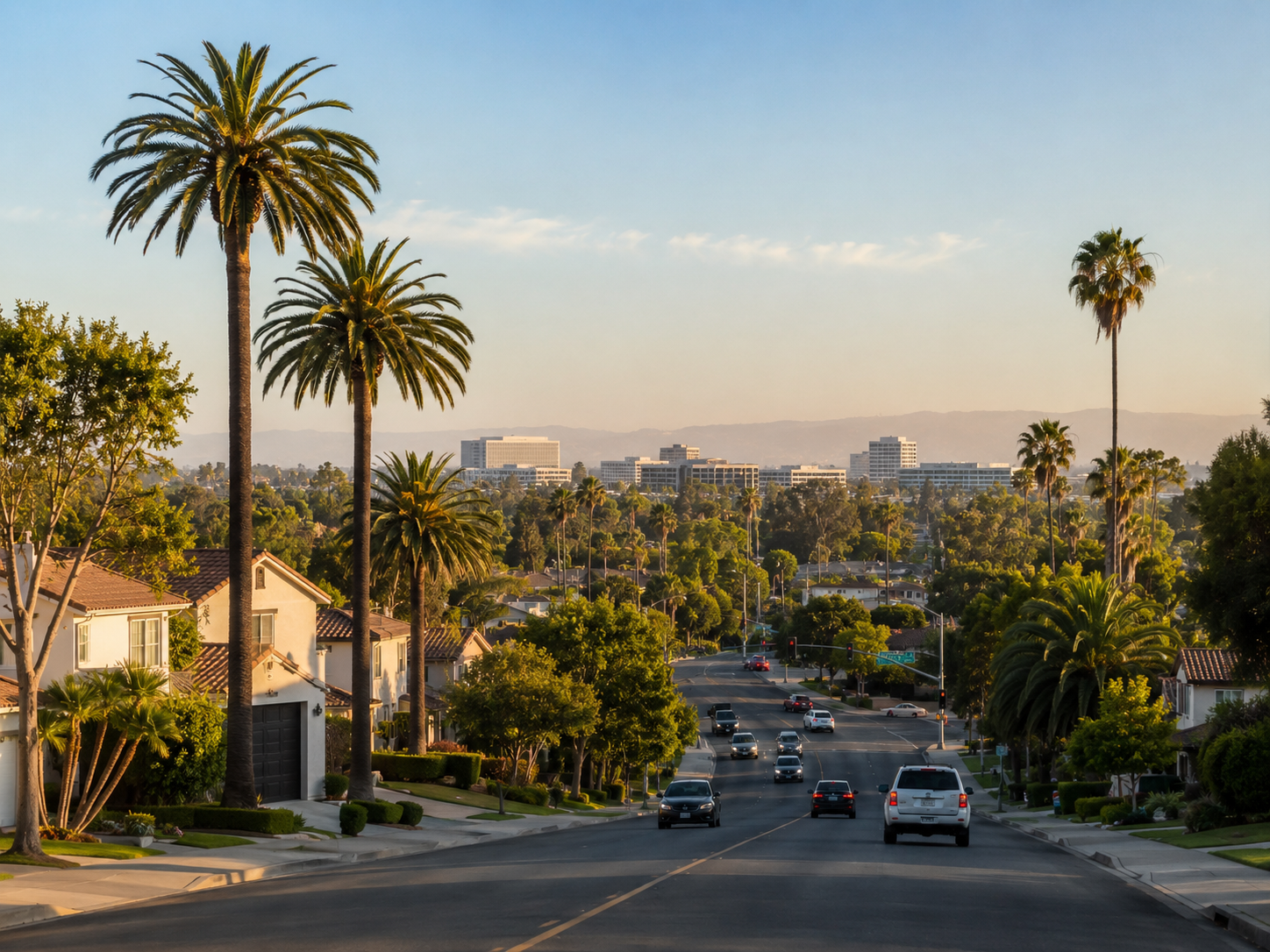 The Tarzana-to-Warner Center commute — one of the shortest residence-to-major-employment-concentration commutes available anywhere in the SFV at Tarzana's price point. The Woodland Hills 91367 Warner Center district is reachable in 4–8 minutes from most Tarzana 91356 residential streets regardless of time of day.
The Warner Center / Woodland Hills 91367 commute from Tarzana:
- → ⏱️ Drive time: 4–8 minutes — essentially no time-of-day variation. Warner Center is west of Tarzana on the same Ventura Boulevard corridor, reachable via Ventura Boulevard surface streets without freeway access.
- → 🗺️ Primary routes: Ventura Boulevard westbound (the direct surface route), or Oxnard Street / Erwin Street for specific Warner Center sub-addresses
- → 🏢 Major employers in Warner Center: Kaiser Permanente's Woodland Hills Medical Center, major financial services and insurance companies, tech sector offices, retail corporate headquarters, Anthem Blue Cross, and the broader commercial office market that makes Warner Center the SFV's primary white-collar employment center
- → ✅ For Warner Center commuters: Tarzana is the optimal residential position — close enough to eliminate meaningful commute time, far enough west to access the 101 easily for any travel needs, and at a price point below the Woodland Hills 91364/91367 residential equivalent for comparable homes
Why this advantage is underappreciated:
Many buyers evaluating Tarzana focus on the 101 freeway and the potential Westside or Hollywood commute while overlooking that Warner Center — the SFV's largest employment concentration and a significant employment destination for the financial, healthcare, and technology sectors — is essentially a neighborhood commute from Tarzana. The buyer who works at Kaiser Woodland Hills, at one of Warner Center's major office towers, or in the broader Woodland Hills commercial corridor has a daily commute from Tarzana that most LA residents would consider extraordinary.
2. 🌊 The Westside — Santa Monica, Century City, Culver City
The Westside commute from Tarzana is the most discussed, most feared, and most honestly variable commute in the 91356 buyer's decision framework. Understanding it specifically — by time of day, by destination within the Westside, and by the surface street alternatives that reduce but don't eliminate the 405 bottleneck — is essential for any Tarzana buyer whose workplace is west of the hill.
The 405 Sepulveda Pass commute reality:
The 405 Sepulveda Pass is the single most congested freeway segment in the United States by some measures — and Tarzana's position requires using it for any Westside commute. The specific numbers by time of day:
- → 🌅 Early departure (5:30–6:30 AM): 25–35 minutes to Santa Monica, 20–28 minutes to Century City. The Sepulveda Pass moves freely at this hour and the commute is entirely acceptable.
- → 🚗 Peak hour (7:30–9:30 AM): 50–75 minutes to Santa Monica, 42–62 minutes to Century City. The pass backs up to the 101/405 interchange and beyond — the specific congestion that defines the Tarzana-to-Westside peak commute.
- → ☀️ Midday (10:00 AM–2:00 PM): 28–38 minutes to Santa Monica. Meaningfully better than peak but not the off-peak that early departure produces.
- → 🌆 PM peak (4:00–6:30 PM): Eastbound on the 405 returning from the Westside: 55–80 minutes from Santa Monica to the 101/405 interchange at peak. The northbound return in the evening is frequently worse than the morning southbound, depending on incident activity.
- → 🌙 Off-peak evening (7:00 PM+): 25–35 minutes — comparable to early morning.
The Sepulveda Boulevard surface alternative:
Sepulveda Boulevard — which parallels the 405 through the pass — provides a surface street alternative that is slower in absolute distance-time but that avoids the freeway backup psychology and provides forward progress when the 405 is completely stopped.
- → ⏱️ Sepulveda Boulevard, peak hour: 45–60 minutes to Santa Monica — meaningfully better than the 405's worst days, worse than the 405's best peak-hour performance
- → ✅ Best use case: When the SigAlert app or Waze shows the 405 stopped beyond the typical backup, Sepulveda provides predictable if slower movement
The honest Westside commute assessment for Tarzana buyers:
The Westside commute from Tarzana is real, it is time-consuming at peak hours, and it is the most significant daily lifestyle friction for Tarzana households commuting to Santa Monica, Century City, and Culver City. Buyers for whom the Westside commute is daily and non-negotiable should evaluate this honestly against the Tarzana price advantage over Westside-adjacent neighborhoods. The calculation: Tarzana saves approximately $600,000–$1,000,000 versus comparable Westside-adjacent residential purchases — and costs approximately 25–35 minutes of additional daily commute in each direction at peak. Whether that trade-off is favorable depends entirely on the specific buyer's financial position and tolerance for the specific commute experience.
3. 🎬 Burbank and the Entertainment Corridor
The Burbank entertainment industry corridor — Warner Bros., Disney, NBC/Universal, and the Burbank airport commercial cluster — is a specific and significant employment destination for the entertainment industry professionals who represent a meaningful share of the Tarzana buyer pool. The Tarzana-to-Burbank commute is genuinely challenging in a specific and predictable way.
The Tarzana-to-Burbank commute:
- → 🗺️ Primary route: 101 East to the Barham, Cahuenga, or Hollywood Way exits — through the Cahuenga Pass and the Hollywood Hills
- → ⏱️ Early departure (6:00–7:00 AM): 22–30 minutes. The 101 East at this hour moves reasonably well through the pass.
- → 🚗 Peak hour (8:00–10:00 AM): 42–62 minutes. The 101 East backs up significantly at the 405/101 interchange and through Studio City 91604/91602 toward the Cahuenga Pass. The specific congestion pattern: the backup begins at the 405/101 merge and extends through Studio City, creating stop-and-go through the entire passage.
- → ⏱️ PM return (5:00–7:00 PM): 40–55 minutes westbound on the 101 — returning from Burbank through the Cahuenga Pass and through Studio City backing toward Tarzana.
Surface street alternatives for the Burbank commute:
- → 🗺️ Laurel Canyon Boulevard: From Ventura Boulevard north of Studio City 91604 over Laurel Canyon to Burbank — viable for light traffic periods, adds 5–10 minutes versus the 101 at off-peak but avoids freeway dependence and provides movement during 101 saturation. Peak performance: 38–52 minutes.
- → 🗺️ Coldwater Canyon: Similar profile to Laurel Canyon — a canyon surface route that provides 101-independent access to the Burbank side of the hills.
The Studio City comparison for Burbank commuters:
Studio City 91604/91602 residents commute to Burbank in 15–20 minutes at peak — a meaningfully better outcome than Tarzana's 42–62 minutes. For entertainment industry professionals whose workplace is in Burbank and whose career trajectory makes that commute daily for 5–10 years, the additional 20–40 minutes daily commute from Tarzana represents a real and measurable quality-of-life cost. The Studio City premium over Tarzana — approximately 30–40% more per comparable home — partially reflects this commute advantage.
4. 🏙️ Downtown LA, Century City, and the Central Business District
Downtown Los Angeles and the financial district represent a specific commute corridor from Tarzana that combines two challenging segments: the 101 East through the Cahuenga Pass and the downtown interchange, or the 405 South to the 10 East. Neither is simple.
Route 1 — 101 East to downtown:
- → ⏱️ Off-peak: 35–45 minutes
- → 🚗 Peak (8:00–9:30 AM): 55–80 minutes — the 101 East from Tarzana through Studio City, through the Cahuenga Pass, and into Hollywood and the downtown interchange carries cumulative congestion from multiple on-ramp contributions
- → 🗺️ Best use: When the 101 East is flowing — typically before 7:00 AM or after 9:30 AM
Route 2 — 101 West to 405 South to 10 East:
- → ⏱️ Off-peak: 40–55 minutes — a longer distance but sometimes faster than the 101-direct route when Studio City/Hollywood congestion is severe
- → 🚗 Peak: 65–90 minutes — this route adds the Sepulveda Pass bottleneck on top of the 10 East downtown approach congestion
The Metro alternative for downtown:
The G Line (formerly Orange Line) bus rapid transit connects the western Valley to the North Hollywood B Line (Red Line) station, which connects directly to downtown LA's Union Station and DTLA stations.
- → 🚌 G Line from near Tarzana: Pick up at the Reseda Station (accessible via Reseda Boulevard surface street, approximately 8–12 minutes from most Tarzana residential streets)
- → ⏱️ Total transit time to DTLA: Approximately 75–90 minutes including the G Line ride to North Hollywood and the B Line connection to downtown
- → ✅ Best use case: Downtown commuters who work near a Metro B Line station, who value the productive transit time over the 55–80 minute driving time, and who can accept 75–90 minutes of total transit versus 55–80 minutes of peak driving — a reasonable trade for the ability to work or read during the transit time
5. 🏥 The Central Valley and Van Nuys Employment Corridor
The central San Fernando Valley employment corridor — Van Nuys 91401/91405/91406, Northridge 91324/91325, Reseda 91335, and Canoga Park 91304 — is Tarzana's most frequently overlooked commute advantage and the one most relevant to the healthcare, education, government, and retail sector employers that form the backbone of the central Valley employment market.
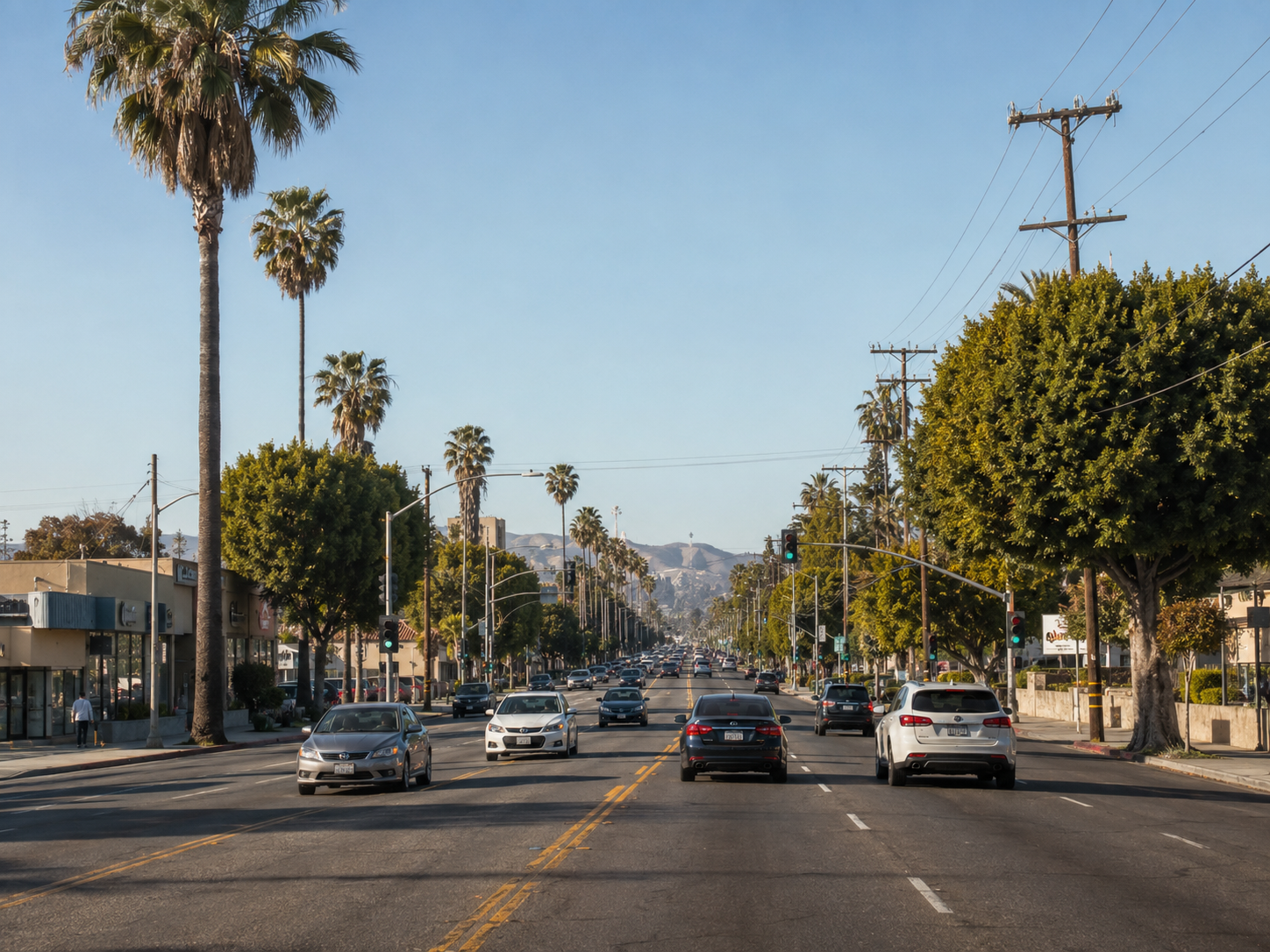 Reseda Boulevard northbound from Tarzana 91356 — the central Valley surface corridor that makes Northridge 91324/91325, Reseda 91335, and Van Nuys 91401/91405/91406 accessible from Tarzana in 12–22 minutes without freeway dependence. For buyers whose workplace is in the central Valley, Tarzana offers the western Valley's lifestyle and price point with central Valley commute convenience.
The central Valley surface street commute from Tarzana:
- → 🗺️ Primary route: Reseda Boulevard northbound from Ventura Boulevard — the central Valley's primary north-south surface arterial
- → ⏱️ To Reseda 91335 (major commercial/medical corridor): 8–14 minutes via Reseda Boulevard
- → ⏱️ To Northridge 91324/91325 (CSUN, Northridge Medical Center, commercial): 14–20 minutes via Reseda Boulevard
- → ⏱️ To Van Nuys 91401/91405/91406 (civic center, Van Nuys Airport, commercial): 15–22 minutes via Reseda Boulevard or Sepulveda Boulevard
- → ⏱️ To Canoga Park 91304 (Topanga Canyon commercial, western Valley retail): 8–14 minutes via Ventura Boulevard or Victory Boulevard westbound
Major employers in the central Valley corridor:
- → 🏥 Northridge Hospital Medical Center (91325): A primary employment destination for the region's healthcare workforce — accessible from Tarzana in 15–18 minutes via Reseda Boulevard
- → 🎓 California State University Northridge (91330): Faculty, staff, and administrators commuting from Tarzana: 16–20 minutes via Reseda Boulevard
- → 🏢 Van Nuys Government Center and civic employers (91401): LAPD Van Nuys Division, LA County courts, government services — accessible via Reseda or Sepulveda in 18–25 minutes
- → ✈️ Van Nuys Airport and aviation sector (91406): Charter aviation, flight training, and related aviation industry employers — 15–22 minutes via Reseda Boulevard
Why this commute advantage is underappreciated in Tarzana market discussions:
Most Tarzana buyer conversations focus on the Westside and entertainment industry commutes — the two most-discussed and most dramatic commute scenarios. The central Valley commute — which is actually among the most convenient available from Tarzana — is rarely discussed because buyers from the Westside or Hollywood don't immediately identify the central Valley employment corridor as their reference point. For buyers whose workplace is in the central Valley, Tarzana's position on the 101 with direct Reseda Boulevard access produces daily commute times in the 12–22 minute range without freeway dependence — a commute profile that most LA residents would consider exceptional.
6. 🚌 Public Transit, Active Commuting, and Remote Work Infrastructure
Public transit from Tarzana 91356:
Tarzana's public transit access is moderate by SFV standards — better than isolated northern Valley communities, less developed than Van Nuys or Sherman Oaks hub positions.
- → 🚌 G Line (Metro Rapid Bus): Accessible from the Reseda Station approximately 8–12 minutes from most Tarzana residential streets via Reseda Boulevard — the primary Valley transit spine connecting Chatsworth to North Hollywood
- → 🚌 LADOT Commuter Express: Multiple lines serve the Ventura Boulevard corridor through Tarzana — useful for Sherman Oaks, Encino, and Warner Center destinations
- → 🚂 Metrolink Ventura Line: The Chatsworth station (approximately 18–22 minutes from Tarzana) provides Metrolink service to downtown LA's Union Station — a genuinely useful option for daily downtown commuters who can reach the station reliably
- → ⏱️ Metrolink total time (Chatsworth to Union Station): Approximately 55–65 minutes train time plus station access time — competitive with peak driving on the 101 East route and superior in reliability and productive time use
Active commuting:
- → 🚴 Cycling: Ventura Boulevard's Class II bike lanes provide some cycling infrastructure, though the boulevard's traffic volume makes it less comfortable than dedicated cycling paths. The Sepulveda Basin's cycling network is accessible from Tarzana's eastern boundary — though it does not directly serve employment commutes. Practical cycling commutes from Tarzana are limited to very short-distance destinations along the Ventura Boulevard corridor.
- → 🚶 Walking: Warner Center's closest offices are 25–35 minutes walking distance from Tarzana's western residential streets — a viable option for walking-comfortable commuters in non-summer months.
Remote work infrastructure on Ventura Boulevard:
Tarzana's Ventura Boulevard commercial corridor supports a functional remote work ecosystem — not the density of Sherman Oaks or Encino's commercial strips, but sufficient for Tarzana residents whose work requires occasional out-of-home workspace:
- → ☕ Coffee shop workspace: Multiple Ventura Boulevard cafes provide laptop-friendly seating with reliable WiFi during business hours
- → 🏢 Coworking: Limited dedicated coworking space in Tarzana proper — most Tarzana remote workers who need professional coworking access drive 10–12 minutes to Woodland Hills or Sherman Oaks coworking facilities
- → 📶 Residential fiber: Most Tarzana 91356 residential addresses have access to fiber internet options — Spectrum, AT&T Fiber, and competitive providers serving the western Valley residential market support the high-bandwidth requirements of video conferencing and remote collaboration at home
🚫 What NOT to Overdo
Don't evaluate the Tarzana-to-Westside commute using off-peak Google Maps times. The Westside commute's defining characteristic is peak-hour severity — and Google Maps route estimates generated at 2 PM on a Tuesday produce numbers that bear no relationship to what a 8:15 AM departure from Tarzana toward Santa Monica actually delivers. Test the specific commute at your specific departure time, on a weekday, before purchasing. Drive it once in the morning and once in the evening return during a week when you're seriously considering Tarzana. The lived experience of the 405 at peak bears no relationship to the theoretical estimate.
Don't assume the 101 East is equivalent to the 101 West from Tarzana. The 101 Westbound from Tarzana toward Calabasas 91302, Agoura Hills 91301, and Thousand Oaks is one of the most consistently free-flowing freeway corridors in the LA metro — typically fast, rarely severely backed up in the morning, and representing one of Tarzana's genuine commute advantages. The 101 Eastbound from Tarzana toward Hollywood, Studio City 91604, and downtown is a fundamentally different experience — subject to the cumulative congestion that builds from the 405/101 interchange through Studio City. These are the same freeway in opposite directions producing completely different commute experiences.
Don't purchase in Tarzana for an entertainment industry Burbank commute without doing the Studio City math. The Tarzana-to-Burbank commute at 42–62 minutes peak versus Studio City's 15–20 minutes is a 25–40 minute daily difference in each direction — 50–80 minutes of additional daily commute time. Over 250 working days, this is 208–333 hours of additional annual commuting — the equivalent of 5–8 full workweeks per year. Studio City 91604 commands approximately 30–40% premium over comparable Tarzana homes, which at Tarzana's price levels represents $300,000–$500,000. Whether that premium is worth 5–8 additional workweeks of commute time annually is a genuinely personal calculation, but it is a calculation that should be made explicitly rather than discovered post-purchase.
Don't ignore the Warner Center commute advantage when evaluating Tarzana against Reseda or Northridge. Reseda 91335 and Northridge 91324/91325 buyers who work in Warner Center/Woodland Hills 91367 commute 18–28 minutes from those neighborhoods to Warner Center. Tarzana residents commute 4–8 minutes to the same destination. This 14–20 minute daily advantage (in each direction) represents approximately 116–166 hours of annual commute time saved for Warner Center employees — a tangible quality-of-life advantage that should be explicitly factored into any Tarzana-versus-Reseda or Tarzana-versus-Northridge comparison for Warner Center employees.
🏠 Real-World Scenario — Tarzana 91356
A couple — one a healthcare administrator at Kaiser Permanente Woodland Hills Medical Center in Warner Center 91367, the other a schoolteacher at a Reseda 91335 LAUSD elementary school — had been evaluating Tarzana and Reseda as competing residential options at comparable price points. Their combined budget reached $1.0M.
Their initial assumption was that Reseda was the natural choice — lower price for comparable homes, closer to the teacher's Reseda school, and a neighborhood whose character they had researched extensively through the Reseda cluster articles. Tarzana's $50,000–$80,000 premium over comparable Reseda inventory was their primary hesitation.
We ran the commute analysis for their specific workplaces. The Kaiser Permanente administrator's commute:
From Tarzana 91356: 5–8 minutes, Ventura Boulevard surface, no freeway. Essentially door-to-parking-structure.
From Reseda 91335: 20–28 minutes via Reseda Boulevard to Ventura Boulevard, then Ventura westbound to Woodland Hills — or 18–24 minutes via the 101 West. A meaningful daily difference.
The teacher's commute to their Reseda 91335 school:
From Tarzana 91356: 10–15 minutes via Reseda Boulevard northbound. A surface street commute that adds approximately 5–7 minutes versus a Reseda residential location.
From Reseda 91335: 5–8 minutes, local streets.
The combined household math: the administrator saves approximately 28–40 minutes daily versus Reseda. The teacher adds approximately 10–14 minutes daily versus Reseda. Net household commute advantage for Tarzana: approximately 18–26 minutes daily saved — roughly 150–216 hours annually.
At their specific household income level, 150–216 hours of recovered annual commute time for the administrator had a genuine economic and quality-of-life value. The $50,000–$80,000 Tarzana premium, financed at 7.25%, added approximately $285–$455/month to their payment — a real cost, but one that bought them 18–26 minutes of daily household commute reduction and the specific western Valley lifestyle advantages of Tarzana over Reseda.
They chose Tarzana. The administrator walks the Tarzana section of the Ventura Boulevard corridor during lunch. The teacher's 12-minute commute remains fully manageable.
🏠 Real-World Scenario — Tarzana 91356
A screenwriter and her partner — a tech startup founder whose company was based in Santa Monica — had purchased a Tarzana 91356 home 18 months prior to our engagement. They came to us in the context of potentially selling and relocating, specifically because the startup founder was "commuting 2 hours each way twice a week" and finding the Santa Monica drive unsustainable.
We walked through the commute math they had apparently not modeled before purchasing. At 2 hours each way from Tarzana to Santa Monica at peak hours — 4 hours of driving per office day, two office days per week — they were spending approximately 416 hours annually on the Tarzana-to-Santa Monica commute for the startup founder alone.
The screenwriter was fully remote, working from home. The Tarzana position was perfectly suited to her situation — she used Ventura Boulevard daily for lunch, coffee, and the specific walkable-adjacent commercial lifestyle that Tarzana's boulevard supports without requiring a car trip.
The honest assessment: they had purchased the home for two people with different commute situations and had optimized for the screenwriter's needs (remote, Ventura Boulevard lifestyle) while underweighting the startup founder's bi-weekly Westside commute reality.
The solution was not relocation — the screenwriter's life in Tarzana was excellent and the home had appreciated meaningfully. The solution was a behavioral adjustment: the startup founder purchased a reliable coworking membership at a Santa Monica coworking facility near the office, stayed in Santa Monica on office nights at an extended-stay hotel two nights per week during crunch periods, and reconfigured the office schedule to include earlier 6:30 AM departures that reduced peak-hour commute time from 110 minutes to 38 minutes.
The commute challenge was not the home — it was the schedule. A schedule adjustment produced a workable Tarzana-to-Santa Monica relationship that the original 8:30 AM departure had made appear unsustainable.
❓ FAQ
How long is the commute from Tarzana to downtown LA? The Tarzana 91356 to downtown LA commute varies significantly by departure time and route: ✓ Early departure (6:00–7:00 AM): 35–45 minutes via 101 East. ✓ Peak hour (8:00–9:30 AM): 55–80 minutes via 101 East, or 65–90 minutes via 405 South to 10 East. ✓ Midday: 38–50 minutes. ✓ PM peak (returning 5:00–7:00 PM): 55–75 minutes. Metro alternative via G Line to North Hollywood then B Line to DTLA: approximately 75–90 minutes total transit time with a less stressful commute experience.
Is Tarzana good for Westside commuters? Challenging but manageable with schedule flexibility. The 405 Sepulveda Pass is the defining constraint — peak hour commutes to Santa Monica run 50–75 minutes, early departures run 25–35 minutes. Tarzana is an appropriate residential choice for Westside commuters who have schedule flexibility (early departure or hybrid work), whose household's other commute is westward (Warner Center), or who specifically value Tarzana's lifestyle and price proposition enough to accept the Westside commute as a known trade-off. It is not appropriate for commuters who must arrive at a Westside office at 9:00 AM daily without schedule flexibility and who will find 55–70 minutes of daily 405 congestion unacceptable over time.
How far is Tarzana from Burbank? Approximately 18–22 miles via the 101 East. At peak hours (8:00–9:30 AM), the Tarzana-to-Burbank commute runs 42–62 minutes. At off-peak hours (before 7:00 AM or after 10:00 AM), the same route takes 22–30 minutes. Surface street alternatives via Laurel Canyon or Coldwater Canyon provide 101-independent access at 38–52 minutes peak. For entertainment industry professionals whose daily workplace is in Burbank, Studio City 91604/91602 is the superior residential commute position — though at a 30–40% price premium over comparable Tarzana homes.
What are the best commute options from Tarzana without a car? The G Line (Metro Rapid Bus) at the Reseda Station — accessible from Tarzana via Reseda Boulevard — provides the most useful car-free commute option from 91356, connecting to the B Line (Red Line) at North Hollywood for downtown and Hollywood destinations. Metrolink from Chatsworth (18–22 minutes from Tarzana) serves downtown LA commuters. LADOT Commuter Express lines along Ventura Boulevard serve Sherman Oaks 91403 and Warner Center. Overall, Tarzana's car-free commute options are moderate — functional for specific corridors but not a fully transit-oriented neighborhood by any standard.
How does the Tarzana commute compare to Encino or Sherman Oaks? Encino 91316 and Sherman Oaks 91403/91423 have slightly better 405 Southbound access — their position east of Tarzana brings them marginally closer to the 405/101 interchange that all three neighborhoods use for Westside access. The practical difference is approximately 5–8 minutes less commute to the Westside from Encino versus Tarzana — meaningful but not dramatic. For Warner Center commutes, Tarzana is more convenient than both Encino and Sherman Oaks, which are east of Warner Center. For Burbank and Hollywood commutes, all three neighborhoods face comparable 101 East congestion challenges.
Does Tarzana have good access to the 101 freeway? Yes — the 101 Ventura Freeway runs directly through Tarzana, with on/off ramps at Reseda Boulevard, Tampa Avenue, and Topanga Canyon Boulevard providing multiple access points from 91356 residential streets. Westbound 101 access (toward Calabasas 91302, Agoura Hills 91301, Thousand Oaks) is among the most reliable freeway corridors in the western Valley. Eastbound 101 access (toward Sherman Oaks 91403, Studio City 91604, Hollywood, and downtown) carries peak-hour congestion that builds from the 405/101 interchange through Studio City.
🎯 Bottom Line
Tarzana 91356's commute profile is genuinely excellent for some employment destinations and genuinely challenging for others — and buyers who evaluate it honestly by their specific workplace destination consistently make better residential decisions than those who apply a generic "the SFV commute is difficult" or "the Valley is convenient" framework without running the specific numbers.
The Warner Center and western Valley commute from Tarzana is extraordinary — 4–8 minutes to one of the SFV's largest employment concentrations, surface streets only, essentially no time-of-day variation. The central Valley commute via Reseda Boulevard is highly convenient — 12–22 minutes to Northridge, Reseda, and Van Nuys without freeway dependence. The 101 West toward Calabasas and the greater Conejo Valley is reliable and typically fast.
The Westside commute via the 405 Sepulveda Pass and the Burbank commute via the 101 East are the specific challenges that require honest evaluation before purchasing in Tarzana. Neither is impossible — both are managed daily by Tarzana residents with schedule flexibility, behavioral adjustments, and the specific value framework that makes Tarzana's lifestyle and price proposition worth the commute trade-off. But both require that the trade-off be made explicitly rather than discovered.
At Parkway Estate Properties, Liana's buyer consultations across Tarzana 91356, Sherman Oaks 91403/91423, Encino 91316/91436, Woodland Hills 91364/91367, and Northridge 91324/91325 begin with the commute conversation — because the neighborhood that is right for your lifestyle and your home priorities is only the right neighborhood if the daily commute to your workplace is one you can realistically sustain.
📩 Want an Honest Commute Assessment for Tarzana vs. Your Specific Workplace Before You Buy?
Tell us where you work, your required arrival time, and your schedule flexibility — and we'll give you the honest commute picture for Tarzana and any comparison neighborhoods you're evaluating, before you've toured a single home.
Contact Liana Shersher at Parkway Estate Properties: 📧 liana@parkwayestate.com · 📞 (818) 208-5881 · 🌐 parkwayestate.com 15021 Ventura Blvd., Ste. 510, Sherman Oaks, CA 91403
About the Authors
Liana Shersher is a licensed real estate agent with Parkway Estate Properties Inc. and an Accredited Buyer's Representative (ABR) serving the San Fernando Valley — with a focus on Sherman Oaks, Encino, Tarzana, Woodland Hills, and Northridge (DRE# 02164224). Liana guides first-time homebuyers through every step of the purchase, from the first showing to the keys in hand, and represents move-up and repeat buyers across the Valley. For sellers, she builds the pricing and marketing strategy that positions a home to sell for top dollar, fast. Buyers and sellers work with Liana for clear communication, sharp local knowledge, and an agent who treats their goals like her own.
Roman Shersher is the broker-owner of Parkway Estate Properties Inc. and a real estate investor with 18 years of experience in the San Fernando Valley (DRE# 01855095). Roman has personally led or co-led renovations on dozens of properties across the Valley, including recent projects in Northridge (91324) and Woodland Hills (91364). That hands-on renovation and investment experience shapes every pricing conversation and days-on-market strategy at Parkway — sellers get a realistic read on what improvements actually return at resale, and buyers get an expert eye on a home's true condition and upside.
Parkway Estate Properties, Inc. · 15021 Ventura Blvd., Ste. 510, Sherman Oaks, CA 91403 · (818) 208-5881 · parkwayestate.com · Broker License #: 01873092 Equal Housing Opportunity. Information herein is general and not legal, tax, or financial advice. Consult qualified professionals for your specific situation.
Categories
Recent Posts








Broker | Realtor ® License ID: 01873092
+1(818) 208-5881 | info@parkwayestate.com