
How Much Are Property Taxes in Woodland Hills?

Property taxes in Woodland Hills 91364 and 91367 follow California's Proposition 13 framework — capped at 1% of the assessed value at purchase plus a maximum 2% annual increase, with additional local assessments that bring the total effective rate to approximately 1.18%–1.26% of the purchase price depending on the specific parcel and the applicable special assessments.
For the Woodland Hills buyer, the property tax calculation requires understanding five components that together produce the total annual tax bill: the base Proposition 13 rate, the LVUSD parcel tax for boundary-eligible addresses, any special district assessments, the supplemental tax that arrives in the months after close, and the Proposition 19 parent-to-child or base-year transfer provisions that may significantly reduce the annual obligation for qualifying buyers.
The total annual property tax at Woodland Hills's primary price points:
- → 💰 At $1.35M purchase (91367 flatland): approximately $15,900–$17,000/year
- → 💰 At $1.65M purchase (91364 LVUSD-boundary improved): approximately $19,500–$21,000/year
- → 💰 At $2.2M purchase (91364 renovated LVUSD-boundary): approximately $26,000–$28,000/year
- → 💰 At $3.0M purchase (91364 hillside view): approximately $35,500–$38,000/year
These totals include the LVUSD parcel tax where applicable, the standard LA County special assessments, and the base Proposition 13 rate — but exclude supplemental taxes (which arrive separately and are discussed in Section 3).
1. 📊 The Proposition 13 Foundation — How Woodland Hills Property Taxes Are Set
California's Proposition 13 (1978) establishes the foundational property tax framework that every California buyer — and every Woodland Hills buyer specifically — must understand before calculating their annual tax obligation.
The Woodland Hills property tax calculation — the Proposition 13 base rate plus LA County special assessments plus the LVUSD parcel tax (for boundary-eligible addresses) that together produce the total annual obligation. Understanding all three components before the offer is submitted is the difference between accurate monthly budget planning and the post-close surprise that the supplemental tax and the LVUSD parcel tax combination produces for buyers who only calculated the 1% base rate.
How Proposition 13 works for the Woodland Hills buyer:
The assessment base:
- → ✅ Purchase price becomes the new assessed value: When you purchase a Woodland Hills home, the County Assessor establishes your assessed value at the purchase price in the year of acquisition
- → ✅ Maximum annual increase: The assessed value can increase no more than 2% per year (or the rate of inflation, whichever is lower) — regardless of how much the market value increases
- → ✅ The long-term tax advantage: The Woodland Hills buyer who purchases at $1.65M in 2026 and holds for 20 years will be paying taxes on approximately $2.45M assessed value in 2046 — while the 2046 market value of the same home may be $4M–$5M. Proposition 13's cap produces an increasingly powerful inflation-adjusted tax advantage over time.
The base rate calculation:
At 1.00% of assessed value (purchase price):
- → $1.35M × 1.00% = $13,500/year ($1,125/month)
- → $1.65M × 1.00% = $16,500/year ($1,375/month)
- → $2.20M × 1.00% = $22,000/year ($1,833/month)
- → $3.00M × 1.00% = $30,000/year ($2,500/month)
The total effective rate:
The base 1.00% is the starting point — not the total. The LA County special assessments and the LVUSD parcel tax add approximately $2,000–$2,800/year in fixed assessments that apply regardless of purchase price (they are flat-dollar amounts, not percentage-based), pushing the effective rate to:
- → 📊 At $1.35M: Total approximately $15,900–$16,800 ($2,400–$3,300 in fixed assessments + $13,500 base) = effective rate approximately 1.18%–1.24%
- → 📊 At $1.65M: Total approximately $19,200–$20,400 = effective rate approximately 1.16%–1.24%
- → 📊 At $2.20M: Total approximately $24,600–$25,800 = effective rate approximately 1.12%–1.17% (fixed assessments become proportionally smaller at higher purchase prices)
- → 📊 At $3.00M: Total approximately $32,800–$34,800 = effective rate approximately 1.09%–1.16%
2. 🏫 The LVUSD Parcel Tax — Woodland Hills's Most Specific Property Tax Feature
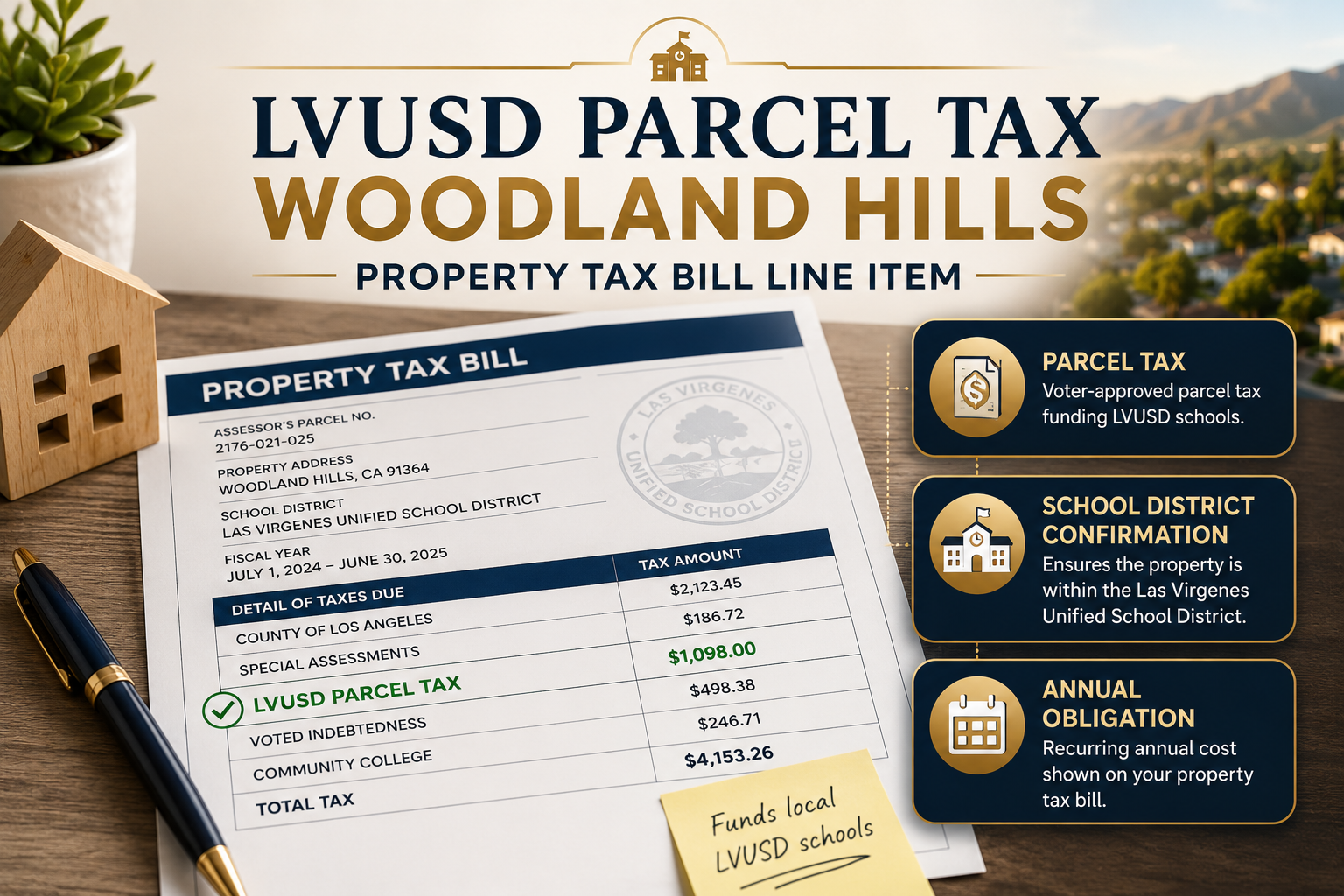 The LVUSD parcel tax is the property tax element most specific to Woodland Hills — and the one that most buyers outside the western Valley don't anticipate when planning their total annual ownership cost.
What is the LVUSD parcel tax?
Las Virgenes Unified School District levies a parcel tax on properties within the LVUSD attendance boundary. Unlike the base property tax (which is percentage-based on assessed value), the LVUSD parcel tax is a flat annual assessment per parcel — currently:
- → 💰 LVUSD parcel tax: Approximately $200–$400/year per parcel (verify the current rate at lvusd.org — school district parcel taxes are periodically renewed by voter approval and the specific rate changes at renewal)
- → 📋 Who pays it: Every property within the LVUSD attendance boundary — including Woodland Hills 91364/91367 LVUSD-eligible addresses, Calabasas 91302/91372 (universally), and LVUSD-boundary Tarzana 91356 and West Hills 91307 addresses
- → 📋 Who doesn't pay it: Woodland Hills 91364/91367 addresses that are LAUSD-assigned (not within the LVUSD boundary) do not pay the LVUSD parcel tax
The LVUSD parcel tax verification:
Determine whether the specific Woodland Hills address carries the LVUSD parcel tax by:
- → ✅ Step 1: Verify LVUSD boundary eligibility at lvusd.org (same verification the Woodland Hills biggest seller mistakes article establishes as the most important pre-listing action — equally important for buyers)
- → ✅ Step 2: If LVUSD-eligible, the parcel tax appears on the County Assessor's property tax bill — confirm the current rate on the existing owner's most recent tax bill (available in the seller disclosure package) or at the LA County Assessor's office at assessor.lacounty.gov
The LVUSD parcel tax as a value signal:
The LVUSD parcel tax is not merely a cost — it is specifically the marker that confirms the buyer is within the LVUSD attendance boundary. The buyer who sees the LVUSD parcel tax on the seller's property tax bill during due diligence has independently confirmed LVUSD eligibility without needing to re-verify at lvusd.org (though we recommend both verifications for completeness).
The LAUSD-assigned Woodland Hills buyer who does not see the LVUSD parcel tax on the prior owner's bill has a specific signal that the address is LAUSD-assigned — the absence of the parcel tax is the school district confirmation that the lvusd.org check provides more explicitly.
3. 📋 The Supplemental Tax — The First-Year Budget Item Most Woodland Hills Buyers Miss
The supplemental property tax is the most consistently underplanned-for property tax event in the Woodland Hills buyer's first year — and at Woodland Hills's purchase price tier, the supplemental tax bill can represent $10,000–$25,000 in unexpected first-year expenditure if the buyer didn't specifically budget for it.
How the supplemental tax works:
When a property is purchased, the County Assessor issues a supplemental assessment reflecting the difference between the prior owner's Proposition 13-protected assessed value and the new owner's purchase price. The supplemental tax is calculated on this difference and covers the period from the close date to the end of the fiscal year (June 30) for the first installment, and the full subsequent fiscal year for the second installment.
The Woodland Hills supplemental tax example:
A Woodland Hills 91364 LVUSD-boundary improved 4-bedroom purchased at $1.65M. The prior owner purchased in 2005 at $785,000 and has been protected by Proposition 13's 2% annual cap since then:
- → Prior owner's 2026 assessed value (approximate): $785,000 × (1.02^21) = approximately $1,172,000
- → New owner's assessed value: $1,650,000
- → Supplemental assessment base: $1,650,000 - $1,172,000 = $478,000
- → Supplemental tax at 1.18% effective rate: $5,640 (pro-rated for the fiscal year remainder)
- → Full-year supplemental tax (second installment): $5,640 (covering the following fiscal year)
- → Total supplemental tax obligation: approximately $11,280
This $11,280 arrives as two separate bills — typically 3–6 months after close — and is separate from the regular annual tax bill that the mortgage servicer's impound account may have begun collecting at close.
The supplemental tax at Woodland Hills price points:
|
Purchase price |
Prior assessed value |
Supplemental base |
Total supplemental tax |
|
$1.35M |
$620,000 |
$730,000 |
approximately $8,600 |
|
$1.65M |
$1,172,000 |
$478,000 |
approximately $11,280 |
|
$2.20M |
$980,000 |
$1,220,000 |
approximately $28,800 |
|
$3.00M |
$1,400,000 |
$1,600,000 |
approximately $37,760 |
Note: prior assessed values vary widely depending on when the prior owner purchased — a 2020 purchase produces a much higher prior assessed value (and smaller supplemental tax) than a 2000 purchase.
Planning for the supplemental tax:
- → ✅ Request the seller's current property tax bill: The seller disclosure package should include the most recent annual tax bill. The assessed value on this bill minus any adjustments gives you the prior owner's current assessed value — subtract from your purchase price to estimate the supplemental base.
- → ✅ Set aside the supplemental tax reserve at close: For a $1.65M Woodland Hills purchase, set aside approximately $12,000 in a dedicated reserve at close — available within 6 months when the supplemental bills arrive.
- → ✅ Coordinate with your mortgage servicer: If your lender collects taxes through an impound account, clarify whether the impound account covers supplemental taxes (most don't — supplemental bills are typically sent directly to the homeowner and require direct payment).
4. 🏡 Proposition 19 — The Woodland Hills Buyer's Most Significant Tax Planning Opportunity
 Proposition 19 (effective February 2021) is the most consequential California property tax provision for the Woodland Hills buyer who is selling a prior California primary residence to purchase in Woodland Hills — and the one most consistently overlooked in property tax planning conversations.
What Proposition 19 provides:
Proposition 19 allows qualifying California homeowners to transfer their existing Proposition 13 base-year assessed value to a new primary residence anywhere in California. Qualifying criteria:
- → ✅ Age 55 or older at the time of the sale of the original property
- → ✅ Severely disabled person (regardless of age)
- → ✅ Victim of a wildfire or natural disaster officially declared by the Governor (regardless of age)
The Proposition 19 application:
- → The transfer can be used three times during the qualifying owner's lifetime (one base-year transfer per property type per qualifying event)
- → The replacement residence must be purchased within 2 years before or after the sale of the original property
- → The replacement residence must become the principal residence of the qualifying person
- → If the replacement property's purchase price is equal to or less than the original property's full cash value: the base-year value transfers completely — zero supplemental tax on the new purchase
- → If the replacement property's purchase price exceeds the original property's full cash value: a blended assessment applies (partial transfer)
The Woodland Hills Proposition 19 scenario:
A couple, both age 61, owned a Brentwood home they purchased in 1998 for $1.1M, now valued at $4.2M with a Proposition 13 protected assessed value of approximately $1,580,000 (after 28 years at 2% annual growth). They sell the Brentwood home and purchase a Woodland Hills 91364 LVUSD-boundary renovated 4-bedroom at $1.78M.
Without Proposition 19 (standard purchase):
- → Woodland Hills assessed value: $1,780,000
- → Annual property tax at 1.21% effective rate: approximately $21,540/year
With Proposition 19 (base-year transfer):
- → Original Brentwood home full cash value at sale: $4,200,000
- → Woodland Hills replacement home purchase price: $1,780,000
- → Since $1,780,000 ≤ $4,200,000: complete base-year value transfer
- → New assessed value: $1,580,000 (transferred from Brentwood)
- → Annual property tax at 1.21% effective rate on $1,580,000: approximately $19,120/year
- → Annual savings from Proposition 19: approximately $2,420/year
- → 20-year cumulative savings: approximately $48,400
Note: The Proposition 19 savings are modest when the replacement home is purchased below the original home's value (the comparison is between the transferred assessed value and the new purchase price assessed value — not between the market values). For the buyer moving from a high-market-value California residence that also had a dramatically lower assessed value than market value, the savings can be more significant.
The Proposition 19 filing requirement:
- → ✅ File the claim with the LA County Assessor (assessor.lacounty.gov) within 3 years of the date of purchase of the replacement property — filing late forfeits the benefit
- → ✅ Provide documentation: Deed of sale of original property, deed of purchase of replacement property, evidence of age (if 55+) or disability
- → ✅ Consult a California CPA or tax attorney before relying on Proposition 19 — the blended assessment calculation for replacement homes priced above the original home's full cash value is complex, and the interaction with estate planning considerations requires professional guidance
5. 🗺️ The Woodland Hills Property Tax Comparison — 91364 vs. 91367 and vs. Adjacent Markets
With the complete Woodland Hills property tax picture mapped, the buyer evaluating Woodland Hills against adjacent western Valley markets can make the fully-informed comparison.
Woodland Hills 91364 vs. 91367 property tax:
The absolute annual property tax bill for 91364 versus 91367 is primarily a function of purchase price (which is higher for 91364 hillside positions) rather than a different rate structure — both zip codes are within LA County and carry the same base rate and similar special assessments.
- → 📊 91367 flatland improved 4-bedroom at $1.35M: approximately $15,900–$16,800/year
- → 📊 91364 LVUSD-boundary improved 4-bedroom at $1.65M: approximately $19,500–$20,600/year (includes LVUSD parcel tax)
- → 📊 91364 hillside renovated 4-bedroom at $2.35M: approximately $27,900–$29,500/year (includes LVUSD parcel tax where applicable)
Woodland Hills vs. Calabasas 91302/91372:
- → 📊 Woodland Hills LVUSD-boundary improved 4-bedroom at $1.65M: approximately $19,500–$20,600/year
- → 📊 Calabasas comparable improved 4-bedroom at $1.95M: approximately $23,100–$24,500/year
- → Woodland Hills annual tax saving vs. Calabasas: approximately $3,600–$3,900/year
- → 20-year cumulative Woodland Hills tax advantage: approximately $72,000–$78,000 at the comparable condition tier
- → ✅ The LVUSD equivalence: Both carry the LVUSD parcel tax (both are LVUSD-eligible at comparable positions) — the annual tax saving is purely the purchase price differential effect
Woodland Hills vs. Porter Ranch 91326:
Porter Ranch's most important property tax distinction from Woodland Hills is the Mello-Roos Community Facilities District obligation on most master-planned new construction:
- → 📊 Porter Ranch new construction with Mello-Roos at $1.55M purchase: Base tax approximately $18,350/year + Mello-Roos $2,500–$5,500/year = total approximately $20,850–$23,850/year
- → 📊 Woodland Hills 91364 resale at $1.55M (no Mello-Roos): approximately $18,350–$19,500/year
- → Porter Ranch Mello-Roos annual addition over Woodland Hills: $2,500–$5,500/year
- → 20-year cumulative Porter Ranch Mello-Roos cost: $50,000–$110,000
The Mello-Roos advantage that Woodland Hills 91364/91367 resale carries over Porter Ranch new construction is the most significant property tax comparison for the buyer who is evaluating the western Valley's two most LVUSD-accessible markets at comparable purchase prices.
Woodland Hills vs. Tarzana 91356:
Tarzana 91356 and LVUSD-boundary Woodland Hills 91364 at comparable price points carry similar property tax obligations — both are LA County, both may carry the LVUSD parcel tax for eligible addresses, and both have similar special assessment profiles. The property tax comparison is not a meaningful differentiator between these two markets — the school access (ECR Charter vs. LVUSD) and lifestyle comparison is the relevant decision framework.
🚫 What NOT to Overdo
Don't estimate your Woodland Hills property tax using only the 1% Proposition 13 rate. The 1% base rate is the starting point — not the total. The LA County special assessments (approximately $1,800–$2,400/year in fixed additions) and the LVUSD parcel tax (approximately $200–$400/year for eligible addresses) push the effective rate to 1.18%–1.26%. For a $1.65M Woodland Hills purchase, the difference between calculating at 1.00% ($16,500/year) and the actual effective rate of approximately 1.22% ($20,130/year) is approximately $3,630/year — a meaningful monthly budget error of $302/month that affects the buyer's accurate total housing cost assessment.
Don't assume the LVUSD parcel tax applies without verifying LVUSD boundary eligibility for the specific address. The LVUSD parcel tax is both a cost and an eligibility confirmation — but it only applies to LVUSD-boundary addresses. The LAUSD-assigned Woodland Hills buyer who budgets for the LVUSD parcel tax has added an unnecessary cost to their estimate; the LVUSD-boundary buyer who forgets to include it has underestimated their tax bill. Verify at lvusd.org and confirm on the seller's tax bill.
Don't ignore the supplemental tax in your post-close cash flow planning. The supplemental tax bill arrives 3–6 months after close — typically not collected through the mortgage impound account and therefore requiring direct payment by the buyer. At Woodland Hills purchase prices of $1.35M–$2.2M, the supplemental tax bill is typically $8,000–$30,000 depending on the prior owner's assessed value. Budget this specifically as a first-year ownership cost — not as a surprise. Request the seller's current assessed value from the disclosure package and calculate the approximate supplemental tax before submitting any offer.
Don't apply Porter Ranch Mello-Roos assumptions to Woodland Hills resale. Most established Woodland Hills 91364/91367 resale does not carry Mello-Roos — a specific ongoing ownership cost advantage over Porter Ranch 91326 master-planned new construction where Mello-Roos of $2,500–$5,500+/year is standard. Verify for any specific Woodland Hills parcel through the preliminary title report or NHD disclosure (some newer development phases may carry CFD obligations) — but expect most established Woodland Hills resale to be Mello-Roos-free.
Don't overlook Proposition 19 if you or your co-buyer is 55 or older and selling a California primary residence. The Proposition 19 base-year value transfer is one of California's most valuable homeowner tax benefits — and it is underutilized because buyers and their agents don't raise it during the purchase process. For the 55+ buyer selling a long-held California primary residence to purchase in Woodland Hills, the base-year transfer can reduce the annual property tax by $1,500–$5,000+ per year, accumulating to $30,000–$100,000 over a 20-year hold. The filing deadline (3 years from the replacement property purchase date) is generous but not unlimited — complete the Proposition 19 filing with the LA County Assessor proactively rather than discovering it after the deadline has passed.
🏠 Real-World Scenario — Woodland Hills 91364
A couple — both technology professionals, ages 38 and 40, purchasing their first home, relocating from a rental in Culver City 90232 — made an offer on a Woodland Hills 91364 LVUSD-boundary improved 4-bedroom at $1.72M. Their lender's monthly payment estimate: $11,840 (P&I at 7.25% on $1.376M) + $1,720/month impound estimate (taxes and insurance) = $13,560/month total.
The impound estimate was based on the current owner's property tax bill — $9,840/year ($820/month) — because the current owner had purchased in 2007 at $640,000 and had been protected by Proposition 13's 2% annual cap for 19 years.
The actual first-year property tax picture:
Base tax at 1.00% on $1,720,000: $17,200/year LA County special assessments: $2,150/year LVUSD parcel tax: $340/year Total annual tax: $19,690/year ($1,641/month)
The lender's impound estimate of $820/month was based on the prior owner's protected assessment — not the buyer's new purchase price assessment. The corrected impound: $1,641/month — $821/month more than the lender had estimated.
Additionally, the supplemental tax:
- → Prior owner's assessed value: approximately $960,000 (2007 purchase × 19 years at 2%)
- → New assessed value: $1,720,000
- → Supplemental base: $760,000
- → Supplemental tax: approximately $8,970 (arriving in two installments, 4 and 8 months after close)
Total first-year tax obligation beyond lender's estimate: $821/month × 12 months = $9,852 in impound underage + $8,970 supplemental tax = $18,822 in unanticipated first-year tax costs.
The couple had budgeted for $5,000 in unexpected first-year costs. They needed $18,822.
The prevention: The buyer's agent who specifically calculates the actual post-purchase property tax (purchase price × 1.22% effective rate) rather than using the current tax bill as the impound estimate, and who specifically budgets the supplemental tax reserve at close, produces the accurate first-year cash flow picture that the buyer needs before any offer is submitted.
🏠 Real-World Scenario — Woodland Hills 91364
A retired couple — ages 67 and 71, selling their long-held Santa Monica 90402 home to purchase in Woodland Hills — was evaluating the complete property tax picture before deciding between a $1.95M Woodland Hills 91364 LVUSD-boundary renovated 4-bedroom and continuing to rent in Santa Monica.
Their Santa Monica property tax situation:
- → Purchased in 1994 at $875,000
- → Current assessed value: approximately $1,287,000 (32 years at 2%)
- → Current annual property tax at 1.15% effective rate: approximately $14,800/year
The Woodland Hills purchase property tax without Proposition 19:
- → Purchase price: $1,950,000
- → Annual property tax at 1.22% effective rate: approximately $23,790/year
- → Annual property tax increase: approximately $8,990/year
The Woodland Hills purchase property tax with Proposition 19:
- → Original Santa Monica home full cash value at sale (current market value): approximately $3,800,000
- → Replacement Woodland Hills home price: $1,950,000
- → Since $1,950,000 ≤ $3,800,000: complete base-year value transfer
- → Transferred assessed value: $1,287,000
- → Annual property tax at 1.22% effective rate on $1,287,000: approximately $15,700/year
- → Annual property tax vs. continuing Santa Monica ownership: approximately $900/year more (versus $8,990/year more without Proposition 19)
The Proposition 19 benefit: reduced the annual tax increase from $8,990/year to $900/year — a $8,090/year annual saving versus the standard purchase, and a 20-year cumulative saving of approximately $161,800.
The couple's decision: the Proposition 19 provision made the Woodland Hills property tax picture dramatically more manageable than the standard calculation had suggested. They filed the Proposition 19 claim within 6 months of close. Their ongoing annual property tax of $15,700/year was only $900/year above their Santa Monica tax bill — and they were living in a 3,600 sq ft Woodland Hills home with a pool versus their 1,800 sq ft Santa Monica home.
The California CPA they consulted also noted that the Proposition 19 transfer preserved their low assessed value for inheritance purposes under current law — a separate estate planning consideration worth reviewing with qualified counsel.
❓ FAQ
What is the property tax rate in Woodland Hills CA? The effective property tax rate in Woodland Hills 91364 and 91367 is approximately 1.18%–1.26% of the purchase price annually. This includes the Proposition 13 base rate of 1.00%, LA County special assessments of approximately $1,800–$2,400/year (fixed additions for school bond measures, library district, flood control, and other levies), and the LVUSD parcel tax of approximately $200–$400/year for addresses within the Las Virgenes Unified School District boundary. The effective rate is higher at lower purchase prices (where fixed assessments represent a larger percentage) and lower at higher purchase prices (where fixed assessments represent a smaller percentage).
How much are property taxes in Woodland Hills for a $1.5M home? At a $1.5M Woodland Hills purchase: base tax at 1.00% = $15,000/year; LA County special assessments approximately $2,100/year; LVUSD parcel tax approximately $300/year (if LVUSD-eligible) = total approximately $17,100–$17,400/year ($1,425–$1,450/month). Additionally, expect a first-year supplemental tax bill of $6,000–$15,000 depending on the prior owner's assessed value — arriving 3–6 months after close. Verify the specific LVUSD parcel tax obligation at lvusd.org for the specific address.
What is the LVUSD parcel tax in Woodland Hills? The LVUSD (Las Virgenes Unified School District) parcel tax is an annual flat-rate assessment of approximately $200–$400/year per parcel levied on properties within the LVUSD attendance boundary. Unlike the Proposition 13 base tax (which is percentage-based on assessed value), the LVUSD parcel tax is a fixed dollar amount regardless of the home's value. It appears as a separate line item on the LA County property tax bill. Verify current rate at lvusd.org — the rate is periodically renewed by voter approval and may change at renewal. Only LVUSD-boundary addresses pay this assessment; LAUSD-assigned Woodland Hills addresses do not.
What is the supplemental property tax in California? The supplemental tax is a one-time (multi-installment) tax bill that California counties issue when a property is purchased, reflecting the tax on the difference between the prior owner's Proposition 13-protected assessed value and the new buyer's purchase price. For a Woodland Hills home where the prior owner has held for 15–25 years, the supplemental tax is typically $8,000–$25,000+ depending on the purchase price and the prior assessed value. Supplemental bills arrive 3–6 months after close in two installments and are typically not collected through the mortgage servicer's impound account — they require direct payment. Budget for the supplemental tax at close.
Does Proposition 19 help Woodland Hills buyers? Yes — significantly for qualifying buyers. Proposition 19 allows California homeowners who are 55 or older, severely disabled, or victims of a declared natural disaster to transfer their existing Proposition 13 base-year assessed value to a new primary residence anywhere in California. For the Westside transplant or long-term California homeowner who has a dramatically lower assessed value than market value, the Proposition 19 transfer reduces the annual property tax at the Woodland Hills replacement home — sometimes by $2,000–$8,000/year — and the cumulative 20-year tax saving can reach $40,000–$160,000. File the claim with the LA County Assessor within 3 years of the replacement property purchase date. Consult a California CPA for guidance on the blended assessment calculation for replacement homes priced above the original home's full cash value.
Is there Mello-Roos in Woodland Hills? Most established Woodland Hills 91364/91367 resale does not carry Mello-Roos Community Facilities District (CFD) obligations — a specific financial advantage over Porter Ranch 91326 master-planned new construction where Mello-Roos of $2,500–$5,500+/year is standard. Verify for any specific parcel through the preliminary title report or Natural Hazard Disclosure (NHD) report — some newer Woodland Hills development phases may carry CFD obligations. Most buyers of established Woodland Hills resale built before 2000 will find no Mello-Roos obligation.
🎯 Bottom Line
Property taxes in Woodland Hills 91364 and 91367 are among the most important and most commonly miscalculated components of the total monthly ownership cost — because the gap between the 1% Proposition 13 base rate that buyers initially calculate and the 1.18%–1.26% effective rate that includes special assessments and the LVUSD parcel tax produces a real monthly underestimate, and because the supplemental tax that arrives 3–6 months after close is a $8,000–$25,000+ cash flow event that requires specific first-year budgeting.
The Woodland Hills buyer who enters the purchase with the complete property tax picture — effective rate rather than base rate, LVUSD parcel tax budgeted where eligible, supplemental tax reserve set aside at close, and Proposition 19 evaluated for qualifying buyers — makes a housing cost decision based on accurate numbers and arrives at the first anniversary of their Woodland Hills purchase without the property tax surprise that under-planned buyers consistently encounter.
At Parkway Estate Properties, Liana's buyer representation across Woodland Hills 91364/91367, Calabasas 91302/91372, Tarzana 91356, Sherman Oaks 91403/91423, and Encino 91316/91436 means every Woodland Hills property tax conversation includes the effective rate calculation, the LVUSD parcel tax confirmation, the supplemental tax reserve planning, and the Proposition 19 eligibility assessment that produces the accurate first-year and long-term ownership cost picture every buyer needs before submitting an offer.
📩 Want a Personalized Woodland Hills Property Tax Estimate for Any Address You're Considering?
We'll calculate the complete annual tax obligation — effective rate, LVUSD parcel tax confirmation, supplemental tax estimate, and Proposition 19 assessment for qualifying buyers — for any Woodland Hills 91364 or 91367 address before any offer is submitted.
Contact Liana Shersher at Parkway Estate Properties: 📧 liana@parkwayestate.com · 📞 (818) 208-5881 · 🌐 parkwayestate.com 15021 Ventura Blvd., Ste. 510, Sherman Oaks, CA 91403
About the Authors
Liana Shersher is a licensed real estate agent with Parkway Estate Properties Inc. and an Accredited Buyer's Representative (ABR) serving the San Fernando Valley — with a focus on Sherman Oaks, Encino, Tarzana, Woodland Hills, and Northridge (DRE# 02164224). Liana guides first-time homebuyers through every step of the purchase, from the first showing to the keys in hand, and represents move-up and repeat buyers across the Valley. For sellers, she builds the pricing and marketing strategy that positions a home to sell for top dollar, fast. Buyers and sellers work with Liana for clear communication, sharp local knowledge, and an agent who treats their goals like her own.
Roman Shersher is the broker-owner of Parkway Estate Properties Inc. and a real estate investor with 18 years of experience in the San Fernando Valley (DRE# 01855095). Roman has personally led or co-led renovations on dozens of properties across the Valley, including recent projects in Northridge (91324) and Woodland Hills (91364). That hands-on renovation and investment experience shapes every pricing conversation and days-on-market strategy at Parkway — sellers get a realistic read on what improvements actually return at resale, and buyers get an expert eye on a home's true condition and upside.
Parkway Estate Properties, Inc. · 15021 Ventura Blvd., Ste. 510, Sherman Oaks, CA 91403 · (818) 208-5881 · parkwayestate.com · Broker License #: 01873092 Equal Housing Opportunity. Information herein is general and not legal, tax, or financial advice. Consult qualified professionals for your specific situation.
Categories
Recent Posts











Broker | Realtor ® License ID: 01873092
+1(818) 208-5881 | info@parkwayestate.com