
How Do Seller-Paid Rate Buydowns Work in Encino?
Seller-paid rate buydowns are the most frequently misunderstood and most underutilized tool available to Encino sellers navigating the current rate environment — and at Encino's $1.15M–$2.5M+ price band, the specific dollar impact of a buydown is large enough that buyers who encounter one in an Encino listing respond to it immediately and concretely. A 2-1 buydown on a $1.6M Encino purchase saves the buyer approximately $1,550/month in year one — a payment reduction that moves payment-sensitive buyers from the edge of qualification to confident commitment, and that differentiates a correctly structured Encino listing from the competing inventory that doesn't offer it.
This article gives Encino sellers the complete buydown picture: how the mechanics work, what the specific costs and returns are at Encino's price points, how the buydown interacts with the competitive dynamics against Sherman Oaks 91403/91423 and Studio City 91604, when the buydown is the right tool versus a direct price reduction, and how to structure it correctly so that it reaches the specific buyer segments that Encino's market most needs to activate.
1. 📚 How the 2-1 Buydown Works — The Mechanics Every Encino Seller Needs to Understand
The seller-paid rate buydown is a specific, structured financial instrument — not a vague concession or a marketing term. Understanding precisely how it functions allows Encino sellers to present it credibly to buyers, structure it correctly with their listing agent and lender, and evaluate whether the cost-benefit analysis supports using it versus alternative strategies.
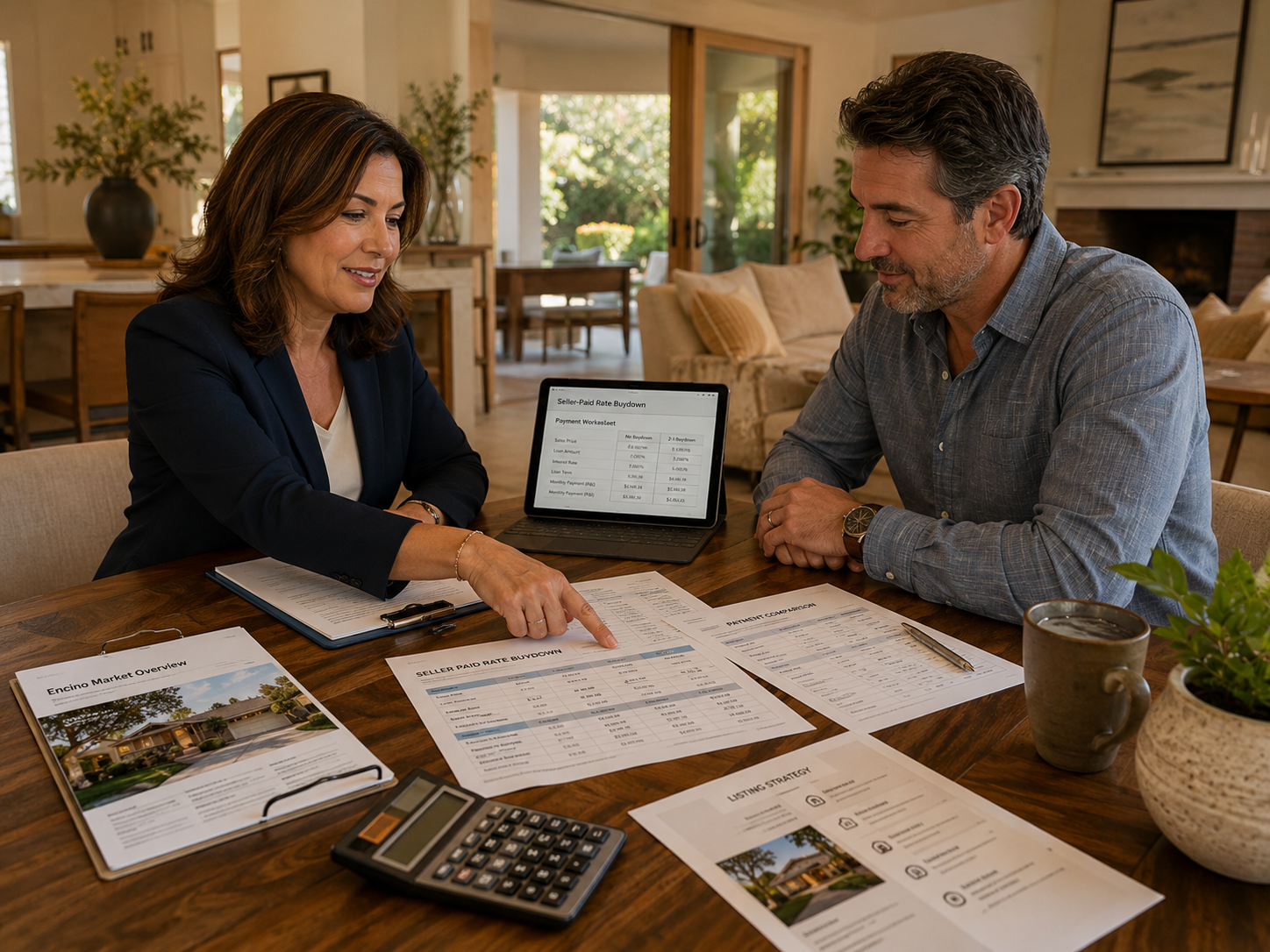 The Encino seller-paid buydown strategy consultation — the pre-listing conversation that establishes whether the 2-1 buydown is the correct tool for this specific Encino home, this specific price tier, and the current competitive landscape against Sherman Oaks 91403/91423 and Studio City 91604 alternatives the buyer pool is simultaneously evaluating.
The 2-1 buydown structure — exactly how it works:
The rate structure:
Assume a base note rate of 7.25% — the approximate conventional 30-year rate at current market conditions.
- → 📅 Year 1: Effective rate = 5.25% (note rate minus 2 percentage points)
- → 📅 Year 2: Effective rate = 6.25% (note rate minus 1 percentage point)
- → 📅 Year 3 and beyond: Effective rate = 7.25% (full note rate applies for the remaining 28 years)
What the buyer pays each month:
- → Year 1: Payment calculated at 5.25%
- → Year 2: Payment calculated at 6.25%
- → Year 3+: Full payment at 7.25%
What funds the difference:
The gap between the buyer's reduced year-one and year-two payments and the actual note rate payments goes to the lender from a buydown escrow account. This account is funded by the seller at closing as a prepaid closing cost credit — the seller contributes the lump sum at close, it is held in escrow, and it is disbursed monthly to cover the rate differential.
The critical buyer qualification point:
The buyer qualifies for the loan at the full 7.25% note rate — not the reduced year-one 5.25% rate. This is not a teaser rate or an adjustable mortgage that sets up payment shock; the buyer's ability to pay the full note rate is verified at underwriting. The buydown simply shifts the payment curve — reducing early-year payments in exchange for a seller-funded escrow account that covers the differential.
The 1-0 buydown alternative:
A simpler, less expensive structure: year one rate is 1 percentage point below the note rate; year two onward the full rate applies.
- → 💰 Lower seller cost: Approximately 40–50% less than the 2-1 buydown
- → 💰 Less buyer payment relief: Approximately half the year-one savings versus the 2-1
- → ✅ Best use case: When the seller's net proceeds are constrained and the full 2-1 buydown cost would require listing above the correct price to net adequately; or when the buyer needs specific year-one payment relief but the 2-percentage-point reduction is more than the market requires to activate
The permanent buydown (buying down the note rate):
Distinct from the temporary 2-1 or 1-0 structure — the permanent buydown reduces the note rate itself for the full 30-year loan term by paying mortgage discount points at close. Each point costs approximately 1% of the loan amount and reduces the rate by approximately 0.25%.
- → 💰 Cost for a 0.5% rate reduction on a $1.2M Encino loan: Approximately $24,000 (2 points)
- → 💰 Monthly savings at a 0.5% lower rate: Approximately $380/month — permanent, not temporary
- → ⚠️ Break-even: 63 months (5.25 years) — the permanent buydown makes financial sense for buyers who will hold the loan for 5+ years and who won't refinance before break-even
- → ✅ Best Encino use case: Buyers who have specifically stated they plan to hold long-term and who would benefit from permanent payment reduction — particularly relevant for the south-of-Ventura large-lot Encino buyer who is purchasing a 10–20+ year family home
2. 💰 The Encino Buydown Math — Specific Numbers at Each Price Tier
The buydown cost and buyer savings vary significantly across Encino's price tiers — and the math at the Encino Hills 91436 level, the south-of-Ventura large-lot level, and the north-of-Ventura volume tier all produce different cost-benefit profiles.
The buydown calculation methodology:
The 2-1 buydown cost equals approximately 2.0–2.3% of the loan amount — specifically, the present value of the payment differential between the note rate and the reduced rates over the 24-month buydown period. This varies slightly by lender but the 2.0–2.3% of loan amount is the reliable estimate.
Encino 91316 north-of-Ventura volume tier — $1.2M purchase:
- → 📋 Down payment (20%): $240,000
- → 💳 Loan amount: $960,000
- → 💰 2-1 buydown cost (2.15% of loan): approximately $20,640
- → 📅 Year 1 payment at 5.25%: $5,295/month P&I (versus $6,545 at 7.25%)
- → 💰 Year 1 monthly savings: approximately $1,250/month
- → 📅 Year 2 payment at 6.25%: $5,913/month P&I (versus $6,545 at 7.25%)
- → 💰 Year 2 monthly savings: approximately $632/month
- → 📊 Total buyer savings over 24 months: approximately $22,488
Encino 91316 north-of-Ventura premium — $1.5M purchase:
- → 📋 Down payment (20%): $300,000
- → 💳 Loan amount: $1,200,000
- → 💰 2-1 buydown cost (2.15%): approximately $25,800
- → 📅 Year 1 payment at 5.25%: $6,620/month P&I (versus $8,181 at 7.25%)
- → 💰 Year 1 monthly savings: approximately $1,561/month
- → 📅 Year 2 payment at 6.25%: $7,393/month P&I
- → 💰 Year 2 monthly savings: approximately $788/month
- → 📊 Total buyer savings over 24 months: approximately $28,188
Encino 91316 south-of-Ventura large-lot tier — $1.9M purchase:
- → 📋 Down payment (20%): $380,000
- → 💳 Loan amount: $1,520,000 (jumbo territory — verify with lender for jumbo buydown availability)
- → 💰 2-1 buydown cost (2.15%): approximately $32,680
- → 📅 Year 1 payment at 5.25%: $8,385/month P&I (versus $10,362 at 7.25%)
- → 💰 Year 1 monthly savings: approximately $1,977/month
- → 📅 Year 2 payment at 6.25%: $9,366/month P&I
- → 💰 Year 2 monthly savings: approximately $996/month
- → 📊 Total buyer savings over 24 months: approximately $35,676
Encino Hills 91436 — $2.2M purchase:
- → 📋 Down payment (20%): $440,000
- → 💳 Loan amount: $1,760,000 (jumbo — confirm availability)
- → 💰 2-1 buydown cost (2.15%): approximately $37,840
- → 💰 Year 1 monthly savings: approximately $2,290/month
- → 📊 Total buyer savings over 24 months: approximately $41,280
The jumbo loan buydown note:
Loans above the conforming loan limit ($766,550 for most counties in 2026 — verify current limit) enter jumbo territory. Most Encino purchases at $1.3M+ with standard 20% down involve jumbo financing. Jumbo lenders generally support 2-1 buydown structures, but terms and availability vary by lender. Confirm buydown eligibility and cost with the specific lender before marketing the buydown in the listing.
3. 🎯 Buydown vs. Price Reduction — The Encino Seller's Strategic Decision
The most common question Encino sellers ask when presented with the buydown concept: "Why wouldn't I just reduce the price by the buydown amount instead?" The answer is specific, quantifiable, and in most Encino market conditions, clearly favors the buydown — but not universally.
Why the buydown outperforms an equivalent price reduction in most Encino situations:
The payment concentration effect:
A $28,000 price reduction on a $1.5M Encino listing reduces the monthly payment by approximately $172/month — spread evenly across 360 months. The buyer's monthly payment goes from $8,181 to $8,009 — a 2.1% reduction that is real but rarely the difference between a buyer committing and not committing.
The same $28,000 as a 2-1 buydown reduces the buyer's year-one payment by approximately $1,561/month — a 19% reduction concentrated in the first year when the buyer's financial position is typically most stretched. This concentrated payment relief is the difference that moves buyers from hesitation to commitment.
The qualifying buyer pool expansion:
Buyers who are at their qualification ceiling — approved for a maximum monthly payment that the full note rate produces on the Encino purchase price — cannot qualify for the purchase regardless of the price reduction. A $28,000 price reduction that lowers the payment by $172/month may not change the qualification calculation if the buyer is approved to the exact previous payment level.
The buydown doesn't change qualification (the buyer still qualifies at the full note rate) — but it changes the buyer's perception of monthly affordability in the first years of homeownership, which is where buyer anxiety about payment management is highest. A buyer who is approved at $8,181/month but anxious about it is meaningfully more likely to commit when year-one payments are $6,620/month than when the payment is $8,009/month after a $28,000 price reduction.
The negotiation positioning advantage:
An Encino listing at $1,500,000 with a seller-paid 2-1 buydown is a different marketing object than an Encino listing at $1,472,000 (the price-reduced equivalent). The $1,500,000 listing communicates pricing confidence — the seller believes the home is worth $1,500,000 and is offering buyer-side financing assistance as a service rather than as an admission that the price needs to come down. The $1,472,000 listing communicates that the seller needed to reduce from a prior position — which invites further negotiation from every buyer who sees it.
When the price reduction is the better choice:
- → ❌ When the listing is above the comp ceiling: A buydown on an overpriced Encino listing does not fix the overpricing. The buyer activates by the payment relief, tours the home, falls in love, gets into escrow — and then the appraisal comes in below the purchase price because the home was priced above the comp ceiling. The deal unwinds or requires price reduction anyway, at much greater cost in time and transaction disruption than an upfront price correction would have produced. Correct the price first; apply the buydown second.
- → ❌ When the buyer pool is already fully activated but not offering: If the Encino listing has strong showing traffic but buyers are making low offers — the problem is price, not payment structure. A buydown does not resolve a pricing objection; it resolves a payment anxiety objection. These are different problems requiring different solutions.
- → ✅ When showing traffic exists but conversion to offer is stalling: The specific scenario where buyers are touring but not committing — "we liked it but we're nervous about the payment at current rates" — is exactly the scenario where the buydown activates commitment.
4. 🏆 The Encino Competitive Differentiation Case — Buydowns Against Adjacent Markets
Encino sellers compete for buyers who are simultaneously evaluating Sherman Oaks 91403/91423, Studio City 91604, and in some sub-neighborhoods and price tiers, Bel Air-adjacent and Beverly Hills Post Office alternatives. The buydown's role as a competitive differentiation tool is specifically valuable in this multi-market competitive context.
Encino competing in the multi-market buyer's evaluation — the south-of-Ventura large-lot Encino home that sits in a buyer's comparison set alongside Sherman Oaks north-of-Mulholland, Studio City south-of-Ventura, and in premium tiers, Bel Air and Beverly Hills Post Office alternatives. A seller-paid buydown in this competitive landscape is a specific, quantifiable differentiation that pricing alone can't replicate.
The Encino-vs-Sherman Oaks 91403/91423 competitive context:
Sherman Oaks north-of-Ventura offers a comparable buyer lifestyle proposition — Ventura Boulevard access, established SFV neighborhood character — at approximately 15–22% below Encino's comparable pricing. The move-up buyer who is evaluating both markets at a $1.4M budget reaches more home in Sherman Oaks at equivalent quality.
An Encino seller at $1.45M competing against Sherman Oaks at $1.22M for the same buyer has a specific problem: the $230,000 price difference is not cosmetically addressable with a $28,000 buydown. The buydown is not the tool for the Encino-versus-Sherman Oaks price justification — that justification requires the lot size, outdoor living proposition, and Encino lifestyle premium to do the heavy lifting.
Where the buydown helps in this comparison: for the buyer who has already decided that Encino is worth the premium and who is wavering specifically on payment management — not on whether Encino is worth more, but on whether their household can manage the Encino payment at current rates. This specific buyer is the buydown's natural audience.
The Encino-vs-Studio City 91604 competitive context:
Studio City at comparable price points delivers superior walkability and entertainment industry community. Encino delivers superior lot size and private outdoor living. This comparison is about lifestyle priority rather than price gap — the buyer who chooses Encino has already decided that the large lot is worth more than Ventura Boulevard walkability.
For this buyer, the Encino buydown is a genuine differentiation tool against Studio City alternatives that don't offer comparable seller concessions. If the Studio City comparable is priced at $1.48M with no seller concessions and the Encino equivalent is priced at $1.45M with a $28,000 2-1 buydown — the buyer who was already leaning toward Encino for the lot receives a specific, quantifiable financial advantage that Studio City doesn't offer. The buydown tips the decision.
The intra-Encino competitive differentiation:
When multiple Encino listings compete in the same sub-neighborhood and price tier simultaneously — the spring peak scenario where 3–5 comparable homes are active — the buydown differentiates correctly positioned listings from equivalently priced alternatives without concessions. At $1.35M, a buyer evaluating two comparable Encino 91316 north-of-Ventura 3-bedrooms — one with a 2-1 buydown and one without — will frequently prefer the buydown listing even if the two homes are essentially equivalent, because the buydown delivers $22,500 in quantifiable value that the non-buydown listing doesn't.
5. 📋 Structuring and Marketing the Buydown — The Execution Details That Matter
A seller-paid buydown that is correctly structured and incorrectly marketed produces minimal activation. A buydown that is correctly structured and correctly marketed produces the showing-to-offer conversion improvement that the strategy is designed to achieve.
The structuring requirements:
- → 🏦 Coordinate with a lender before listing: The buydown must be specifically structured by the buyer's lender as part of the loan package. As the Encino seller, work with your listing agent to identify a preferred lender partner who understands buydown structuring and who can produce accurate buydown savings illustrations for listing marketing materials.
- → 📋 Credit in the purchase contract: The seller-paid buydown is documented as a seller credit toward buyer's closing costs — specifically designated for the buydown escrow account. The contract language must specify "seller to provide $X credit toward 2-1 buydown of buyer's financing" rather than a generic closing cost credit that the buyer could redirect.
- → 📋 Lender credit limit verification: Conventional loan programs cap seller credits at 3–6% of the purchase price depending on down payment percentage. Confirm that the buydown cost plus any other seller credits doesn't exceed the applicable cap — a common structuring error that requires correction during escrow.
- → 📋 Jumbo buydown confirmation: For Encino purchases requiring jumbo financing (most purchases above $1.1M–$1.3M with standard down payments), confirm with the specific lender that the buydown structure is available on jumbo products before marketing it. Most jumbo lenders support it, but availability and cost may differ slightly from conforming loan buydown structures.
Marketing the buydown effectively:
- → 📢 Headline the buydown explicitly in listing remarks: Not buried in agent remarks — featured prominently. "Seller offering 2-1 rate buydown — payments starting at 5.25% in year one" is the specific marketing language that activates payment-sensitive buyer agents who flag these listings for their clients.
- → 📊 Provide a buyer-facing payment illustration: A one-page PDF prepared by the lender partner showing year-one, year-two, and year-three+ payments at the Encino list price with the 2-1 buydown applied. This document — available in the listing package and offered to buyer agents — gives the buyer's household the specific numbers they need to see to commit.
- → 📣 Active outreach to buyer agents: The listing agent should specifically contact active Encino and Sherman Oaks buyer agents with the buydown information — not relying on MLS discovery alone. Buyer agents with payment-sensitive clients are specifically looking for listings with buydown availability; direct outreach connects the listing to that buyer pool faster than passive MLS exposure.
- → 🌐 Feature in listing description and social marketing: The property tax article in this cluster noted that buyers researching Encino are sophisticated — they will read the listing description carefully. A buydown featured prominently in the online listing description reaches the buyer doing their own research as well as the buyer working through an agent.
🚫 What NOT to Overdo
Don't offer a buydown as a substitute for correct pricing. The buydown is a buyer activation tool for listings that are correctly priced at or near the comp ceiling. Encino sellers who are priced $150,000 above the comp ceiling and who add a buydown have not solved the pricing problem — they have added a concession to an overpriced listing. The appraisal will surface the overpricing during escrow regardless of the buydown, and the resulting deal disruption will be more costly than a price correction at launch would have been. Price correctly first; offer the buydown second.
Don't offer the buydown on all Encino tiers without evaluating buyer profile sensitivity. The north-of-Ventura Encino move-up buyer at $1.2M–$1.55M is the most payment-sensitive segment of the Encino buyer pool — these buyers are frequently at or near their qualification ceiling and are the most likely to be specifically activated by the year-one payment relief a buydown provides. The south-of-Ventura large-lot buyer at $1.9M–$2.5M and the Encino Hills 91436 buyer at $2M–$4M+ are generally less payment-sensitive relative to their income and asset base — the buydown may be appreciated but is less likely to be the decision-tipping factor. Match the tool to the buyer profile.
Don't structure the buydown as a generic closing cost credit. A seller credit that is not specifically designated for the buydown escrow account can be redirected by the buyer to other closing costs — leaving the seller having provided $28,000 in credit with no buydown marketing differentiation to show for it. Specify in the contract that the credit is for the 2-1 buydown specifically.
Don't market the buydown without a lender-prepared payment illustration. The abstract statement "seller offering 2-1 buydown" without specific payment numbers does not activate buyers. The specific statement "year-one payments of $6,620/month on a $1.5M purchase versus $8,181/month at current market rates" gives the buyer's household a concrete number to evaluate against their monthly budget. Without the specific numbers, the buydown marketing is a feature without a price tag — and buyers can't make decisions about features without price tags.
Don't confuse a seller-paid buydown with an adjustable-rate mortgage. Buyers who have heard horror stories about adjustable-rate mortgages that reset upward may initially confuse the 2-1 buydown structure with an ARM. The distinction is critical: the 2-1 buydown is a fixed-rate loan where the buyer qualified at the full rate from day one, funded by seller-contributed escrow, with no mortgage reset risk. This distinction should be clearly communicated in any buyer conversation about the buydown structure.
🏠 Real-World Scenario — Encino 91316
An Encino 91316 seller north of Ventura — a 3-bedroom, 1,850 sq ft, comprehensively renovated, 9,400 sq ft lot — had launched at $1.495M in September (the early fall window). First two weeks: 7 showings, one follow-up inquiry that didn't advance to an offer.
The comp analysis showed the listing was correctly priced — renovated comp ceiling $1.51M–$1.55M, list price of $1.495M was accurately positioned. The problem was not pricing; the market was signaling something else.
We conducted brief follow-up research through buyer agents who had toured. The recurring theme: "My clients love it — the lot and the renovation are exactly what they wanted — but they're running the payment numbers and getting nervous. At 7.25% on a $1.2M loan that's $8,181/month just in P&I, and that's before taxes and insurance." The payment anxiety was real and consistent.
We recommended adding a seller-paid 2-1 buydown at day 21 — structured as a $25,800 seller credit (2.15% of the $1.2M loan at 20% down). We had the lender partner prepare a payment illustration: year-one at 5.25% = $6,620/month P&I; year-two at 6.25% = $7,393/month P&I; year-three at full 7.25% = $8,181/month P&I. Total buyer savings over 24 months: $28,176.
We updated the listing remarks to feature the buydown prominently, distributed the payment illustration to the seven buyer agents who had toured without offering, and sent direct outreach to twelve additional buyer agents with active Encino-range buyer clients.
Day 28 (one week after buydown announcement): three new showings, including two from buyer agents who had received the outreach. Day 32: an offer from a buyer who had toured in week one, processed the payment illustration with their lender, and confirmed they could manage year-one payments comfortably. Offer: $1.485M with the buydown. Counter at $1.495M with buydown confirmed.
Accepted at $1.495M. Close at day 52 — 52 days on market, correctly priced, with a buydown that activated the buyer who was showing but not offering due to payment anxiety. Net to seller: $1.495M minus the $25,800 buydown cost, minus commission and closing costs — approximately $1.378M net. The buydown activated the specific buyer who was already interested but not committing, without requiring a price reduction that would have produced lower net proceeds.
🏠 Real-World Scenario — Encino 91316
A different Encino 91316 seller in the south-of-Ventura large-lot sub-neighborhood — a 4-bedroom, 2,800 sq ft on a 14,500 sq ft lot, partially renovated — had a $2.1M list price and was 45 days into the market with minimal showing traffic.
We evaluated the situation. The buydown question was secondary to a prior question: was the listing's low showing traffic a payment problem or a pricing problem?
The comp analysis indicated the listing was $180,000–$220,000 above the current south-of-Ventura comp ceiling for partially renovated condition. The renovated comp ceiling for this sub-neighborhood was approximately $2.2M–$2.45M. The partially renovated condition applied a 12–18% discount from the renovated ceiling — producing a supportable price of approximately $1.87M–$1.99M. The $2.1M list price was above the comp ceiling for the home's actual condition.
A buydown on a $2.1M listing that should be $1.92M does not solve the overpricing. The buyer who tours, falls in love, gets into escrow at $2.1M with a buydown, and then receives an appraisal at $1.93M faces a $170,000 appraisal gap that requires either additional cash to bridge, a renegotiated purchase price, or deal termination. None of these outcomes serve the seller.
We recommended a price reduction to $1.945M — within the comp-supported range — before introducing any buydown. The seller was resistant: "I don't want to reduce by $155,000. Can't we just offer a bigger buydown?"
We walked through the math. A buydown on a $2.1M purchase at the $1.76M loan amount (with 16.2% down at $2.1M to keep within the jumbo structure): 2-1 buydown cost approximately $37,840. The buyer would still face an appraisal gap at $2.1M that would require renegotiation. The buydown cost would be wasted.
Alternatively: reduce to $1.945M (within comp ceiling), add a 2-1 buydown at the $1.556M loan amount = $33,454 buydown cost. List effectively at $1.945M with a $33,454 buyer benefit — a credible, comp-supported listing that reaches the correct buyer pool.
The seller agreed after reviewing the appraisal gap risk explanation. Reduced to $1.939M and added the buydown. First week post-relaunch: 9 showings — more than the prior 45 days combined. Offer at day 58 of total market time, day 13 of the relaunch. Accepted at $1.935M. The buydown activated the buyer; the price correction made the buydown viable.
❓ FAQ
What is a seller-paid rate buydown and how does it work in Encino? A seller-paid rate buydown is a closing cost credit from the seller that funds a temporary reduction in the buyer's mortgage interest rate. The most common structure in Encino is the 2-1 buydown: year one rate is 2 percentage points below the note rate, year two is 1 percentage point below, and years three through thirty the full note rate applies. The cost — approximately 2.15% of the loan amount — is paid by the seller at closing as an escrow-funded concession. The buyer qualifies at the full note rate throughout and benefits from concentrated payment relief in the first two years of homeownership. At a $1.5M Encino purchase with 20% down, the 2-1 buydown costs the seller approximately $25,800 and saves the buyer approximately $1,561/month in year one.
How much does a seller-paid buydown cost in Encino? At Encino's primary transaction prices: ✓ $1.2M purchase (20% down, $960K loan): approximately $20,640. ✓ $1.5M purchase (20% down, $1.2M loan): approximately $25,800. ✓ $1.9M purchase (20% down, $1.52M loan): approximately $32,680. ✓ $2.2M purchase (20% down, $1.76M loan): approximately $37,840. All are paid at close as a seller credit — not an out-of-pocket pre-close expense. For jumbo loans (most Encino transactions above $1.1M–$1.3M), confirm buydown availability and exact cost with the specific lender before marketing.
Is a seller-paid buydown better than a price reduction in Encino? In most Encino market conditions, yes — the buydown outperforms an equivalent price reduction. A $25,800 price reduction reduces the buyer's monthly payment by approximately $158/month (distributed evenly over 360 months). The same $25,800 as a 2-1 buydown reduces year-one payments by approximately $1,561/month — a concentrated payment reduction that moves buyers from payment anxiety to commitment. The exception: when the listing is priced above the comp ceiling, a price correction is the prerequisite before any buydown can function effectively. Buydowns on correctly priced listings outperform price reductions; buydowns on overpriced listings don't solve the fundamental problem.
Does a seller-paid buydown help sell a home faster in Encino? Yes, in specific market conditions: when showing traffic exists but conversion to offers is stalling, when the active buyer pool includes rate-sensitive move-up buyers at the qualification ceiling, and when competing inventory in the same Encino price tier doesn't offer equivalent seller concessions. The buydown is most effective in the Encino north-of-Ventura volume tier ($1.15M–$1.65M) where buyers are most likely to be payment-sensitive. In the south-of-Ventura large-lot tier ($1.85M–$2.5M+) and Encino Hills 91436, where buyers tend to have more financial flexibility relative to the payment, the buydown is still useful but has a less dramatic activation effect.
Can any Encino buyer use a seller-paid buydown? Most conventionally financed Encino buyers — including jumbo loan buyers — can benefit from a seller-paid buydown. Exceptions and limitations: ✓ Cash buyers don't benefit (no loan, no rate to buy down). ✓ FHA/VA financing has specific seller credit limitations that may affect buydown structuring. ✓ Jumbo lenders must specifically confirm buydown availability for loans above the conforming limit. ✓ Total seller credits (including buydown cost) cannot exceed the lender's seller concession cap — typically 3–6% of the purchase price depending on down payment. Confirm eligibility with the lender before marketing.
How is a seller-paid buydown structured in the Encino purchase contract? The buydown is documented as a seller credit in the purchase agreement — typically worded as "seller to credit buyer $X toward 2-1 buydown of buyer's financing." The credit is specific to the buydown escrow account rather than a generic closing cost credit, ensuring it is applied as intended. The lender structures the buydown escrow, holds the funds, and disburses them monthly to cover the rate differential between the note rate and the reduced year-one and year-two rates. Confirm the exact contract language with your listing agent and attorney — documentation specificity prevents the credit from being redirected to general closing costs.
🎯 Bottom Line
The seller-paid rate buydown is the most specific and most quantifiable buyer activation tool available to Encino sellers in the current rate environment — and at Encino's $1.15M–$2.5M price band, the specific dollar impact of a correctly structured buydown is large enough to be the difference between a buyer committing and a buyer continuing to search.
The 2-1 buydown's power is its concentration: $25,800–$38,000 delivered as payment reduction rather than price reduction produces $1,400–$2,000/month of year-one payment relief — relief that the Encino move-up buyer, the rate-sensitive family buyer, and the professionally qualified buyer who is managing simultaneous competing financial demands specifically values when the full note rate payment produces anxiety that a $180/month price-reduction-equivalent doesn't address.
The tool works when the listing is correctly priced at the comp ceiling, when showing traffic exists but offer conversion is stalling, and when the specific Encino buyer segment being targeted is payment-sensitive rather than purely lifestyle-motivated. When those conditions are present, the buydown consistently produces faster offer conversion, stronger competitive differentiation against Sherman Oaks and Studio City alternatives, and better net proceeds than an equivalent price reduction would have generated.
At Parkway Estate Properties, Liana's seller strategy across Encino 91316/91436, Sherman Oaks 91403/91423, Tarzana 91356, Woodland Hills 91364/91367, and Northridge 91324/91325 means every buydown recommendation is preceded by the comp ceiling analysis, the buyer profile assessment, and the competitive landscape evaluation that determines whether the buydown is the right tool for the specific Encino home, at the specific price, in the specific market window.
📩 Want a Buydown Cost-Benefit Analysis for Your Specific Encino Home?
We'll run the comp analysis, calculate the buydown cost at your price point, model the buyer activation impact against the current showing traffic picture, and give you the honest recommendation on whether the buydown or a price strategy serves your specific situation better.
Contact Liana Shersher at Parkway Estate Properties: 📧 liana@parkwayestate.com · 📞 (818) 208-5881 · 🌐 parkwayestate.com 15021 Ventura Blvd., Ste. 510, Sherman Oaks, CA 91403
About the Authors
Liana Shersher is a licensed real estate agent with Parkway Estate Properties Inc. and an Accredited Buyer's Representative (ABR) serving the San Fernando Valley — with a focus on Sherman Oaks, Encino, Tarzana, Woodland Hills, and Northridge (DRE# 02164224). Liana guides first-time homebuyers through every step of the purchase, from the first showing to the keys in hand, and represents move-up and repeat buyers across the Valley. For sellers, she builds the pricing and marketing strategy that positions a home to sell for top dollar, fast. Buyers and sellers work with Liana for clear communication, sharp local knowledge, and an agent who treats their goals like her own.
Roman Shersher is the broker-owner of Parkway Estate Properties Inc. and a real estate investor with 18 years of experience in the San Fernando Valley (DRE# 01855095). Roman has personally led or co-led renovations on dozens of properties across the Valley, including recent projects in Northridge (91324) and Woodland Hills (91364). That hands-on renovation and investment experience shapes every pricing conversation and days-on-market strategy at Parkway — sellers get a realistic read on what improvements actually return at resale, and buyers get an expert eye on a home's true condition and upside.
Parkway Estate Properties, Inc. · 15021 Ventura Blvd., Ste. 510, Sherman Oaks, CA 91403 · (818) 208-5881 · parkwayestate.com · Broker License #: 01873092 Equal Housing Opportunity. Information herein is general and not legal, tax, or financial advice. Consult qualified professionals for your specific situation.
Categories
Recent Posts










Broker | Realtor ® License ID: 01873092
+1(818) 208-5881 | info@parkwayestate.com