
How Do Seller-Paid Rate Buydowns Work in Reseda?
Seller-paid rate buydowns are the most underutilized buyer activation tool available to Reseda 91335 sellers — and at Reseda's $650,000–$950,000 primary transaction band, the specific financial impact of a correctly structured buydown is large enough to move first-time buyers from hesitation to commitment and to differentiate a Reseda listing from comparable competing inventory in a market where $300–$500 in monthly payment savings is a meaningful share of the buyer's total housing budget.
The math at Reseda's price points is both smaller in absolute dollars than the Encino and Tarzana equivalents and more impactful per dollar spent — because the Reseda buyer stretching to their $780,000–$870,000 qualification ceiling experiences $900–$1,100/month in year-one payment relief from a 2-1 buydown as a proportion of their household budget that the Encino buyer at $1.5M doesn't feel the same way. The Reseda first-time buyer whose total PITI is $6,200/month and whose combined household take-home is $8,800/month experiences a year-one payment of $5,300/month from the buydown as genuinely life-changing breathing room — not a modest financial convenience, but the difference between feeling financially comfortable in the first year of homeownership and feeling financially stretched.
This article gives Reseda sellers the complete buydown picture — how the mechanics work at Reseda's specific price points, what it costs, what it saves the buyer, when it is the correct tool versus a price reduction, how to structure and market it correctly, and the specific buyer profiles in the Reseda 91335 market that a buydown most powerfully activates.
1. 📚 How the 2-1 Buydown Works — The Mechanics Applied to Reseda's Price Band
The seller-paid 2-1 buydown is a specific, structured financial instrument that works the same way in Reseda 91335 as it does in Encino 91316 or Tarzana 91356 — but its specific costs and savings amounts are calibrated to Reseda's $650,000–$950,000 transaction band. Understanding the mechanics precisely, rather than as a vague marketing concept, allows Reseda sellers to present the buydown credibly, structure it correctly, and evaluate whether the cost-benefit analysis supports using it for their specific listing.
 The Reseda seller-paid buydown consultation — the pre-listing conversation that establishes whether the 2-1 buydown is the right tool for this specific Reseda home at this specific price point and in the current market conditions. At Reseda's $700K–$870K primary transaction band, the buydown cost of $12,500–$16,500 produces year-one buyer savings of $800–$1,050/month — payment relief that specifically activates the first-time buyer whose budget is tightest in year one of ownership.
The 2-1 buydown rate structure:
Assuming a base note rate of 7.25% — the approximate conventional 30-year rate at current market conditions:
- → 📅 Year 1: Effective rate = 5.25% (2 percentage points below note rate)
- → 📅 Year 2: Effective rate = 6.25% (1 percentage point below note rate)
- → 📅 Year 3 and beyond: Full 7.25% note rate for the remaining 28 years
The Reseda buydown math at specific price points:
$700,000 purchase price (10% down, $630,000 loan):
- → 💰 2-1 buydown cost (2.15% of loan): approximately $13,545
- → 📅 Year 1 P&I at 5.25%: $3,478/month (versus $4,297 at 7.25%)
- → 💰 Year 1 monthly savings: approximately $819/month
- → 📅 Year 2 P&I at 6.25%: $3,882/month
- → 💰 Year 2 monthly savings: approximately $415/month
- → 📊 Total buyer savings over 24 months: approximately $14,808
$780,000 purchase price (10% down, $702,000 loan):
- → 💰 2-1 buydown cost: approximately $15,093
- → 📅 Year 1 P&I at 5.25%: $3,874/month (versus $4,788 at 7.25%)
- → 💰 Year 1 monthly savings: approximately $914/month
- → 📅 Year 2 P&I at 6.25%: $4,326/month
- → 💰 Year 2 monthly savings: approximately $462/month
- → 📊 Total buyer savings over 24 months: approximately $16,512
$850,000 purchase price (10% down, $765,000 loan):
- → 💰 2-1 buydown cost: approximately $16,448
- → 📅 Year 1 P&I at 5.25%: $4,223/month (versus $5,218 at 7.25%)
- → 💰 Year 1 monthly savings: approximately $995/month
- → 📅 Year 2 P&I at 6.25%: $4,714/month
- → 💰 Year 2 monthly savings: approximately $504/month
- → 📊 Total buyer savings over 24 months: approximately $17,988
$920,000 purchase price (10% down, $828,000 loan):
- → 💰 2-1 buydown cost: approximately $17,802
- → 📅 Year 1 P&I at 5.25%: $4,570/month (versus $5,648 at 7.25%)
- → 💰 Year 1 monthly savings: approximately $1,078/month
- → 📅 Year 2 P&I at 6.25%: $5,100/month
- → 💰 Year 2 monthly savings: approximately $548/month
- → 📊 Total buyer savings over 24 months: approximately $19,512
The critical buyer qualification point:
The buyer qualifies for the loan at the full 7.25% note rate — not the reduced year-one 5.25% rate. The buydown is not a teaser rate or an adjustable-rate product that creates payment shock; the buyer's ability to sustain the full note rate payment has been verified at underwriting. The buydown shifts the payment curve — reducing early-year payments through a seller-funded escrow account that covers the rate differential — while the buyer's qualification remains anchored to the full note rate.
The 1-0 buydown alternative:
For Reseda sellers whose net proceeds are constrained or whose listing is at the lower end of the price band:
- → 💰 Cost: Approximately 40–50% less than the 2-1 — approximately $5,500–$8,500 for a $700,000–$850,000 Reseda purchase
- → 💰 Year 1 savings: Approximately $400–$500/month — half the activation impact of the 2-1
- → ✅ Best use case: When the full 2-1 cost would require listing above the correct price to net adequately, or when the Reseda sub-neighborhood comp gap is narrow and the seller's margin is limited
2. 🎯 Buydown vs. Price Reduction — The Reseda Decision
The most common question Reseda sellers ask when the buydown concept is introduced: "Why wouldn't I just reduce the price by the same amount?" At Reseda's price points, the answer is specific, quantifiable, and consistently favors the buydown for the specific buyer activation problem it is designed to solve — with one important exception.
Why the buydown outperforms an equivalent price reduction in most Reseda situations:
The payment concentration effect — amplified at Reseda's price band:
At Reseda's $700,000–$870,000 price band, a $15,000 price reduction reduces the monthly payment by approximately $92/month — a number that is real but rarely the difference between a buyer committing and a buyer continuing to search. The Reseda first-time buyer who is managing a household budget of $8,500–$10,500/month (combined take-home) and a PITI of $5,800–$6,800/month experiences $92/month of payment reduction as a minor convenience.
The same $15,000 as a 2-1 buydown produces $900–$1,000/month in year-one payment relief — concentrated in the year when the first-time buyer's financial position is most constrained: the post-close period when moving costs have been paid, reserves have been partially depleted, and the household is adjusting to the combination of mortgage, property taxes, insurance, and the inevitable small maintenance items that accompany homeownership.
For the Reseda first-time buyer, $900/month in year-one payment relief is not a marginal convenience — it is the difference between feeling financially stable and feeling financially anxious in the first year of their most significant financial commitment. This emotional and practical reality is what the buydown specifically addresses and what the equivalent price reduction distributes too thinly to replicate.
The negotiation positioning advantage:
A Reseda listing at $795,000 with a prominently marketed seller-paid 2-1 buydown communicates pricing confidence — the seller believes the home is worth $795,000 and is offering financing assistance as a service to the buyer. A Reseda listing at $780,000 (the price-reduced equivalent) communicates that the seller reduced from a prior position — which invites every buyer's agent to present the price history as evidence for further negotiation.
The competing inventory differentiation:
In Reseda's active market, correctly priced 3-bedroom homes in the same sub-neighborhood and condition tier frequently compete simultaneously. A $795,000 listing with a marketed 2-1 buydown stands out from a $792,000 listing without one — the specific, quantifiable buyer benefit differentiates the listing in a way that a $3,000 price difference alone does not.
When the price reduction is the better choice:
- → ❌ When the listing is priced above the comp ceiling: The buydown's most common misuse in Reseda is applying it to an overpriced listing hoping it will compensate for the pricing error. A Reseda home priced at $870,000 when the comp ceiling is $825,000 is overpriced by $45,000. A buydown costing $17,000 on an overpriced listing does not fix the overpricing — the buyer who is activated by the buydown payment will have their enthusiasm tempered when the appraisal comes in at $820,000 and they face a $50,000 appraisal gap. Fix the price first; add the buydown second.
- → ❌ When showing traffic is strong but offers are low: If Reseda buyers are touring and making low offers — the problem is pricing, not payment structure. The buydown addresses payment anxiety; it doesn't address overpricing. Diagnose the problem correctly before applying the tool.
- → ✅ When showing traffic exists but conversion to offers is stalling: The specific scenario — buyers touring, agents giving positive feedback, no offers materializing — where the issue is payment anxiety rather than pricing. The buydown activates the buyer who is interested and payment-hesitant.
3. 👥 The Reseda Buyer Profiles — Who the Buydown Activates and Who It Doesn't
The Reseda 91335 buyer pool includes two meaningfully different buyer profiles whose response to the seller-paid buydown is distinctly different — and targeting the buydown marketing to the profile it specifically activates, rather than broadcasting it to both, produces stronger activation results.
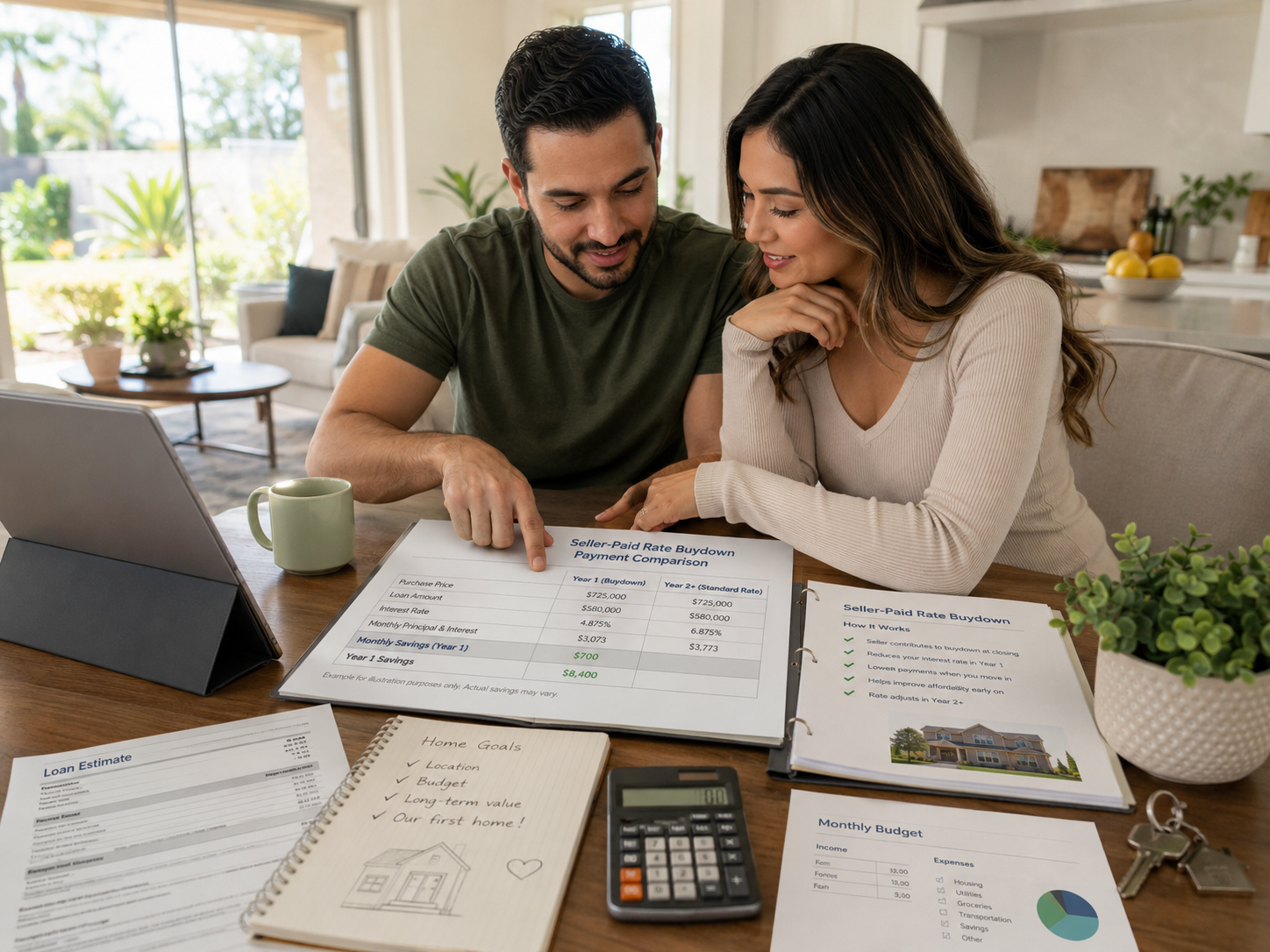 The Reseda buydown activation moment — a first-time buyer couple reviewing the specific year-one and year-two payment savings from a seller-paid 2-1 buydown at a Reseda showing. At $900–$1,050/month in year-one savings, the buydown converts a buyer who is interested but payment-anxious into a buyer who submits an offer. This activation dynamic is specific to the first-time and move-up buyer profile and does not apply equally to the BRRRR investor profile also active in Reseda.
Profile 1 — The First-Time Buyer (primary buydown activation target):
The Reseda first-time buyer — typically a household purchasing for the first time at the $680,000–$820,000 qualification ceiling — is the buyer profile for whom the seller-paid buydown produces the strongest activation effect.
Why the buydown specifically activates this profile:
- → 💰 Post-close financial position: The first-time buyer has depleted a significant share of their savings for the down payment and closing costs. Their liquid reserves immediately post-close are often $25,000–$60,000 — enough for a few months of mortgage payments but insufficient to absorb the simultaneous financial pressures of a new mortgage, new insurance, new property tax obligations, and the small maintenance items that every new homeowner encounters in year one.
- → 🏠 Payment anxiety: The first-time buyer is making their first payment of this magnitude. The PITI of $5,800–$6,800/month may be well within their qualification, but it is substantially higher than any prior monthly obligation they've managed — and the anxiety of this transition is specific, real, and a genuine obstacle to offer commitment.
- → 💡 Year-one buydown impact: Reducing the year-one payment by $900–$1,050/month gives the first-time buyer the specific financial breathing room that makes the transition from renting to ownership feel manageable rather than suffocating. This is the most powerful activation the buydown produces at Reseda's price points.
- → ✅ Marketing approach: Lead the listing description with the buydown payment illustration: "Year-one payments from $3,874/month P&I on a $780,000 purchase — seller-paid 2-1 rate buydown included." This specific number, at the specific price point the buyer is researching, triggers the "I need to see this home" response.
Profile 2 — The Move-Up Family (secondary buydown activation target):
The Reseda move-up buyer — a family transitioning from Reseda, Van Nuys 91401/91405/91406, or Canoga Park 91304 who is selling their current home and applying equity to the Reseda purchase — is the second buydown activation target.
Why the buydown activates this profile:
- → 💰 Bridge period financial pressure: The move-up buyer is frequently managing a simultaneous close — selling their current home and purchasing the Reseda home within a compressed timeline that creates a specific short-term financial pressure. The year-one payment reduction provides relief during the transition period when moving costs, overlap carrying costs, and the new mortgage simultaneously impact the household budget.
- → 🏠 Payment calibration: The move-up buyer's current mortgage was established at a prior rate. The transition to a 7.25% Reseda mortgage on a larger loan produces payment sticker shock that the buydown specifically addresses — the year-one effective rate of 5.25% feels closer to the prior mortgage environment than the full 7.25%.
- → ✅ Marketing approach: Lead with the year-over-year comparison: "Your year-one payment is comparable to a 5.25% rate — seller pays the difference. See the full payment illustration at showing."
Profile 3 — The BRRRR Investor (NOT a buydown activation target):
The BRRRR investor active in Reseda 91335 — described extensively in the investor guide article — underwrites acquisition decisions based on post-renovation appraised value, renovation cost, and 75% LTV cash-out refinance mathematics. The investor's year-one payment during the renovation and stabilization period is a carrying cost rather than a long-term ownership obligation — they refinance after renovation completion, resetting the payment entirely.
- → ❌ Buydown impact on investors: The investor who refinances at month 8–12 post-close extracts the buydown's value only for the pre-refinance hold period. More importantly, the investor's acquisition decision is driven by purchase price (which determines the margin available in the BRRRR cycle), not by year-one payment. A $800,000 with buydown versus $785,000 without buydown — the investor chooses the lower price.
- → ⚠️ The buydown misallocation: Reseda sellers who offer a buydown to an investor-focused listing (original condition, below-comp pricing, explicitly marketed as "investor opportunity") are spending the buydown cost on a buyer profile for whom it provides no activation value. Save the buydown cost for owner-occupant-positioned listings where the first-time and move-up buyer is the primary audience.
4. 📋 Structuring and Marketing the Reseda Buydown
A correctly structured buydown that is incorrectly marketed produces minimal activation. A correctly marketed buydown that is incorrectly structured produces the specific mid-escrow complications described in the Encino buydown article. Both pieces must be in place before the listing launches.
Structuring requirements:
Coordinate with a lender before listing:
The buydown must be specifically structured by the buyer's lender as part of the loan package. As the Reseda seller, work with your listing agent to identify a preferred lender partner who understands 2-1 buydown structuring for conventional conforming and FHA loan products — the most common financing types in Reseda's $650,000–$950,000 price band.
FHA financing note for Reseda:
Reseda's first-time buyer pool includes a meaningful share of FHA-financed buyers — the 3.5% down payment minimum that makes FHA specifically accessible to buyers with limited down payment savings. The 2-1 buydown is compatible with FHA financing, but confirm availability with the specific lender for the FHA product type and verify that total seller credits (including buydown cost) don't exceed the FHA seller contribution cap (currently 6% of the purchase price for most FHA transactions — verify current limits before structuring).
Contract language:
Document the buydown as a specific seller credit in the purchase agreement: "Seller to credit buyer $X toward 2-1 buydown of buyer's financing." This specific language prevents the credit from being redirected to general closing costs and ensures the buyer's lender receives the credit specifically for buydown escrow funding.
Seller contribution cap verification:
Conventional loans cap seller contributions at 3% of the purchase price for down payments below 10%, and 6% for down payments of 10%–25%. At a $780,000 Reseda purchase with 10% down: seller contribution cap is $46,800 (6%). The buydown cost of $15,093 is well within this cap — but confirm with the lender if additional seller credits (closing cost credits, repair credits) are also being offered, as the combined total must not exceed the cap.
Marketing the buydown effectively:
In the MLS listing description:
Feature the buydown prominently and specifically — not buried in a footnote:
"SELLER-PAID 2-1 RATE BUYDOWN INCLUDED — Year-one payments from $3,874/month P&I on $780,000 purchase at 5.25% effective rate. See payment illustration at showing or contact listing agent for details."
This specific, numerical representation activates buyer agents who are searching for rate-relief options for their payment-sensitive clients — and it gives the buyer's household a concrete number to evaluate against their budget rather than an abstract concept.
Buyer payment illustration document:
Have the preferred lender prepare a one-page PDF showing:
- → Year 1 P&I at 5.25% vs. market rate 7.25%
- → Year 2 P&I at 6.25% vs. market rate 7.25%
- → Year 3+ P&I at 7.25%
- → Total 24-month savings
Provide this document at every showing and include it in the listing package distributed to buyer agents. The document turns the buydown from an abstract benefit into a specific financial decision the buyer can evaluate with their household.
Active buyer agent outreach:
The listing agent should specifically contact active Reseda and adjacent market buyer agents with buyer clients in the $680,000–$870,000 range — communicating the buydown availability directly rather than relying solely on MLS discovery. Buyer agents with payment-sensitive first-time buyer clients are specifically filtering for listings with rate relief options; direct outreach connects the listing to that buyer pool faster.
5. 🌟 The Reseda Buydown in Context — When to Add It and When to Hold Back
The seller-paid buydown is not appropriate for every Reseda listing in every market condition. Understanding when to deploy it — and when to hold back — prevents the misallocation of buydown cost on listings or buyer profiles where it produces minimal activation value.
✅ Deploy the buydown:
- → Summer and fall listings: Reseda's summer (June–August) and fall (October–November) windows produce a reduced buyer pool compared to the spring peak. The buydown's payment relief specifically activates the remaining buyer pool's most payment-hesitant segment — the buyer who is searching year-round but who hesitates to commit when competing demands on their budget are highest.
- → Correctly priced listings with showing traffic but stalled offer conversion: The specific diagnostic — buyers touring, agents providing positive feedback, no offers appearing — where payment anxiety rather than pricing is the obstacle. The buydown addresses payment anxiety; pricing addresses overpricing. Diagnose correctly.
- → Listings competing against similar inventory without buydown: When two comparable Reseda 3-bedrooms are simultaneously active in the same sub-neighborhood at comparable prices, the buydown creates a specific, quantifiable differentiation that the buyer and their agent will discuss in the offer decision.
- → FHA buyer-targeted owner-occupant listings: FHA-financed first-time buyers represent a meaningful share of the Reseda buyer pool and are the most payment-sensitive segment of that pool. The buydown's year-one payment relief is specifically impactful for buyers whose 3.5% down payment has depleted their savings to a level that makes the full market-rate payment genuinely stressful.
❌ Hold back the buydown:
- → Investor-positioned listings: Original-condition Reseda homes explicitly positioned for the BRRRR investor market should not include a buydown — the investor buyer is optimizing acquisition price, not year-one payment, and the buydown cost is wasted on this buyer profile.
- → Spring peak listings with strong showing traffic: In the Reseda spring peak, correctly priced and well-prepared listings generate sufficient competing buyer interest without the buydown. Adding the buydown in a competitive spring market costs the seller $13,000–$17,000 for an activation effect that the competitive market is already producing independently.
- → Overpriced listings: The buydown does not fix overpricing. A Reseda listing at $50,000 above the comp ceiling with a buydown attached is still $50,000 above the comp ceiling. Correct the price before evaluating whether the buydown is appropriate.
🚫 What NOT to Overdo
Don't use a buydown to avoid having the overpricing conversation. This is the most consistently misapplied use of the seller-paid buydown in Reseda — the seller or agent who adds a buydown to an overpriced listing as a substitute for the difficult but necessary conversation about reducing the price. The buydown activates buyers at the correct price point; it does not prevent appraisal gaps at an overpriced one. A buyer who is activated by the buydown's payment relief, falls in love with the Reseda home, and gets into escrow at an overpriced $855,000 when comps support $815,000 faces a $40,000 appraisal gap that the buydown payment relief cannot bridge. Fix the price. Then evaluate the buydown.
Don't market the buydown without the specific payment numbers. "Seller offering rate buydown" without specific payment calculations is marketing language without decision-driving information. The Reseda buyer who sees "rate buydown available" without seeing "year-one payments from $3,874/month on this home" has no basis for evaluating whether the buydown materially changes their purchasing calculation. Always include the specific year-one and year-two payment numbers in listing marketing materials.
Don't confuse the 2-1 buydown with a permanent rate reduction. The 2-1 buydown's activation power comes from year-one payment relief — a temporary benefit that expires after 24 months when the full note rate applies. Some buyers, particularly sophisticated purchasers who are planning a 30-year hold, will ask whether the same amount would be better deployed as mortgage discount points (a permanent rate reduction). For buyers who plan to hold without refinancing for 7+ years, the permanent buydown may produce more total value — the correct answer depends on the buyer's specific hold plan. The listing agent should be prepared to address this comparison honestly rather than dismissing it.
Don't structure the buydown as a generic closing cost credit. A generic seller closing cost credit that the buyer can redirect to other closing costs at their discretion may or may not be applied to the buydown. The marketing benefit of the buydown — the specific payment illustration, the first-week differentiation against competing inventory — requires that the credit be specifically designated for the buydown escrow account in the purchase contract. Generic closing cost credits provide financial benefit but not the specific marketing differentiation of a named buydown.
Don't assume every lender offers the same buydown terms. The 2-1 buydown's cost is approximately 2.15% of the loan amount across most lenders, but the specific availability, terms, and compatibility with different loan products (conventional, FHA, VA) varies by lender. Confirm buydown availability and cost with the specific lender before marketing it in the listing — and identify a preferred lender who can provide the buydown payment illustration document for buyer distribution at showings.
🏠 Real-World Scenario — Reseda 91335
A Reseda 91335 seller had a renovated 3-bedroom on a 7,200 sq ft lot — updated kitchen, LVP flooring, fresh paint, curb appeal complete. Listed in late June at $812,000 — correctly priced at the comp ceiling for renovated 3-bedroom homes in the specific Reseda sub-neighborhood.
First two weeks: 6 showings. No offers. Buyer agent feedback consistently: "Clients love the home. It's exactly what they wanted. They're just nervous about the payment — $5,200/month PITI is more than they've ever committed to, and the first year feels scary."
This was the specific diagnostic — correctly priced, good showing traffic, payment anxiety creating the offer conversion problem. Not a pricing issue. A payment anxiety issue.
We added the seller-paid 2-1 buydown at week three: $15,093 buydown cost on the $702,000 loan (10% down on $812,000 becomes $730,800 loan — recalculating at the listed price with 10% down). The lender partner prepared the payment illustration: year-one P&I at 5.25% = $4,036/month versus $5,000 at 7.25%. Year-one PITI with buydown: approximately $5,440/month versus $6,404/month at the full rate.
We updated the listing remarks: "SELLER-PAID 2-1 BUYDOWN INCLUDED — Year-one effective rate 5.25%, payments from $4,036/month P&I. Full payment illustration available at showing."
We contacted the six buyer agents who had toured without offering and communicated the buydown addition specifically: "The sellers have added a seller-paid 2-1 buydown — year-one payments are $4,036/month P&I versus $5,000 at current market rate. If your clients have revisited the payment concern, this may change their calculation."
Three days after the buydown announcement: two of the six buyer agents responded. One scheduled a second showing; one submitted an offer at $800,000. Counter accepted at $807,000. The buyer had toured twice and hesitated on the payment; the $964/month year-one reduction moved them from hesitation to commitment.
Close at day 34 from original listing, day 14 from buydown announcement. The $15,093 buydown cost produced the offer that closed the deal — in a summer market where a price reduction of the same amount ($812,000 → $797,000) would have reduced the monthly payment by $93/month and likely not moved the same buyer from hesitation to commitment.
🏠 Real-World Scenario — Reseda 91335
A different Reseda 91335 seller — an original-condition 3-bedroom explicitly positioned for the investor market ("investor opportunity, priced below comps, as-is sale, motivated seller") — was advised by a neighboring seller to add a 2-1 buydown to their listing. The neighboring seller's buydown had produced a quick sale (the scenario described above). Why not do the same?
We evaluated the listing. Original condition, explicitly investor-positioned, priced at $693,000 — the BRRRR investor acquisition price that leaves the renovation margin investors specifically require.
Adding a buydown to this listing: the $14,900 buydown cost (2.15% of $693,000) would reduce the listing appeal to the investor buyer by zero — the investor was evaluating the acquisition at $693,000 as the starting point for a renovation-and-refinance model. Whether the year-one carrying payment was $3,820/month or $4,719/month was irrelevant to their BRRRR math — they were refinancing at month 8–10 after renovation completion, at which point the buydown's escrow was returned to the lender unused for the remaining buy-down period.
Moreover, the investor specifically wanted the $693,000 price to be net — adding a buydown cost of $14,900 that the investor perceived as a financing gimmick rather than a value benefit effectively raised their net acquisition cost to $707,900 (seller receives $693,000 but spends $14,900 on the buydown), which narrowed the BRRRR margin precisely where investors are most sensitive.
Recommendation: no buydown. Price the as-is listing correctly for the investor market at $693,000. Offer direct communication of the renovation scope estimate, permit history, and as-is disclosure documentation — the specific information the investor decision-maker needs.
The listing sold as-is at $691,000 in 19 days to a BRRRR investor buyer. The $14,900 the seller almost spent on a buydown that would have produced zero activation for the investor buyer pool remained in the seller's proceeds where it belonged.
The tool that works for the owner-occupant first-time buyer fails for the BRRRR investor. The most important buydown decision in Reseda is identifying which buyer profile is the primary audience for the specific listing — and targeting the tool accordingly.
❓ FAQ
How does a seller-paid rate buydown work in Reseda? A seller-paid 2-1 buydown in Reseda works as follows: ✓ The seller contributes approximately 2.15% of the loan amount as a closing cost credit at close. ✓ This credit funds a buydown escrow account held by the lender. ✓ The buydown escrow covers the difference between the buyer's year-one effective rate (2 percentage points below the note rate) and the actual note rate payment. ✓ In year two, the escrow covers 1 percentage point of rate reduction. ✓ From year three onward, the buyer pays the full note rate. ✓ The buyer qualifies at the full note rate throughout. At a $780,000 Reseda purchase with 10% down, the buydown costs the seller approximately $15,093 and saves the buyer approximately $914/month in year one.
How much does a seller-paid buydown cost in Reseda? At Reseda's primary transaction prices: ✓ $700,000 purchase (10% down, $630,000 loan): approximately $13,545. ✓ $780,000 purchase (10% down, $702,000 loan): approximately $15,093. ✓ $850,000 purchase (10% down, $765,000 loan): approximately $16,448. ✓ $920,000 purchase (10% down, $828,000 loan): approximately $17,802. These costs are paid at close as a seller credit — not an out-of-pocket pre-close expense. The seller receives the buydown cost from the buyer's deposit held in escrow and it appears as a line item in the closing statement.
Is a seller-paid buydown better than reducing the price in Reseda? For most Reseda owner-occupant-targeted listings where payment anxiety is the obstacle to offer commitment — yes. A $15,000 price reduction on a $780,000 listing saves the first-time buyer $92/month. The same $15,000 as a 2-1 buydown saves the first-time buyer $914/month in year one. The concentrated payment relief of the buydown activates the payment-hesitant first-time buyer in a way that the distributed payment reduction of the price cut doesn't. The exception: when the listing is priced above the comp ceiling — in that case, the price reduction is required before any buydown can function effectively.
Do BRRRR investors in Reseda benefit from seller-paid buydowns? No — the BRRRR investor active in Reseda 91335 is specifically not activated by the seller-paid buydown. The investor underwrites the acquisition decision based on purchase price (which determines the renovation margin), renovation cost, and the 75% LTV cash-out refinance mathematics. Year-one payment is a carrying cost rather than a long-term obligation for the investor, who refinances after renovation completion. Reseda sellers should specifically avoid adding a buydown to investor-positioned as-is listings — the buydown cost produces no activation value for the BRRRR buyer and reduces the seller's net proceeds for no benefit.
Can FHA buyers in Reseda use a seller-paid buydown? Yes — the 2-1 buydown is compatible with FHA financing, which is commonly used by Reseda first-time buyers who use the 3.5% down payment minimum. Confirm buydown availability with the specific FHA lender and verify that total seller contributions (including the buydown cost plus any other seller credits) don't exceed the FHA seller contribution cap (currently 6% of the purchase price for most FHA transactions — verify current limits). FHA-financed buyers are among the most payment-sensitive buyers in the Reseda market and represent the buyer profile for whom the buydown produces the strongest activation.
When should a Reseda seller add a buydown to their listing? The optimal timing for adding a buydown: ✓ Before launch for summer (June–August) and fall (October–November) listings where the smaller buyer pool needs activation. ✓ At day 14–21 when a spring or summer listing has showing traffic but no offer conversion — the diagnostic that identifies payment anxiety as the obstacle. ✓ When directly competing against a similar Reseda listing without a buydown that is making the direct comparison at comparable price points. Hold back the buydown for: spring peak listings with strong competitive showing traffic (the market is producing competition without the buydown tool); investor-positioned as-is listings; and overpriced listings where the price must be corrected before any buydown is appropriate.
🎯 Bottom Line
The seller-paid rate buydown is the most specific, most quantifiable, and most impactful buyer activation tool available to Reseda 91335 sellers targeting the first-time and move-up owner-occupant buyer pool — and at Reseda's $650,000–$950,000 transaction band, the $900–$1,050/month in year-one payment relief it produces is proportionally more impactful to this buyer profile's household budget than the equivalent buydown is to the Encino or Tarzana professional household buyer.
The tool works when the listing is correctly priced, when showing traffic exists but offer conversion is stalling, and when the specific Reseda buyer profile being targeted is the payment-sensitive first-time buyer or move-up family rather than the BRRRR investor. When those conditions are present, the buydown consistently produces faster offer conversion, direct differentiation against competing inventory, and better net proceeds than an equivalent price reduction would have generated.
At Parkway Estate Properties, Liana's seller strategy across Reseda 91335, Northridge 91324/91325, Tarzana 91356, Granada Hills 91344, and Lake Balboa 91406/91411 means every buydown recommendation is preceded by the pricing verification, the buyer profile identification, and the competitive landscape assessment that determines whether the buydown is the right tool for the specific Reseda home at the specific price in the specific market window.
📩 Want to Know Whether a Seller-Paid Buydown Is the Right Tool for Your Reseda Listing?
We'll evaluate your specific listing — price, condition, sub-neighborhood, current market activity, and buyer profile — and tell you honestly whether the buydown produces better net proceeds than alternative strategies for your specific situation.
Contact Liana Shersher at Parkway Estate Properties: 📧 liana@parkwayestate.com · 📞 (818) 208-5881 · 🌐 parkwayestate.com 15021 Ventura Blvd., Ste. 510, Sherman Oaks, CA 91403
About the Authors
Liana Shersher is a licensed real estate agent with Parkway Estate Properties Inc. and an Accredited Buyer's Representative (ABR) serving the San Fernando Valley — with a focus on Sherman Oaks, Encino, Tarzana, Woodland Hills, and Northridge (DRE# 02164224). Liana guides first-time homebuyers through every step of the purchase, from the first showing to the keys in hand, and represents move-up and repeat buyers across the Valley. For sellers, she builds the pricing and marketing strategy that positions a home to sell for top dollar, fast. Buyers and sellers work with Liana for clear communication, sharp local knowledge, and an agent who treats their goals like her own.
Roman Shersher is the broker-owner of Parkway Estate Properties Inc. and a real estate investor with 18 years of experience in the San Fernando Valley (DRE# 01855095). Roman has personally led or co-led renovations on dozens of properties across the Valley, including recent projects in Northridge (91324) and Woodland Hills (91364). That hands-on renovation and investment experience shapes every pricing conversation and days-on-market strategy at Parkway — sellers get a realistic read on what improvements actually return at resale, and buyers get an expert eye on a home's true condition and upside.
Parkway Estate Properties, Inc. · 15021 Ventura Blvd., Ste. 510, Sherman Oaks, CA 91403 · (818) 208-5881 · parkwayestate.com · Broker License #: 01873092 Equal Housing Opportunity. Information herein is general and not legal, tax, or financial advice. Consult qualified professionals for your specific situation.
Categories
Recent Posts










Broker | Realtor ® License ID: 01873092
+1(818) 208-5881 | info@parkwayestate.com