
How Much Are Property Taxes in Tarzana?

Property taxes are one of the most consistently miscalculated line items in the monthly payment analysis that Tarzana 91356 buyers bring to their home search — and at Tarzana's $850K–$1.4M primary transaction band, the miscalculation carries a larger absolute dollar consequence than in lower-priced central Valley markets. A buyer who budgets $900/month for property taxes on a $1,050,000 Tarzana home and discovers at their lender's first impound review that the correct figure is $1,065/month has a $165/month shortfall — not catastrophic, but real, ongoing, and compounding against a household budget that may already be stretched to reach the Tarzana price point.
This article gives Tarzana buyers the complete property tax picture — California's Proposition 13 system applied to Tarzana's specific price band, the supplemental tax that first-year buyers consistently underestimate, the monthly payment math at representative Tarzana price points, the exemptions that reduce the annual burden, and the payment schedule that determines when checks are due. All of it calibrated to the buyer profile that most frequently purchases in Tarzana: the move-up family reaching from Reseda 91335 or Canoga Park 91304, the ECR Charter-motivated family, and the Westside professional who has discovered that $1.1M reaches meaningfully more home in Tarzana than in their prior neighborhood.
1. 📚 Proposition 13 and How It Works in Tarzana
California's property tax system is governed by Proposition 13, passed by voters in 1978 — and understanding it is not optional for Tarzana buyers who want to calculate their actual monthly payment accurately. Proposition 13 produces the single most confusing element of California real estate: the enormous gap between a long-term owner's property tax bill and the new buyer's property tax bill on the same property.
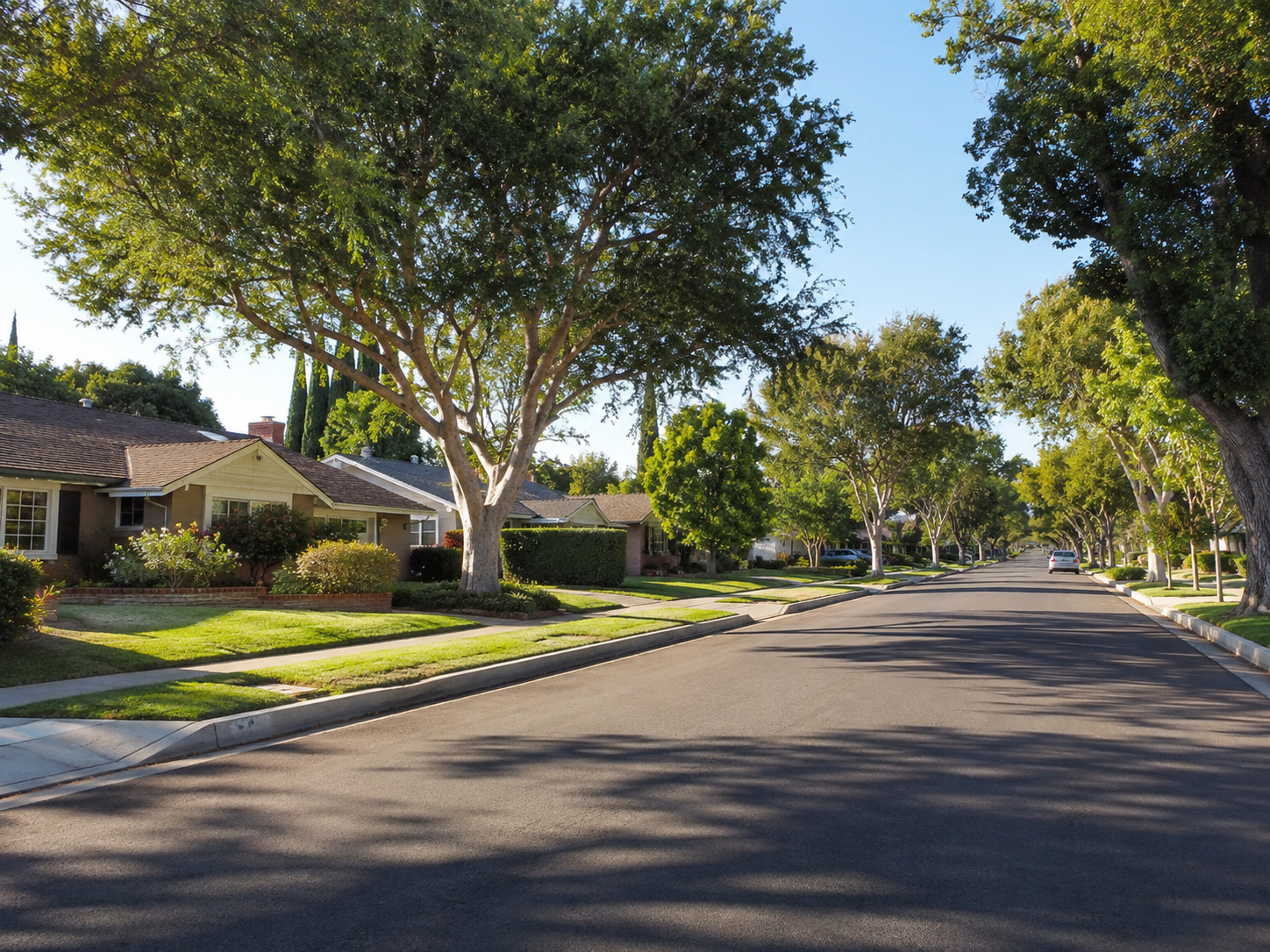 Tarzana 91356 — the western Valley move-up market where property tax accuracy matters specifically because the buyer profile is frequently stretching from lower-priced central Valley neighborhoods where their prior property tax experience was built at $450,000–$700,000 assessed values. At $950,000–$1.25M, the monthly property tax obligation is meaningfully higher, and correct pre-purchase budgeting determines whether the move is financially comfortable or financially strained.
The Proposition 13 mechanics:
- → 📋 Your purchase price becomes your assessed value: When you purchase a Tarzana home, the purchase price immediately becomes the taxable assessed value — not the prior owner's assessed value, not an appraiser's estimate of fair market value, not Zillow's Zestimate. The price you pay is the base on which all your property taxes are calculated from day one.
- → 📈 Annual increase capped at 2%: After purchase, Proposition 13 limits the annual increase in your assessed value to a maximum of 2% per year, regardless of how much the Tarzana market appreciates. This is the provision that creates the compounding gap between long-term owners' and new buyers' tax bills.
- → 🔄 Reassessment triggers: A complete reassessment to current market value occurs only upon a change of ownership (sale) or upon new permitted construction. Cosmetic improvements — paint, flooring, appliance replacement — do not trigger reassessment. Adding permitted square footage does trigger reassessment of the added portion.
The Tarzana long-term owner vs. new buyer gap:
A Tarzana homeowner who purchased in 1995 at $285,000 and has applied the 2% annual increase for 31 years has an assessed value of approximately $553,000 in 2026. Their annual property tax: approximately $6,600–$6,900. Their monthly property tax: approximately $550–$575.
When you purchase that same home for $1,125,000 in 2026, your assessed value resets to $1,125,000. Your annual property tax: approximately $12,900–$14,100. Your monthly property tax: approximately $1,075–$1,175.
The prior owner's $550/month property tax has no relationship to your $1,125/month property tax. They are the same home, the same neighborhood, the same LAUSD district, the same LA County services — at radically different assessed values because of a 31-year Proposition 13 compounding history.
Why this matters specifically for Tarzana buyers:
Tarzana buyers — particularly move-up buyers from Reseda 91335 and Canoga Park 91304 who have been renting or who owned at $500,000–$700,000 assessed values — frequently encounter Tarzana listing data showing prior owner property taxes of $3,500–$7,000/year and assume this approximates their post-purchase obligation. It does not. At Tarzana's $950K–$1.3M purchase prices, the new buyer's property tax runs $10,900–$16,300/year — 2x to 4x the prior owner's bill on the same property.
2. 💰 The Complete Tarzana Property Tax Calculation — All Components
The 1.0% Proposition 13 base rate is the largest component of Tarzana's property taxes but not the only one. Los Angeles County applies additional assessments that bring the effective total rate to approximately 1.15%–1.25% for most Tarzana 91356 addresses.
The additional assessment components in Tarzana 91356:
- → 🏫 LAUSD school bonds: Los Angeles Unified School District has passed multiple general obligation bonds for school construction, renovation, and technology — these appear as specific line items on the Tarzana property tax bill. Combined contribution: approximately $200–$380/year depending on assessed value and current bond obligations.
- → 🏛️ LA County general obligation bonds: Los Angeles County carries bond obligations that appear on all county property tax bills — infrastructure, public safety, and other capital programs. Contribution: approximately $120–$260/year.
- → 🚒 Special district assessments: Fire protection (LA County Fire District), vector control, flood control, and other special district assessments appear as line items on Tarzana property tax bills. These are typically $60–$180/year combined.
- → 🌊 LA River flood control: Properties within or near flood control infrastructure boundaries may carry specific flood control district assessments.
- → 📊 Combined additional assessments: For most Tarzana 91356 addresses, the additional assessments beyond the 1.0% base rate add approximately $600–$1,200/year — bringing the effective total annual tax to approximately 1.15%–1.25% of purchase price.
No Mello-Roos in most Tarzana 91356:
Unlike newer master-planned communities such as portions of Calabasas 91302/91372, Porter Ranch 91326, and parts of Stevenson Ranch, most Tarzana 91356 properties were built and established long before Mello-Roos Community Facilities Districts became common funding mechanisms. The majority of Tarzana 91356 single-family residential parcels do not carry Mello-Roos obligations. Verify for any specific parcel through the NHD disclosure and the LA County Assessor's detailed property tax breakdown — individual parcels near newer infrastructure or in boundary areas should be specifically verified rather than assumed Mello-Roos-free.
The complete Tarzana property tax calculation at key price points:
$950,000 purchase price:
- → Base tax (1.0%): $9,500/year = $792/month
- → Additional assessments (estimated $900/year): $75/month
- → Total estimated annual: $10,400 | Monthly: $867
- → After homeowner's exemption (-$80/year): approximately $860/month net
$1,050,000 purchase price:
- → Base tax (1.0%): $10,500/year = $875/month
- → Additional assessments (estimated $1,000/year): $83/month
- → Total estimated annual: $11,500 | Monthly: $958
- → After homeowner's exemption: approximately $952/month net
$1,150,000 purchase price:
- → Base tax (1.0%): $11,500/year = $958/month
- → Additional assessments (estimated $1,100/year): $92/month
- → Total estimated annual: $12,600 | Monthly: $1,050
- → After homeowner's exemption: approximately $1,044/month net
$1,275,000 purchase price:
- → Base tax (1.0%): $12,750/year = $1,063/month
- → Additional assessments (estimated $1,200/year): $100/month
- → Total estimated annual: $13,950 | Monthly: $1,163
- → After homeowner's exemption: approximately $1,157/month net
$1,400,000 purchase price:
- → Base tax (1.0%): $14,000/year = $1,167/month
- → Additional assessments (estimated $1,300/year): $108/month
- → Total estimated annual: $15,300 | Monthly: $1,275
- → After homeowner's exemption: approximately $1,269/month net
⚠️ Important: These are estimates based on typical Tarzana 91356 effective rates. The exact additional assessments on any specific Tarzana address are available through the LA County Assessor (assessor.lacounty.gov) and LA County Tax Collector (ttc.lacounty.gov). Always verify the specific parcel's tax components before finalizing any monthly payment calculation.
3. 📬 Supplemental Property Taxes — The First-Year Bill Tarzana Buyers Miss
The supplemental property tax is the most consistently overlooked property tax obligation for Tarzana buyers — and at Tarzana's price points, it represents a meaningfully larger first-year financial surprise than buyers at lower-priced markets experience. Understanding it before closing is the difference between a planned expense and an unexpected $8,000–$12,000 bill arriving in month 6 of homeownership.
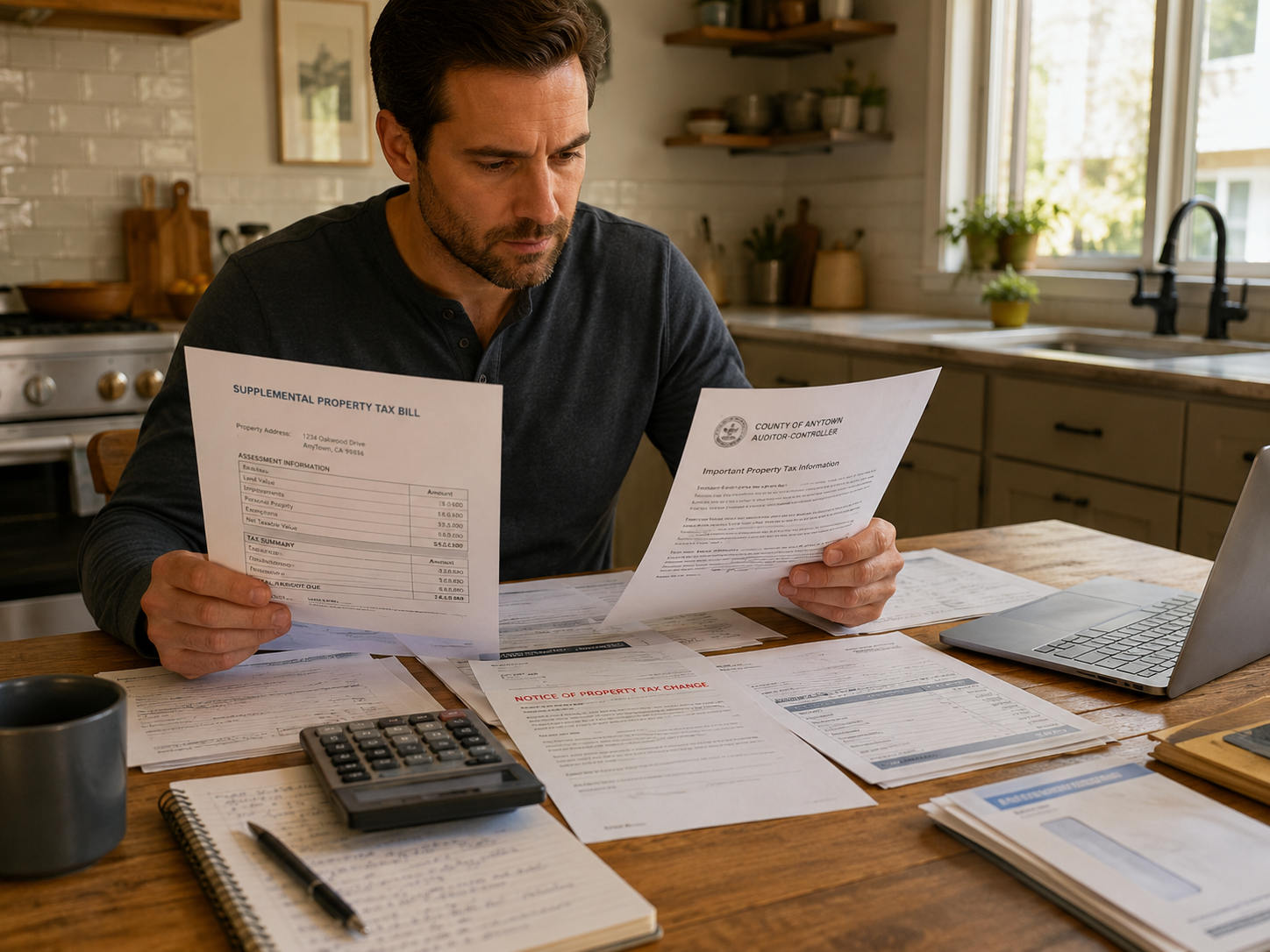 The Tarzana first-year property tax reality — including the supplemental tax bill that most move-up buyers from lower-priced neighborhoods significantly underestimate. At $950,000–$1.3M purchase prices, the supplemental tax runs $5,500–$12,000 and arrives 4–8 months after close whether or not the buyer budgeted for it.
What the supplemental tax is:
When you purchase a Tarzana home, the LA County Assessor reassesses the property at your purchase price. The prior owner had been paying taxes on a lower assessed value — in most Tarzana cases, dramatically lower after decades of Proposition 13 2% compounding. The difference between the prior owner's assessed value and your new purchase price — prorated for the remaining months of the current tax year — is billed as a supplemental property tax.
The Tarzana supplemental tax calculation:
Supplemental assessment = (Your purchase price) - (Prior owner's assessed value) × (Months remaining in tax year ÷ 12) × 1.0%
Example at a $1,100,000 purchase with prior assessed value of $380,000:
- → Assessment difference: $1,100,000 - $380,000 = $720,000
- → Effective supplemental assessed value: $720,000
- → Base supplemental tax: $720,000 × 1.0% = $7,200
- → If purchase closes in April (3 months remaining in tax year ending June 30): $7,200 × (3/12) = $1,800 supplemental tax due for current year
- → If purchase closes in November (7 months remaining in full year, but crosses fiscal year — second supplemental bill follows): approximately $7,200 × (7/12) = $4,200 first supplemental + second supplemental covering remaining period
The realistic Tarzana supplemental tax range:
For most Tarzana 91356 purchases in the $900K–$1.3M range from long-term owners (20–35 years of Proposition 13 compounding):
- → 💰 $900,000 purchase (prior owner assessed at ~$300,000): Supplemental approximately $4,500–$6,000 depending on close timing
- → 💰 $1,050,000 purchase (prior owner assessed at ~$340,000): Supplemental approximately $5,000–$7,100
- → 💰 $1,150,000 purchase (prior owner assessed at ~$380,000): Supplemental approximately $5,700–$7,700
- → 💰 $1,275,000 purchase (prior owner assessed at ~$420,000): Supplemental approximately $6,400–$8,500
- → 💰 $1,400,000 purchase (prior owner assessed at ~$460,000): Supplemental approximately $7,000–$9,400
The supplemental tax timeline:
- → The supplemental tax bill arrives by mail approximately 4–8 months after your close date — after the Assessor's office processes the ownership change and issues the reassessment
- → Two-installment billing: first installment due November 1 (delinquent December 10), second installment due February 1 (delinquent April 10) — or adjusted based on when in the fiscal year your close date falls
- → If your lender has established an impound account for regular property taxes — the supplemental tax is typically NOT included in the impound account. It arrives as a separate bill you receive and pay directly. Confirm with your lender.
Budgeting for the Tarzana supplemental tax:
Tarzana buyers should reserve $5,500–$9,500 in liquid savings specifically for the supplemental tax bill — separate from their down payment, closing costs, and moving expenses. At Tarzana's price points, this is a real, legally required obligation that arrives regardless of whether the buyer planned for it.
4. 🏠 Exemptions and Reductions Available to Tarzana Buyers
California and Los Angeles County provide several property tax exemptions that reduce the assessed value — and therefore the annual tax obligation — for qualifying Tarzana homeowners.
✅ The Homeowner's Exemption:
- → What it is: A $7,000 reduction in assessed value available to owners who occupy their home as their primary residence
- → Annual savings: $7,000 × 1.15%–1.25% effective rate = approximately $80–$88/year — approximately $6.67–$7.33/month. Meaningful over a 30-year hold (cumulative $2,400–$2,600) but not life-changing on a monthly basis.
- → How to apply: File a Claim for Homeowner's Property Tax Exemption with the LA County Assessor's office — available at assessor.lacounty.gov. The form can be filed online or by mail.
- → Filing deadline: File by February 15 for the full exemption for the coming fiscal year. Applications filed between February 15 and December 1 receive 80% of the exemption.
- → Automatic continuation: Once filed, the exemption continues automatically as long as you remain in the home as your primary residence — no annual re-filing required.
- → Timing for Tarzana buyers: Most Tarzana buyers close at various times throughout the year. File the exemption immediately after close regardless of month — even a partial-year exemption saves something, and the following full year is fully covered. Don't wait for the first tax bill to discover you missed the filing.
✅ The Disabled Veterans' Exemption:
- → Available to veterans with service-connected disabilities — provides assessed value reductions ranging from approximately $100,000 to the full assessed value depending on disability rating and income level
- → Significant savings for qualifying veterans purchasing in the $950K–$1.4M Tarzana range — the full exemption on a $1.1M Tarzana home eliminates essentially all base property tax
- → Application through the LA County Assessor's office — honorable discharge and California primary residence required
✅ Proposition 19 — Parent-Child Transfer:
Proposition 19 (effective 2021) significantly restructured California's parent-child assessed value transfer. The current rules for Tarzana buyers receiving property from parents:
- → A child who inherits a parent's primary residence can maintain the parent's Proposition 13 assessed value only if the child uses the home as their own primary residence — and only for the value up to $1,000,000 above the parent's assessed value
- → For Tarzana homes: a parent with an assessed value of $350,000 and a current market value of $1,150,000 — the child inheriting could potentially maintain the $350,000 assessed value if they occupy it as their primary residence (since the $800,000 appreciation is below the $1,000,000 threshold)
- → Consult a qualified tax professional or estate attorney before completing any Proposition 19 transfer — the rules are complex and decisions made at the time of transfer are not easily reversible
✅ Senior Property Tax Postponement Program:
- → California's state program allows qualifying homeowners aged 62+ to defer property tax payments until the property is sold or transferred
- → Qualification: age 62+, at least 40% equity, income below $49,017 (verify current limits at sco.ca.gov)
- → Most relevant for existing Tarzana senior homeowners — Tarzana buyers who are purchasing as seniors should be aware of the program for future planning
5. 📅 The Payment Schedule — When Tarzana Property Taxes Are Due
Understanding the California property tax payment calendar prevents the late payment penalties that catch new homeowners off guard — particularly Tarzana buyers whose prior rental experience didn't require them to track these deadlines independently.
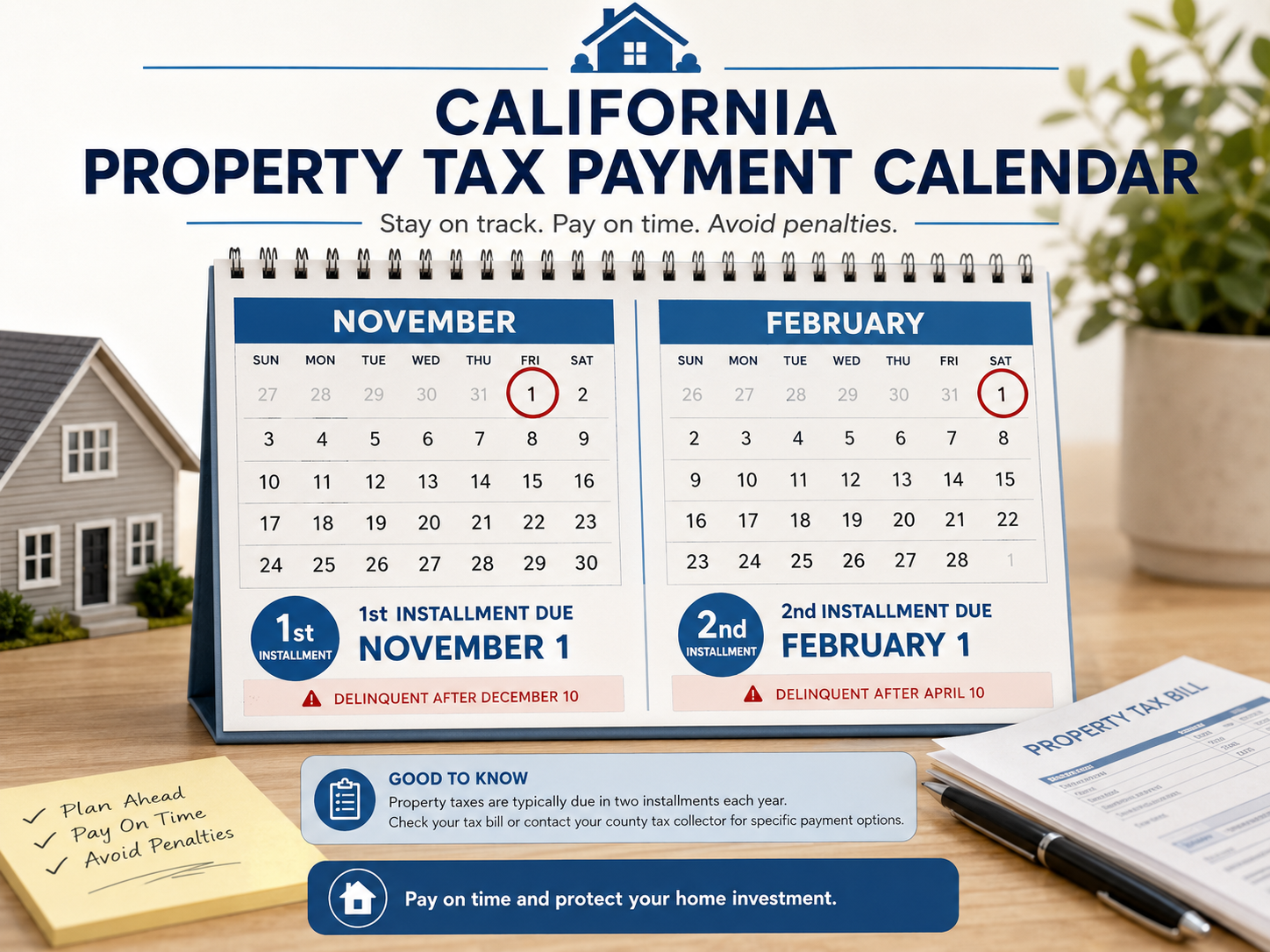 California's property tax payment calendar — the two-installment schedule that Tarzana homeowners must track whether they pay directly or through a lender impound account. At Tarzana's $950K–$1.4M assessed values, a 10% late penalty runs $950–$1,400 per installment — a meaningful cost for a missed payment date.
The California property tax calendar:
California property taxes are assessed annually for a fiscal year running July 1 through June 30, divided into two installments:
First installment — covers July 1 through December 31:
- → 📅 Due: November 1
- → 🚨 Delinquent (10% penalty): December 10
- → At a $1,100,000 assessed value, the first installment is approximately $6,325. The 10% late penalty after December 10: $632.50 — automatically assessed regardless of reason for late payment.
Second installment — covers January 1 through June 30:
- → 📅 Due: February 1
- → 🚨 Delinquent (10% penalty): April 10
- → At a $1,100,000 assessed value, the second installment is approximately $6,325. The 10% late penalty after April 10: $632.50.
Impound accounts — the lender-managed payment option:
Most Tarzana buyers with conventional financing have the option (and in some cases the requirement based on loan-to-value ratio) of an impound account — also called an escrow account — where the lender collects monthly property tax reserves as part of the total mortgage payment and remits the installment payments to LA County directly.
- → ✅ Benefit: Automatic payment eliminates the risk of missed due dates and the 10% late penalty. Monthly budgeting is simplified — property taxes are folded into a single monthly payment.
- → ✅ Who should use it: Move-up buyers and first-time Tarzana homeowners who prefer predictable monthly budgeting over managing a large bi-annual bill. Buyers at the upper end of their qualification who cannot easily set aside the full semi-annual installment.
- → ⚠️ Setup cost: At closing, lenders typically collect 2–3 months of property tax into the impound reserve — approximately $1,800–$3,150 for most Tarzana purchases. This is separate from the down payment and other closing costs and should be anticipated.
- → ⚠️ Supplemental taxes not included: The impound account collects and pays the regular installments only. The supplemental tax bill that arrives in year one is separate and must be paid directly by the buyer.
- → ⚠️ Impound account setup error: The most common Tarzana impound account mistake is the lender setting up the initial reserve based on the prior owner's tax bill rather than the new assessed value. Verify at closing that your impound is calculated on your purchase price × effective rate, not on the historical tax record.
Direct payment — the self-managed option:
Tarzana buyers who waive the impound account requirement (typically available to buyers with 20%+ down and strong credit) pay directly to LA County:
- → 💻 Online: ttc.lacounty.gov — e-check (no fee) or credit card (convenience fee applies)
- → 📬 Mail: Check payable to LA County Tax Collector, postmarked by the delinquency date with sufficient delivery time
- → ⚠️ "I didn't receive the bill" is not a basis for waiving the penalty in California. Property owners are responsible for knowing the payment dates regardless of whether the physical bill was received or opened.
🚫 What NOT to Overdo
Don't use the prior owner's property tax to estimate your monthly payment. This is the single most damaging property tax budgeting error for Tarzana buyers — and it is extremely common among buyers purchasing from long-term Tarzana owners. A seller who purchased in 1992 at $295,000 pays approximately $3,900/year in property taxes on their $295,000 Proposition 13 assessed value. When you purchase that home for $1,125,000, your assessed value is $1,125,000 and your annual tax is approximately $12,900–$14,100. The prior owner's tax on the Zillow listing page, in the seller's disclosure, or in the listing agent's marketing materials is completely irrelevant to your post-purchase obligation.
Don't budget your monthly payment before including property taxes at the correct assessed value. A Tarzana buyer who qualifies for a payment of $6,800/month and allocates $5,100 to mortgage P&I, $800 to property taxes (prior owner's level), and $350 to insurance discovers at their first impound review that the actual property tax is $1,075/month — a $275/month shortfall that the lender's impound deficiency notice will require to be corrected either through a lump-sum catch-up or an increased monthly payment. Run the property tax calculation on your purchase price before you are in contract, not after.
Don't forget to file the homeowner's exemption. The exemption saves approximately $80–$88/year at Tarzana's effective rate — not a large annual saving at this price point, but worth the 10-minute filing. More importantly, establishing the homeowner's exemption creates the documented owner-occupancy record that LA County maintains and that is relevant to future Proposition 19 considerations. File it the week after close.
Don't assume Tarzana is Mello-Roos-free without verifying your specific parcel. Most Tarzana 91356 single-family residential properties do not carry Mello-Roos obligations — the neighborhood was substantially established before Mello-Roos financing became common. But specific parcels at boundaries, near newer infrastructure, or in small development pockets may carry assessments. The NHD (Natural Hazard Disclosure) report and the LA County Assessor's detailed property tax breakdown for your specific address are the verification tools — use them rather than assuming based on neighborhood reputation.
Don't confuse the annual property tax with the supplemental tax when budgeting your first year. Your first year of Tarzana homeownership involves both: the regular annual property tax (included in your impound account if you established one) and the supplemental property tax (a separate bill not in the impound account, typically arriving 4–8 months after close). Both are real, both are legally required, and first-year Tarzana buyers who budget only for the regular installments discover the supplemental bill without reserves to cover it. Budget for both explicitly and separately.
🏠 Real-World Scenario — Tarzana 91356
A couple purchasing their first home in Tarzana 91356 — moving up from a Reseda 91335 rental — had been pre-approved at $1,050,000. Their lender had quoted a total monthly payment of $7,250, which included P&I on an $840,000 loan at 7.25%, homeowner's insurance, and property taxes. The property tax estimate in the lender's quote: $780/month.
The $780/month figure had been pulled from the Tarzana listing's public tax record — the seller's current annual tax of $9,360/year divided by 12. The seller had owned since 1988. Their Proposition 13 assessed value: approximately $750,000 after 38 years of 2% annual increases.
The correct calculation for the buyers' $1,050,000 purchase: $1,050,000 × 1.20% effective rate = $12,600/year = $1,050/month.
The discrepancy: $1,050 correct versus $780 quoted = $270/month the buyers had not budgeted.
At $270/month undercounting in a $7,250 quoted total payment, the actual total payment was $7,520 — still within their qualification ceiling but meaningfully tighter than they had planned for. More critically, the $270/month impound shortfall would trigger an impound account deficiency notice approximately 12 months after closing, requiring either a $3,240 lump-sum catch-up or a $270/month increase in their monthly payment going forward.
We flagged the discrepancy before their offer was submitted. They had the lender recalculate the payment using the correct post-purchase assessed value. Their lender confirmed the $1,050/month figure. The adjusted $7,520 monthly payment was still within their qualification range with modest adjustment.
We also walked through the supplemental tax: estimated $5,800–$7,200 based on the seller's approximately $750,000 prior assessed value and a mid-year close date. They reserved $7,000 in liquid savings specifically for the supplemental bill, separate from their closing costs and moving budget.
Their supplemental tax arrived 6 months after close: $6,640. They paid it without financial stress because the reserve existed. The couple who hadn't done this calculation would have faced a $6,640 bill on a household budget that was already tighter than the original lender quote suggested.
🏠 Real-World Scenario — Tarzana 91356
A single buyer — a physician relocating from out of state, purchasing a 4-bedroom Tarzana 91356 home at $1,285,000 — had extensive financial sophistication in her professional context and essentially no familiarity with California property tax structure. Her prior home in Texas had a 2.1% property tax rate on assessed values reset annually to market value — no Proposition 13, no prior-owner discount, no supplemental tax concept.
Her initial assumption: California taxes at approximately 1.1% of market value annually. On a $1,285,000 Tarzana home, she budgeted $14,135/year or $1,178/month — a reasonable approximation of the correct figure.
What she missed: the supplemental tax. In Texas, there is no equivalent to California's supplemental tax because Texas reassesses annually to market value — the new buyer's tax adjusts automatically in the next tax year without a separate supplemental bill. In California, the reassessment is triggered by purchase but doesn't flow through the annual bill cycle immediately — it arrives as a separate one-time supplemental bill.
For her $1,285,000 purchase with the seller's Proposition 13 assessed value of approximately $420,000 (purchased in 1991), the supplemental assessment was $865,000. At 1.0% base rate, prorated for 8 months remaining in the fiscal year at her April close date: approximately $5,767 supplemental tax due.
She received the supplemental tax bill in October — 6 months after close. Having budgeted for the regular annual tax but not the supplemental, the $5,767 bill required drawing from her investment account rather than her designated home operating reserve.
When we walked through the California property tax structure at the pre-offer stage, we specifically covered the supplemental tax and recommended she add it to her pre-close financial reserves. She had decided it was "unlikely to be significant" given her prior Texas experience and moved on without reserving for it. The $5,767 bill was manageable at her income level but unexpected — and specifically because the California supplemental tax structure has no Texas equivalent that would have prepared her for it.
❓ FAQ
How are property taxes calculated in Tarzana? Tarzana 91356 property taxes follow California's Proposition 13 system: your purchase price becomes the assessed value, and the base tax rate of 1.0% of that assessed value is applied annually. Additional LA County assessments — LAUSD school bonds, county bonds, special district fees — add approximately 0.15%–0.25% to the effective rate. For most Tarzana buyers, the total effective rate is approximately 1.15%–1.25% of purchase price annually. On a $1,100,000 purchase: approximately $12,650–$13,750/year, or approximately $1,054–$1,146/month.
What is the property tax on a $1,000,000 home in Tarzana? On a $1,000,000 Tarzana 91356 purchase: ✓ Base tax (1.0%): $10,000/year = $833/month. ✓ Additional LA County assessments (estimated $950/year): $79/month. ✓ Total estimated: $10,950/year = $913/month. ✓ After homeowner's exemption (-$82/year): approximately $906/month net. Plus: first-year supplemental tax of approximately $4,800–$7,000 depending on the prior owner's assessed value and close date.
Does Tarzana have Mello-Roos taxes? Most Tarzana 91356 single-family residential properties do not carry Mello-Roos Community Facilities District assessments — the neighborhood was substantially established before Mello-Roos financing became common for residential infrastructure. Unlike newer master-planned communities such as Porter Ranch 91326 or parts of Calabasas 91302/91372, most Tarzana properties carry only the standard LA County assessment components. Verify for any specific parcel through the NHD disclosure and LA County Assessor's detailed property tax breakdown — specific boundary parcels or newer small developments may carry assessments.
What is the supplemental property tax in California? The supplemental property tax is a one-time additional bill triggered when you purchase a California home — representing the difference between the prior owner's assessed value and your new purchase price, prorated for the remaining months of the tax year. It is billed by the LA County Assessor 4–8 months after your close date and is due separately from regular property tax installments. For most Tarzana buyers purchasing from long-term owners, the supplemental tax runs $5,500–$9,500. It is not included in lender impound accounts — you receive and pay the bill directly. Budget for it before closing.
When are property taxes due in Tarzana? California property taxes are due in two installments annually: ✓ First installment (July 1 – December 31): due November 1, delinquent after December 10 (10% penalty applies). ✓ Second installment (January 1 – June 30): due February 1, delinquent after April 10 (10% penalty applies). At Tarzana's $950K–$1.4M assessed values, each installment runs approximately $5,500–$8,750. A 10% late penalty represents $550–$875 per installment — a meaningful cost for a missed payment date.
How does Tarzana property tax compare to Reseda or Calabasas? The same Proposition 13 base rate (1.0%) and similar LA County assessment components apply across all three markets — the primary difference is the purchase price on which the rate is applied. ✓ Reseda 91335 typical purchase: $700,000–$875,000 → monthly tax approximately $672–$910. ✓ Tarzana 91356 typical purchase: $850,000–$1,350,000 → monthly tax approximately $819–$1,313. ✓ Calabasas 91302/91372 typical purchase: $1,300,000–$2,500,000 → monthly tax approximately $1,248–$2,604, with some Calabasas properties additionally carrying Mello-Roos obligations that Tarzana typically doesn't have. The tax rate is similar; the purchase price drives the absolute monthly obligation.
🎯 Bottom Line
Tarzana 91356 property taxes are not complicated — but at the $850K–$1.4M purchase prices that define this market, they are meaningfully larger than the prior home purchase, the rental experience, or the prior owner's tax bill that most Tarzana buyers reference when building their payment model. The Proposition 13 mechanics that produce a long-term Tarzana owner's $3,500–$7,000/year tax bill also produce your $10,900–$16,300/year obligation at current purchase prices — and understanding that gap before you're in escrow is the most practically valuable property tax knowledge you can have.
The Tarzana buyer who correctly budgets $1,000–$1,150/month for property taxes on a $1.0M–$1.15M purchase, reserves $6,000–$9,000 for the first-year supplemental bill, and files the homeowner's exemption immediately after close is the buyer who experiences no property tax surprises in their first year of Tarzana homeownership. That buyer is not doing anything extraordinary — they are simply doing the calculation accurately before they need to.
At Parkway Estate Properties, every Tarzana buyer we work with gets the property tax calculation for their specific target properties before they're in contract — including the post-purchase assessed value calculation, the supplemental tax estimate, and the impound account setup verification — as a standard part of the pre-offer financial preparation that produces confident, correctly budgeted purchases.
📩 Want an Accurate Property Tax Calculation for Any Tarzana Home You're Evaluating?
Give us the address and the purchase price and we'll produce the complete first-year property tax picture — monthly installment, supplemental tax estimate, impound setup requirements, and homeowner's exemption filing guidance — before you submit any offer.
Contact Liana Shersher at Parkway Estate Properties: 📧 liana@parkwayestate.com · 📞 (818) 208-5881 · 🌐 parkwayestate.com 15021 Ventura Blvd., Ste. 510, Sherman Oaks, CA 91403
About the Authors
Liana Shersher is a licensed real estate agent with Parkway Estate Properties Inc. and an Accredited Buyer's Representative (ABR) serving the San Fernando Valley — with a focus on Sherman Oaks, Encino, Tarzana, Woodland Hills, and Northridge (DRE# 02164224). Liana guides first-time homebuyers through every step of the purchase, from the first showing to the keys in hand, and represents move-up and repeat buyers across the Valley. For sellers, she builds the pricing and marketing strategy that positions a home to sell for top dollar, fast. Buyers and sellers work with Liana for clear communication, sharp local knowledge, and an agent who treats their goals like her own.
Roman Shersher is the broker-owner of Parkway Estate Properties Inc. and a real estate investor with 18 years of experience in the San Fernando Valley (DRE# 01855095). Roman has personally led or co-led renovations on dozens of properties across the Valley, including recent projects in Northridge (91324) and Woodland Hills (91364). That hands-on renovation and investment experience shapes every pricing conversation and days-on-market strategy at Parkway — sellers get a realistic read on what improvements actually return at resale, and buyers get an expert eye on a home's true condition and upside.
Parkway Estate Properties, Inc. · 15021 Ventura Blvd., Ste. 510, Sherman Oaks, CA 91403 · (818) 208-5881 · parkwayestate.com · Broker License #: 01873092 Equal Housing Opportunity. Information herein is general and not legal, tax, or financial advice. Consult qualified professionals for your specific situation.
Categories
Recent Posts










Broker | Realtor ® License ID: 01873092
+1(818) 208-5881 | info@parkwayestate.com