
Top 10 Things To Know About The Northridge Housing Market

Northridge is one of the most consistently active residential markets in the San Fernando Valley — and one of the most consistently misread. Buyers arrive expecting a discount market with easy wins and discover a competitive $700K–$1.2M range where first-time buyers, move-up families, and investors compete seriously for well-prepared inventory. Sellers arrive expecting the peak 2022 dynamics to still apply and discover a market that rewards correct pricing and penalizes overpricing with 60-day DOM and buyer leverage they handed away voluntarily.
The reality of the Northridge housing market in 2026 sits between both misconceptions — more competitive than buyers expect at the entry level, more pricing-disciplined than sellers prefer at every level, and shaped by specific local variables that no other SFV city shares at the same scale. This article gives buyers and sellers the ten things that actually matter about the Northridge market — the facts, the patterns, and the context that inform every smart decision in Northridge 91324 and 91325.
1. 🎓 The CSUN Factor — Northridge's Market-Defining Variable
No SFV market analysis of Northridge is complete without understanding California State University, Northridge — and how the university's presence shapes demand, buyer profiles, and seasonal market dynamics in ways that distinguish Northridge from every other neighborhood in the Valley.
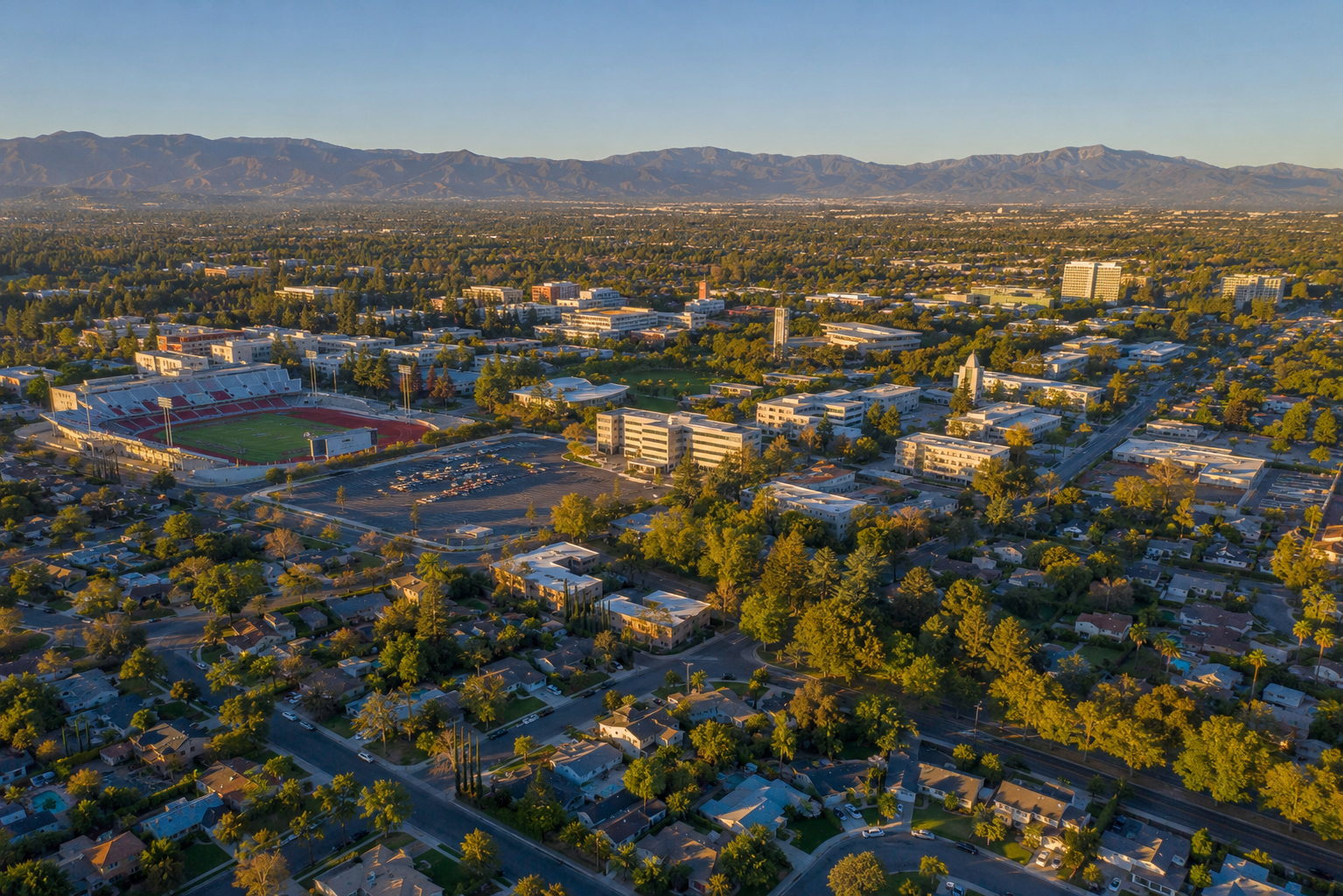 The CSUN campus embedded in west Northridge 91324 is the defining market variable that separates Northridge from every other SFV residential neighborhood — creating a specific buyer profile, moderating the summer demand trough, and producing a community character that consistently attracts buyers who specifically value academic-adjacent neighborhood energy.
How CSUN shapes the Northridge market:
- → 👩🏫 The faculty and staff buyer pool: CSUN employs thousands of faculty, administrators, and staff — many of whom specifically target the CSUN-adjacent streets of west Northridge 91324 for the walkability to campus, the academic community character, and the commute simplicity. This buyer pool activates on the university's hiring calendar rather than the standard spring residential calendar — producing demand pulses in late spring through summer when new academic-year hires are making housing decisions.
- → 🎓 The academic community character: The CSUN adjacency attracts a buyer demographic that values intellectual community, cultural diversity, and the campus energy that pervades the surrounding streets. This character is not replicable in any other Northridge sub-neighborhood — and buyers who specifically seek it pay a small premium for it.
- → 📅 The seasonal moderation effect: CSUN's fall semester activation in late August brings a buyer and renter-adjacent audience back into the neighborhood at a time when the broader SFV market is at its annual demand trough. This moderates — but does not eliminate — the August slowdown that Woodland Hills 91364, Tarzana 91356, and Sherman Oaks 91403 sellers experience more severely during the same window.
- → 🏘️ The investor attraction: CSUN's student and graduate student population creates a persistent rental demand base that attracts buy-and-hold investors to the CSUN-adjacent streets of Northridge 91324. This investor competition — frequently cash or near-cash — is a meaningful presence in the $700K–$850K CSUN-adjacent price band that first-time buyers need to understand when calibrating their competitive positioning.
What the CSUN factor means for buyers:
CSUN-adjacent Northridge 91324 streets are consistently the most competitive sub-market in Northridge at the $700K–$850K price point — investor competition, CSUN-buyer demand, and first-time buyer competition converge here. Buyers who want CSUN-adjacent character need to be fully pre-approved, offer-ready within 7 days, and aware that they may be competing against investors with cash.
What the CSUN factor means for sellers:
CSUN-adjacent Northridge 91324 sellers have a year-round buyer pool that extends beyond the spring residential calendar — particularly the June through September window when CSUN hiring and enrollment cycles drive specific demand. A correctly priced, well-prepared CSUN-adjacent Northridge listing in August has a more active buyer audience than a comparable listing in Woodland Hills or Sherman Oaks during the same period.
2. 💰 The $700K–$1.1M Price Band — Where the Volume Lives
Understanding the Northridge price band distribution is the foundational market intelligence for both buyers and sellers — because the buyer profiles, DOM expectations, competitive dynamics, and renovation ROI profiles are meaningfully different across the $700K–$1.2M range that defines most Northridge 91324 and 91325 transactions.
The Northridge price band breakdown:
- → 🏡 $700K–$800K: Entry-level Northridge — primarily the CSUN-adjacent sub-neighborhoods of west 91324. Highest transaction volume, most competitive buyer pool, shortest DOM. First-time buyers, investors, and CSUN-adjacent buyers all compete here. Multiple offers on well-prepared homes in the spring window.
- → 🏡 $800K–$950K: The core Northridge family buyer range — 3-bedroom single-family homes in mid-91324 and entry-level 91325. Move-up families from Reseda 91335, Canoga Park 91304, and Van Nuys dominate this price band. Active with competitive spring market; more negotiating room in summer and fall.
- → 🏡 $950K–$1.1M: The upper middle range — larger 3–4 bedroom homes in premium 91324 streets and mid-91325. Dual-income professional households. More inventory and more negotiating room than lower bands.
- → 🏡 $1.1M–$1.3M: Northridge's premium tier — approaching Granada Hills 91344 and Chatsworth 91311 in character and buyer profile. Longest DOM in Northridge, most buyer negotiating room, most price-sensitive to condition.
Why the $700K–$1.1M band is the Northridge story:
Above $1.2M, Northridge buyers have Granada Hills 91344, Chatsworth 91311, and even entry-level Woodland Hills 91364/91367 as competing options — which creates price sensitivity that constrains appreciation at the top. Below $700K, inventory is limited and frequently investor-dominated. The $700K–$1.1M band is where Northridge's volume, its community character, and its value proposition relative to adjacent markets are most clearly expressed.
3. 📊 Sub-Neighborhood Variation — The Map Every Northridge Decision-Maker Needs
Northridge 91324 and 91325 contain sub-neighborhoods that differ more meaningfully from each other than the zip codes suggest. The most expensive street in Northridge 91325 and the least expensive street in Northridge 91324 can be within 2 miles of each other — and have comp ceilings that differ by $250,000+.
The Northridge sub-neighborhood matrix:
- → 🎓 West 91324 / CSUN-adjacent: $700K–$850K range, highest transaction velocity, investor presence significant, CSUN academic character, 1960s–1970s home vintage, smaller lots (6,500–8,000 sq ft). The most accessible and most competitive Northridge entry point.
- → 🏘️ Mid 91324: $800K–$1.0M range, family buyer dominated, larger homes (1,600–2,200 sq ft), standard to slightly above-standard lots. The Northridge core — where most move-up buyers land.
- → 🏡 East 91324 approaching Reseda Boulevard corridor: Mixed character — some streets more transitional in character than the mid-91324 residential core. Buyer due diligence on specific block quality is important here.
- → 🏰 Premium 91325 toward Granada Hills 91344: $950K–$1.2M+ range, largest homes and lots in Northridge, quieter and more residential than the CSUN-adjacent streets, longer DOM, most negotiating room for buyers.
- → 🌐 North of the 118 freeway (91324/91325): Some Northridge-addressed properties north of the 118 feel more like Porter Ranch 91326 or Chatsworth 91311 in character — different buyer profile, different commute dynamics.
Why sub-neighborhood precision matters:
A seller in mid-91324 who prices their home using 91325 premium comp data is overpricing by $50,000–$100,000. A buyer who searches "Northridge" without understanding the CSUN-adjacent versus premium-91325 distinction will lose repeatedly in the wrong price tier. The map matters — and the agent who knows it at street level produces better outcomes than the agent who operates at zip code level.
4. 🔄 Seller-Paid Rate Buydowns — The Northridge Standard Practice
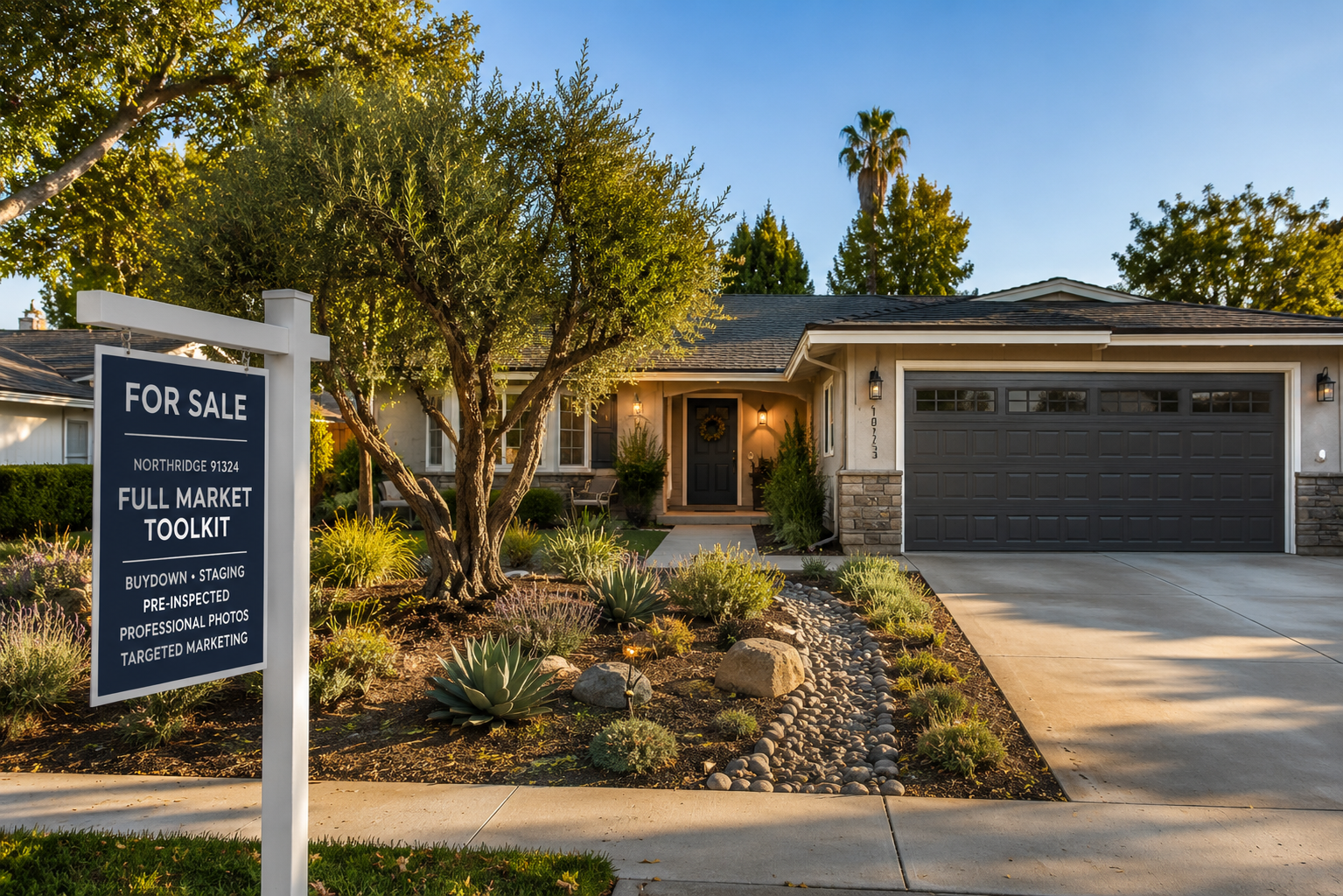 Seller-paid rate buydowns have become standard practice in Northridge 91324 and 91325 — the market where buyer rate sensitivity is highest in the PEP SFV coverage area, and where the monthly payment relief a 2-1 buydown delivers most directly affects whether buyers can qualify and how sustainable their ownership experience will be.
Northridge has the most rate-sensitive buyer pool in the PEP SFV coverage area — because first-time buyers and move-up families operating near their income threshold feel monthly payment changes more acutely than higher-income buyers in Calabasas or Sherman Oaks. This rate sensitivity makes Northridge the market where seller-paid buydown strategy is most frequently deployed — and most consistently effective.
Why buydowns work so well in Northridge:
- → 💰 Buyer income proximity to ceiling: Most Northridge buyers at $800K–$950K are within $20,000–$35,000 of their maximum comfortable income ceiling. A 2-1 buydown that reduces year-one effective rate from 7.0% to 5.0% delivers $700–$900/month in payment relief — enough to move a buyer from "we can't quite make this work" to "this is workable."
- → 📊 More impactful than price reduction: A $15,000 buydown contribution delivers approximately $15,000 in buyer payment savings over two years. A $15,000 price reduction delivers $15,000 in purchase price reduction — but only about $100/month in payment savings. The buydown consistently produces more buyer purchasing power per seller dollar in the Northridge price band.
- → 🏘️ Seller openness in this market: Northridge sellers whose listings have accumulated 20–30 days of DOM are consistently more open to buydown contributions than to equivalent price reductions — because the buydown is positioned as a buyer benefit rather than a seller capitulation.
The Northridge buydown standard:
Our team structures seller-paid buydown requests into Northridge buyer offers as standard practice — not as an occasional negotiating tool. For sellers, proactively advertising a buydown contribution in the listing marketing consistently generates more first-week showing traffic than comparable listings without the buydown — because the payment relief signal attracts buyers who had been filtering out listings based on payment concerns.
5. 🏗️ The 1960s–1980s Vintage Reality — What Every Market Participant Needs to Know
The Northridge housing stock is primarily built between 1960 and 1985 — a vintage that produces beautiful, livable, spacious homes with specific and predictable maintenance realities that every buyer, seller, and investor in Northridge 91324 and 91325 needs to understand and price correctly.
The predictable Northridge vintage maintenance profile:
- → ⚠️ HVAC systems: Original or early-replacement HVAC units in Northridge 1960s–1970s homes are frequently at or past their useful life. Northridge summer temperatures (95–105°F in July and August) make functional HVAC non-negotiable — replacement runs $6,000–$12,000 and surfaces on inspections consistently.
- → ⚠️ Roofing: 20–25-year composition shingle roofs are common in Northridge vintage homes — homes that haven't had a roof replacement in this century frequently need one before or shortly after sale. Replacement: $12,000–$22,000 for a standard Northridge single-family home footprint.
- → ⚠️ Electrical panels: Original 100-amp panels in 1960s Northridge homes don't support modern electrical loads — EV chargers, modern appliances, and home office equipment together frequently exceed 100-amp capacity. Panel upgrades run $3,500–$6,000.
- → ⚠️ Plumbing supply lines: Galvanized steel supply lines in older Northridge homes corrode and restrict water flow over time. Repiping runs $8,000–$18,000 depending on home size.
- → ⚠️ Foundation and seismic: Los Angeles's seismic history means older Northridge homes occasionally show foundation cracking, cripple wall vulnerabilities, or inadequate anchorage. Seismic retrofitting: $4,500–$8,500.
What this means for buyers:
Budget $20,000–$50,000 in potential deferred maintenance for any 1960s–1980s Northridge home — before you've seen the inspection report. This doesn't mean every Northridge home has $50,000 in deferred maintenance. It means that inspections consistently surface some combination of the items above, and buyers who haven't mentally priced this possibility make poor decisions under inspection-period pressure.
What this means for sellers:
A pre-listing inspection ($450–$650) surfaces these items before you've priced the home and before buyers use them as negotiating leverage. Sellers who know their deferred maintenance items in advance can: disclose them fully, price them into the list price, address the highest-priority items before listing, or use them as negotiating tools they control rather than surprises buyers exploit.
What this means for investors:
Northridge's vintage maintenance profile is the primary reason BRRRR strategy works in this market — under-renovated inventory with predictable improvement scopes, purchased at a discount, produces returns that newer housing stock can't match. Roman's renovation experience across Northridge 91324 and 91325 means every investor we work with gets an accurate cost estimate for the renovation scope, not an optimistic projection.
6. 📈 Appreciation — Northridge's Five-Year Price Story
Northridge 91324 and 91325 participated in the full SFV price cycle of the past five years — pandemic-era surge, rate-shock correction, stabilization, measured recovery — with Northridge-specific characteristics that distinguish its trajectory from higher-priced adjacent markets.
The Northridge five-year arc:
- → 📈 2020–2022 (Surge): Northridge prices rose approximately 35–45% across most sub-neighborhoods — driven by the same pandemic-era forces that lifted all SFV markets: historic low rates, remote work demand, and compressed inventory. The CSUN-adjacent streets saw strong investor demand layered on top of the residential surge.
- → 📉 2022–2023 (Correction): The rate shock produced a volume collapse and a modest price correction — approximately 6–10% off peak in most Northridge 91324 sub-neighborhoods. Slightly deeper in the CSUN-adjacent investor-heavy streets (8–12%) as investors pulled back. The correction was shallower than many analysts predicted because Northridge's move-up family demand is more fundamental than discretionary.
- → 📊 2023–2024 (Stabilization): Northridge found its price floor faster than higher-priced SFV markets — the $700K–$900K band's relative affordability maintained buyer engagement even in a 7%+ rate environment, and golden handcuff dynamics constrained supply.
- → 📈 2024–2026 (Recovery): The $700K–$1.0M band has recovered to or within 3–5% of 2022 peak pricing in most Northridge sub-neighborhoods. The $1.0M–$1.2M premium tier remains slightly further below peak.
The forward appreciation case:
Northridge's structural demand drivers — CSUN adjacency, LAUSD magnet school access, relative value versus adjacent Granada Hills 91344 and Chatsworth 91311, and persistent move-up buyer flow from Reseda 91335 and Canoga Park 91304 — remain intact. Steady 4–5% annual appreciation is the historical pattern and the most likely forward trajectory, absent significant macro disruption.
7. 🏫 LAUSD School Quality — The Verification Requirement That Every Family Buyer Must Execute
School quality is one of the primary drivers of family buyer demand in Northridge 91324 and 91325 — and the variable that most consistently produces the most consequential buyer mistakes when it's not properly verified.
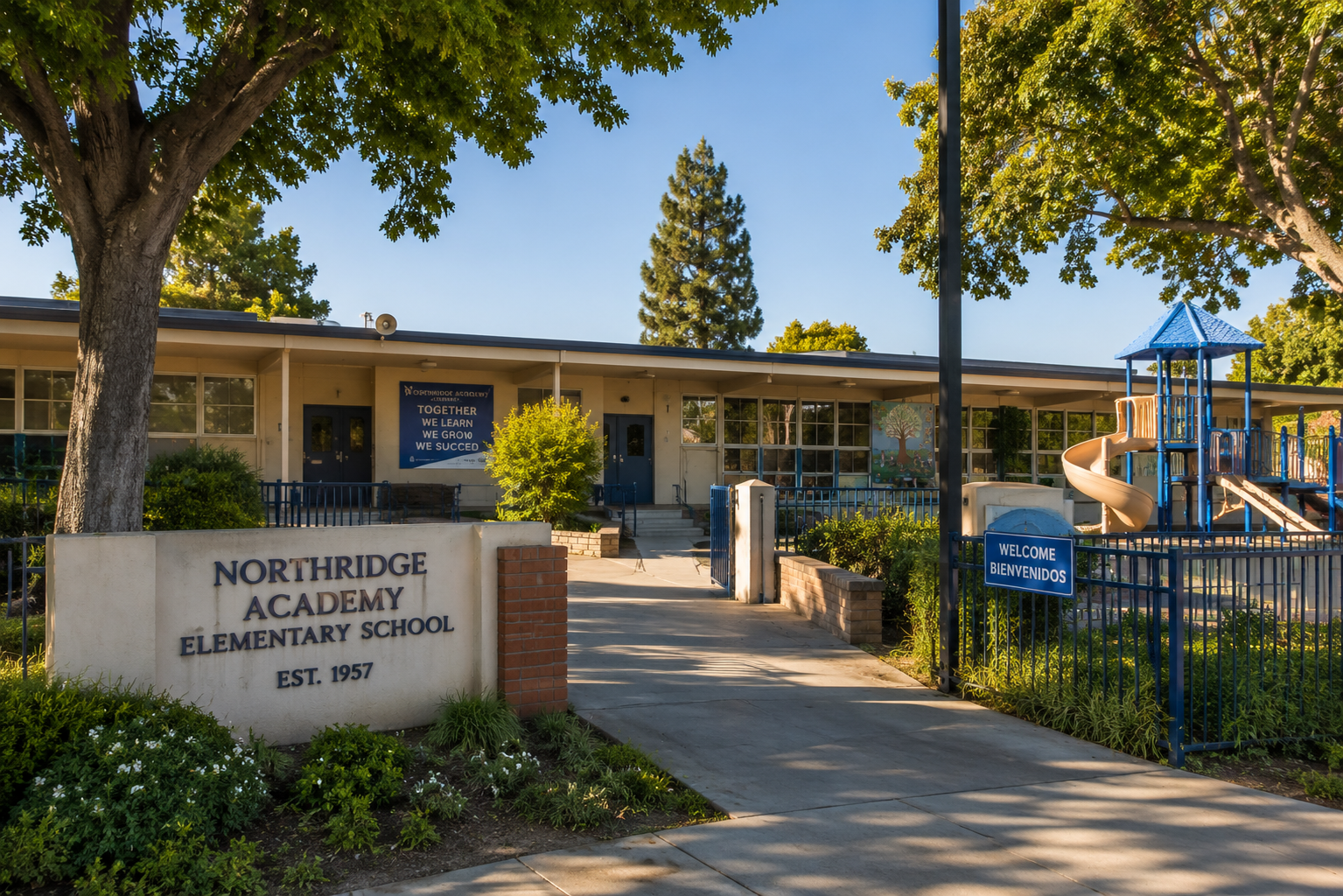 LAUSD school assignments in Northridge 91324 and 91325 are address-specific — not neighborhood-wide. Two homes on the same block can feed to different schools depending on the exact catchment boundary. Verification through the LAUSD official school finder is the non-negotiable first step for every family buyer.
The Northridge LAUSD landscape:
- → 🏫 Elementary: Multiple LAUSD elementaries serve Northridge — with quality varying meaningfully by school. Verify specific assignment for your target address through lausd.net/schoolfinder.
- → 🏫 Middle: Multiple middle schools with LAUSD magnet program access providing an alternative to local catchment schools for qualifying students.
- → 🏫 High school: Granada Hills Charter High School is one of the SFV's most sought-after public high schools — accessible to certain Northridge 91324 and 91325 addresses. This school access creates a specific demand premium for homes in the Granada Hills Charter catchment that influences pricing in northern Northridge 91325.
- → 🎓 CSUN: California State University, Northridge is not a K-12 school — but its proximity, its community center programs, and its cultural events provide a quality-of-life supplement for families in the surrounding neighborhood that buyers value beyond the traditional school conversation.
The critical verification rule:
School assignments in Northridge are address-specific within LAUSD. Never make a school-motivated buying decision based on:
- → ✗ Listing description ("great schools")
- → ✗ Zillow school badges (proximity indicators, not catchment verification)
- → ✗ Neighbor confirmation
- → ✗ General neighborhood reputation
Always verify at lausd.net/schoolfinder using the exact property address. This takes 3 minutes. Not doing it takes 3 months to correct after closing.
8. 🔨 Renovation ROI — Real But Comp-Ceiling-Constrained
The renovation ROI opportunity in Northridge is genuine — but it operates within a comp-ceiling discipline that differs fundamentally from the higher-priced markets in the PEP coverage area. Understanding this distinction protects sellers from over-investing and helps buyers identify the genuine value-add opportunities that the Northridge market presents.
The focused Northridge renovation scope that consistently pencils:
At the $700K–$1.1M Northridge price point, the improvements that produce positive ROI are:
- → ✅ Mid-range kitchen refresh ($18K–$32K): Returns $35K–$60K consistently — the highest single-improvement ROI in Northridge
- → ✅ Professional interior repaint ($6K–$12K): Returns $15K–$25K — highest dollar-per-dollar return of any Northridge improvement
- → ✅ Primary bath refresh ($4.5K–$9K): Returns $20K–$40K
- → ✅ Main-floor flooring unification ($8K–$18K): Returns $15K–$30K
- → ✅ Curb appeal package ($5K–$10K): Generates the showing traffic that makes every other improvement relevant
The Northridge renovation ceiling:
Total focused scope runs $45K–$80K. Above $80K in Northridge 91324/91325, specific comp support is required to validate the incremental investment — the market does not uniformly absorb renovation investment above this level. This is the most important discipline that differentiates profitable Northridge renovations from break-even ones.
The investor opportunity:
For BRRRR investors, the Northridge renovation ceiling discipline creates a specific opportunity: homes priced 10–15% below the renovated comp ceiling — available from estate sales, extended DOM situations, and original-condition inventory — produce positive returns when purchased correctly and renovated at the appropriate scope and cost. Roman's renovation experience across Northridge 91324 and 91325 makes this analysis precise rather than theoretical.
9. 📅 Seasonal Patterns — The Annual Northridge Market Rhythm
Northridge follows the SFV's broad seasonal patterns — spring peak, summer softening, fall re-engagement, winter slowdown — with the CSUN-specific moderation that distinguishes the summer period from other SFV markets.
The Northridge annual market calendar:
- → 🌸 March–May (Peak Seller Window): The year's strongest conditions — move-up family urgency, first-time buyer activation, constrained inventory. Well-prepared homes priced correctly move in 12–25 days. Multiple offers common on sub-$900K listings.
- → ☀️ June–Early July (Active, Softening): Still active but buyer urgency declining as school enrollment deadlines pass. Price at midpoint, not top of range.
- → 🎓 Mid-July–September (CSUN-Moderated Summer): Most challenging general window — but CSUN's fall semester activation moderates August trough for campus-adjacent sub-neighborhoods. DOM stretches to 35–55 days; buydown strategy essential.
- → 🍂 October–Early November (Second Wind): Re-engaged serious buyers, year-end financial motivation, thinner competing inventory. Well-priced fall listings move in 20–40 days — the underrated second Northridge selling opportunity.
- → ❄️ December–January (Slowest Window): Annual low in buyer traffic. List only if timeline requires; price at or below midpoint.
The preparation imperative:
The most consistent Northridge seller mistake is underestimating renovation timelines and listing underprepared in the spring window. A focused renovation takes 7–9 weeks. Starting in January sets up a March spring launch. Starting in March produces a May or June launch — the tail of the spring window, workable but missing the peak.
10. 🏠 The Investor Presence — What It Means for Every Northridge Market Participant
Northridge 91324 and 91325 have a meaningful and active investor presence that shapes market dynamics for both buyers and sellers — and that most general market overviews underweight because it's less visible than the residential buyer competition.
The Northridge investor landscape:
- → 💰 CSUN-adjacent rental investors: The persistent rental demand from CSUN students, faculty, and staff creates a buy-and-hold investor market in the CSUN-adjacent streets of west Northridge 91324. These investors frequently buy for cash or near-cash — offering speed and certainty that financed buyers can't match on price alone.
- → 🔄 BRRRR investors: Under-renovated Northridge inventory — original-condition homes priced 8–15% below renovated comp value, estate sales, extended DOM situations — attracts BRRRR investors who buy, renovate, rent, refinance, and repeat. This demand for under-renovated inventory creates a price floor that prevents original-condition Northridge homes from falling as far below renovated comparables as pure market mechanics might suggest.
- → 📊 The competition implications for first-time buyers: In the $700K–$850K CSUN-adjacent price band specifically, financed first-time buyers are regularly competing against cash-or-near-cash investor offers. The response is not to panic — it is to be structurally competitive through strong pre-approval, flexible close timelines, lower contingency periods where appropriate, and offer structures that minimize lender risk signals.
- → 📈 The appreciation support from investor activity: Investor purchase activity at the bottom of the Northridge price range provides demand support that helps the overall market maintain its price floor through rate-cycle corrections — when residential buyer demand softens, investor demand for rental-appropriate Northridge inventory partially compensates.
🚫 What NOT to Overdo
Don't treat Northridge 91324 and 91325 as a single market. The CSUN-adjacent streets of west 91324 and the premium streets of north 91325 approaching Granada Hills 91344 are not the same market — they have different buyer profiles, different DOM expectations, different renovation ROI ceilings, and different competitive dynamics. Every Northridge buying and selling decision should be made at the sub-neighborhood level, not the zip code level.
Don't apply Northridge renovation cost assumptions from other SFV markets. Renovation costs in Northridge 91324/91325 are comparable to Woodland Hills 91364 and Sherman Oaks 91403 from the same contractor pool — but the comp ceiling that determines whether the renovation returns its cost is meaningfully lower. A renovation scope that pencils perfectly in Woodland Hills 91364 may be break-even or negative in Northridge 91324 if the comp ceiling doesn't support the spend. Run the comp gap analysis before any renovation commitment.
Don't assume the investor competition is overwhelming. First-time buyers frequently become discouraged by investor competition in the CSUN-adjacent Northridge market and conclude they can't win. This overreaction is itself a mistake — investors competing for Northridge rental properties are typically targeting specific criteria (rent-to-price ratio, rental condition, proximity to CSUN) that don't overlap perfectly with first-time buyer priorities. A first-time buyer targeting a well-renovated mid-91324 home with a specific school assignment is frequently in a different competitive set than the cash investor targeting original-condition CSUN-adjacent inventory.
Don't price based on neighboring city comparisons. Northridge sellers who price based on Granada Hills 91344 or Chatsworth 91311 comparables — citing their home's proximity to those neighborhoods — are making a comping error that consistently produces overpriced listings and extended DOM. Northridge closes at Northridge prices. Granada Hills closes at Granada Hills prices. The boundary matters. Use sub-neighborhood-specific Northridge comps within 0.4 miles for every Northridge pricing decision.
🏠 Real-World Scenario — Northridge 91324
A seller in Northridge 91324 had been on market for 47 days — listed at $965,000 based on a comparable sale in the premium north 91325 sub-neighborhood. Their home was a 2,100 sq ft mid-91324 home on a 7,500 sq ft lot — comparable in size but in a sub-neighborhood whose renovated comp ceiling was $895,000–$930,000, not the $965,000 that a north 91325 comp supported.
The 47-day DOM was entirely explained by the sub-neighborhood comp misapplication. We relaunched at $919,000 — the top of the mid-91324 defensible range for their renovation condition — with a proactive 2-1 buydown of $14,000 advertised in the listing marketing. Under contract in 16 days at $924,000. The 47 days of accumulated DOM and the price reduction that might have been necessary without the relaunch were avoided entirely by correcting the comp methodology that should have been applied in the first place.
🏠 Real-World Scenario — Northridge 91325
A first-time buyer couple had lost four consecutive offers in Northridge — three in mid-91324 and one in 91325. Their pattern: making offers at 3–4% below asking on homes that had been on market for fewer than 10 days, being outcompeted by buyers who offered at or above asking.
We recalibrated their strategy. In the spring Northridge market, correctly priced listings at the $850K–$925K level don't have 3–4% negotiating room within the first 10 days — that room only appears after 25–30 days of DOM. We redirected their search to homes with 20–35 days of DOM in premium north 91325 where their budget had genuine purchasing power and where sellers had demonstrated motivation through market exposure.
We identified a 91325 home at $949,000 with 28 days of DOM — asking price had been reduced once from $979,000. We offered $928,000 with a 21-day close and a seller-paid 2-1 buydown of $14,500. Offer accepted. The first-time buyers who had been losing for months won on their fifth offer — not because the market changed, but because the strategy was corrected to match where their budget and the market dynamics actually created purchasing leverage.
❓ FAQ
What is the average home price in Northridge in 2026? Northridge 91324 median single-family home prices in 2026 run approximately $820K–$900K for the mid-market range. Northridge 91325 runs approximately $900K–$1.05M. CSUN-adjacent west 91324 entry-level inventory trades in the $700K–$820K range. Premium north 91325 approaching Granada Hills 91344 reaches $1.0M–$1.3M. These are directional estimates — verify current comp data for your specific sub-neighborhood with your agent.
Is Northridge a buyer's or seller's market in 2026? It depends on price band and season. ✅ $700K–$850K CSUN-adjacent (91324): seller-leaning — multiple offers on well-prepared listings in spring, investor competition year-round. ⚠️ $850K–$1.0M mid-91324: balanced — active competition in spring, negotiating room in summer and fall. ✅ $1.0M–$1.2M premium 91325: buyer-leaning — longer DOM, meaningful negotiating room, sellers open to concessions.
How does Northridge compare to Reseda 91335 and Canoga Park 91304? Northridge 91324/91325 commands a premium over Reseda 91335 and Canoga Park 91304 — driven by larger average home sizes, stronger school access at the top end (Granada Hills Charter), and the CSUN community character that Reseda and Canoga Park don't replicate. The premium runs approximately $50,000–$150,000 for comparable size homes. For buyers who prioritize the CSUN community character or Granada Hills Charter access and have the budget to reach Northridge, the premium is typically justified. For buyers whose budget tops out below Northridge's floor, Reseda 91335 is the most accessible adjacent SFV entry point.
What are typical days on market in Northridge in 2026? ✅ Spring (March–May), well-prepared correctly priced: 12–25 days. ⚠️ Early summer (June–July): 22–38 days. 🌡️ Late summer (August–September): 30–55 days, moderated by CSUN factor in campus-adjacent sub-neighborhoods. 🍂 Fall (October–early November): 20–40 days. ❄️ Winter (December–January): 45–75+ days.
Do investors have an advantage over regular buyers in Northridge? In the CSUN-adjacent west 91324 price band ($700K–$850K) specifically — yes, cash investors have structural advantages that financed buyers need to compensate for through strong pre-approval, flexible close timelines, and offer structure. In the broader mid-91324 and 91325 market — not necessarily. Well-prepared financed buyers with strong pre-approvals and competitive offer structures win regularly against investor competition in the $850K–$1.1M Northridge range.
Is Northridge a good long-term investment? For buyers with a 5–7+ year hold horizon — yes, based on historical performance. Northridge has delivered consistent 4–5% annual appreciation over the prior decade, supported by structural demand from CSUN adjacency, persistent move-up buyer flow from Reseda 91335 and Canoga Park 91304, and relative value versus Granada Hills 91344 and Chatsworth 91311. The vintage maintenance reality requires realistic maintenance budgeting. Consult a financial advisor for the analysis specific to your situation.
What is the BRRRR investment opportunity in Northridge? Under-renovated Northridge 91324/91325 inventory — original-condition homes from estate sales, extended DOM situations, and motivated sellers — provides BRRRR investment opportunities when: purchase discount to renovated comp is 10–15%+ of purchase price, focused renovation cost stays within $45K–$80K, and the post-renovation appraised value supports a 75% LTV refinance that recovers meaningful capital. The Northridge vintage maintenance profile produces predictable renovation scopes that experienced operators can bid and execute accurately.
🎯 Bottom Line
The Northridge housing market in 2026 is more nuanced than its reputation suggests — and the nuance rewards market participants who operate at sub-neighborhood precision rather than zip code generality.
The CSUN factor is real and shapes this market in ways that no other SFV city experiences. The $700K–$1.1M price band is where the volume, the competition, and the value proposition all converge. The vintage maintenance reality is predictable and manageable when priced correctly. The renovation ROI opportunity is genuine when the comp ceiling discipline is respected. The seasonal patterns are clear and consistently useful when sellers use them to sequence preparation correctly. And the investor presence — CSUN rental investors, BRRRR operators, and estate purchasers — is a permanent feature of the market that buyers need to understand and sellers need to position against.
At Parkway Estate Properties, Northridge 91324 and 91325 is one of the markets we know at street level. Roman's renovation experience across Northridge — including recent projects in 91324 — means every buyer gets an honest condition and cost assessment. Liana's first-time buyer and move-up buyer work across Northridge, Reseda 91335, Canoga Park 91304, and West Hills 91307 means every market participant we work with gets intelligence that is specific to their sub-neighborhood and their transaction situation — not a zip code average applied to a decision that deserves more precision.
📩 Want to Know What These 10 Market Dynamics Mean for Your Specific Northridge Situation?
Whether you're buying, selling, or evaluating Northridge as an investment — let's start with your specific address, budget, and goals.
Contact Liana Shersher at Parkway Estate Properties: 📧 liana@parkwayestate.com · 📞 (818) 208-5881 · 🌐 parkwayestate.com 15021 Ventura Blvd., Ste. 510, Sherman Oaks, CA 91403
About the Authors
Liana Shersher Liana Shersher is a licensed real estate agent with Parkway Estate Properties Inc. and an Accredited Buyer's Representative (ABR) serving the San Fernando Valley — with a focus on Sherman Oaks, Encino, Tarzana, Woodland Hills, and Northridge (DRE# 02164224). Liana guides first-time homebuyers through every step of the purchase, from the first showing to the keys in hand, and represents move-up and repeat buyers across the Valley. For sellers, she builds the pricing and marketing strategy that positions a home to sell for top dollar, fast. Buyers and sellers work with Liana for clear communication, sharp local knowledge, and an agent who treats their goals like her own.
Roman Shersher Roman Shersher is the broker-owner of Parkway Estate Properties Inc. and a real estate investor with 18 years of experience in the San Fernando Valley (DRE# 01855095). Roman has personally led or co-led renovations on dozens of properties across the Valley, including recent projects in Northridge (91324) and Woodland Hills (91364). That hands-on renovation and investment experience shapes every pricing conversation and days-on-market strategy at Parkway — sellers get a realistic read on what improvements actually return at resale, and buyers get an expert eye on a home's true condition and upside.
Parkway Estate Properties, Inc. 15021 Ventura Blvd., Ste. 510, Sherman Oaks, CA 91403 · (818) 208-5881 · parkwayestate.com · Broker License #: 01873092 Equal Housing Opportunity. Information herein is general and not legal, tax, or financial advice. Consult qualified professionals for your specific situation.
Categories
Recent Posts











Broker | Realtor ® License ID: 01873092
+1(818) 208-5881 | info@parkwayestate.com