
What's the Average Days on Market in Studio City?

Days on market in Studio City 91604 and 91602 is shaped by market forces that are specific to this neighborhood — the Carpenter Elementary school premium that compresses DOM for verified south-of-Ventura catchment listings during the spring LAUSD enrollment window, the entertainment industry buyer concentration that creates production-season DOM peaks and troughs no other SFV market experiences, and the spec-builder new construction pipeline that places resale listings in direct competition with brand-new product at overlapping price points.
Understanding the DOM picture in Studio City requires the sub-market precision that the neighborhood's internal variation demands. The north-of-Ventura seller at $1.4M–$2.1M is operating in a different DOM environment from the south-of-Ventura Carpenter-catchment seller at $1.9M–$3.5M+. The spring market entertainment buyer responds to a different listing urgency than the summer market buyer who has production schedule flexibility. And the resale seller competing against a spec-builder new construction that launched 3 blocks away at the same price is in a different competitive position than a resale seller in a sub-neighborhood where new construction is absent.
This article maps the complete Studio City DOM picture — by sub-market, by season, by competition type, and with the specific market feedback interpretation framework that allows Studio City sellers to diagnose and respond to DOM signals before the leverage transfer that extended market time produces.
1. 📊 DOM by Sub-Market — The Studio City Three-Tier Picture
Studio City's internal market variation produces three distinct DOM environments — each requiring different seller strategy, different pricing calibration, and different timing sensitivity.
 The Studio City three-tier DOM reality — the north-of-Ventura working-professional sub-market, the south-of-Ventura Carpenter Elementary catchment premium, and the hillside and canyon positions each producing materially different days-on-market benchmarks that require sub-market-specific seller strategy. The seller who applies a single Studio City DOM benchmark to all three positions is navigating with the wrong map.
Tier 1 — North-of-Ventura 91604/91602:
The north-of-Ventura Studio City sub-market — the established residential streets north of Ventura Boulevard serving the working-professional and entertainment-adjacent household at $1.4M–$2.1M — is the volume tier that produces the most transactions and the most predictable seasonal patterns.
- → 📊 Spring peak DOM (correctly priced, renovated): 22–38 days
- → 📊 Spring peak DOM (correctly priced, improved condition): 28–48 days
- → 📊 Spring peak DOM (correctly priced, original condition): 38–60 days
- → 📊 Summer DOM (all conditions): 38–65 days — the entertainment industry production season DOM extension
- → 📊 Fall DOM (correctly priced): 25–45 days — the fall secondary window
- → ✅ Buyer profile: Entertainment industry professionals commuting to the Cahuenga Pass and Universal City 91608 employers, design-forward households seeking the Tujunga Village walkability and Ventura Boulevard lifestyle access, and move-up buyers from Van Nuys 91401/91405/91406 and North Hollywood 91601/91605
- → ⚠️ Primary pricing risk: Applying the south-of-Ventura Carpenter catchment premium to a north-of-Ventura listing — the most common Studio City overpricing error
Tier 2 — South-of-Ventura Carpenter Elementary catchment 91604:
The most premium and most DOM-compressed sub-market in Studio City — the verified Carpenter Elementary catchment addresses south of Ventura Boulevard that command the school-quality premium that produces the neighborhood's tightest spring DOM.
- → 📊 Spring peak DOM (correctly priced, renovated): 18–32 days — the tightest DOM in Studio City and among the tightest in the PEP SFV coverage area
- → 📊 Spring peak DOM (correctly priced, improved condition): 25–42 days
- → 📅 The Carpenter enrollment urgency window: January 15–April 15 is the LAUSD enrollment decision period when Carpenter catchment families have a specific, non-deferrable motivation to close before the next school year — producing the decision urgency that compresses DOM most dramatically
- → 💰 Price support: The strongest in Studio City — multiple offers on correctly priced renovated Carpenter catchment listings in the peak spring window are consistently possible
- → ✅ Buyer profile: Entertainment industry professionals with school-age children, Westside transplants who have specifically identified Carpenter Elementary as their public school alternative to the $38,000+/year private school tuition they would pay in their current Westside neighborhood
- → ⚠️ The verification imperative: DOM performance at the Carpenter premium is only available to verified catchment addresses — the single most important Studio City sub-market distinction
Tier 3 — South-of-Ventura non-Carpenter and hillside/canyon 91604:
The south-of-Ventura positions that are not in verified Carpenter catchment — plus the hillside and canyon positions above both sub-markets — produce broader DOM ranges reflecting the thinner and more selective buyer pools at these positions.
- → 📊 Spring peak DOM (non-Carpenter, correctly priced, renovated): 25–48 days
- → 📊 Spring peak DOM (hillside/canyon $2.5M–$3.5M+, correctly priced): 35–72 days
- → ⚠️ The non-Carpenter pricing trap: A south-of-Ventura Studio City 91604 address that is not in verified Carpenter catchment but is priced to the Carpenter premium (because it is geographically proximate to the catchment area) produces the most specific DOM problem in Studio City — a listing that prices above the non-Carpenter comp ceiling while failing to attract the Carpenter-motivated buyer who has verified the specific address and confirmed it is outside catchment
2. 🎬 The Entertainment Industry Calendar — Studio City's Unique DOM Variable
No other PEP seller market has the specific DOM seasonality that Studio City's entertainment industry buyer concentration produces — and understanding the production calendar's intersection with the buyer calendar is the most Studio City-specific piece of seller timing intelligence available.
The entertainment industry buyer's annual search calendar:
The entertainment industry professional — the showrunner, director, producer, senior agent, and studio executive who makes up a disproportionate share of Studio City's premium buyer pool — has a specific annual schedule that directly affects their home search activity:
🟢 Active search periods:
- → January–March (Winter/Spring): Production schedule clarity period. The entertainment professional who has resolved their project commitments for the spring season is the most active and most motivated buyer. The January–March buyer has time to tour, is ready to make decisions, and has the financial clarity (year-end bonus received, deal structure resolved) that supports a purchase commitment.
- → September–November (Fall): Post-summer production wrap and fall development season. Pilots and series have been ordered or not; the entertainment professional knows their financial picture for Q4 and is making the real estate decisions that the spring market momentum didn't resolve.
🔴 Reduced search periods:
- → June–August (Summer): Peak production season. The entertainment professional is on set, in the writers room, in production meetings, or managing the summer's active projects. Home search is actively deprioritized. The buyer who was seriously searching in April may completely pause in June — not because they lost motivation but because they have no time for showings.
- → November–December: Awards season preparation, holiday disruption, year-end professional commitments reduce active search frequency.
The practical DOM consequence:
A correctly priced Studio City north-of-Ventura listing that launches in March generates first-week showing traffic from the active winter/spring entertainment buyer — who has time, motivation, and financial clarity. The same listing launching in June encounters the same buyer who is now in production and can't schedule a showing for 3 weeks. The DOM extends not because the buyer lost interest but because their schedule eliminated the showing opportunity.
The spec-builder competition interaction:
Studio City's active spec-builder new construction pipeline — the teardown-rebuild activity documented in the Studio City new construction vs. resale article throughout the PEP content library — creates a specific DOM competition dynamic for resale sellers. When a spec-builder new construction within the same sub-neighborhood launches at the same price as a resale listing, the entertainment industry buyer who is specifically motivated by contemporary design and new construction specification frequently tours the new construction first and, if it meets their requirements, makes an offer before the resale listing generates its first serious offer.
The resale seller in a Studio City sub-neighborhood with active new construction must specifically differentiate on the dimensions where resale has genuine advantages — mature landscaping, established outdoor space, larger usable lot, Carpenter catchment status (which the new construction may or may not carry) — and price to those advantages rather than trying to match the new construction's price on equal terms.
3. 🌸 Seasonal DOM Patterns — The Studio City Calendar
Studio City's seasonal pattern is more complex than most SFV markets because the entertainment industry calendar, the Carpenter enrollment urgency, and the spec-builder new construction pipeline all layer on top of the standard SFV seasonal pattern.
February–April — The Primary Window:
- → 📊 Carpenter catchment: 18–32 days (spring peak, enrollment urgency maximum)
- → 📊 North-of-Ventura: 22–38 days
- → 📊 Non-Carpenter south-of-Ventura: 25–48 days
- → ✅ Entertainment industry buyer: Most active and most motivated of any annual window
- → ✅ Westside transplant buyer: Activates in spring with the Carpenter Elementary enrollment calendar as their timing anchor
- → 💰 Price support: Maximum of the year — correctly priced renovated listings generate competitive first-week activity
- → 📅 The preparation timeline for spring launch: The Studio City seller targeting a March 1 launch must begin preparation in November — the studio-specification renovation scope (custom cabinetry, natural stone, Wolf/Sub-Zero, wide-plank white oak) requires more lead time than the focused cosmetic scope of the Reseda 91335 or Northridge 91324/91325 markets
May–June — Late Spring Transition:
- → 📊 All sub-markets: 28–52 days — the spring buyer pool has partially exhausted; the summer production season begins to thin entertainment industry showing traffic
- → ✅ Still viable: The May listing that is correctly priced and well-prepared generates meaningful buyer engagement. The June 15 listing is entering summer conditions.
July–August — Summer Production Season:
- → 📊 All sub-markets: 42–75 days — the entertainment industry production season's impact on buyer availability is the dominant seasonal factor
- → ⚠️ The summer Studio City seller challenge: Unlike Reseda 91335 where the seller-paid buydown addresses a rate-sensitivity issue, the Studio City summer challenge is calendar-driven — the premium buyer is not hesitating on the payment but is unavailable for showings. The buydown doesn't solve a calendar problem.
- → ✅ Summer strategy: Specifically target the buyer populations whose calendar is NOT tied to the entertainment production season — the Westside transplant who is a tech or healthcare professional, the empty-nester downsizing from a Bel Air or Brentwood home, the investor evaluating the Studio City spec-builder thesis. These buyers are active in summer and represent a genuine Studio City demand source outside the entertainment industry concentration.
September–October — Fall Secondary Window:
- → 📊 All sub-markets: 22–45 days for correctly priced listings — approaching spring peak conditions in well-functioning fall markets
- → ✅ Entertainment industry re-activation: The post-summer production wrap-up produces the fall buyer who specifically has time to tour and make decisions. The fall entertainment industry buyer is often the same person who was searching in April but got pulled into production — returning in September with the same motivation and a more compressed timeline.
- → 📅 The fall Carpenter window: The LAUSD enrollment urgency that peaks in February–April also has a secondary activation in October–November as families with children in LAUSD enrollment cycles begin the next year's school planning. The fall Carpenter catchment seller captures this secondary urgency.
November 10 — The Fall Cutoff:
As established across all PEP DOM articles, the SFV fall window closes at approximately November 10. For Studio City specifically, the entertainment industry's awards season preparation and holiday disruption compound the standard fall closure — making the November 10 cutoff particularly important to observe.
December–January — The Dormancy and Reset:
- → 📊 All sub-markets: 55–90+ days for new listings
- → ✅ The January 15–February 1 Carpenter pre-activation: The Carpenter catchment addresses have a specific January opportunity — the family that is making the LAUSD school enrollment decision for the following September is specifically motivated in January. A January 15–February 1 launch targeting a verified Carpenter catchment position captures this specific buyer 4–6 weeks before the broader spring market activates.
4. 📣 Reading Studio City Market Feedback — The DOM Interpretation Framework
Studio City's premium price tier and entertainment industry buyer concentration produce market feedback signals that are sometimes misinterpreted by sellers who expect the volume-tier SFV feedback patterns that lower-price markets produce.
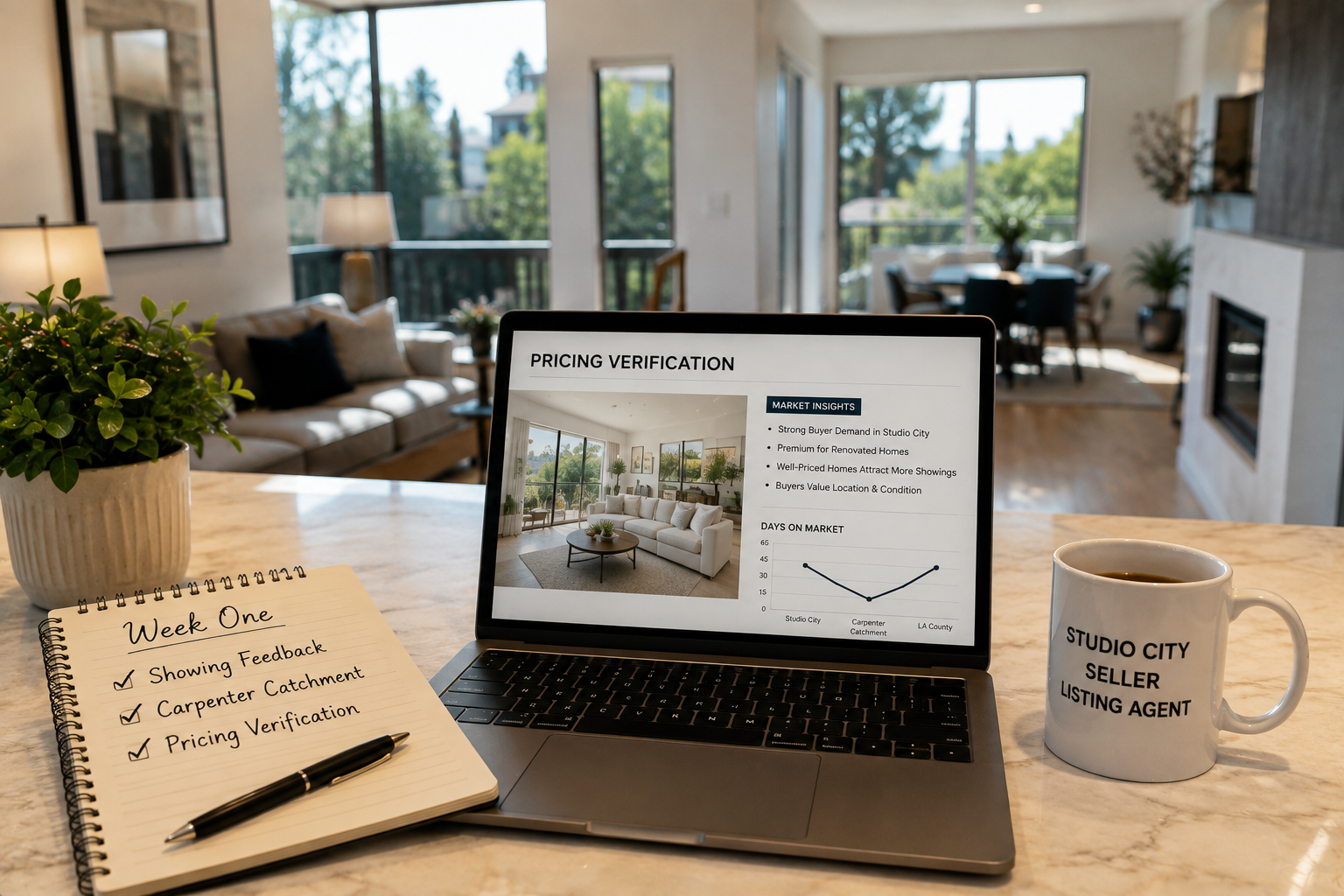 The Studio City market feedback review — the week-one showing traffic and buyer agent feedback conversation that determines whether the listing is correctly positioned for its specific sub-market or accumulating the early DOM signals that, if unaddressed by day 14–21, compound into the extended DOM that transfers negotiating leverage to buyers. At Studio City's $1.4M–$3.5M+ price points, the consequence of misreading market feedback is measured in tens of thousands of dollars in unnecessary carrying costs and negotiated discounts.
Week-one feedback benchmarks by Studio City sub-market:
Carpenter catchment south-of-Ventura (spring peak, active buyer pool 20–30 motivated households):
- → ✅ 10–18 showings week one: Strong — the majority of the active Carpenter-motivated buyer pool engaged. Expect offers by day 10–21. Multiple offers possible at the correctly priced renovated tier.
- → ⚠️ 5–9 showings: Moderate — monitor week two. The Carpenter buyer may be touring but hesitating on price or specification relative to the catchment comp set.
- → 🚨 0–4 showings: Pricing signal — at this showing level, the Carpenter-motivated buyer pool has filtered the listing at the search stage. The price likely exceeds the catchment comp ceiling, OR the listing has been identified by buyers as non-Carpenter in a sub-neighborhood where Carpenter is assumed. Verify catchment status and pricing. Act by day 14.
North-of-Ventura (spring peak, active buyer pool 15–25 households):
- → ✅ 7–12 showings week one: Strong for this sub-market
- → ⚠️ 3–6 showings: Cautionary — review the comp set for the specific sub-neighborhood
- → 🚨 0–2 showings: Overpricing signal — the north-of-Ventura buyer pool knows the comp set precisely
Hillside/canyon ($2.5M–$3.5M+, thin buyer pool of 8–15 households in spring):
- → ✅ 4–8 showings week one: Strong for this thin market
- → ⚠️ 2–3 showings: Monitor — may be correct pricing in a thin market or early overpricing signal
- → 🚨 0–1 showings through week two: Clear pricing signal in a market where the thin buyer pool has limited current-buyer depth
The Carpenter non-catchment mis-pricing signal:
The most specific Studio City feedback pattern — a south-of-Ventura listing that generates showing traffic from Carpenter-motivated buyers who tour once, don't return, and leave feedback that amounts to "priced above what this non-Carpenter address supports" — is the signal that requires the most immediate correction because it reflects a systematic pricing error rather than a gradual market adjustment.
The specific feedback pattern:
- → 4–8 showings from Carpenter-motivated buyers
- → Zero second showings
- → Buyer agent feedback: "Our clients loved the home but confirmed it's not in Carpenter catchment — the price reflects Carpenter premium"
- → No offers by day 21
This feedback pattern requires an immediate price correction to the non-Carpenter south-of-Ventura comp ceiling — not a modest 2% adjustment but the full recalibration to the correct comp set.
The meaningful adjustment standard:
- → 💰 North-of-Ventura: 3–5% reduction targeting the current active buyer pool's offer threshold
- → 💰 Non-Carpenter south-of-Ventura: 5–8% reduction — the full recalibration from Carpenter pricing to non-Carpenter ceiling
- → 💰 Hillside/canyon: 5–8% reduction when the thin buyer pool feedback signals overpricing
5. 💰 DOM and Net Proceeds — The Studio City Cost of Extended Market Time
The relationship between DOM accumulation and net proceeds reduction is acute at Studio City's price points — where the carrying cost of each additional month ($14,000–$22,000/month at the $1.6M–$2.4M price tier) compounds rapidly against negotiated price reductions.
The Carpenter mis-pricing scenario:
A south-of-Ventura Studio City 91604 seller with a non-Carpenter address priced their listing at the Carpenter premium tier ($2.35M versus the non-Carpenter south-of-Ventura comp ceiling of $2.12M).
- → Week one: 6 showings from Carpenter-motivated buyers — none returned
- → Day 28: reduction to $2.18M — still above the non-Carpenter ceiling
- → Day 45: 3 additional showings from the corrected price tier
- → Day 52: first offer at $2.04M — buyer using 52 days of DOM as leverage
- → Counter at $2.11M — accepted at $2.08M on day 61
Close: $2.08M — $40,000 below the non-Carpenter comp ceiling that a correct launch would have targeted. Carrying costs for 61 days ($17,000/month): $34,540. Total net proceeds shortfall versus correct pricing from launch: $40,000 + $15,000 excess carrying = $55,000 in net proceeds lost to the Carpenter mis-pricing strategy.
The seller who had verified the non-Carpenter catchment status before listing, priced to the $2.12M non-Carpenter ceiling, and launched with that honest positioning would have generated a buyer pool specifically motivated by the non-Carpenter south-of-Ventura premium — a real and active buyer pool — and closed within 30–40 days at approximately $2.09M–$2.14M. Net proceeds improvement versus the 61-day mis-priced outcome: approximately $55,000.
The production season timing error scenario:
A north-of-Ventura Studio City 91604 seller — correctly priced at $1.72M for a renovated 3-bedroom — listed on June 28. Their spring preparation had extended past the target May 1 launch.
- → July: 4 showings in 4 weeks — the entertainment industry production season buyer unavailability at its peak
- → August: 5 showings — modest improvement as some production schedules allow summer breaks
- → Day 58 (late August): reduction to $1.68M — responding to accumulated DOM
- → September 8: fall window opens, re-engagement begins
- → Day 72: offer at $1.64M from buyer using full DOM history as leverage
- → Accepted at $1.66M on day 79
Close: $1.66M versus a projected spring close at $1.70M–$1.74M. Carrying costs for additional 55 days (versus a 25-day spring close): $13,750. Net proceeds shortfall versus correct spring launch: $60,000–$80,000 in gross price plus $13,750 additional carrying = $73,750–$93,750 in net proceeds lost to the summer launch timing error.
The preparation delay that cost this seller a spring launch cost them $73,750–$93,750 in net proceeds — an outcome that an 8-week preparation timeline starting in mid-March would have prevented.
🚫 What NOT to Overdo
Don't price a south-of-Ventura Studio City listing to the Carpenter catchment premium without verified catchment status. The Carpenter Elementary catchment premium — the $140,000–$280,000 above comparable non-catchment south-of-Ventura addresses — is earned by the verified catchment address, not by geographic proximity. The listing that prices to the Carpenter premium for a non-catchment address systematically attracts and then loses the Carpenter-motivated buyer who verifies the specific address and discovers it is outside catchment. The feedback is specific and demoralizing: "We loved the home but it's not Carpenter." Price to the non-Carpenter south-of-Ventura comp ceiling and market to the buyer specifically motivated by the home's other premium attributes — large lot, mature landscaping, south-of-Ventura position, renovation quality.
Don't launch in June through August without specifically accounting for the production season buyer availability reduction. The Studio City seller who targets a June launch because "summer has good weather for showings" is specifically optimizing for a variable that doesn't drive the Studio City buying decision while ignoring the variable that does — the entertainment industry buyer's schedule. Summer weather in Studio City is excellent; summer entertainment industry buyer availability is at its annual low. The seller who cannot achieve a spring or fall launch should specifically market to the non-entertainment buyer populations that are active in summer: Westside transplants, tech and healthcare professionals, and empty-nesters — and should price to the reduced summer buyer pool rather than the broader spring audience.
Don't confuse a thin hillside/canyon buyer pool with an extended DOM problem. The Studio City hillside and canyon positions ($2.5M–$3.5M+) have a legitimate thin buyer pool that produces 35–72 day DOM even for correctly priced listings. The seller who panics at day 42 of a hillside listing and reduces aggressively may be cutting into a correctly priced position that would have generated an offer in week 7 from the patient buyer who was completing their purchase decision timeline. The thin market feedback benchmarks in Section 4 provide the specific showing-traffic signals that distinguish "the market hasn't found the right buyer yet" from "the market is telling you the price is wrong."
Don't list before the professional photography is truly ready. Studio City buyers — the entertainment industry professional, the Westside transplant who has been touring Beverly Hills, Pacific Palisades, and Brentwood, and the design-forward household that arrived in Studio City because of its visual character — are the most visually sophisticated buyer pool in the PEP coverage area. The Studio City listing photography that would be "good enough" in Reseda or Northridge is "disappointing" in Studio City. Invest in the full professional photography, architectural drone, video walkthrough, and staging quality that the buyer's prior search history has calibrated their expectations around — because the first 8 seconds of online listing engagement determine whether the Studio City buyer calls their agent for a showing or scrolls past.
Don't stay on the market through November after a fall launch that hasn't produced an offer by November 10. The Studio City listing that launched in October and hasn't generated an offer by November 10 is entering the fall window's close with the winter dormancy immediately ahead. Withdraw, reassess pricing and presentation, and re-launch in the February spring activation — or reduce decisively before November 10 to generate the fall offer that the dormant December market cannot produce. The listing that carries from November through February accumulates DOM history that every spring buyer uses as a negotiating tool.
🏠 Real-World Scenario — Studio City 91604
A Studio City 91604 south-of-Ventura seller — a renovated 4-bedroom at the buyer's full studio specification (custom cabinetry, Calacatta quartzite, Wolf range, wide-plank white oak), extensively prepared, long-term owner — had received two competing pricing recommendations: $2.55M from one agent who used Carpenter catchment comps and $2.18M from a second agent who filtered to non-Carpenter south-of-Ventura comps.
The $370,000 spread reflected the exact Carpenter vs. non-Carpenter distinction. We verified the specific address at lausd.net/schoolfinder: LAUSD elementary assigned was Riverside Drive Charter School — not Carpenter Elementary. The address was south-of-Ventura Studio City in a beautiful sub-neighborhood with large lots and mature landscaping, but specifically outside the Carpenter catchment boundary.
The correct comp set:
Non-Carpenter south-of-Ventura Studio City 91604 renovated 4-bedroom, 90 days: three comps at $2.14M, $2.19M, and $2.23M. Renovated non-Carpenter ceiling: approximately $2.22M.
The $2.55M scenario:
At $2.55M in the non-Carpenter sub-neighborhood, the listing would attract Carpenter-motivated buyers who would verify the address, discover the non-Carpenter assignment, and tour or skip based on that information. The buyers for whom $2.55M is appropriate budget specifically have verified Carpenter catchment as a prerequisite — the non-Carpenter home at $2.55M is not on their shortlist.
The non-Carpenter south-of-Ventura buyer specifically purchasing for the outdoor living scale, the Studio City specification, and the south-of-Ventura character — without school as a primary motivation — has a budget ceiling of approximately $2.22M–$2.30M for the non-Carpenter comp set. At $2.55M, this buyer either can't afford the listing or finds it $330,000 above the comps that inform their offer behavior.
The launch at $2.19M (spring, Carpenter verification disclosed proactively in listing remarks):
We specifically called out the school assignment in the listing remarks — not as an apology but as an honest disclosure that allowed the right buyer to evaluate the listing on its genuine merits. First week: 9 showings from non-Carpenter south-of-Ventura buyers who had specifically evaluated the listing on its outdoor space, specification quality, and sub-neighborhood character. Two offers by day 12. Accepted at $2.22M at day 16.
The seller who had been considering the $2.55M recommendation netted approximately $2.01M at the $2.19M launch (after commission and closing) versus an estimated $1.87M–$1.96M from the 60–90 day DOM trajectory that the $2.55M Carpenter-mis-pricing would have produced — a $50,000–$140,000 net improvement from the correctly positioned launch.
🏠 Real-World Scenario — Studio City 91604
A north-of-Ventura Studio City 91604 seller — a showrunner on a streaming series — had been planning to list in May but was pulled into a production extension that pushed their available listing preparation time to late July. Their question: list in August or wait for the fall window?
The August option:
- → DOM projection at $1.78M (correctly priced, renovated north-of-Ventura): 48–70 days in summer
- → Entertainment industry buyer availability: low — most of the natural buyer pool for this home (entertainment professionals) was in production
- → Close projection: mid-October to November
- → Risk: close after November 10 in the holiday compression period
The September 15 fall window launch:
- → DOM projection at $1.78M in fall conditions: 28–42 days
- → Entertainment industry buyer availability: significantly improved — fall production wraps beginning in September, entertainment industry buyers re-activating
- → Close projection: late October to early November
- → Target: close before November 10 to avoid holiday dormancy
The recommendation: Wait 6 weeks from July preparation completion to September 15 launch. Use the 6 weeks to complete the staging, final photography, and pre-launch marketing that the rushed August listing wouldn't have allowed.
The outcome: Launched September 18 at $1.77M. First week: 8 showings including 5 entertainment industry professionals. Offer by day 14 at $1.73M. Counter at $1.76M. Accepted at $1.745M at day 22.
Net after commission and closing: approximately $1.585M. The August launch would have produced a projected close at approximately $1.68M–$1.72M after 60+ days of DOM and a negotiated summer discount — a $65,000–$105,000 improvement from the 6-week wait for the fall entertainment industry buyer re-activation.
The showrunner's assessment: "I've been in the industry long enough to know that summer is for production, not real estate. I should have known the same applies to selling my house."
❓ FAQ
What is the average days on market in Studio City? Studio City's average DOM varies significantly by sub-market, season, and condition tier. The most useful benchmarks: ✓ Carpenter Elementary catchment south-of-Ventura (spring peak, renovated): 18–32 days. ✓ North-of-Ventura (spring peak, renovated): 22–38 days. ✓ Non-Carpenter south-of-Ventura (spring peak, renovated): 25–48 days. ✓ Hillside/canyon ($2.5M–$3.5M+, spring): 35–72 days. ✓ All sub-markets in summer (June–August): 42–75 days. ✓ Fall secondary window (October 1–November 10): 22–48 days. These benchmarks apply to correctly priced listings — overpriced listings accumulate significantly longer DOM regardless of season.
Why is the Carpenter Elementary school important for Studio City sellers? Carpenter Elementary School in Studio City 91604 consistently earns top-tier California Dashboard performance ratings and serves a catchment area of verified south-of-Ventura Studio City addresses. Verified Carpenter catchment addresses command a premium of $140,000–$280,000 above comparable non-catchment south-of-Ventura addresses — and generate specifically more compressed DOM during the spring LAUSD enrollment window (January–April) because the school-motivated buyer has a non-deferrable enrollment deadline that creates purchase urgency. Sellers with Carpenter catchment addresses should verify status at lausd.net/schoolfinder and price specifically to the verified Carpenter comp set. Sellers without Carpenter catchment should price to the non-Carpenter comp set regardless of geographic proximity to the catchment area.
Does the entertainment industry affect Studio City home sales? Yes — significantly and specifically. Studio City's entertainment industry buyer concentration produces the year's reduced-activity summer period (June–August, when production season limits buyer showing availability) and the year's most active buyer periods in fall (September–November, post-production) and winter/spring (January–April, pre-production and spring activation). This entertainment calendar-driven seasonality is unique to Studio City among SFV markets — the seller who plans around it consistently produces better DOM outcomes than the seller who doesn't.
What should I do if my Studio City listing isn't selling? By day 14–21: evaluate three specific factors in order. ✓ First — Carpenter catchment verification: if the listing is south-of-Ventura and priced at the Carpenter premium, confirm that the specific address is in verified Carpenter catchment at lausd.net/schoolfinder. If not, the price requires immediate recalibration to the non-Carpenter comp ceiling. ✓ Second — pricing versus comp set: pull the most recent 90-day closed comps filtered to the specific sub-market and condition tier. The correct comp set is 91604 or 91602 only, within 0.4 miles, same bedroom count, same condition tier. ✓ Third — photography quality: Studio City buyers are visually sophisticated; the listing photography must match the premium. If the photography doesn't show the home at its absolute best, reshoot before any price adjustment.
When is the best time to sell a home in Studio City? The primary window is February through April — Carpenter enrollment urgency peaks, entertainment industry buyers are active between production commitments, and broad SFV spring activation produces the strongest first-week showing traffic. The fall secondary window (October 1–November 10) produces the year's second-best conditions — particularly strong for entertainment industry sellers whose buyers are wrapping production and re-engaging in the market. Avoid June through August if possible — the production season buyer calendar thins showing traffic regardless of listing price or quality.
How does Studio City DOM compare to Sherman Oaks? Studio City 91604/91602 and Sherman Oaks 91403/91423 are the two most proximate premium markets in the PEP coverage area, and their DOM profiles are broadly comparable at the same price tier. Studio City produces slightly more compressed spring DOM at the south-of-Ventura Carpenter catchment tier due to the specific enrollment urgency that Sherman Oaks doesn't replicate — but slightly longer summer DOM due to the production season entertainment industry buyer reduction that Sherman Oaks 91403/91423's more diverse buyer pool partially offsets. Both markets reward correct spring timing and specification quality with the sub-30-day DOM that the SFV premium market's best conditions produce.
🎯 Bottom Line
Days on market in Studio City 91604 and 91602 is controlled by three Studio City-specific variables that sellers who understand before listing make better decisions about than those who discover them mid-listing: Carpenter Elementary catchment verification (the single most important pricing variable in the Studio City market), the entertainment industry production calendar (the seasonal dynamic that Studio City shares with no other SFV market), and the new construction competition awareness (the spec-builder pipeline that places resale listings in direct competition with brand-new product at overlapping price points).
The Studio City seller who verifies Carpenter catchment status before pricing, times the launch to the spring or fall entertainment industry buyer activation windows, photographs and stages to the visual standard that Studio City's sophisticated buyer pool expects, and responds to week-one feedback with the specific correction the sub-market signals require — consistently achieves the 18–42 day DOM that characterizes the neighborhood's best conditions and the net proceeds that follow from it.
At Parkway Estate Properties, Liana's seller representation across Studio City 91604/91602, Sherman Oaks 91403/91423, Encino 91316/91436, Tarzana 91356, and Northridge 91324/91325, combined with Roman's hands-on renovation experience across dozens of SFV properties, means every Studio City seller conversation is grounded in the sub-market-specific Carpenter catchment data, the entertainment industry calendar awareness, and the specification quality framework that produces the strongest achievable net proceeds for each specific Studio City seller.
📩 Want Your Specific Studio City Address's Carpenter Catchment Status and DOM Expectation?
We'll verify the specific catchment status, pull the current sub-market comp set, and give you the honest DOM expectation and launch price range for your specific Studio City home — before any listing agreement is signed.
Contact Liana Shersher at Parkway Estate Properties: 📧 liana@parkwayestate.com · 📞 (818) 208-5881 · 🌐 parkwayestate.com 15021 Ventura Blvd., Ste. 510, Sherman Oaks, CA 91403
About the Authors
Liana Shersher is a licensed real estate agent with Parkway Estate Properties Inc. and an Accredited Buyer's Representative (ABR) serving the San Fernando Valley — with a focus on Sherman Oaks, Encino, Tarzana, Woodland Hills, and Northridge (DRE# 02164224). Liana guides first-time homebuyers through every step of the purchase, from the first showing to the keys in hand, and represents move-up and repeat buyers across the Valley. For sellers, she builds the pricing and marketing strategy that positions a home to sell for top dollar, fast. Buyers and sellers work with Liana for clear communication, sharp local knowledge, and an agent who treats their goals like her own.
Roman Shersher is the broker-owner of Parkway Estate Properties Inc. and a real estate investor with 18 years of experience in the San Fernando Valley (DRE# 01855095). Roman has personally led or co-led renovations on dozens of properties across the Valley, including recent projects in Northridge (91324) and Woodland Hills (91364). That hands-on renovation and investment experience shapes every pricing conversation and days-on-market strategy at Parkway — sellers get a realistic read on what improvements actually return at resale, and buyers get an expert eye on a home's true condition and upside.
Parkway Estate Properties, Inc. · 15021 Ventura Blvd., Ste. 510, Sherman Oaks, CA 91403 · (818) 208-5881 · parkwayestate.com · Broker License #: 01873092 Equal Housing Opportunity. Information herein is general and not legal, tax, or financial advice. Consult qualified professionals for your specific situation.
Categories
Recent Posts











Broker | Realtor ® License ID: 01873092
+1(818) 208-5881 | info@parkwayestate.com