
Is Now a Good Time to Buy a Home in Lake Balboa?
The "is now a good time to buy" question for Lake Balboa 91406 and 91411 has two meaningfully different answers depending on which buyer is asking — and the Lake Balboa market's specific dual buyer pool structure makes this distinction more important here than in most SFV neighborhoods.
For the owner-occupant first-time buyer and working-family move-up household who is specifically motivated by the Sepulveda Basin Recreation Area lifestyle access, the Lake Balboa neighborhood character, and the value proposition that 91406/91411 delivers above Reseda 91335 and Van Nuys 91401/91405/91406 at a meaningful price advantage below Northridge 91324/91325 and Sherman Oaks 91403/91423 — the 2026 Lake Balboa market is a specifically good entry point. The price recovery from the 2022–2023 correction is proceeding at a measured pace; the spring and fall windows produce genuine seller-favorable DOM compression without the extreme competitive dynamics that make entry difficult; and the seller-paid buydown opportunity reduces the first-year payment burden that 7.25%+ rates otherwise impose on the FHA and low-down-payment buyer.
For the BRRRR investor who is specifically evaluating the Lake Balboa acquisition thesis — the renovation-refinance-rental cycle with ADU addition potential described throughout the Lake Balboa content library — the 2026 market is also favorable but for different reasons: the January and summer acquisition windows continue to produce the motivated seller negotiating dynamics that support investor acquisition price targets; the rental market has remained stable enough to sustain the BRRRR math; and the ADU opportunity is specifically more executable in 2026 than in prior years as California's permitting framework continues to streamline the garage conversion process.
This article addresses both buyer profiles with the honest, market-specific analysis each needs — not a generic "real estate is always a good investment" narrative but the specific Lake Balboa 2026 market intelligence that informs the timing decision correctly.
1. 📊 The Lake Balboa Market Position — Where Prices Stand in 2026
Understanding whether now is a good time to buy requires a clear picture of where Lake Balboa prices stand relative to the 5-year cycle — specifically the 2020 baseline, the 2022 peak, the 2022–2023 correction, and the 2024–2026 recovery.
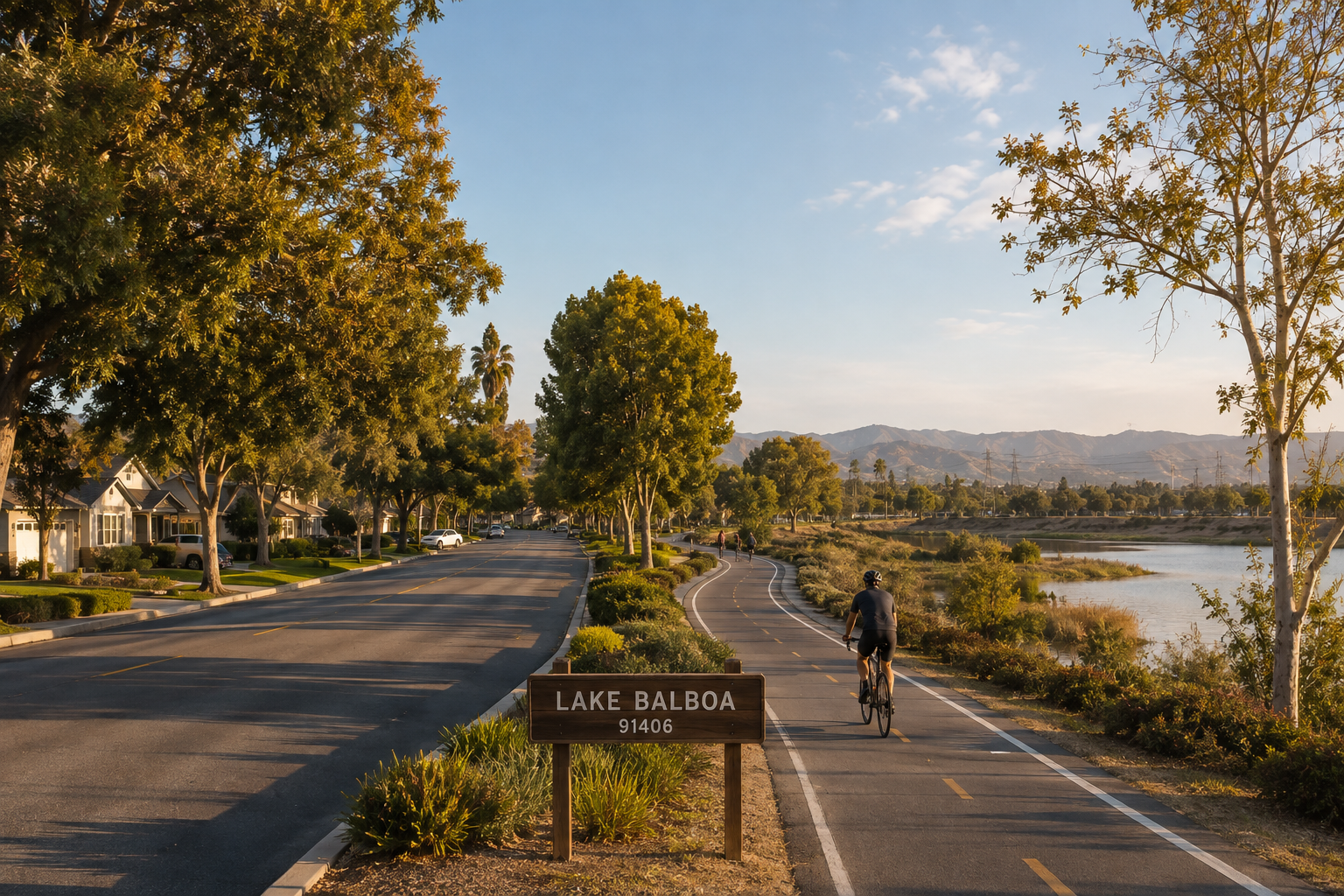 Lake Balboa 91406 in 2026 — the market that has recovered approximately 80–85% of the 2022–2023 correction at the volume tier, approaching but not yet exceeding 2022 peak levels. The Sepulveda Basin Recreation Area visible in the background represents the structural demand floor — the outdoor access premium that distinguishes Lake Balboa from adjacent markets without equivalent lifestyle anchors and that has maintained buyer motivation through the rate cycle's most challenging periods.
The 5-year price trajectory:
91406/91411 improved-condition 3-bedroom benchmark:
- → 📊 2020 baseline: $720,000–$780,000
- → 📊 2022 peak: $890,000–$960,000 (+22–25% from 2020)
- → 📊 2023 correction trough: $800,000–$855,000 (-10–12% from peak)
- → 📊 2026 current position: $845,000–$915,000 (approximately 80–85% recovery from trough to peak)
- → 📈 Net appreciation from 2020 baseline: approximately 18–22% — solid long-term appreciation with partial peak recovery
What the current position means for buyers:
- → ✅ Not at peak: Lake Balboa prices have not yet returned to 2022 peak levels across all condition tiers — the buyer entering now is purchasing below the peak at approximately 5–8% discount to the 2022 high in most sub-neighborhoods
- → ✅ Not at trough: The deepest correction discounts (October 2023) have closed — the buyer who waited for maximum correction missed the trough by approximately 18–24 months
- → ✅ In moderate recovery: The 2024–2026 recovery has been measured (3.5–4.5%/year) rather than explosive — producing the steady appreciation that supports a purchase decision without the FOMO urgency that peak-market conditions generate
- → ⚠️ Rate headwind: The 7.0%–7.5% mortgage rate environment has partially offset the price recovery's good-news headline — the buyer's monthly payment at $845,000 with 7.25% is higher than at the $960,000 2022 peak with 3.5% rates. The absolute price recovery from trough is real; the affordability position is challenging due to rates.
The Sepulveda Basin demand floor:
Throughout the 2022–2023 correction and the 2024–2026 recovery, Lake Balboa's outdoor access premium has produced a consistently lower correction depth and a more stable recovery pace than comparable-quality central Valley markets without an equivalent lifestyle anchor:
- → 📊 Lake Balboa 91406/91411 correction depth: 10–12% from 2022 peak
- → 📊 Reseda 91335 comparable correction depth: 12–15% from 2022 peak
- → 📊 Van Nuys 91401/91405/91406 comparable correction depth: 14–17% from 2022 peak
The 2–5 percentage point shallower correction reflects the Sepulveda Basin premium's durability — the lifestyle-motivated buyer who specifically wants the Basin access maintained their search intensity through the correction in ways that buyers without this specific motivation did not.
2. 💰 The Rate Environment — Honest Assessment for Lake Balboa's FHA Buyer Pool
No Lake Balboa buyer timing analysis is complete without the honest rate environment assessment — because Lake Balboa's FHA and low-down-payment buyer concentration makes this market more rate-sensitive than any other neighborhood in the PEP coverage area.
The monthly payment reality at 2026 rates:
At a $825,000 Lake Balboa 91406 purchase (5% conventional down, $783,750 loan at 7.25%):
- → 💳 Monthly P&I: $5,347
- → 🏛️ Property taxes (1.22%): $839/month
- → 🏠 Insurance: $145/month
- → 📋 PMI (0.8% on 95% LTV): $523/month
- → Total PITI + PMI: $6,854/month
- → 💰 Required income (32% front-end): approximately $257,000/year
At the same $825,000 purchase with FHA financing (3.5% down, $796,125 loan at 7.25%):
- → 💳 Monthly P&I: $5,430
- → 🏛️ Property taxes: $839/month
- → 🏠 Insurance: $145/month
- → 📋 FHA MIP (0.85% annually): $564/month
- → Total PITI + FHA MIP: $6,978/month
- → 💰 Required income (32% front-end): approximately $261,000/year
The seller-paid buydown transformation:
With a seller-paid 2-1 buydown (seller concession of approximately $13,500–$15,000):
At 5.25% effective year-one rate on the $796,125 FHA loan:
- → 💳 Year-one P&I: $4,392/month
- → Year-one PITI + MIP: $5,940/month
- → 💰 Year-one income required (32% front-end): approximately $222,750/year
- → Monthly savings versus full-rate payment: $1,038/month in year one
The seller-paid buydown reduces the income required to qualify in year one by approximately $38,000 — specifically reactivating the Lake Balboa buyer who earns $220,000–$250,000/year and whose full-rate qualification is at the maximum stretch DTI.
The rate trajectory consideration:
The buyer who waits for rate normalization (hoping for 6.0% or below) faces a specific risk: if rates decline to 6.0%, the Lake Balboa buyer who was priced out at 7.25% re-enters the market alongside everyone else who was waiting — accelerating price recovery and potentially eliminating the current modest below-peak discount. The rate normalization scenario that improves monthly affordability may simultaneously worsen price competition.
The buyer who purchases at 7.25% with a seller-paid buydown, holds for 3–5 years, and refinances when rates normalize captures both the current below-peak entry price and the future rate reduction — a sequencing that outperforms the wait-for-rates scenario when rates decline over the hold period.
3. 🏗️ The ADU Opportunity — Why 2026 Is Specifically the Right Year for the Lake Balboa Investor
The Lake Balboa ADU opportunity documented in the biggest seller mistakes article is not only relevant to sellers — it is specifically relevant to buyers in 2026 because the combination of California's streamlined ADU permitting framework, the current Lake Balboa acquisition pricing, and the rental market that supports ADU construction economics creates the most favorable ADU investment conditions the Lake Balboa market has produced.
The 2026 ADU opportunity for Lake Balboa buyers:
California's ADU legislation has progressively streamlined the permitting process since 2020 — reducing the permit approval timeline for garage conversion ADUs from 60–90+ days to as little as 30–45 days in many LADBS jurisdictions. For the Lake Balboa buyer evaluating the ADU addition:
- → 💰 Garage conversion ADU cost (2026): $55,000–$80,000 for a 400–600 sq ft unit
- → 💰 Post-ADU appraised value addition: $85,000–$120,000
- → 📊 ADU rental income (Lake Balboa 91406/91411): $1,500–$2,100/month
- → 📊 ADU construction ROI: 1.4:1 to 1.5:1 (value added / cost) — the strongest per-dollar value addition available in the Lake Balboa market
- → 🏡 Cash flow impact: The $1,500–$2,100/month ADU rental income reduces the net monthly ownership cost meaningfully — transforming a $6,854/month PITI + PMI payment into a $4,754–$5,354/month net cost after ADU rental offset
The BRRRR + ADU thesis in 2026:
The Lake Balboa BRRRR buyer who acquires an original-condition home with a detached garage at the correct January or summer acquisition price target, executes the renovation, adds an ADU through the garage conversion, and then refinances at the post-ADU appraised value:
Illustrative BRRRR + ADU model at $785,000 acquisition:
- → Down payment (25%): $196,250
- → Renovation scope (focused cosmetic): $45,000
- → ADU garage conversion: $67,000
- → Carrying costs (14 weeks): $13,500
- → Total all-in investment: $321,750
Post-renovation + ADU appraised value: approximately $985,000–$1,020,000
75% LTV refinance on $1,000,000 appraised: $750,000
Capital recycled at refinance: $750,000 - $588,750 (remaining mortgage) = $161,250 returned
Capital remaining in deal: $321,750 - $161,250 = $160,500 (50% recycling efficiency)
Monthly rental income (main unit + ADU): $3,100 (main) + $1,750 (ADU) = $4,850/month
Monthly PITI on $750,000 at 7.75% investment rate: $6,585
Monthly cash flow: approximately -$1,735/month (negative but dramatically better than single-unit)
Annual wealth building: $40,000 appreciation (4.0% × $1,000,000) + $15,000 principal paydown - $20,820 cash flow cost = $34,180/year net on $160,500 remaining equity = 21.3% annual return
The BRRRR + ADU buyer who enters the Lake Balboa market in the January or summer 2026 acquisition window at the correct price target achieves the specific investment return that makes the current rate environment manageable — because the ADU rental income specifically reduces the cash flow burden that the 7.75% investment rate otherwise creates.
4. ⏰ Timing Within 2026 — The Best Entry Windows for Lake Balboa Buyers
For buyers who have decided that Lake Balboa is their target market, the within-year timing optimization produces meaningful differences in purchase price, seller concession availability, and buyer competition.
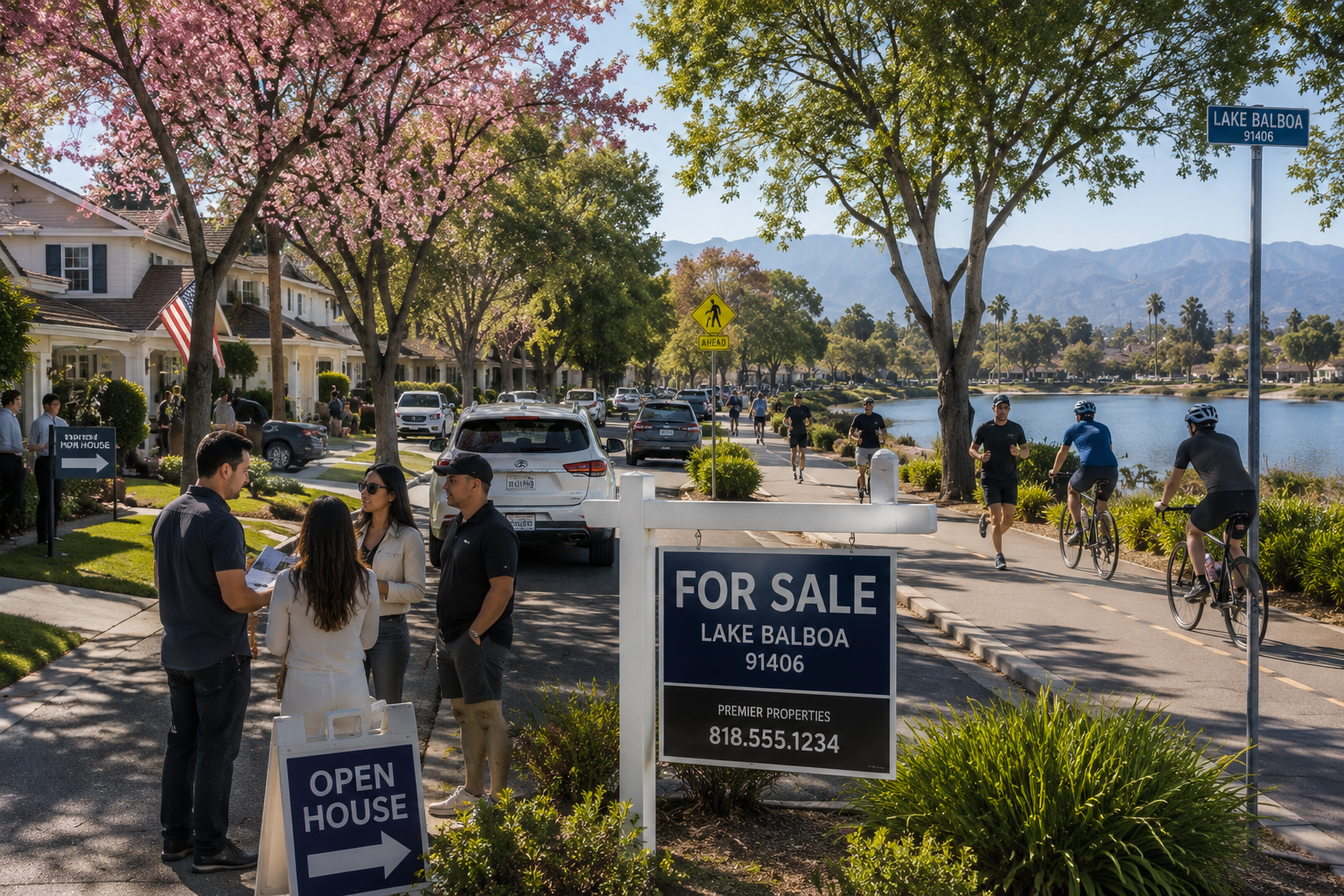 The Lake Balboa within-year timing conversation — the seasonal market analysis that helps owner-occupant buyers identify the spring window for competitive inventory access and summer/winter windows for seller concession availability, while helping BRRRR investors identify the January and summer acquisition windows where motivated sellers and reduced buyer competition produce the best acquisition price targets.
For the owner-occupant first-time and move-up buyer:
✅ Best windows:
March 1–April 30 (spring peak):
- → 📊 DOM: 18–32 days for correctly priced improved listings
- → 📊 Inventory: Best selection of the year
- → 📊 Competition: Highest of the year — multiple offers possible on well-prepared 91406/91411 listings
- → ✅ Why now: The broadest combination of inventory choice and buyer competition — the window where the first-time buyer who is ready to purchase should be actively making offers
- → ⚠️ The competition caveat: Spring competition means the Lake Balboa buyer needs pre-approval in hand and willingness to move within 48–72 hours of a first showing on a well-priced listing
October 1–November 10 (fall secondary):
- → 📊 DOM: 24–40 days — approaching spring conditions with less competition
- → 📊 Seller motivation: Higher than spring — sellers who have been on market since summer are more concession-flexible
- → ✅ The fall advantage: Seller concession availability (seller-paid buydown, repair credits, closing cost contribution) is higher in fall than spring — the fall buyer who asks for the 2-1 buydown frequently receives it with less resistance than the spring buyer competing with other offers
July–August (summer — specifically for buydown-negotiating buyers):
- → 📊 DOM: 35–52 days — extended summer conditions but with buydown availability
- → ✅ The summer strategy: Target listings with 30+ days of DOM and negotiate the seller-paid buydown as part of the offer — the summer motivated seller who hasn't received an offer in 35 days is specifically receptive to the buydown concession that activates the payment-hesitant buyer
❌ Avoid (for owner-occupant buyers):
- → December: minimum inventory, minimum buyer competition, but also minimum seller inventory and maximum motivated-seller-only selection
- → January 1–15: holdover from December dormancy
For the BRRRR investor:
✅ Best acquisition windows:
January 10–25:
- → The annual maximum negotiating leverage window — motivated estate sales, relocation-deadline sellers, and year-end-motivated sellers who didn't close in Q4 are most concentrated and most flexible
- → ✅ BRRRR acquisition target prices are most consistently achievable in this window
- → ✅ CSUN (adjacent in Northridge 91324) spring semester begins mid-January — rental demand reactivates simultaneously with the acquisition window
July–August:
- → The summer motivated seller window — listings that accumulated DOM through the spring-summer transition without closing are specifically negotiating from maximum accumulated DOM leverage
- → ✅ The BRRRR investor who identifies correctly priced summer extended-DOM listings and negotiates 3–5% below the already-reduced price achieves acquisition targets that spring pricing doesn't allow
5. 🎯 The Decision Framework — Should You Buy Now or Wait?
With the market position, the rate environment, the ADU opportunity, and the seasonal timing mapped, the Lake Balboa buyer needs the specific decision framework that converts this intelligence into a buy-now or wait conclusion for their specific situation.
The five-question Lake Balboa buyer decision framework:
Question 1 — Is your lifestyle motivation genuine and long-term?
The Lake Balboa purchase that is primarily motivated by the Sepulveda Basin outdoor access, the neighborhood character, and the central Valley lifestyle access — with a planned hold of 5+ years — produces better outcomes in 2026 than waiting because:
- → The Sepulveda Basin demand floor that underlies Lake Balboa's premium over Reseda and Van Nuys is structural and durable — it doesn't disappear if rates rise further or if a mild price correction occurs
- → The 5+ year hold captures the Proposition 13 annual 2% maximum assessment cap benefit — the same home in 2031 at a higher market value pays taxes on the lower Proposition 13 protected assessment
- → The opportunity cost of renting while waiting for rates to normalize is real: at $3,200/month rent (market rate for a comparable Lake Balboa rental), waiting 18 months costs $57,600 in rent with zero equity accumulation
Question 2 — Can you qualify comfortably, not just at maximum stretch DTI?
The buyer who qualifies for a $825,000 Lake Balboa purchase at maximum 43% total DTI but who carries $1,800/month in other debt obligations is at financial risk if income disrupts. The correct qualification threshold for a Lake Balboa purchase in the current rate environment:
- → ✅ Buy now if: Housing payment (PITI + PMI/MIP) is at or below 32% of gross income, with comfortable margin above the minimum qualifying threshold
- → ⚠️ Wait if: Qualifying requires 43% total DTI with minimal buffer — use the waiting period to reduce existing debt obligations, improve credit score to the 740+ tier for better rate access, and accumulate the full capital requirement including reserves
Question 3 — Do you have the complete capital requirement, not just the down payment?
As documented in the Lake Balboa seller mistakes article, the total capital requirement for a Lake Balboa purchase includes:
- → Down payment (3.5%–20%): $26,250–$165,000 at $750,000–$825,000
- → Closing costs: $11,000–$22,000
- → Reserves (2–6 months PITI): $13,700–$41,100
- → Supplemental tax reserve: $7,000–$11,000
- → ✅ Total minimum capital (FHA, $750,000): approximately $64,000
- → ✅ Total recommended capital (20% down, $825,000): approximately $222,000
- → ⚠️ Wait if: Available liquid capital covers only the down payment — the reserves and supplemental tax bill will create the post-close financial stress that makes the purchase feel wrong even when the purchase decision itself was correct
Question 4 — Have you specifically evaluated the ADU potential for your target address?
For BRRRR investors and for owner-occupant buyers who want to explore the ADU income offset:
- → ✅ Buy now if: The target parcel has a detached garage or rear structure that supports ADU conversion at the $55,000–$80,000 cost range — the ADU addition specifically improves the hold economics regardless of the rate environment
- → ⚠️ Reconsider the specific parcel if: The lot has no detachable structure and the single-unit rental yield at 7.75% investment rates doesn't support the BRRRR thesis
Question 5 — Are you specifically comparing Lake Balboa to its correct alternatives?
The Lake Balboa buyer who is also considering Reseda 91335 at $70,000–$90,000 lower and Northridge 91324/91325 at $100,000–$150,000 higher should specifically evaluate whether the Sepulveda Basin lifestyle premium is a genuine priority for their household — not just a nice-to-have. The buyer who moves to Reseda and discovers they don't use the Reseda Boulevard food corridor but would have used the Sepulveda Basin trail every weekend has made the wrong choice; the buyer who correctly identifies that the Basin access isn't genuinely part of their lifestyle and purchases in Reseda at the $70,000–$90,000 discount has made the right choice.
🚫 What NOT to Overdo
Don't wait for mortgage rates to hit a specific target before purchasing. The buyer waiting for rates to reach 6.0% before buying in Lake Balboa is subject to the specific risk that when rates do normalize to 6.0%, the increased buyer pool activation that rate normalization produces simultaneously closes the current modest below-peak entry opportunity. The rate-wait strategy specifically concentrates benefit only if rates decline while prices remain flat or decline — a combination that is possible but not the base case for Lake Balboa's structurally demand-supported market. The seller-paid 2-1 buydown provides a more reliable path to first-year affordability improvement than a rate-wait that may never deliver the price improvement it requires to offset the opportunity cost.
Don't evaluate Lake Balboa timing without specifically including the Sepulveda Basin premium in the analysis. The buyer who applies the Tarzana 91356 or Granada Hills 91344 school-premium timing logic to Lake Balboa has applied the wrong analytical framework. Lake Balboa's structural demand driver is not school quality (there is no universal school anchor equivalent to ECR Charter or GHCHS) — it is the Sepulveda Basin outdoor access premium. The durability of this premium through the rate cycle is the relevant timing variable, and it has been more stable than the school-premium markets' correction-and-recovery dynamics suggest.
Don't over-optimize for entry timing at the expense of address quality. The Lake Balboa buyer who waits for the "perfect" seasonal window and then purchases in a sub-neighborhood that doesn't capture the Sepulveda Basin premium has optimized the wrong variable. The basin-proximate sub-neighborhoods that command the outdoor access premium are the correct target — and the winter acquisition window at a basin-adjacent address at the correct price is better than the spring window at a less-premium address at a similar price.
Don't let the ADU opportunity drive the purchase decision if the owner-occupant lifestyle isn't genuinely present. The Lake Balboa buyer who purchases primarily for the ADU investment thesis but whose household doesn't genuinely value the neighborhood's lifestyle proposition — the outdoor access, the working-family neighborhood character, the central Valley location — has purchased an investment property that requires primary residence management. The strongest Lake Balboa purchases are those where the lifestyle motivation is genuine AND the ADU or BRRRR opportunity is an additive benefit rather than the primary motivation.
Don't compare Lake Balboa prices to peak prices as the reference for "good value." The buyer whose mental reference point is the 2022 peak comparing the current market unfavorably to the trough is applying a backward-looking price reference that doesn't inform the forward decision. The relevant comparison is: what does Lake Balboa deliver for the purchase price today relative to the alternatives today — not relative to where the market was 3 years ago. The current 91406/91411 improved-condition 3-bedroom at $845,000–$900,000 delivers the Sepulveda Basin access, the neighborhood character, and the central Valley position at a meaningful discount to Northridge 91324/91325 and Sherman Oaks 91403/91423 — that value comparison is what determines whether the current price represents good value.
🏠 Real-World Scenario — Lake Balboa 91406
A couple — a respiratory therapist and a logistics coordinator, combined income $218,000/year, first-time buyers with a 3-year-old child — had been searching for 14 months across Reseda 91335, Lake Balboa 91406/91411, and North Hills 91343 without purchasing. Their hesitation: "Rates are so high. We keep thinking they'll come down and we'll be able to afford more."
We walked through the specific analysis:
The wait scenario (18 more months to hypothetical 6.0% rates):
- → Rent paid while waiting (18 months × $2,950/month): $53,100 — permanently gone
- → Lake Balboa price projection at 6.0% rates (increased buyer pool activation): approximately 8–12% above current levels = approximately $74,000–$110,000 increase on an $855,000 current target
- → Net position at 6.0% rates: buying at $929,000–$965,000 at 6.0% versus $855,000 at 7.25% now
- → Monthly P&I at $929,000 / 6.0%: $5,574 versus $855,000 / 7.25%: $5,835 — a $261/month savings
- → Annual savings from rate normalization: $3,132/year
- → Total additional price paid from waiting: approximately $74,000–$110,000
The break-even on waiting: $74,000–$110,000 additional price / $3,132/year savings = 23–35 years to break even on the wait-for-rates strategy — before accounting for the $53,100 in rent paid while waiting.
The buy-now + seller-paid buydown scenario:
Current Lake Balboa 91406 improved-condition 3-bedroom at $855,000, fall window, seller-paid 2-1 buydown negotiated:
- → Year-one effective payment (5.25% buydown rate): $5,682/month PITI + PMI
- → Seller buydown cost contribution: $14,500 (seller concession, net to buyer: zero additional cost)
- → Year-one monthly savings versus full rate: $985/month
- → Equity position at 18 months (Proposition 13 protection begins, ~$28,000 principal paydown + ~$38,500 appreciation): approximately $66,500 in equity built versus $53,100 in rent paid
The buy-now path produced $66,500 in wealth building versus $53,100 in permanent rent expenditure over the same 18-month period — a $119,600 swing in the buyer's favor from the decision to purchase rather than wait.
They purchased in Lake Balboa 91406 in October at $848,000 with a seller-paid 2-1 buydown ($14,200 seller credit). The Sepulveda Basin trail is their Saturday morning family ritual. Their daughter starts kindergarten in 2027 at the assigned LAUSD school while they explore magnet options.
🏠 Real-World Scenario — Lake Balboa 91411
A BRRRR investor — a dentist in private practice, income $380,000, second investment property, specifically targeting Lake Balboa for the ADU opportunity described in the Lake Balboa biggest seller mistakes article — was evaluating whether to acquire in the January 2026 window or wait for a potential rate decline.
The January 2026 acquisition analysis:
Original-condition Lake Balboa 91411 3-bedroom with detached garage — targeted at the correct January acquisition price window.
January acquisition offer: $762,000 (approximately $58,000 below the spring improved-condition comp ceiling of $820,000 for the as-is discount, negotiated from a motivated estate sale at $778,000 list price).
The renovation + ADU plan:
- → Focused renovation scope: $48,000
- → Garage conversion ADU: $68,000
- → Carrying costs (13 weeks): $12,100
- → Total investment: $890,100
Post-renovation + ADU appraised value: $1,010,000
75% LTV refinance: $757,500 — returning $757,500 - $571,500 (remaining on $762,000 acquisition) = $186,000
Capital remaining: $890,100 - $186,000 = $704,100 total invested with $186,000 returned = $518,100 net investment
Wait — that's not right. The down payment structure needs refinement:
Correct BRRRR math:
- → Acquisition at $762,000 (25% down = $190,500, loan $571,500)
- → Renovation + ADU + carrying: $128,100
- → Total cash deployed: $318,600
Post-renovation appraised: $1,010,000 75% LTV cash-out refinance: $757,500 Payoff prior loan ($571,500) + return capital: $757,500 - $571,500 = $186,000 returned to investor Capital remaining in deal: $318,600 - $186,000 = $132,600
Monthly income: Main unit rent $3,050 + ADU $1,700 = $4,750/month Monthly PITI on $757,500 at 7.75%: $6,652/month Monthly cash flow: -$1,902/month
Annual wealth building: $40,400 appreciation (4.0% × $1,010,000) + $16,500 principal paydown - $22,824 cash flow cost = $34,076/year net
Return on remaining equity: $34,076 / $132,600 = 25.7% annual return
The rate-wait analysis for this investor:
Waiting for 6.5% rates (18 months):
- → Acquisition price at lower rates: approximately $830,000 (spring competition at lower rates)
- → Same investment scenario but $68,000 more in acquisition cost
- → Cash deployed: $386,600
- → Cash returned at refinance: approximately $193,000 (75% × $1,055,000 projected appraised value at higher price)
- → Capital remaining: $193,600
- → Annual return: approximately 17.6% — meaningfully below the January 2026 acquisition scenario
The January 2026 acquisition at the correct motivated-seller price produced a 25.7% annual return versus the 17.6% from the rate-wait scenario at a higher acquisition price — a clear case where the current Lake Balboa market timing is specifically superior to waiting for rate normalization.
The investor acquired in January at $758,000, completed the renovation and ADU in April, refinanced in May at the $1,005,000 appraised value. Both units rented by June 1.
❓ FAQ
Is now a good time to buy in Lake Balboa? Yes — for both owner-occupant buyers and BRRRR investors, with specific timing and qualification conditions. For owner-occupant buyers: the Lake Balboa volume tier ($740,000–$920,000) has recovered approximately 80–85% from the 2022–2023 correction trough without yet exceeding 2022 peak levels — creating a modest below-peak entry opportunity. The seller-paid 2-1 buydown reduces the rate-sensitivity concern, and the Sepulveda Basin demand floor provides structural protection against significant further correction. For BRRRR investors: the January and summer acquisition windows continue to produce motivated seller dynamics that support acquisition price targets; the ADU opportunity specifically strengthens the investment math at current rates.
Will Lake Balboa home prices go up or down in 2026? Up — modestly and consistently at the volume tier. The structural demand drivers (Sepulveda Basin lifestyle access, working-family first-time buyer demand, BRRRR investor thesis) sustain the 3.5–4.5% annual appreciation projection for 2026. The primary risk scenario that could produce flat or declining prices: a significant rate increase above 8.0% that further compresses the FHA buyer pool or a broad economic disruption that reduces household formation in the central SFV. Neither is the 2026 base case. The base case is continued measured appreciation with spring and fall windows producing seller-favorable conditions and summer/winter producing buyer opportunity.
Should I buy in Lake Balboa or wait for rates to go down? The wait-for-rates strategy produces break-even economics only when the rate decline exceeds the price appreciation that lower rates activate — a combination that typically requires 10–15+ years of savings from the rate differential to offset the additional price paid at the rate-normalized market. For buyers with genuine lifestyle motivation and a 5+ year hold horizon, purchasing now with a seller-paid 2-1 buydown and planning to refinance when rates normalize is specifically superior to renting while waiting. For buyers at maximum qualification stretch with minimal reserves, waiting to build financial margin is the correct strategy — but this is a financial readiness issue, not a market timing issue.
What are property values like in Lake Balboa? Lake Balboa 91406/91411 improved-condition 3-bedroom homes are currently priced at $845,000–$915,000; renovated 3-bedrooms reach $895,000–$985,000; renovated 4-bedrooms reach $975,000–$1,060,000. Original-condition inventory is priced at $740,000–$820,000. These values represent approximately 80–85% recovery from the 2022–2023 correction trough toward the 2022 peak — an 18–22% net appreciation from the 2020 baseline. The Sepulveda Basin outdoor access premium sustains an 8–15% premium above comparable Reseda 91335 inventory.
Is Lake Balboa good for investment? Yes — particularly for the BRRRR investor with $190,000–$280,000 in available capital and a 7–10 year hold horizon. The January and summer acquisition windows produce motivated seller dynamics; the ADU garage conversion opportunity at $55,000–$80,000 adds $85,000–$120,000 in value and $1,500–$2,100/month in rental income; and the BRRRR + ADU structure produces approximately 20–26% annual return on remaining equity at current acquisition prices. The key BRRRR qualification: the specific parcel must have a detachable garage or rear structure suitable for ADU conversion — verify before any offer.
How does Lake Balboa compare to buying in Reseda or Northridge? Lake Balboa 91406/91411 prices at an 8–15% premium above comparable Reseda 91335 inventory and 10–18% below comparable Northridge 91324/91325 inventory — a pricing position that reflects the Sepulveda Basin outdoor access premium over Reseda and the absence of the CSUN and school-quality anchors that support the Northridge premium. For buyers whose primary lifestyle motivation is the Basin outdoor access and the neighborhood character, Lake Balboa is specifically the right market — the premium over Reseda is earned by a real lifestyle asset. For buyers without this specific outdoor motivation, Reseda at $70,000–$90,000 below Lake Balboa may represent better value for the same home quality.
🎯 Bottom Line
Now is a good time to buy a home in Lake Balboa 91406/91411 — not because the market is at its absolute bottom or because rates are at their most favorable level (neither is true), but because the specific combination of conditions in 2026 produces outcomes that are superior to the realistic alternatives.
The Lake Balboa volume tier has recovered to a measured below-peak position that provides modest entry advantage over buying at the 2022 peak. The seller-paid buydown is freely negotiable in fall and summer windows, specifically addressing the rate-sensitivity that is the primary affordability constraint. The ADU opportunity is specifically more accessible in 2026 than in prior years. And the Sepulveda Basin demand floor provides the structural protection that makes Lake Balboa's value position specifically more durable than central Valley markets without an equivalent lifestyle anchor.
The buyer who is waiting for a better entry point faces the specific risk that rate normalization — when it occurs — produces the price appreciation that erases the current modest discount and simultaneously makes the monthly payment better. The buyer with genuine Lake Balboa lifestyle motivation, qualified income, and the complete capital requirement is specifically well-positioned to purchase in 2026 and build the equity that the following 5–7 years of appreciation produces.
At Parkway Estate Properties, Liana's buyer representation across Lake Balboa 91406/91411, Reseda 91335, Northridge 91324/91325, Sherman Oaks 91403/91423, and Granada Hills 91344 means every Lake Balboa timing conversation is grounded in the current market data, the ADU opportunity assessment, and the specific buyer qualification analysis that produces confident purchase decisions rather than analysis paralysis.
📩 Want a Personalized Lake Balboa Market Timing and Qualification Assessment?
Tell us your income, your capital position, your lifestyle motivation, and your investment goals — and we'll give you the honest analysis of whether the 2026 Lake Balboa market is specifically right for your situation right now.
Contact Liana Shersher at Parkway Estate Properties: 📧 liana@parkwayestate.com · 📞 (818) 208-5881 · 🌐 parkwayestate.com 15021 Ventura Blvd., Ste. 510, Sherman Oaks, CA 91403
About the Authors
Liana Shersher is a licensed real estate agent with Parkway Estate Properties Inc. and an Accredited Buyer's Representative (ABR) serving the San Fernando Valley — with a focus on Sherman Oaks, Encino, Tarzana, Woodland Hills, and Northridge (DRE# 02164224). Liana guides first-time homebuyers through every step of the purchase, from the first showing to the keys in hand, and represents move-up and repeat buyers across the Valley. For sellers, she builds the pricing and marketing strategy that positions a home to sell for top dollar, fast. Buyers and sellers work with Liana for clear communication, sharp local knowledge, and an agent who treats their goals like her own.
Roman Shersher is the broker-owner of Parkway Estate Properties Inc. and a real estate investor with 18 years of experience in the San Fernando Valley (DRE# 01855095). Roman has personally led or co-led renovations on dozens of properties across the Valley, including recent projects in Northridge (91324) and Woodland Hills (91364). That hands-on renovation and investment experience shapes every pricing conversation and days-on-market strategy at Parkway — sellers get a realistic read on what improvements actually return at resale, and buyers get an expert eye on a home's true condition and upside.
Parkway Estate Properties, Inc. · 15021 Ventura Blvd., Ste. 510, Sherman Oaks, CA 91403 · (818) 208-5881 · parkwayestate.com · Broker License #: 01873092 Equal Housing Opportunity. Information herein is general and not legal, tax, or financial advice. Consult qualified professionals for your specific situation.
Categories
Recent Posts











Broker | Realtor ® License ID: 01873092
+1(818) 208-5881 | info@parkwayestate.com