
What's the Biggest Mistake Sellers Make in Encino?

The biggest mistake Encino sellers make is overpricing — but not in the generic way that every real estate article describes overpricing. The Encino version of this mistake has specific causes, specific mechanisms, and specific consequences that are shaped by the neighborhood's price point, its buyer profile, and the particular psychology that $1.5M–$3M+ price points produce in sellers who have watched their homes appreciate dramatically over a decade or more.
Encino 91316 and 91436 sellers are, on average, more sophisticated than sellers in lower-priced SFV markets. They have more equity. They have more options. They have more time — or believe they do. And they consistently arrive at the listing table with a number in mind that is anchored not to the current closed comp data for their specific sub-neighborhood but to something more compelling and more dangerous: the highest price they've heard a Encino home sold for recently, the estimate a neighbor mentioned, the Zestimate they've been watching climb, or the 2022 peak valuation that their refinance appraisal produced three years ago.
This article addresses the overpricing mistake specifically as it manifests in Encino — and the five secondary mistakes that compound it.
1. 🔴 Overpricing — The Primary Mistake and How It Specifically Manifests in Encino
Overpricing is the most common, most costly, and most preventable mistake Encino sellers make — and it takes several distinct forms in Encino 91316 and 91436 that are worth understanding individually because each requires a different correction.
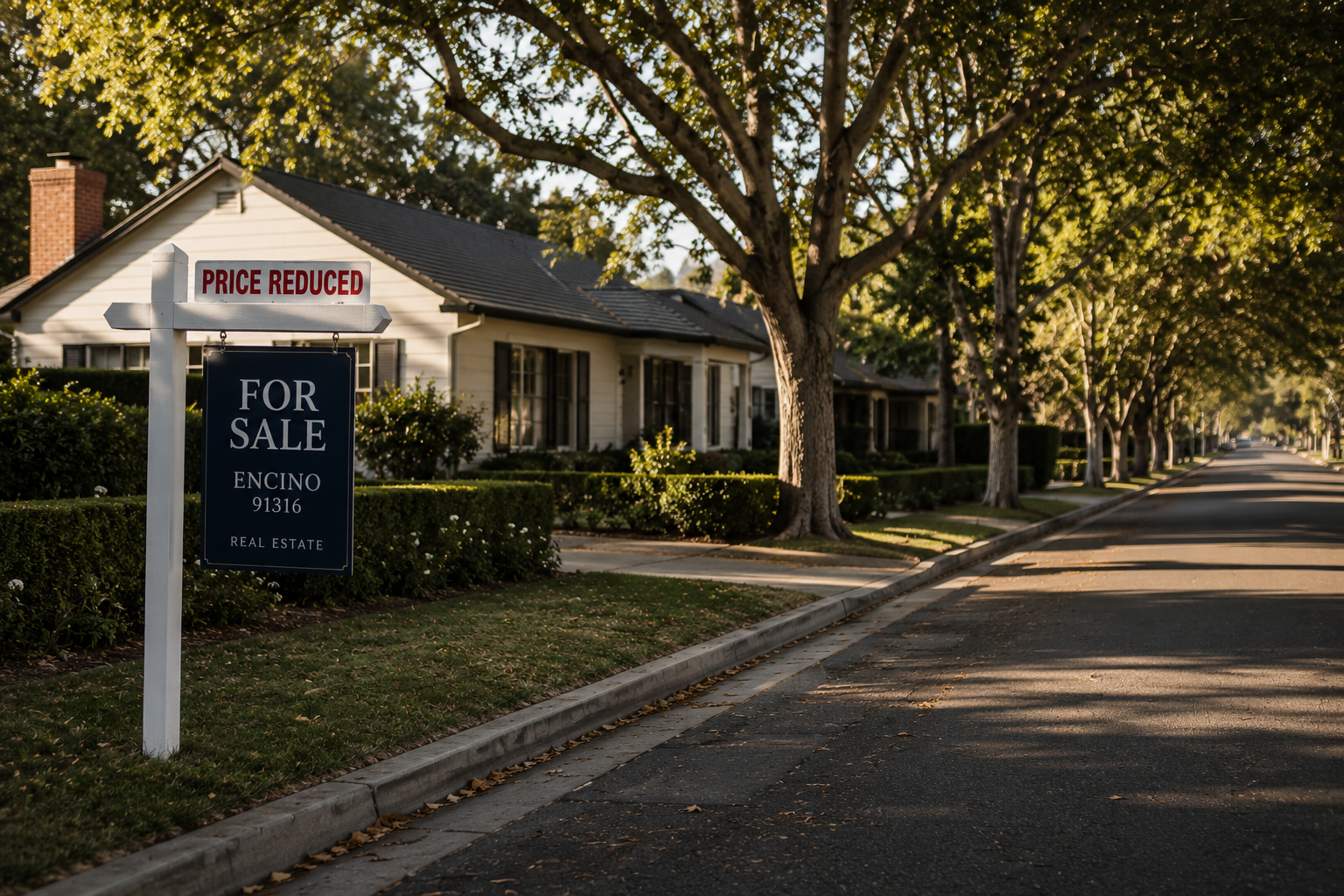 The "Price Reduced" sign in Encino 91316 is the most visible signal of the neighborhood's most expensive seller mistake — overpricing that accumulated DOM, built buyer leverage, and forced a correction that consistently produces lower net proceeds than a correctly priced launch would have generated.
Form 1 — The 2022 peak anchor:
Encino home values peaked in spring 2022 during the pandemic-era surge — and a meaningful share of Encino 91316 and 91436 sellers in 2026 still have a 2022 peak valuation somewhere in their mental furniture. It came from a refinance appraisal in 2021 or 2022, a neighbor's sale at peak, or a Zestimate that climbed to its all-time high and then corrected. The seller knows the 2022 number. They anchor to it. And they resist a 2026 list price that, while reflecting genuine current market value, feels like "selling for less than the home is worth."
The 2026 Encino reality: the $1.5M–$2.2M range in most Encino 91316 sub-neighborhoods has recovered to within 3–8% of 2022 peak pricing — the correction was real but the recovery has been substantial. The correct pricing anchor is current closed comps, not 2022 peak data. Sellers who use 2022 peak as their anchor overprice by 5–15% in most Encino situations — which looks small in percentage terms and enormous in absolute dollars at Encino price points.
Form 2 — South-of-Ventura / north-of-Ventura comp contamination:
Encino 91316 contains two meaningfully different sub-markets separated by Ventura Boulevard:
- → 🏡 North of Ventura: Standard SFV residential character, comparable to adjacent Tarzana 91356 and Reseda 91335 at the boundary — renovated comp ceiling typically $1.35M–$1.75M for 3–4 bedroom homes
- → 🏰 South of Ventura: Premium residential, larger lots, more architectural character, buyer profile overlapping with Sherman Oaks 91403 south-of-Ventura and Calabasas 91302 — renovated comp ceiling typically $1.6M–$2.5M+
Sellers north of Ventura who use south-of-Ventura comps — or who select the 3 highest Encino sales of the past 18 months regardless of which side of Ventura they're on — are not making a legitimate pricing argument. They are constructing a number that looks comp-supported but is not comp-supported by the relevant comparable set. Listing agents who allow this — or who construct this comp set deliberately to win the listing — are doing the seller a disservice that will manifest at day 45 of an overpriced listing.
Form 3 — Encino Hills 91436 premium misapplied to standard 91316 inventory:
Encino 91436 — the Encino Hills and premium estate tier — commands price premiums over standard 91316 inventory that reflect lot size, view, architectural quality, and the specific buyer profile that targets this sub-neighborhood. A 4,000 sq ft Encino Hills home on a 20,000 sq ft lot with canyon views is not a comp for a 2,400 sq ft north-of-Ventura 91316 home on a 9,000 sq ft flat lot — regardless of how close they are geographically. Sellers who use 91436 premium closings to support 91316 standard inventory pricing are applying a comp set that no competent buyer's agent, lender, or appraiser will validate.
Form 4 — Renovation investment recovery overestimation:
Encino sellers who have invested $150,000–$250,000 in comprehensive pre-sale renovation frequently arrive at the pricing conversation expecting to recover the renovation investment dollar-for-dollar on top of the pre-renovation value baseline. In some Encino sub-neighborhoods and at some investment levels, this is partially achievable. In others, the comp ceiling absorbs $100,000 of a $180,000 renovation investment and the seller nets a negative renovation return — not because the renovation was poorly executed, but because the comp ceiling didn't support the full investment.
The correct renovation pricing discipline: the comp ceiling for renovated homes in your specific Encino sub-neighborhood is the maximum your list price can target — regardless of what the renovation cost. If your renovation invested $180,000 and the renovated comp ceiling for your sub-neighborhood is 8% above your pre-renovation value baseline, you are pricing against market reality — not against your renovation cost.
2. 📸 The Presentation Mistake — Underestimating Encino Buyer Sophistication
The second most consequential mistake Encino sellers make is underpreparing the presentation — listing photography, staging, and pre-market digital presence — for a buyer pool that is, on average, the most visually and financially sophisticated in the SFV markets PEP serves.
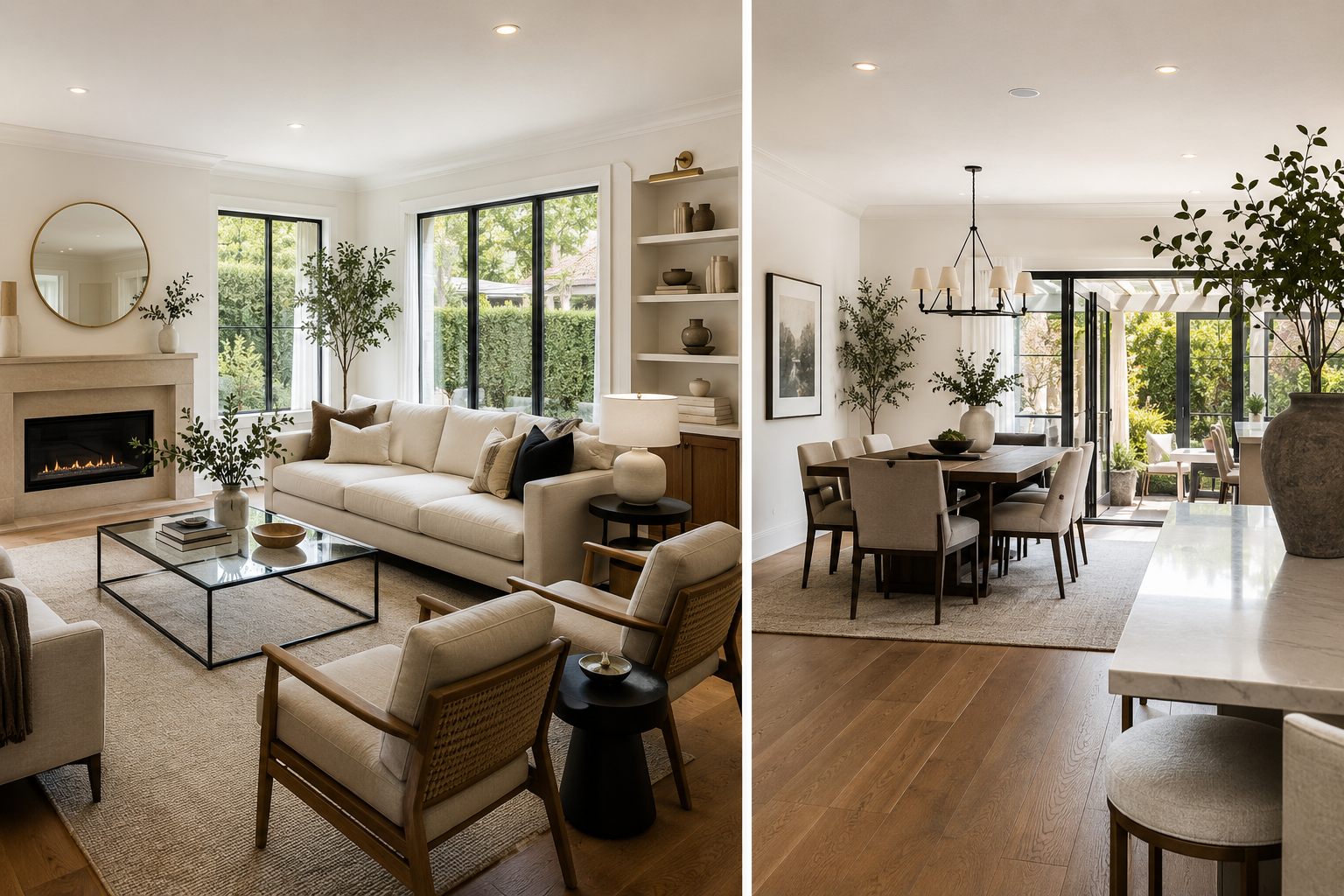 Presentation quality in Encino produces a measurable, quantifiable showing traffic difference — and in a market where first-week showing volume is the primary predictor of offer quality, the seller who skips professional photography and staging in the $1.5M–$2.5M Encino range is unilaterally reducing their buyer competition at the most valuable moment in the listing cycle.
The Encino buyer profile and what it demands:
Encino buyers in the $1.3M–$3M range include:
- → 🎬 Entertainment industry professionals: Writers, directors, producers, and above-the-line talent who spend their professional lives in visually curated environments and who evaluate listing photography with the same critical eye they bring to production design
- → 🏠 Westside relocators: Buyers who have been renting or owning in Santa Monica, Brentwood, and West Hollywood — markets where listing presentation quality is categorically higher than most SFV inventory — and who bring Westside presentation expectations to their Encino search
- → 💼 Move-up buyers from Sherman Oaks 91403/91423: Buyers who have already purchased once and who have seen hundreds of listings and have calibrated their perception of listing quality to the Sherman Oaks premium inventory that defines presentation standards in the mid-SFV market
This buyer pool does not give sellers credit for "potential." They evaluate what is presented. A home that is listed with iPhone photography, occupied and cluttered, with dark rooms and an overgrown front yard is not receiving the same consideration from an Encino buyer as the same home presented with professional photography, vacant or virtually staged, with fresh landscaping and a freshly painted front elevation.
The specific presentation elements that matter in Encino:
- → 📸 Professional listing photography: Not just "professional" in the sense of a dedicated camera — professional in the sense of an architectural photographer who understands light, composition, and the specific visual language of $1.5M–$2.5M residential real estate. The Encino buyer pool distinguishes between acceptable photography and excellent photography, and allocates showing time accordingly.
- → 🛋️ Vacant staging or virtual staging: Occupied homes with personal furniture arrangements, family photos, and personal decor consistently produce lower showing-to-offer conversion rates than staged or virtually staged homes that allow buyers to visualize their own life in the space.
- → 🎥 Video and 3D tour: The Encino buyer pool has the highest share of out-of-area evaluators — Westside buyers, relocation buyers, and out-of-state equity transplants — who make showing decisions based on the digital presentation before they invest time in a physical showing. A listing without video or 3D tour loses a meaningful share of this buyer segment before it has a chance to compete.
- → 🌐 Digital distribution: Premium listing syndication beyond Zillow and Redfin — targeted social distribution, agent-to-agent marketing, and the pre-launch coming-soon strategy that builds buyer queue before the active listing date — is the difference between a first-week showing schedule of 4 and a first-week showing schedule of 14 in Encino.
3. ⏰ The Timing Mistake — Seasonal Miscalculation in Encino
The third significant mistake Encino sellers make is launching in the wrong seasonal window without compensating appropriately in preparation and pricing — or, conversely, using seasonal excuse-making to justify poor results that are actually caused by overpricing and underpresentation.
The Encino seasonal reality:
Encino 91316 and 91436 follow the SFV's broad seasonal pattern — spring peak (March–May), summer softening (June–August), fall re-engagement (October–November), winter slowdown (December–January) — with one Encino-specific nuance: the entertainment industry buyer cycle.
The entertainment industry — a significant Encino buyer segment — has a hiring and production calendar that partially decouples from the standard residential spring cycle. Pilot season (January–March) and production season (spring through fall) create buyer activation patterns among entertainment households that are less correlated with school enrollment calendars and more correlated with career and financial events.
Seasonal mistakes specific to Encino:
- → ❌ Launching in July or August without price and strategy adjustment: Encino sellers who carry their spring pricing expectations into a summer launch consistently accumulate DOM without understanding why. Summer Encino buyers are real — but fewer in number, less urgency-driven, and more negotiating-room-focused than spring buyers. Summer pricing should be at midpoint of the defensible range, not the top.
- → ❌ Delaying a fall launch because "spring is better": The October fall window in Encino is consistently underutilized — re-engaged serious buyers, year-end financial motivation, and thinner competing inventory create conditions that a prepared, correctly priced Encino listing should exploit rather than skip. Sellers who delay a October-ready listing until the following March are paying 5+ months of carrying costs to gain a marginal seasonal advantage that correct pricing and strong preparation can partially compensate for in October.
- → ❌ Blaming the season for overpricing results: The most pervasive seasonal mistake in Encino is attributing extended DOM to market seasonality when the actual cause is overpricing. A correctly priced, well-prepared Encino home sells in any month. An overpriced Encino home doesn't sell in any month and blames July.
4. 🤝 The Agent Selection Mistake — Choosing the Highest Price Over the Best Strategy
The fourth most consequential Encino seller mistake is choosing the listing agent based on who quoted the highest list price — rather than who has the strongest net proceeds track record in Encino 91316 and 91436.
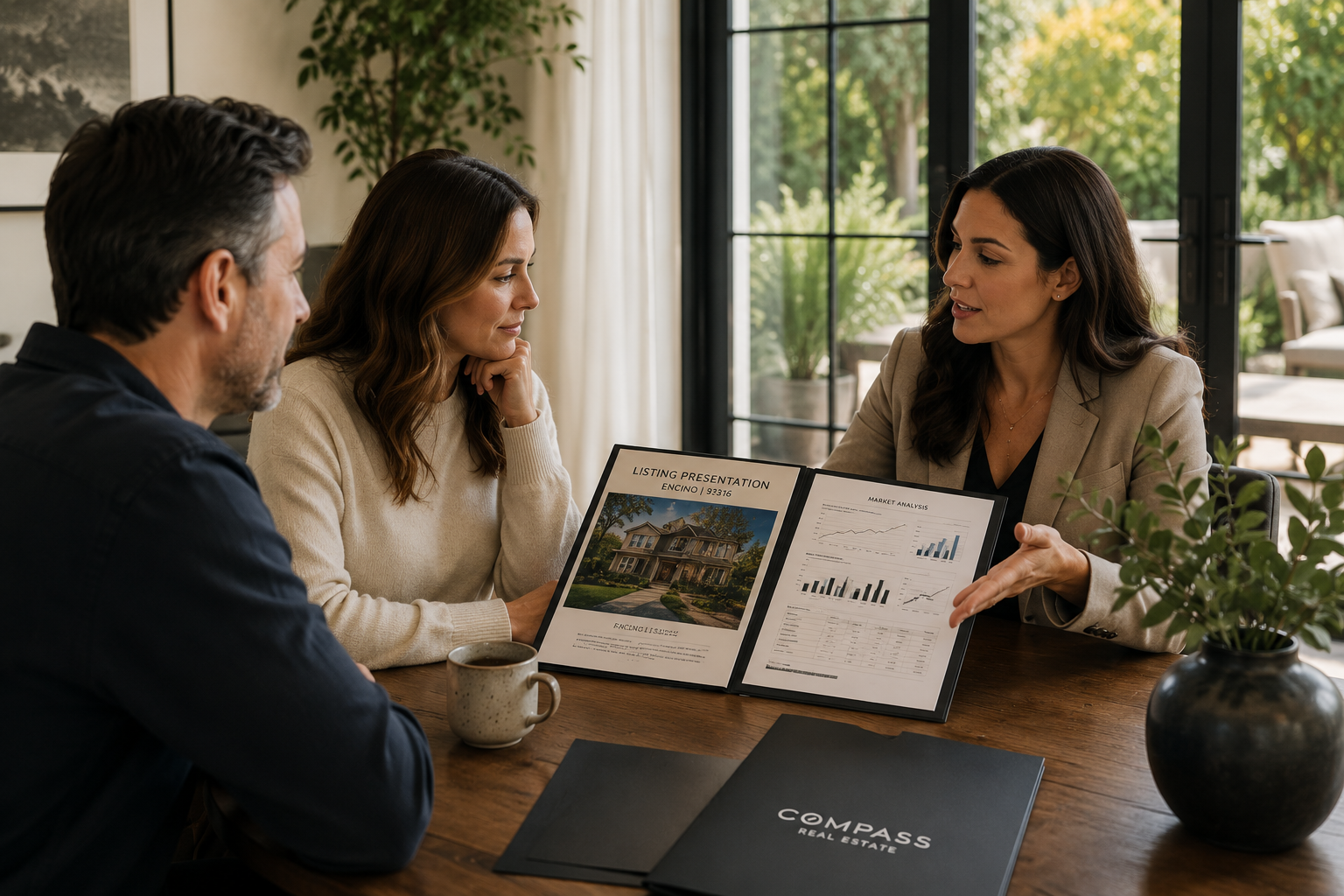 The listing agent selection conversation in Encino is the decision that determines everything that follows — and the most common Encino seller error is selecting based on the highest quoted list price rather than the agent's verifiable track record on list-price-to-close-price ratio and DOM in Encino 91316 and 91436.
The "buying the listing" dynamic in Encino:
"Buying the listing" is the industry term for an agent who quotes an inflated list price to win the listing agreement — knowing that the price reduction will come later, after the listing is secured, and that the seller will be more committed to the agent relationship by that point than they were during the initial selection process.
In Encino, where sellers have significant equity, sophisticated financial sensibilities, and strong opinions about their home's value, the temptation to listen to the agent who quotes the highest price is particularly acute — because the high price feels validating rather than suspicious. A seller who has watched their Encino home appreciate from $900,000 to $2.0M+ over 15 years wants to believe the $2.35M quote. The agent who quotes $1.95M based on honest comp analysis feels like they're leaving money on the table.
The outcome of choosing the $2.35M quote: 60–90 days of DOM, two price reductions, and a close at $1.97M — $20,000 below the honest agent's target close, plus $15,000–$20,000 in accumulated carrying costs, plus the emotional cost of a listing process that felt like failure rather than success.
How to evaluate Encino listing agents correctly:
- → ✅ Ask for their last 10 Encino 91316/91436 closed listings: List price, close price, and DOM. Calculate their average list-to-close ratio. An agent averaging 98–103% of list price with 20-day average DOM is telling you something real about their pricing discipline and marketing effectiveness. An agent averaging 94% of list price with 55-day average DOM is telling you something equally real.
- → ✅ Ask specifically how they determined their suggested list price: A comp-based answer with specific addresses, specific adjustments for sub-neighborhood, condition, and recency is an honest answer. A general assertion that "Encino is hot right now" or "your home's unique features support a premium" without specific comp support is a warning sign.
- → ✅ Ask what happens if the home doesn't receive an offer in the first 21 days: An agent with a clear protocol — showing feedback analysis, price adjustment framework, proactive buyer outreach — is better prepared than an agent who says "we'll give it more time."
- → ✅ Ask who will be presenting your home and handling your transaction: Some Encino listing agents produce the listing presentation personally and then hand the transaction to a less experienced team member. Know specifically who is doing the work.
5. 🔍 The Disclosure Mistake — Underestimating What Encino Buyers Will Discover
The fifth mistake Encino sellers make — particularly relevant for the 1960s–1970s Encino 91316 housing stock and the larger estate properties in 91436 that have accumulated decades of improvements, additions, and deferred maintenance — is incomplete or inadequate disclosure.
The Encino disclosure reality:
California requires extensive seller disclosure — the Transfer Disclosure Statement (TDS), the Seller Property Questionnaire (SPQ), local addenda, and the Natural Hazard Disclosure (NHD). But beyond the legal requirements, the practical disclosure reality in Encino is this: sophisticated Encino buyers with experienced buyer's agents and comprehensive inspection protocols will discover material issues that the seller did not disclose. The question is whether those discoveries happen before offer acceptance (with the seller in control) or during the inspection contingency period (with the buyer in control and a transaction at risk of falling out).
The specific Encino disclosure issues that surface most frequently:
- → ⚠️ Unpermitted additions and conversions: Encino homes — particularly in 91316 — frequently have room additions, garage conversions, and structure changes completed without permits over decades of ownership. These show up on permit searches, in inspection reports, and in the title history. Undisclosed unpermitted work discovered post-acceptance gives buyers a contract exit right and negotiating leverage they wouldn't have if the disclosure was complete.
- → ⚠️ Prior insurance claims: Water damage, mold remediation, fire, and other prior insurance claims are discoverable through CLUE (Comprehensive Loss Underwriting Exchange) reports that buyers can obtain. Sellers who don't disclose known prior claims hand buyers a disclosure gap that complicates or kills transactions.
- → ⚠️ Encino Hills geological issues: Properties in the Encino Hills sub-neighborhoods of 91436 may have geological conditions — hillside soil stability, landslide risk, expansive soil — that require disclosure and that surface in geological inspections. Sellers who don't proactively address these in the disclosure create the conditions for inspection-period transaction failures.
- → ⚠️ HOA compliance issues: For Encino homes within HOA-governed communities, undisclosed violations, special assessments, or pending HOA litigation that affects the property creates buyer remedies post-acceptance that the seller would have been better off addressing pre-listing.
The proactive disclosure strategy:
The sellers who navigate Encino disclosure most successfully are those who order a pre-listing inspection, address what they can address, disclose what they cannot, and price the known issues into the list price rather than hoping buyers don't discover them. The seller who knows about the unpermitted addition before listing can disclose it, get a retroactive permit or legalization quote, and price accordingly — maintaining control. The seller who discovers the buyer has discovered it at day 12 of the inspection contingency has lost control of the transaction at its most vulnerable moment.
🚫 What NOT to Overdo
Don't let the Zillow Zestimate anchor your Encino pricing decision. Zillow's automated valuation model is a directional indicator — not a comp analysis. In Encino 91316 and 91436, where sub-neighborhood variation between north-of-Ventura and south-of-Ventura is $200,000–$500,000 on comparable home sizes, and where lot size, view, and architectural character produce wide individual property variation, the Zestimate's accuracy is insufficient for a $1.5M–$3M pricing decision. Use it as a sanity check, not an anchor.
Don't list before the home is genuinely ready. The first week of a Northridge listing is the most valuable — showing traffic and buyer attention peak in days 1–7 and decline steadily from there. An Encino listing is no different. A home that launches before the renovation is complete, before the staging is in place, before the professional photography is done is spending its most valuable marketing days in a state that is generating rejections rather than offers. The cost of a 10-day launch delay to complete preparation is $2,000–$3,000 in additional carrying costs. The cost of launching underprepared is $30,000–$80,000 in reduced buyer competition and offer quality.
Don't make price reductions in increments too small to generate renewed buyer interest. When a price reduction is warranted in Encino, the reduction needs to be large enough to reset buyer perception and generate new showing activity — not just satisfy the seller's psychological need to "try something." A $15,000 price reduction on a $2.1M Encino listing that has been sitting for 55 days will not be noticed by the buyer pool. A $75,000–$100,000 reduction that brings the list price to the correct market position will generate new showing activity and potentially new offers. Make price reductions meaningful or don't make them.
Don't confuse buyer interest in showings with buyer willingness to pay your list price. Encino sellers frequently interpret active showing traffic as validation of their list price — "we've had 12 showings, so the price must be right." Showings are generated by marketing and positioning. Offers are generated by value alignment between list price and buyer perception. An overpriced Encino listing can generate 15 showings and zero offers — because sophisticated Encino buyers will tour a home they're interested in, confirm that it's overpriced, and move on without making an offer they know won't be entertained. Showings without offers is the clearest market signal that the price is wrong, not that the buyers are wrong.
🏠 Real-World Scenario — Encino 91316
A seller in Encino 91316 received three listing presentations. One agent quoted $2.25M. One quoted $2.05M. We quoted $1.92M — the top of the defensible range for their specific north-of-Ventura Encino 91316 sub-neighborhood based on renovated comps from the last 90 days within 0.4 miles.
The seller chose the $2.25M agent. We wished them well and followed the listing.
Day 1–7: 8 showings, no offers. Day 8–21: 4 additional showings, no offers. Day 22: First price reduction to $2.1M. Day 22–45: 6 showings, no offers, one lowball at $1.88M rejected. Day 46: Second price reduction to $1.97M. Day 47–62: 4 showings, offer at $1.93M. Counter-accepted at $1.95M. DOM: 63 days.
Net to seller: $1.95M gross minus commission ($107,250 at 5.5%), minus closing costs ($24,375), minus carrying costs during 63-day listing ($22,050), minus mortgage payoff ($850,000) = approximately $946,325.
Our projected outcome at $1.92M: launch with pre-marketing, 12–18 first-week showings, multiple offers in week two, close at $1.95M–$1.98M in 18–22 days. Net to seller: $1.97M gross (conservative) minus commission ($108,350), minus closing costs ($24,625), minus carrying costs for 22 days ($7,700), minus mortgage payoff ($850,000) = approximately $979,325.
The overpricing cost: approximately $33,000 in reduced net proceeds — from extended carrying costs and the buyer leverage that accumulated DOM produced. The seller reached the same close price through a 63-day painful process that a correctly priced 22-day launch would have produced more efficiently with less stress and $33,000 more in net proceeds.
🏠 Real-World Scenario — Encino 91436
A seller in Encino 91436 had completed a comprehensive renovation — $195,000 in scope — and expected to list at $2.85M based on the renovation investment added to a pre-renovation baseline of $2.1M. The renovated comp ceiling for their specific Encino 91436 sub-neighborhood, based on actual closed sales within 0.4 miles in the last 90 days: $2.55M–$2.70M.
The seller's expected price ($2.85M) exceeded the current renovated comp ceiling by $150,000–$300,000. The renovation was beautiful. The comp ceiling was what it was.
We presented the data — the three most relevant closed comps, the condition adjustments, the price-per-square-foot analysis. The seller acknowledged the comp data but pushed to launch at $2.75M — a compromise between their expectation and our recommendation. We launched at $2.75M with full pre-marketing, professional photography, and a proactive buyer's agent outreach campaign.
Day 1–14: 9 showings. Consistent showing feedback: "love the renovation, the price feels high relative to recent sales." No offers. Day 15: Price reduction to $2.65M. Day 15–30: 7 showings, one offer at $2.48M. Counter at $2.60M. Buyer accepted $2.58M. DOM: 31 days.
Had we launched at $2.65M on day one — within the renovated comp ceiling — the probability of multiple offers and a close at $2.65M–$2.70M was significantly higher than the single-offer negotiation that the overpriced launch produced. The seller who pushed for $2.75M closed at $2.58M — $70,000–$120,000 below where a correctly positioned launch would likely have produced, because the overpriced launch gave the first-offer buyer the negotiating position that multiple competing buyers would have eliminated.
❓ FAQ
Why do Encino homes sit on the market so long? The most common reason Encino 91316 and 91436 homes accumulate extended DOM is overpricing — specifically, list prices that exceed the current closed comp ceiling for the specific sub-neighborhood and condition tier. Encino's sophisticated buyer pool identifies overpriced listings quickly, tours them to confirm the assessment, and then moves on without making offers they know won't be accepted. The result is showing traffic without offer conversion — the clearest market signal that the price, not the home, is the problem. Secondary causes include underprepared presentation (photography, staging, condition) and timing mismatches between list date and seasonal buyer pool depth.
What is the right list price for a home in Encino? The right Encino list price is the top of the defensible range supported by closed comps within 0.4 miles, adjusted for condition, in the last 90 days — not 18 months, not across all of 91316, not cherry-picked from the highest Encino sales. North-of-Ventura Encino 91316 renovated comps currently support $1.35M–$1.75M for most 3–4 bedroom homes. South-of-Ventura 91316 supports $1.6M–$2.3M. Encino Hills 91436 supports $2.0M–$3.5M+ at the premium tier. Your specific list price requires the sub-neighborhood-specific comp analysis — not the zip code average.
How long should my Encino home take to sell? A correctly priced, well-prepared Encino 91316 home in the spring peak window (March–May) should sell in 18–35 days. South-of-Ventura and Encino Hills 91436 premium homes run 25–50 days in normal spring conditions. Summer and fall listings add 10–20 days to these ranges in normal conditions. If your Encino home is at 45+ days without an offer, the most likely cause is pricing — not market conditions, not the season, not buyer fatigue. Evaluate the showing feedback and the comp analysis before extending the listing at the same price.
Should I renovate before selling in Encino? For most Encino 91316 homes where the renovated comp ceiling is $100,000–$200,000 above the as-is value and a focused renovation costs $60,000–$100,000 — yes, renovate. The net renovation return in this scenario is typically $60,000–$100,000+ in additional net proceeds. For Encino 91436 premium estate properties where comprehensive renovation costs $150,000–$250,000 and the comp ceiling supports the investment — yes, with specific comp validation. For homes where the comp gap is less than $60,000 or the timeline is under 45 days — sell as-is and price correctly for condition.
What's the difference between Encino 91316 and 91436 for sellers? Encino 91436 is the Encino Hills and premium estate tier — larger lots (15,000–40,000+ sq ft), more significant architectural character, canyon views, and a buyer profile that expects luxury finishes and justifies a $2.0M–$3.5M+ price range for the right home. Encino 91316 spans north-of-Ventura (more standard SFV residential character, $1.3M–$1.75M for most renovated homes) and south-of-Ventura (premium residential, $1.6M–$2.5M for larger, better-positioned homes). The mistake most sellers make is treating these as one market rather than three distinct sub-markets with different buyer profiles, comp ceilings, and presentation requirements.
How do I choose the right listing agent in Encino? Ask every agent presenting to you for their last 10 closed Encino 91316/91436 listings: list price, close price, and DOM. Calculate their average list-price-to-close-price ratio and their average DOM. Strong Encino representation produces 97–103% of list price with 20–35 day DOM. Ask specifically how they determined their suggested list price — the answer should reference specific closed comps with adjustments, not general market sentiment. Ask what their protocol is if the home doesn't receive an offer in the first 21 days. Choose based on this data, not on who quoted the highest price.
🎯 Bottom Line
The biggest mistake Encino sellers make is overpricing — in its specific Encino forms: 2022 peak anchoring, south-of-Ventura comp contamination applied to north-of-Ventura inventory, renovation investment recovery overestimation, and the seductive but destructive practice of choosing the listing agent who validates the seller's hoped-for price rather than the one who presents the honest comp analysis.
The Encino seller who prices correctly from day one — based on current, sub-neighborhood-specific closed comp data rather than aspirational anchors — consistently outperforms the seller who overprices and corrects, because the correctly priced seller generates genuine buyer competition at launch rather than extended DOM that accumulates carrying costs and buyer leverage simultaneously.
The secondary mistakes — underprepared presentation, seasonal miscalculation, agent selection by highest quote, and incomplete disclosure — compound the overpricing mistake when they appear together. But overpricing is the mistake that causes the most damage in Encino, in the most Encino-specific ways, to the sellers who can most afford to get it right and most consistently don't.
At Parkway Estate Properties, our Encino seller representation begins with an honest comp analysis — sub-neighborhood specific, condition-tier adjusted, 90-day closed data, no aspirational cherry-picking. Liana's pricing strategy and Encino market knowledge, combined with Roman's renovation experience that informs every pre-sale preparation recommendation, gives Encino sellers the foundation that correct list prices, strong presentation, and clean transaction management require.
📩 Want an Honest Encino Pricing Analysis Before You List?
We'll run the sub-neighborhood comp analysis for your specific address, give you the defensible range and the rationale for every number in it, and build the net proceeds calculation that shows you what correct pricing actually produces — before any listing agreement is signed.
Contact Liana Shersher at Parkway Estate Properties: 📧 liana@parkwayestate.com · 📞 (818) 208-5881 · 🌐 parkwayestate.com 15021 Ventura Blvd., Ste. 510, Sherman Oaks, CA 91403
About the Authors
Liana Shersher Liana Shersher is a licensed real estate agent with Parkway Estate Properties Inc. and an Accredited Buyer's Representative (ABR) serving the San Fernando Valley — with a focus on Sherman Oaks, Encino, Tarzana, Woodland Hills, and Northridge (DRE# 02164224). Liana guides first-time homebuyers through every step of the purchase, from the first showing to the keys in hand, and represents move-up and repeat buyers across the Valley. For sellers, she builds the pricing and marketing strategy that positions a home to sell for top dollar, fast. Buyers and sellers work with Liana for clear communication, sharp local knowledge, and an agent who treats their goals like her own.
Roman Shersher Roman Shersher is the broker-owner of Parkway Estate Properties Inc. and a real estate investor with 18 years of experience in the San Fernando Valley (DRE# 01855095). Roman has personally led or co-led renovations on dozens of properties across the Valley, including recent projects in Northridge (91324) and Woodland Hills (91364). That hands-on renovation and investment experience shapes every pricing conversation and days-on-market strategy at Parkway — sellers get a realistic read on what improvements actually return at resale, and buyers get an expert eye on a home's true condition and upside.
Parkway Estate Properties, Inc. 15021 Ventura Blvd., Ste. 510, Sherman Oaks, CA 91403 · (818) 208-5881 · parkwayestate.com · Broker License #: 01873092 Equal Housing Opportunity. Information herein is general and not legal, tax, or financial advice. Consult qualified professionals for your specific situation.
Categories
Recent Posts










Broker | Realtor ® License ID: 01873092
+1(818) 208-5881 | info@parkwayestate.com