
First-Time Homebuyer's Guide to Reseda

Reseda 91335 is the San Fernando Valley's most accessible entry point for the first-time homebuyer who has been renting in the central Valley — Van Nuys 91401/91405/91406, Canoga Park 91304, or Northridge 91324/91325 — and who is ready to transition from renting to owning a genuine single-family home with a real backyard, a garage, and the equity accumulation that the Reseda market's BRRRR demand floor has sustained through rate cycles that have been harder on markets without an investment buyer backstop.
This guide maps everything a Reseda first-time buyer needs to navigate the purchase successfully — the income and capital required at each price point, the FHA financing mechanics specific to Reseda's housing stock, the seller-paid buydown and how to negotiate it, the pre-offer inspection intelligence that the Reseda 91335 housing vintage specifically requires, and the ADU-awareness that allows the first-time buyer to identify properties whose lot configuration supports future value-add rather than purchasing without this future optionality mapped.
1. 💳 The Financial Foundation — What You Need to Buy in Reseda
The Reseda first-time buyer's financial readiness has four components — income qualification, down payment, closing costs, and post-close reserves — each requiring specific understanding before any active home search begins.
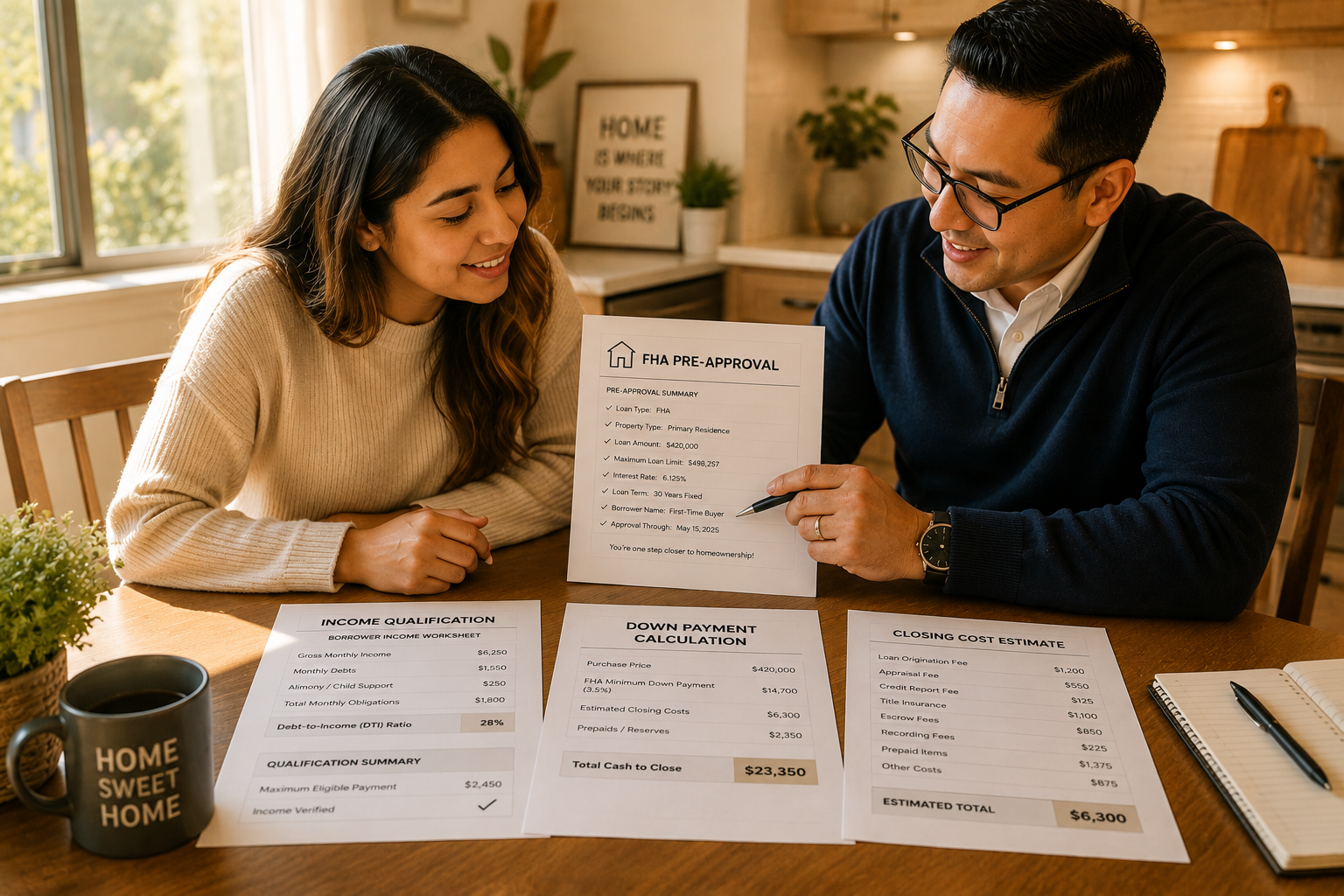 The Reseda first-time buyer financial foundation conversation — the pre-approval and complete capital requirement assessment that determines whether a buyer is ready to begin an active home search or needs additional time to build income, credit, or savings. At Reseda's FHA-accessible price tier, the four-component financial assessment (income, down payment, closing costs, reserves) is more achievable than most first-time buyers assume — but requires specific planning rather than discovery after an offer is accepted.
Component 1 — Income Qualification:
At the Reseda volume tier with FHA financing:
At $680,000 purchase (3.5% down, $656,200 FHA loan at 7.25%):
- → 💳 Monthly P&I: $4,477
- → 🏛️ Property taxes (1.22%): $691/month
- → 🏠 Insurance: $105/month
- → 📋 FHA MIP (0.55%): $300/month
- → Total PITI + MIP: $5,573/month
- → 💰 Comfortable income (32% front-end DTI): $208,988/year
- → 💰 Minimum qualifying (43% total DTI, $1,200/month other debts): $188,700/year
With seller-paid 2-1 buydown (qualifying at 5.25% year-one rate):
- → Year-one P&I at 5.25%: $3,624/month
- → Year-one PITI + MIP: $4,720/month
- → 💰 Year-one qualifying income (32% front-end): $177,000/year
- → Income threshold reduction from buydown: $32,000/year
At $760,000 purchase (3.5% down, $733,400 FHA loan at 7.25%):
- → 💳 Monthly P&I: $5,004
- → 🏛️ Property taxes: $773/month
- → 🏠 Insurance: $120/month
- → 📋 FHA MIP: $336/month
- → Total PITI + MIP: $6,233/month
- → 💰 Comfortable income: $233,738/year
- → 💰 Minimum qualifying: $210,850/year
With seller-paid buydown at 5.25% year-one:
- → Year-one PITI + MIP: $5,271/month
- → 💰 Year-one qualifying income: $197,663/year
Component 2 — Down Payment:
FHA minimum down payment is 3.5% of the purchase price (with 580+ FICO score):
- → $680,000 × 3.5% = $23,800
- → $720,000 × 3.5% = $25,200
- → $760,000 × 3.5% = $26,600
- → $800,000 × 3.5% = $28,000
✅ Down payment gift funds: FHA allows the full down payment to come from eligible gift funds — from family members, specifically. A gift letter from the donor and bank statement documentation of the transfer are required at underwriting. Many Reseda first-time buyers use family gift funds for part or all of the FHA down payment.
⚠️ 5% conventional alternative: Conventional loans with 5% down eliminate the FHA Mortgage Insurance Premium (MIP) requirement that adds $300–$400/month to FHA monthly costs — but require a higher FICO score (620+ minimum, 740+ for best rates) and private mortgage insurance (PMI) instead of MIP. At comparable credit scores and down payment levels, FHA and conventional produce similar monthly costs for the Reseda first-time buyer. Compare both with the specific lender before deciding.
Component 3 — Closing Costs:
The Reseda first-time buyer's closing costs include:
- → Lender origination fee: $1,800–$3,500
- → Appraisal: $600–$850
- → Title insurance (lender's policy): $1,200–$2,000
- → Escrow fees (buyer's share): $1,100–$2,000
- → Recording fees: $150–$300
- → Pre-paid interest: $300–$1,800 (varies by close date)
- → Pre-paid property taxes (varies by close month): $0–$4,500
- → Pre-paid homeowners insurance (first year): $1,140–$1,740
- → 💰 Total buyer closing costs: $9,500–$17,500
✅ Seller credit for closing costs: The Reseda first-time buyer can negotiate seller closing cost credits as part of the offer — reducing the cash needed at close. FHA allows seller credits up to 6% of the purchase price. A seller credit of $8,000 on a $720,000 Reseda purchase covers most of the buyer's closing costs, leaving only the down payment and reserves as the primary capital requirements.
Component 4 — Post-Close Reserves:
FHA lenders typically require 2–3 months of PITI in liquid reserves post-close:
- → At $680,000 FHA: 2-month reserve = $11,146
- → At $760,000 FHA: 2-month reserve = $12,466
Total capital required (FHA, $720,000):
- → Down payment: $25,200
- → Closing costs (after $8,000 seller credit): $6,500
- → Reserves: $11,800
- → Total: approximately $43,500
Without the seller credit:
- → Total: approximately $52,000–$58,000
2. 🏠 FHA Financing and Reseda's Housing Stock — What First-Time Buyers Must Know
The Reseda first-time buyer who uses FHA financing must understand a specific interaction between the FHA loan product and Reseda's 1950s–1970s housing stock that no other financing type produces in the same way — and that the Northridge 91324/91325 first-time buyer guide addressed at the FHA market level but that requires Reseda-specific calibration here.
FHA minimum property condition requirements:
FHA loans require that the property meet specific minimum property standards (MPS) at the time of the FHA appraisal. The appraiser is required to note — and the lender is required to resolve — conditions that fail the MPS before the loan funds. The most common FHA condition flags in Reseda's housing stock:
🌡️ HVAC systems:
- → Reseda's 1950s–1970s housing stock frequently has HVAC systems at or past the 15–20 year useful life threshold
- → An FHA appraiser who finds an HVAC system that is non-functional or clearly deteriorated will flag it as a required repair
- → ✅ Buyer strategy: Ask the listing agent for the HVAC system's age and service history before making an offer on any Reseda listing. If the HVAC is 18–22+ years old, budget for either a negotiated seller repair credit or a potential FHA condition flag post-appraisal.
🏠 Roofing:
- → Roofing with less than 2–3 years of estimated remaining life is an FHA flag condition
- → Original Reseda roofing that has not been replaced may have reached the end of its useful life
- → ✅ Buyer strategy: Request the roof age from the listing disclosures. If the roof is 20+ years old, request the seller's pest and roof inspection reports before making an offer.
⚡ Electrical panels:
- → Some Reseda 1950s–1960s homes have original 60-amp or 100-amp panels that are inadequate for modern electrical loads
- → Federal Pacific Electric (FPE) Stab-Lok and Zinsco panels have documented safety concerns and are FHA flag conditions
- → ✅ Buyer strategy: Ask the listing agent whether the electrical panel has been updated. A 200-amp panel is the current standard; anything smaller or with a known safety concern is worth investigating pre-offer.
🎨 Peeling paint in pre-1978 homes:
- → FHA triggers a lead paint assessment requirement for peeling paint in homes built before 1978 — which includes most of Reseda's housing stock
- → ✅ Buyer strategy: Look for peeling exterior paint at showing. If present, a lead-based paint inspection may be required as an FHA condition — budget time and cost ($300–$500) for this assessment.
The FHA condition timing strategy:
The first-time Reseda buyer using FHA financing has two approaches to FHA condition flags:
Approach A — Purchase improved or renovated condition inventory: The FHA buyer who specifically targets improved or renovated Reseda listings (LVP flooring updated, kitchen refreshed, primary living areas painted, HVAC recently replaced) significantly reduces the FHA condition flag risk — the seller has already addressed the primary inspection concerns, and the FHA appraiser finds a well-maintained property that meets MPS without conditions.
Approach B — Budget for FHA conditions in the offer structure: The FHA buyer who purchases original-condition Reseda inventory (at a lower purchase price reflecting the deferred maintenance) should include a specific FHA condition repair budget in their financial planning — either as a seller repair credit negotiated in the offer or as a buyer-funded repair fund post-close if the FHA conditions are minor.
3. 🎁 The Seller-Paid Buydown — The Reseda First-Time Buyer's Best Negotiating Tool
The seller-paid 2-1 buydown is the single most valuable negotiating tool available to the Reseda first-time buyer — and it is the tool that most first-time buyers don't know to request, don't know how to request, or don't understand well enough to evaluate correctly when a seller offers it.
What the buydown does for the Reseda first-time buyer:
At a $760,000 FHA purchase with the 2-1 buydown:
Year one (effective rate 5.25%):
- → Monthly P&I: $4,049 vs. $5,004 at full rate
- → Monthly savings: $955/month = $11,460 in year one
Year two (effective rate 6.25%):
- → Monthly P&I: $4,520 vs. $5,004 at full rate
- → Monthly savings: $484/month = $5,808 in year two
Total buyer savings over 24 months: $17,268
The seller's cost to provide this benefit: approximately $14,200 — less than the total buyer savings because the discount to the lender is calculated on a present-value basis.
How to request the buydown in the Reseda market:
The buydown can be requested in two ways:
Method 1 — Offer-incorporated request: Include the seller-paid buydown as a specific seller concession in the purchase offer. In the offer, specify: "Seller to provide a 2-1 buydown as a seller concession, not to exceed $14,500 in seller-paid closing costs/concessions." This structures the request clearly and within FHA's 6% seller concession limit.
Method 2 — Counter-offer negotiation: If the initial offer doesn't include the buydown request, it can be negotiated in the counter-offer process. The Reseda buyer who offers at or near the seller's asking price and then requests the buydown as the primary concession is making a strong offer that the seller is likely to accept — because the seller receives the price they wanted while providing a concession that activates the buyer's qualification without reducing the sale price.
Why sellers accept the buydown:
The Reseda seller who accepts the buydown instead of a price reduction is making a financially superior decision — as documented in the cost-to-sell article. The $14,200 buydown produces $955/month in year-one savings for the buyer; a $14,200 price reduction produces approximately $97/month in payment savings. The buydown activates the buyer's comfortable qualification threshold; the price reduction often doesn't move the needle on qualification at all.
The buydown vs. price reduction for the Reseda buyer:
If you have a choice between a $14,000 seller concession as a buydown versus a $14,000 price reduction — take the buydown. Every time. The payment relief in year one is 10x more valuable than the payment reduction from the price cut, and the year two savings of $5,808 offset almost half the total buydown cost in your favor over the first two years.
4. 🔍 ADU Awareness — How to Evaluate Reseda Properties for Future Value-Add
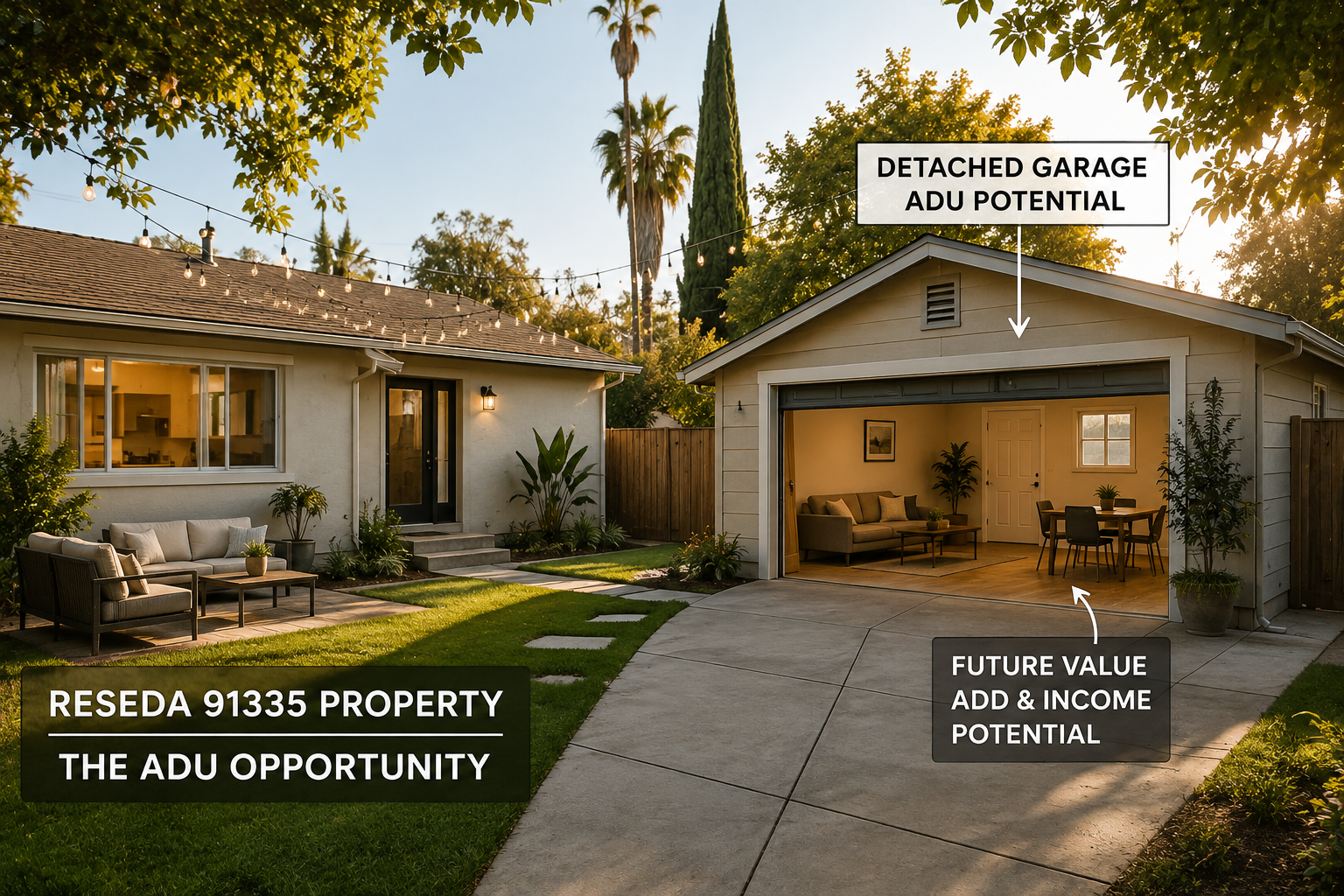 The ADU (Accessory Dwelling Unit) opportunity is the Reseda-specific first-time buyer evaluation framework that no other PEP first-time buyer guide addresses — because Reseda is the market in the PEP coverage area where the ADU opportunity is most consistently viable and most financially compelling at the first-time buyer's entry price point.
Why ADU awareness matters for the Reseda first-time buyer:
The Reseda first-time buyer who purchases a property with a detached garage or rear structure suitable for ADU conversion has purchased not just a home but a future value-add opportunity that can:
- → ✅ Add $85,000–$118,000 in appraised value at $55,000–$78,000 in conversion cost — a positive equity creation event if executed post-purchase
- → ✅ Generate $1,450–$1,900/month in rental income that reduces the net monthly ownership cost and improves long-term wealth building
- → ✅ Support a future BRRRR cycle if the buyer later decides to leverage the post-ADU equity for a second property acquisition
What to evaluate at every Reseda property showing:
✅ Lot size and configuration: Reseda 91335 lots of 7,000+ sq ft typically have sufficient rear or side yard to support a detached ADU (new construction, separate from the existing home) or a garage conversion. Lots below 6,500 sq ft have more limited ADU options but may still support attached or JADU (Junior ADU) configurations.
✅ Detached garage status: The most commonly viable and most cost-effective Reseda ADU type — the garage conversion. A detached 1-car or 2-car garage with adequate ceiling height (8 feet minimum), suitable electrical service, and access to plumbing (or routing capability) is the ADU opportunity the buyer should specifically identify.
Questions to ask at showing:
- → Is the garage detached or attached?
- → What is the interior height of the garage?
- → Is the garage currently used for parking, storage, or another purpose?
- → Has the seller ever explored ADU conversion?
✅ LADBS pre-check: For any Reseda property where the ADU opportunity appears viable, the buyer can complete a free pre-check at the Los Angeles Department of Building and Safety (LADBS — ladbs.org) to confirm the specific parcel's ADU conversion eligibility before close. The LADBS pre-check takes 2–3 business days online and confirms whether any lot constraints, existing unpermitted structures, or code violations would affect ADU conversion viability.
The ADU-aware first-time buyer's property evaluation:
Not every Reseda property has ADU potential — and the buyer who specifically wants this future optionality should explicitly filter their property search for:
- → ✅ Detached garage (not converted to living space already)
- → ✅ Lot size 7,000+ sq ft
- → ✅ Single-story home (leaves the most rear yard for the potential ADU)
- → ✅ No pool (pools typically occupy the rear yard that ADU construction requires)
The ADU timing:
First-time buyers should not plan to execute the ADU conversion immediately at purchase — the renovation scope, the permit process, and the construction timeline (typically 12–18 weeks after permit) requires post-purchase stability that the first 6–12 months of homeownership doesn't always support. The ADU is a 12–36 month post-purchase project that the buyer's financial position grows into rather than executes immediately.
5. 🌮 Making the Reseda Purchase Decision — The Buyer's Framework
With the financial foundation, the FHA mechanics, the buydown strategy, and the ADU awareness mapped, the Reseda first-time buyer needs the specific purchase decision framework that converts this knowledge into confident offer submission.
The five steps from search to offer:
Step 1 — Complete FHA pre-approval before any active search: The Reseda spring market (March–April) produces first-week offers on correctly priced improved-condition listings. The buyer without a pre-approval letter cannot make a competitive offer in these conditions. Complete the pre-approval process — gathering 2 years of tax returns, recent pay stubs, 2 months of bank statements — before attending any showing. Timeline: 5–10 business days for a standard W-2 buyer with organized documentation.
Step 2 — Identify the sub-neighborhood relative to your lifestyle priorities: Reseda 91335 has internal sub-neighborhood variation:
- → ✅ Southern Reseda (approaching Ventura Boulevard and Woodland Hills 91367): ECR Charter High School eligibility for many addresses (verify at lausd.net/schoolfinder); more Ventura Boulevard commercial lifestyle proximity
- → ✅ Central Reseda (Reseda Boulevard and "Little Lima" proximity): Maximum cultural food corridor access; the sub-neighborhood most motivating for the food-forward first-time buyer
- → ✅ Northern Reseda (approaching Northridge 91324 and the 118 corridor): Slightly larger lots in some sub-neighborhoods; different LAUSD school assignments
- → ✅ Verify ECR Charter eligibility for any address where high school quality is a purchase motivation — lausd.net/schoolfinder for the specific address
Step 3 — Build the pre-offer property intelligence: Before submitting any offer, the prepared Reseda first-time buyer should have assembled:
- → 📋 Listing disclosures review (including natural hazard disclosure, seller property questionnaire, any prior inspection reports in the seller's possession)
- → 📋 Visual assessment of HVAC age, roofing condition, and electrical panel type — the three primary FHA condition risk factors in Reseda's housing stock
- → 📋 ADU potential assessment (detached garage present, lot size adequate, no disqualifying constraints visible)
- → 📋 The 91335-filtered comp set for the specific sub-neighborhood and condition tier — to confirm the offer price is supported by the current market data
Step 4 — Structure the offer for Reseda conditions: A competitive Reseda spring offer:
- → ✅ Purchase price at or near the comp-supported ceiling for the specific condition tier
- → ✅ Pre-approval letter from a lender experienced with FHA financing at this price tier
- → ✅ Seller-paid 2-1 buydown request (specify as a seller concession, not to exceed $14,500)
- → ✅ Seller closing cost credit request if needed to reduce cash at close (combined with buydown within FHA's 6% seller concession limit)
- → ✅ Inspection contingency (17 days standard; use this period to complete the FHA-condition-specific pre-inspection described in Step 3 if not completed pre-offer)
- → ✅ Financing contingency (21 days standard for FHA; confirm with lender that FHA underwriting can be completed within the contingency period)
- → ✅ Realistic close date (45–60 days — FHA loans require more underwriting time than conventional; the FHA buyer who offers a 30-day close risks the close deadline before underwriting is complete)
Step 5 — Navigate the inspection and FHA appraisal: If the offer is accepted:
- → ✅ Independent inspection (days 1–14 of inspection contingency): Hire a licensed California home inspector for a comprehensive inspection. Focus the inspector's attention on HVAC condition, roofing remaining life, electrical panel type, and any visible moisture or structural concerns.
- → ✅ FHA condition negotiation (if inspection finds flags): If the inspection identifies items that will trigger FHA appraisal conditions, negotiate seller repair credits before removing the inspection contingency. The seller who won't address FHA condition items leaves the buyer with an FHA financing problem that conventional financing doesn't create.
- → ✅ FHA appraisal (ordered by lender after inspection contingency removal): The FHA appraiser independently confirms both the property value and the minimum property standards. The FHA appraisal must come in at or above the purchase price for the loan to fund at the agreed terms.
🚫 What NOT to Overdo
Don't begin active home search before FHA pre-approval is complete. The Reseda spring market's 18–32 day DOM for correctly priced improved-condition listings means desirable properties receive offers in the first 10 days. The buyer who finds the right home at a showing but doesn't have a pre-approval letter loses to the buyer who does. The pre-approval takes 5–10 business days — complete it before the first showing, not after.
Don't use the Zillow or Redfin "Zestimate" as your price reference for Reseda offers. Automated valuation models consistently produce inaccurate estimates for Reseda 91335 because they blend Van Nuys 91401/91405/91406 and Canoga Park 91304 comparables into the 91335 estimate, underpricing the "Little Lima" neighborhood character premium. Use the 91335-filtered comp set from an active MLS search — same bedroom count, same condition tier, within 0.4 miles, last 90 days — as your offer price reference. Your buyer's agent should provide this filtered comp set before any offer.
Don't overlook the FHA Mortgage Insurance Premium's lifetime obligation. FHA loans with less than 10% down require the FHA MIP for the life of the loan — not until 20% equity is reached as PMI on conventional loans allows. At $300–$400/month, FHA MIP is a real and ongoing cost. The Reseda first-time buyer who reaches 20% equity through appreciation and paydown and wants to eliminate the MIP must refinance to a conventional loan — which at current rates may not improve the monthly payment unless rates have declined from the FHA purchase rate. Factor the MIP as an ongoing cost throughout your projected hold period.
Don't purchase a Reseda property for ADU potential without verifying ADU viability through LADBS. The detached garage that visually appears convertible may have a code violation, a setback constraint, or an existing unpermitted structure that prevents permitted ADU construction. The LADBS pre-check (ladbs.org) is free and takes 2–3 business days — complete it during the inspection contingency period for any property where ADU potential is a specific motivation for the purchase.
Don't let the "Little Lima" food corridor motivate a purchase without specifically visiting it. The "Little Lima" cultural food corridor on Reseda Boulevard is the most distinctive lifestyle asset in 91335 — but its appeal is specifically cultural and specifically food-oriented. The first-time buyer who has researched the corridor online but hasn't experienced it in person should specifically visit on a Saturday morning and a weeknight evening before purchasing. The buyer who arrives post-close to discover that the food culture is not to their specific taste has anchored a neighborhood purchase to a lifestyle feature they haven't validated.
🏠 Real-World Scenario — Reseda 91335
A couple — a respiratory therapist and a pharmacy technician, combined income $231,000/year, zero prior homeownership experience, renting in Van Nuys 91401 at $2,650/month — was evaluating Reseda as their first purchase specifically because the "Little Lima" food corridor aligned with their food culture and because the entry price was lower than Lake Balboa 91406/91411.
Their starting position:
- → Savings: $52,000 in combined checking and savings accounts
- → Credit scores: 718 (respiratory therapist), 695 (pharmacy technician) — both above FHA minimum
- → Student loans: $380/month combined
- → Car payments: $648/month combined
The pre-approval analysis:
At $710,000 FHA (3.5% down = $24,850 down, $685,150 loan at 7.25%):
- → Monthly P&I: $4,674
- → Taxes: $724/month
- → Insurance: $112/month
- → FHA MIP: $314/month
- → PITI + MIP: $5,824/month
- → Total monthly debt (housing + student + car): $5,824 + $380 + $648 = $6,852
- → At 43% total DTI: $6,852 / 0.43 = $15,935/month gross required = $191,220/year
- → Their income: $231,000/year — qualified ✓
With seller-paid buydown at 5.25% year one:
- → Year-one PITI + MIP: $4,892
- → Total debt at year-one rate: $5,920/month
- → 43% DTI: requires $165,116/year — well within their income ✓
- → Year-one qualifying was comfortable rather than at maximum stretch
The capital assessment:
- → Down payment ($24,850) + closing costs ($11,500 estimated, no seller credit assumed) + reserves ($11,648 = 2 months PITI) = $47,998 required
- → Available: $52,000
- → Buffer: $4,002 — tight but sufficient
The offer strategy: They targeted an improved-condition Reseda 91335 3-bedroom with a detached garage at $715,000 list price. They offered $710,000 with a seller-paid 2-1 buydown request (capped at $14,000) and a $6,000 seller closing cost credit — reducing their cash at close requirement to approximately $28,000 (down payment only, with seller covering most closing costs through the credit).
The seller accepted $712,500 with the $14,000 buydown and $5,500 closing cost credit. The couple's cash at close: $31,200 — within their $52,000 available savings with $20,800 remaining as their post-close buffer.
Year-one ownership experience:
- → Monthly PITI + MIP at 5.25% buydown rate: $4,915
- → versus prior rent of $2,650/month: $2,265/month more than rent
- → versus what they would have paid at 7.25% full rate without buydown: $909/month less than full rate
- → The ADU assessment during inspection contingency: the detached garage was confirmed ADU-eligible through a LADBS pre-check. Their 18-month post-close plan includes the garage conversion ADU ($65,000 estimated) that will produce $1,550/month in rental income — at which point their net monthly ownership cost drops to approximately $3,365/month, approaching the rent they had been paying in Van Nuys.
🏠 Real-World Scenario — Reseda 91335
A single buyer — a 30-year-old K-12 LAUSD teacher, income $98,000/year, purchasing alone, specifically evaluating Reseda against continuing to rent — ran into the income qualification challenge that single-income first-time buyers face at Reseda's entry tier.
The income-to-Reseda challenge:
At $680,000 FHA (3.5% down, $656,200 loan at 7.25%):
- → PITI + MIP: $5,573/month
- → Other debts: $520/month (car payment)
- → Total: $6,093/month
- → At 43% total DTI: requires $169,254/year — above her $98,000 income ✗
She didn't qualify at the entry-tier price on her income alone.
The buydown re-qualification:
At 5.25% qualifying rate (buydown year-one):
- → PITI + MIP at 5.25%: $4,720/month
- → Total debt: $5,240/month
- → At 43% total DTI: requires $145,116/year — still above $98,000 ✗
The buydown alone didn't close the income gap.
The solution — FHA with co-borrower:
Her mother agreed to co-sign the FHA loan — adding her Social Security income of $28,500/year and a small part-time income of $18,000/year to the qualifying income.
Combined qualifying income: $98,000 + $28,500 + $18,000 = $144,500/year.
At 5.25% qualifying rate with buydown:
- → Required income (43% total DTI): $145,116/year — near but still slightly above ✗
A small price reduction to $660,000 (3.5% down, $636,900 loan):
- → PITI + MIP at 5.25%: $4,604/month
- → Total debt: $5,124/month
- → Required income (43% total DTI): $142,444/year — within $144,500 ✓
The purchase: $660,000 with mother as co-borrower, seller-paid buydown, and a $5,500 seller closing cost credit. Close in Reseda 91335, central sub-neighborhood, 3-bedroom with detached garage.
Her teaching schedule (school year August–June, summers off) meant the garage conversion ADU was planned for the first summer post-purchase — executed during her summer break with a contractor she had vetted during the escrow period. ADU rental: $1,450/month. Her net monthly ownership cost after ADU income: approximately $3,670/month — competitive with her prior Van Nuys 91401 rent of $2,850/month and building equity simultaneously.
The lesson for single-income Reseda first-time buyers: The income gap that prevents qualification at the entry-tier alone has multiple solutions — co-borrower addition, price reduction, seller-paid buydown, or a combination. Explore all options with the lender before concluding that Reseda is unaffordable.
❓ FAQ
How much do I need to buy a home in Reseda for the first time? The minimum capital required for a Reseda 91335 first-time FHA purchase: ✓ Down payment (3.5%): $23,800–$28,000 at the $680,000–$800,000 price range. ✓ Closing costs: $9,500–$17,500 (can be reduced through seller closing cost credits of $5,000–$8,500). ✓ Post-close reserves (2 months PITI): $11,000–$12,500. ✓ Total without seller credit: approximately $50,000–$58,000. ✓ Total with $7,500 seller credit: approximately $43,000–$50,000. Income required for comfortable qualification: $209,000–$234,000/year for the $680,000–$760,000 entry-tier FHA purchase. With seller-paid buydown qualifying at year-one rate: $177,000–$198,000/year.
Is Reseda a good place to buy a first home? Yes — for the first-time buyer whose priorities specifically align with what Reseda delivers. Reseda 91335 provides the most accessible SFV single-family home entry point ($650,000–$800,000 for a 3-bedroom with backyard and garage), the "Little Lima" cultural food corridor that is the most distinctive lifestyle anchor in the central Valley, the BRRRR investor demand floor that prevents the deep price corrections that pure owner-occupant markets experience, and the ADU opportunity that allows the value-add-minded first-time buyer to build equity post-purchase through a planned garage conversion. The first-time buyer who values cultural food diversity, central Valley lifestyle access, and the future optionality of ADU income will find Reseda specifically compelling. The buyer who needs Westside commute proximity, urban walkability, or a LVUSD school anchor should evaluate adjacent markets.
What loan is best for first-time buyers in Reseda? FHA is the most commonly used loan for Reseda first-time buyers — 30–40% of Reseda transactions use FHA financing. The 3.5% minimum down payment makes entry accessible; the income documentation requirements are standard; and the seller-paid buydown that specifically benefits FHA buyers is widely available in the Reseda market. Conventional with 5% down is a strong alternative for buyers with 740+ FICO scores — the PMI requirement replaces FHA MIP but may be removed when equity reaches 20% (unlike FHA MIP which is lifetime for loans with less than 10% down). Discuss both with a lender who is specifically experienced with FHA financing at the Reseda price tier before committing to either product.
What is the seller-paid buydown and how do I get it in Reseda? The seller-paid 2-1 buydown is a seller concession (typically $12,500–$14,500 at the Reseda volume tier) that reduces the buyer's effective mortgage rate by 2% in year one and 1% in year two — producing $850–$1,000/month in year-one payment savings. Request it in the purchase offer as a seller concession ("Seller to provide 2-1 buydown, not to exceed $14,500 in seller concessions"). FHA allows total seller concessions of up to 6% of the purchase price — the buydown plus a closing cost credit typically stays well within this limit. Reseda sellers are specifically receptive to the buydown request because it activates their FHA buyer pool more effectively per dollar than an equivalent price reduction.
What are the FHA condition requirements in Reseda? FHA loans require that the property meet minimum property standards (MPS) — and Reseda's 1950s–1970s housing stock commonly has conditions that FHA appraisers flag as requiring resolution: ✓ HVAC at end of useful life (non-functional or clearly deteriorated). ✓ Roofing with less than 2–3 years of estimated remaining life. ✓ Electrical panels that are inadequate or have documented safety concerns (Federal Pacific Electric/Zinsco panels). ✓ Peeling paint in homes built before 1978 (lead paint assessment trigger). ✓ Broken or non-functional windows. Cosmetic issues — dated but functional kitchens, aged but intact flooring — don't trigger FHA conditions. Assess the primary FHA condition risk factors at every showing before making an offer.
Can I add an ADU to a Reseda home after I buy it? In most cases, yes — Reseda 91335 has excellent ADU viability due to the lot configurations (detached garages are common), California's streamlined ADU permitting framework, and the rental market that sustains $1,450–$1,900/month for a well-executed conversion. Verify the specific parcel's ADU eligibility through the LADBS pre-check at ladbs.org before purchasing if ADU potential is a specific motivation. The most viable and most cost-effective Reseda ADU type is the garage conversion ($55,000–$78,000 to convert a detached garage to a 400–550 sq ft studio or 1-bedroom ADU). The ADU adds $85,000–$118,000 in appraised value and $1,450–$1,900/month in rental income — making it the highest per-dollar value-add available in the Reseda market post-purchase.
🎯 Bottom Line
Reseda 91335 is the most accessible and most specifically compelling first-time homebuyer market in the PEP SFV coverage area — for the buyer whose income, cultural lifestyle priorities, and future planning specifically align with what it delivers. The FHA-accessible price tier ($650,000–$800,000), the "Little Lima" cultural food corridor, the BRRRR demand floor that sustains the market through rate cycles, and the ADU opportunity that allows value-add post-purchase combine to produce a first-time buyer outcome that is uniquely available in the central Valley at no other market's price point.
The first-time Reseda buyer who completes the four-component financial readiness assessment, obtains FHA pre-approval before any active search, negotiates the seller-paid buydown as the primary concession request, evaluates every property for ADU potential, and structures the offer with the FHA-condition awareness that Reseda's housing stock specifically requires — consistently produces successful purchases and specifically positions themselves for the equity-building that Reseda's appreciation trajectory and ADU value-add support over a 5–10 year hold.
At Parkway Estate Properties, Liana's buyer representation across Reseda 91335, Northridge 91324/91325, Lake Balboa 91406/91411, Sherman Oaks 91403/91423, and Granada Hills 91344 means every Reseda first-time buyer conversation includes the FHA-specific qualification analysis, the buydown negotiation strategy, the ADU viability assessment, and the "Little Lima" lifestyle validation that together produce the confident first-time purchase rather than the uncertain one.
📩 Ready to Start Your Reseda First-Time Buyer Journey?
Tell us your income, your current savings, your school priorities, and your lifestyle preferences — and we'll give you the honest Reseda assessment alongside the pre-approval referral, the buydown strategy, and the property evaluation framework before you attend a single showing.
Contact Liana Shersher at Parkway Estate Properties: 📧 liana@parkwayestate.com · 📞 (818) 208-5881 · 🌐 parkwayestate.com 15021 Ventura Blvd., Ste. 510, Sherman Oaks, CA 91403
About the Authors
Liana Shersher is a licensed real estate agent with Parkway Estate Properties Inc. and an Accredited Buyer's Representative (ABR) serving the San Fernando Valley — with a focus on Sherman Oaks, Encino, Tarzana, Woodland Hills, and Northridge (DRE# 02164224). Liana guides first-time homebuyers through every step of the purchase, from the first showing to the keys in hand, and represents move-up and repeat buyers across the Valley. For sellers, she builds the pricing and marketing strategy that positions a home to sell for top dollar, fast. Buyers and sellers work with Liana for clear communication, sharp local knowledge, and an agent who treats their goals like her own.
Roman Shersher is the broker-owner of Parkway Estate Properties Inc. and a real estate investor with 18 years of experience in the San Fernando Valley (DRE# 01855095). Roman has personally led or co-led renovations on dozens of properties across the Valley, including recent projects in Northridge (91324) and Woodland Hills (91364). That hands-on renovation and investment experience shapes every pricing conversation and days-on-market strategy at Parkway — sellers get a realistic read on what improvements actually return at resale, and buyers get an expert eye on a home's true condition and upside.
Parkway Estate Properties, Inc. · 15021 Ventura Blvd., Ste. 510, Sherman Oaks, CA 91403 · (818) 208-5881 · parkwayestate.com · Broker License #: 01873092 Equal Housing Opportunity. Information herein is general and not legal, tax, or financial advice. Consult qualified professionals for your specific situation.
Categories
Recent Posts











Broker | Realtor ® License ID: 01873092
+1(818) 208-5881 | info@parkwayestate.com