
How Do I Price My Home to Sell in Calabasas?

Pricing a Calabasas 91302 or 91372 home to sell requires the most sub-market-precise analysis in the PEP SFV seller coverage area — because Calabasas's internal pricing variation is larger in absolute dollar terms than any other neighborhood we serve, its buyer pool is the most informed and most research-intensive of any SFV market, and the specific variables that create pricing complexity in Calabasas — LVUSD-verified catchment, VHFHSZ wildfire insurance access, gated community tier, and the conforming-to-jumbo loan threshold transition — each require specific pricing adjustment that the SFV-wide or the Encino-level analysis doesn't capture.
The Calabasas seller who prices correctly — to the specific comp set that their sub-market, their condition tier, their gated or non-gated status, and their VHFHSZ position support — generates the spring or fall showing traffic that the buyer pool's focused school-and-lifestyle motivation produces and closes in 20–42 days at or near the comp ceiling. The Calabasas seller who prices to the wrong reference set — the adjacent sub-market, the neighboring gated community's recent sale, or the off-market hillside custom that inflated the perceived ceiling — generates the most specific and most expensive pricing error in the PEP seller coverage area.
This article maps the complete Calabasas pricing methodology — the comp set construction, the sub-market tier identification, the insurance and HOA adjustment factors, the conforming-to-jumbo transition, and the specific Calabasas pricing errors that cost sellers the most net proceeds.
1. 📊 Building the Correct Calabasas Comp Set — The Four-Filter Methodology
The Calabasas comp set construction requires four sequential filters that together produce the only comp set specific enough to price accurately in this market. Applying fewer than four filters produces a comp set that includes non-comparable sales — inflating or deflating the ceiling by $150,000–$400,000 depending on which filter was omitted.
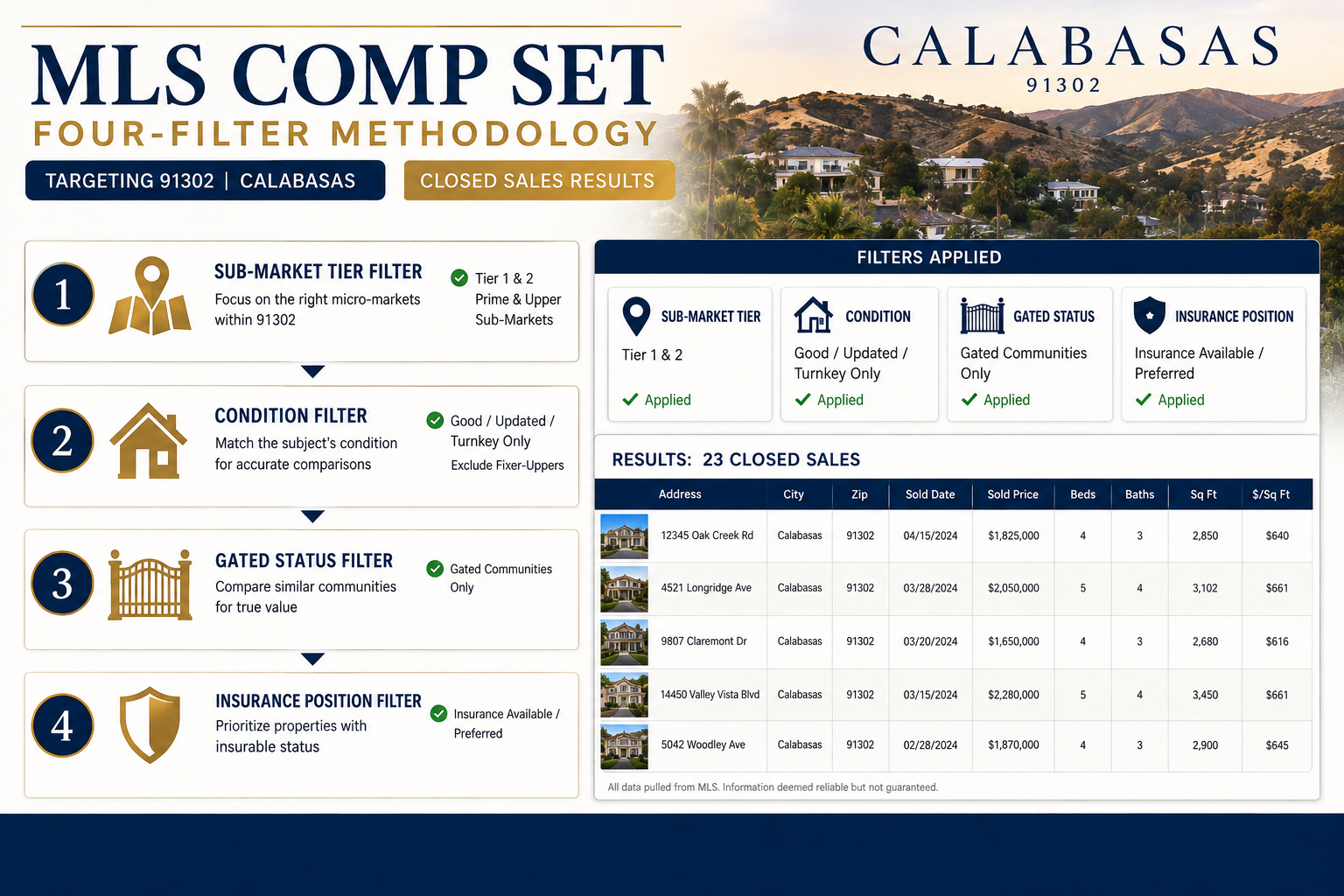 The Calabasas four-filter comp set — the only pricing methodology that produces an accurate price for the sub-market-, condition-, HOA-, and insurance-adjusted Calabasas position. The buyer pool that tours Calabasas listings has applied these same four filters to their understanding of the market — the seller whose price is based on fewer filters is pricing against a comp set the buyer will immediately identify as incorrect.
Filter 1 — Sub-Market Tier:
Calabasas's three primary pricing tiers require separate comp sets — comps across tiers produce meaningless averages:
- → 🏘️ Flatland non-gated: The standard Calabasas residential sub-neighborhoods without HOA gating — the volume-tier inventory that serves the LVUSD-motivated family at accessible Calabasas pricing
- → 🔒 Gated community: The Oaks of Calabasas and comparable guard-gated communities — a separate comp set reflecting the gating premium and HOA amenity package
- → ⛰️ Hillside and view positions: The Santa Monica Mountains-adjacent hillside inventory with view premiums and VHFHSZ considerations
Why cross-tier comps distort pricing:
A gated community renovation that closed at $2.55M is not a comp for a flatland non-gated renovation — even if the bedroom count, square footage, and renovation quality are identical. The gating premium ($200,000–$350,000) is a structural sub-market premium, not a condition premium. Using the gated community sale to price a non-gated property inflates the ceiling by that amount — and the informed Calabasas buyer identifies this immediately.
Filter 2 — Condition Tier:
Within each sub-market tier, condition creates the second-order pricing distinction:
- → 🏠 Original condition: The as-is baseline — priced to the investor-buyer and renovation-ready conventional buyer
- → 🔨 Improved condition: Kitchen or primary living area updated but not comprehensively renovated
- → ✨ Comprehensively renovated: The full custom kitchen, spa primary bath, wide-plank flooring, and exterior refresh that reaches the sub-market's renovated ceiling
- → ⚠️ The Calabasas condition precision requirement: The difference between improved and comprehensively renovated at the Calabasas gated community tier is $300,000–$450,000 — the most condition-sensitive pricing gap in the PEP seller coverage area. Miscategorizing an improved-condition home as comprehensively renovated in the pricing analysis produces a $300,000+ overpricing error.
Filter 3 — Gated vs. Non-Gated Status:
Within the flatland tier, gated and non-gated are separate markets:
- → 🔒 Gated premium: The guard gate security infrastructure commands $200,000–$350,000 above comparable quality non-gated flatland inventory
- → ❌ The error: Using gated community comps to price a non-gated flatland property — inflating the non-gated ceiling by the gating premium amount
Filter 4 — VHFHSZ Insurance Position:
For any hillside or canyon-adjacent Calabasas position, the admitted market versus FAIR Plan insurance access is a fourth pricing filter:
- → ✅ Admitted market insurance available: Price to the full insurable hillside comp ceiling
- → ⚠️ FAIR Plan-only position: Apply 8–15% below the admitted market equivalent — the insurance-market discount that the buyer's financing requirements and ongoing cost calculations produce
The correct comp set parameters:
Once the four filters are applied, pull closed sales from the filtered set using:
- → ✅ Geographic range: Within 0.5 miles for flatland tier; within the same hillside sub-neighborhood for hillside tier
- → ✅ Time range: 90 days maximum; 60 days preferred in active spring or fall markets
- → ✅ Bedroom match: Same bedroom count — a 4-bedroom Calabasas comp is not usable for a 3-bedroom pricing decision at Calabasas's price points where the bedroom increment is $150,000–$250,000
- → ✅ Minimum comps: At least 3 closed sales to establish the ceiling range; if fewer than 3 exist, extend to 120 days or slightly expand the geographic range
2. 🏫 The LVUSD Premium — How School Access Affects Calabasas Pricing
As established throughout the Calabasas content library, LVUSD is universal for all Calabasas 91302/91372 addresses — eliminating the boundary verification complexity of Woodland Hills 91364/91367. But within Calabasas, a specific school routing distinction affects the pricing picture for some westernmost 91302 addresses.
The Calabasas High School vs. Agoura High School routing:
Most Calabasas addresses are assigned to Calabasas High School — the LVUSD flagship whose school community functions as the neighborhood's primary social infrastructure. Some westernmost 91302 addresses (approaching the Agoura Hills border) are assigned to Agoura High School — also an excellent LVUSD school of comparable academic quality but with a different school community social network than the Calabasas-centric buyer specifically values.
The pricing implication:
For the school-motivated buyer specifically purchasing to access the Calabasas High School community — the Friday night football culture, the CHS parent network, the school community social fabric described in the Calabasas schools article — the distinction matters:
- → ✅ Calabasas High School-assigned address: Access the full Calabasas school community social infrastructure — the primary school motivation that the LVUSD-school-motivated buyer specifically values
- → ⚠️ Agoura High School-assigned address: LVUSD quality is equivalent — but the CHS-specific school community social network requires a different motivation framework. Some school-motivated buyers at the westernmost 91302 positions may specifically prefer the Agoura Hills community anyway; others specifically want CHS.
The pricing adjustment:
The impact on pricing is modest — the LVUSD quality is equivalent regardless of the specific high school assignment, and most Calabasas 91302/91372 addresses are CHS-assigned. However:
- → ✅ Proactively verify and disclose: Confirm the specific high school assignment for any westernmost Calabasas address through LVUSD at (818) 878-5200 before setting the listing price. If the assignment is Agoura High School, this should be disclosed upfront rather than discovered by the CHS-motivated buyer post-offer.
- → ✅ Price to the Agoura-assigned buyer pool: An Agoura High School-assigned Calabasas address should be priced to the comp set that includes Agoura High School-assigned comps rather than purely CHS-assigned comps — the two comp sets may diverge by 3–7% in sub-neighborhoods where the assignment difference affects buyer motivation.
3. 💰 The Conforming-to-Jumbo Transition — Calabasas's Loan Limit Pricing Factor
Calabasas's price band spans a specific threshold that affects the buyer's financing options — and therefore the seller's accessible buyer pool — in ways that SFV markets priced below this threshold don't encounter.
The 2026 conforming loan limit:
The 2026 FHFA conforming loan limit for Los Angeles County: $1,149,825 (confirm the current limit at fhfa.gov — this figure is adjusted annually).
How the conforming limit affects Calabasas pricing:
For Calabasas listings priced at the conforming limit interaction zone ($1.35M–$1.65M at 20% down purchase prices producing loans at or near the conforming limit):
- → ✅ Buyer with 20% down at $1.4M purchase: Loan of $1,120,000 — just below the conforming limit. Conventional conforming financing available. Buyer pool is broad.
- → ⚠️ Buyer with 20% down at $1.5M purchase: Loan of $1,200,000 — above the conforming limit. Jumbo financing required. Buyer pool narrows: jumbo lenders require higher credit scores (typically 720+), higher income qualification thresholds, and 12-month PITI reserves (versus 2–3 months for conforming).
- → ❌ The pricing trap: A Calabasas listing at $1.48M that would qualify for conforming financing at 20% down ($1.18M loan, below the limit) priced at $1.52M instead crosses the jumbo threshold for the 20% down buyer ($1.22M loan, above the limit) — potentially eliminating a share of the buyer pool that cannot qualify for jumbo financing.
The Calabasas seller's conforming-zone pricing decision:
For Calabasas listings priced between $1.35M and $1.7M where the conforming/jumbo threshold interaction is live:
- → ✅ Price at or below $1.44M (loan $1,152,000 at 20% down): Maintains conforming access with 20% down — broadest buyer pool
- → ✅ Price at or above $1.5M: Accept that the buyer pool is jumbo-qualified — narrower but specifically capable of the Calabasas purchase. Most Calabasas buyers in this range are jumbo-capable.
- → ⚠️ Price in the $1.44M–$1.50M zone: The most complex zone — the price where small adjustments change the buyer's financing category. Evaluate the specific comp-supported ceiling for the subject property and price to the ceiling that maximizes net proceeds, not to avoid the jumbo threshold unless the comp analysis clearly supports a below-threshold price.
Above $1.7M — the full jumbo market:
All Calabasas listings above approximately $1.44M with 20% down require jumbo financing — and at the $1.8M–$4.5M hillside and premium gated community tier, the buyer pool is 100% jumbo-qualified. The pricing strategy at this tier is not conforming-limit aware but is specifically jumbo-underwriting aware:
- → ✅ Jumbo appraisal standards: Jumbo lenders use their own appraisal standards and may require more conservative comp methodology than standard conforming appraisals. Price to the comp set that will support a jumbo lender's appraisal — not to a comp that requires the appraiser to make significant adjustments that jumbo underwriting doesn't support.
- → ✅ Reserve requirements: The jumbo buyer at $2.5M+ is typically required to demonstrate 12 months of PITI in reserves — approximately $240,000–$360,000 in liquid assets. This buyer exists in the Calabasas market; the seller who sets price appropriately for this pool can expect the buyer's financing to close.
4. 🔥 The VHFHSZ Pricing Adjustment — Calabasas's Most Specific Variable
The wildfire insurance market's impact on Calabasas hillside pricing is the most Calabasas-specific pricing variable in the PEP seller coverage area — requiring specific analysis before any hillside or canyon-adjacent listing price is set.
 The Calabasas VHFHSZ pricing pre-check — the insurance market determination that must precede any hillside listing price commitment. The admitted market insurance availability (or absence) is a structural comp ceiling variable that the seller cannot price around and the buyer cannot ignore — the hillside Calabasas seller who sets price without this determination is pricing against a ceiling the market may not support.
The VHFHSZ insurance pricing adjustment:
For Calabasas hillside positions:
Step 1 — Determine the insurance position: Obtain binding insurance quotes from 3+ admitted market carriers before setting any hillside listing price. If admitted market insurance is available:
- → ✅ Price to the admitted market hillside comp set — the full renovated hillside ceiling based on comparable insurable positions
If FAIR Plan-only:
- → ⚠️ Apply the 8–15% FAIR Plan discount to the admitted market equivalent ceiling. At a $3.0M admitted market equivalent: FAIR Plan-adjusted ceiling = approximately $2.55M–$2.76M.
Step 2 — Identify the correct comp set by insurance position: The comp set for a FAIR Plan-only hillside Calabasas position must be filtered to other FAIR Plan-only comparable sales — not to admitted market comparable sales that don't carry the same buyer pool constraint. The FAIR Plan comp set is smaller (fewer comparable sales in any given 90-day window) but produces the only accurate ceiling for the specific position.
Step 3 — Disclose proactively in marketing: The Calabasas hillside seller who proactively documents the insurance market situation — providing the admitted market quote (or the FAIR Plan assessment) in the listing supplements — attracts buyers who have pre-researched the insurance situation rather than buyers who discover it mid-escrow and renegotiate. The proactive insurance disclosure is both an ethical requirement and a strategic pricing tool: the buyer who enters the offer already aware of the insurance cost is priced in at the FAIR Plan-adjusted price rather than negotiating down after discovering it.
The pricing error to avoid:
The Calabasas hillside seller who prices to the admitted market ceiling without verifying their insurance position, lists at $3.2M, and then has the buyer's insurance research reveal FAIR Plan-only access mid-escrow — faces a buyer renegotiation to $2.75M–$2.85M after 30+ days of carrying costs and the psychological leverage transfer that an extended under-contract period produces. The 8–15% price reduction that happens post-accepted-offer is a materially worse outcome than the 8–15% reduction that informed pre-listing pricing would have built into the listing from day one.
5. 📅 Calibrating to the Calabasas Seasonal Market — When to Launch and at What Price
With the comp set built, the sub-market tier identified, the insurance position determined, and the conforming/jumbo threshold assessed, the Calabasas seller has all the pricing inputs they need — and the final question is how to calibrate the launch price to the specific seasonal market conditions that determine the size of the buyer pool the listing will access.
Spring peak (February 15–April 30) — The Primary Pricing Window:
- → 📊 Buyer pool character: The LVUSD enrollment-urgency family buyer, the entertainment industry professional returning from winter production, and the lifestyle-motivated Westside transplant are all simultaneously most active
- → 💰 Pricing posture: Launch at the comp-supported ceiling with confidence — the spring buyer pool is the largest, most motivated, and most willing to transact at full comp ceiling prices. This is not the season to underprice to attract attention; it is the season to price correctly and allow the buyer pool's depth to produce competitive first-week activity.
- → ✅ Multiple offer strategy: At the flatland volume tier and gated community tier, correctly priced spring listings generate the first-week showing traffic that produces multiple offers — specifically because the LVUSD enrollment urgency creates time pressure that makes the motivated buyer move faster than in any other season. Price at the ceiling, present the home at its best condition, and let the enrollment-urgency buyer pool create the competition.
Fall secondary window (October 1–November 10):
- → 📊 Buyer pool character: The re-engaged entertainment industry buyer (post-summer production wrap), the LVUSD family beginning to plan next September's enrollment, and the fall lifestyle buyer whose search season overlaps with the best Calabasas weather conditions
- → 💰 Pricing posture: Price at the ceiling with the fall buyer pool in mind — the fall pool is smaller than spring but highly motivated. The fall listing that prices modestly below the spring ceiling (1–2%) to account for the slightly thinner buyer pool often generates better total offers than the full-ceiling fall launch with a longer absorption period.
Summer (June 15–September 15) — The Challenging Window:
- → 📊 Buyer pool character: Thinner than spring or fall — the entertainment industry buyer is in production, the LVUSD enrollment urgency has resolved, and the Calabasas summer heat (regularly 95–100°F in the 91302 flatland, hotter in canyon positions) makes showing traffic less spontaneous
- → 💰 Pricing posture: If a summer launch is necessary, price 2–4% below the spring comp ceiling to generate the first-week engagement that the thinner summer pool requires. The seller who launches at the spring ceiling in summer typically generates less first-week traffic than the spring market produced — requiring either a summer price reduction or extended DOM carrying costs that exceed the initial 2–4% discount.
- → ✅ Summer strategy: Morning showings only (before 10:30 AM) for the canyon and hillside positions; HVAC pre-cooling to 72°F for all showings; the shaded outdoor entertaining space specifically featured in the early morning photography that captures the lifestyle at its most appealing.
The Calabasas price reduction decision framework:
When the Calabasas listing generates below-target first-week traffic:
Day 14 benchmark by tier:
- → Flatland volume tier spring: fewer than 4 showings = pricing or condition signal. Diagnose before acting.
- → Gated community tier spring: fewer than 3 showings = pricing signal or HOA compliance question
- → Hillside tier spring: fewer than 2 showings = pricing signal, insurance concern, or VHFHSZ discovery
The meaningful reduction standard:
- → ❌ Token reduction (1–2%): At Calabasas's price points, a $30,000–$40,000 reduction on a $1.8M listing is psychologically insufficient — the informed Calabasas buyer knows the comp set and recognizes a token reduction that still prices above the ceiling
- → ✅ Meaningful reduction (3–6%): The recalibration to the correct comp ceiling that the buyer pool was filtering to at the search stage — bringing the listing back into the search result set the motivated buyer is already running
- → ✅ Timing: Act by day 14–21 in spring and fall; by day 21–28 in summer. The Calabasas seller who waits past day 28 for the first reduction begins accumulating the "stale listing" signal that progressively reduces the listing's appeal to the still-active buyer who was watching and is now wondering what is wrong.
🚫 What NOT to Overdo
Don't use Malibu, Pacific Palisades, or Bel Air comps to price a Calabasas listing. The Calabasas listing that cites Malibu coastal comps or Westside prestige neighborhood sales as justification for a price above the 91302/91372 comp ceiling will not attract the Malibu buyer (who is specifically purchasing for beach access and coastal lifestyle that Calabasas doesn't deliver) and will repel the Calabasas buyer (who knows the Calabasas comp set and recognizes the Westside comp inflation immediately). Every Calabasas comp must come from 91302 or 91372 — filtered to the correct sub-market tier, condition level, and insurance position.
Don't confuse a custom hillside new construction sale with a comp for a resale hillside property. Custom hillside new construction in Calabasas (described in the new construction vs. resale article) sells at a premium that reflects the architectural statement, the new construction specification, and the custom design that the resale property cannot replicate. Using a custom new construction hillside sale as a comp for a 15-year-old renovated hillside resale inflates the ceiling by $400,000–$800,000. The correct hillside resale comp set includes only resale transactions — not custom new construction that is architecturally unique.
Don't ignore the HOA special assessment or violation history when setting the gated community price. A Calabasas gated community listing with pending HOA special assessments or outstanding ARC violations faces a specific buyer price resistance that the standard comp set doesn't capture — because the comparable sales in the comp set didn't carry these obligations. The HOA assessment or violation is a buyer-disclosed cost that informed buyers will demand be resolved before or at close (or credited against the sale price). Price the gated community listing with full knowledge of the HOA financial situation — request the HOA financial disclosures and the most recent meeting minutes before setting the listing price, not after the first offer is rejected.
Don't price a FAIR Plan-only Calabasas hillside listing to the admitted market comp ceiling. The pricing error documented throughout this article and the Calabasas DOM content library: the FAIR Plan-only hillside position priced at the admitted market ceiling generates first-week showing traffic from buyers who cancel their offers or renegotiate after discovering the insurance situation. Every showing that ends without an offer because of the FAIR Plan discovery is a wasted opportunity — and the carrying cost accumulated during those wasted showings is real. Determine the insurance position before setting any hillside listing price.
Don't over-rely on price-per-square-foot analysis in Calabasas. The price-per-square-foot metric that works reasonably well in Reseda 91335 or Northridge 91324/91325 fails in Calabasas because the sub-market tier premiums (gating, views, position) and the lot quality variation (usable outdoor space, pool configuration, mature landscaping) are so significant that the price-per-square-foot calculation between two Calabasas properties with different tier characteristics is meaningless. The gated community home with a pool on a 12,000 sq ft lot prices dramatically above the non-gated home on a 7,500 sq ft lot at the same price-per-square-foot — the lot quality, the gating premium, and the pool value are not captured in square footage. Use closed comparable transactions with the four-filter comp methodology — not price-per-square-foot.
🏠 Real-World Scenario — Calabasas 91302
A Calabasas 91302 flatland seller — a comprehensively renovated 4-bedroom on a 10,800 sq ft lot, non-gated sub-neighborhood, verified Calabasas High School assignment, admitted market homeowners insurance at $5,400/year — had received three pricing recommendations that spanned $1.79M to $2.35M:
- → Agent A at $2.35M: used gated community renovated comps from The Oaks — specifically, three sales in the $2.1M–$2.5M range from gated community renovated 4-bedrooms within 91302
- → Agent B at $1.95M: used a mix of gated and non-gated flatland comps without filtering for the gating premium
- → Agent C at $1.79M: used non-gated flatland comps but included one comp that was improved condition rather than comprehensively renovated — underweighting the renovation premium
The four-filter comp analysis:
Filter 1 (sub-market tier): Flatland non-gated only — eliminates Agent A's gated community comps. Filter 2 (condition tier): Comprehensively renovated only — eliminates Agent C's improved-condition comp. Filter 3 (gated status): Non-gated only — eliminates all gated community sales. Filter 4 (insurance position): Admitted market — all flatland non-gated in this sub-neighborhood have admitted market access, no adjustment needed.
Remaining comp set (5 closed sales, 90 days): $1.82M, $1.87M, $1.90M, $1.93M, $1.96M.
Renovated non-gated flatland ceiling: approximately $1.93M–$1.96M.
Correct listing price: $1.93M — at the ceiling supported by the filtered comp set.
The outcome:
Spring launch at $1.93M. First week: 11 showings — all from the LVUSD-motivated family buyer pool researching the non-gated flatland tier. Six of the eleven showings were from buyers who had specifically filtered Agent A's $2.35M recommendation out of their search results as overpriced. Three offers by day 12. Accepted at $1.945M at day 16 — the spring competition producing a close 0.8% above the listed comp ceiling.
Net proceeds: approximately $1,744,000 after commission, closing costs, and preparation.
What the $2.35M launch would have produced: Zero first-week showings from the non-gated flatland buyer pool (filtered at search stage as above-ceiling), 2–3 showings from buyers drawn by the price but who know the comp ceiling and use it as leverage. First reduction to $2.1M at day 28, second reduction to $1.96M at day 52. Close at approximately $1.90M after 65 days — $45,000 below the correctly-priced close and with $15,000+ in additional carrying costs. Net proceedings would have been approximately $25,000–$60,000 less than the correct pricing produced.
🏠 Real-World Scenario — Calabasas 91302
A Calabasas 91302 hillside seller — a 5-bedroom with panoramic Valley views, 20 years old, comprehensively renovated 5 years prior, Santa Monica Mountains-adjacent position — needed to determine the correct listing price before engaging a listing agent. Their instinct was $3.6M based on a neighbor's recent sale.
The four-filter analysis:
Filter 1 (sub-market tier): Hillside/view — correct tier Filter 2 (condition tier): Comprehensively renovated 5 years prior — improved but not newly renovated. The 5-year renovation age means the specification is no longer "new" — the kitchen is 5 years past its studio-fresh point, the primary bath specification reflects 2021's design trends rather than 2026's. Condition tier adjustment: approximately 3–5% below the newly renovated ceiling. Filter 3 (gated status): Not applicable — hillside position is non-gated Filter 4 (insurance position): Pre-listing insurance research — binding quotes obtained from 4 admitted market carriers. Two declined, two quoted at $12,400/year and $14,800/year. Admitted market access confirmed.
The neighbor's sale the seller referenced: Custom hillside new construction, architecturally significant, 2-year-old completion — a specific design statement that the market valued as a one-of-a-kind custom home. Not a valid comp for a 20-year-old resale.
The filtered hillside resale comp set: Five resale (not new construction) hillside Calabasas 91302 sales in the prior 180 days (only 3 in the prior 90 days at this tier — the thinner hillside market requires the extended time window): $2.85M, $3.05M, $3.18M, $3.35M, $3.42M. The $3.35M and $3.42M sales were newly renovated (1–2 years); the $2.85M was 8-year-old renovation. The 5-year renovation vintage positions the subject property at approximately the mid-range of this comp set — approximately $3.0M–$3.2M.
5-year renovation age adjustment (3%): $3.1M × 0.97 = approximately $3.0M.
Listing price recommendation: $3.05M — at the comp-supported ceiling for a 5-year renovation hillside resale with admitted market insurance.
The outcome:
Fall launch at $3.05M with proactive insurance documentation (binding quotes from both admitted market carriers provided in the listing supplements). Fall hillside buyer pool: 6 showings in the first two weeks — appropriate for this tier's thinner buyer pool. Two buyers specifically mentioned the insurance documentation as the feature that allowed them to make a confident offer without an insurance discovery concern. Offer at day 22 at $2.95M. Counter at $3.02M. Accepted at $2.99M.
The seller's $3.6M instinct — anchored to the custom new construction sale rather than the filtered resale comp set — would have produced zero first-week showings, DOM accumulation, and a fall close at approximately $2.85M–$2.95M after extended market time. The correctly priced launch at $3.05M produced a $140,000–$140,000+ improvement over the instinct-priced alternative.
❓ FAQ
How do I determine what my Calabasas home is worth? Calabasas home value requires a four-filter comp set analysis: sub-market tier (flatland non-gated, gated community, or hillside), condition tier (original, improved, or comprehensively renovated), gated versus non-gated status, and VHFHSZ insurance position for hillside locations. Apply all four filters to the 90-day closed sale history in 91302/91372 at the correct geographic radius (0.5 miles for flatland, sub-neighborhood for hillside), then identify the ceiling range from the filtered results. Avoid using custom new construction comps for resale pricing, gated community comps for non-gated properties, or Malibu/Westside comps for any Calabasas position.
What is the Calabasas real estate market like for sellers in 2026? The 2026 Calabasas seller market is two-speed: the flatland volume tier ($1.3M–$2.2M) is seller-favorable in spring and fall windows with DOM of 20–40 days for correctly priced improved and renovated listings; the gated community and hillside premium tier ($1.8M–$4.5M+) is balanced to seller-favorable depending on the season, with DOM of 25–55 days. Both tiers are specifically sensitive to pricing accuracy — Calabasas's most informed buyer pool filters overpriced listings at the search stage, producing the zero-first-week-showing pattern that signals overpricing earlier and more completely than in lower-price SFV markets.
When is the best time to sell a home in Calabasas? February 15–April 30 is the primary Calabasas seller window — the LVUSD enrollment urgency activates the school-motivated family buyer simultaneously with the spring lifestyle buyer and the entertainment industry buyer returning from winter production commitments. October 1–November 10 is the fall secondary window. Both windows produce the buyer pool depth that correctly priced Calabasas listings require for competitive first-week activity. Summer (June 15–September 15) is the most challenging window — price 2–4% below the spring ceiling for summer launches to compensate for the thinner buyer pool.
How does wildfire insurance affect my Calabasas home price? For hillside and canyon-adjacent Calabasas positions within VHFHSZ designations, the admitted market versus FAIR Plan insurance access directly affects the achievable comp ceiling. FAIR Plan-only positions — where admitted market carriers decline coverage — sell approximately 8–15% below comparable admitted market positions because the buyer's ongoing insurance cost is higher and some buyers are specifically deterred by the FAIR Plan coverage limitations. Obtain binding insurance quotes from 3+ admitted market carriers before setting any hillside listing price. Provide the insurance documentation proactively in the listing to attract pre-researched buyers who won't renegotiate after discovering the insurance situation mid-escrow.
How does the conforming loan limit affect Calabasas pricing? The 2026 Los Angeles County conforming loan limit is approximately $1,149,825 (verify at fhfa.gov). Calabasas listings priced where the buyer's loan amount would exceed this limit (typically listings above $1.44M with 20% down) require jumbo financing — which reduces the eligible buyer pool to jumbo-qualified buyers (higher credit score, higher reserve requirements, higher income threshold). Most Calabasas buyers at the $1.5M+ tier are jumbo-qualified; the conforming limit is most relevant for the $1.35M–$1.55M transition zone where small price adjustments change the buyer's financing category.
What pricing mistakes do Calabasas sellers make most often? The five most costly Calabasas pricing errors: ✓ Using gated community comps to price a non-gated flatland listing (inflates ceiling by $200,000–$350,000). ✓ Pricing a FAIR Plan-only hillside property to the admitted market ceiling (produces mid-escrow renegotiation rather than pre-listing adjustment). ✓ Using custom new construction comps to price a resale hillside property (inflates ceiling by $400,000–$800,000+). ✓ Token price reductions of 1–2% on a listing that is 8–12% above the comp ceiling (the Calabasas buyer knows the comp set and doesn't respond to reductions that don't reach the ceiling). ✓ Waiting past day 28 to reduce an overpriced Calabasas listing (the stale listing signal accumulates quickly in a market where the buyer pool is small enough that word-of-mouth about the overpriced listing reaches most active buyers within 3 weeks).
🎯 Bottom Line
Pricing a Calabasas 91302/91372 home to sell requires the most methodical and most sub-market-specific comp analysis in the PEP SFV seller coverage area — because the consequences of pricing errors are larger in absolute dollar terms, the buyer pool is more informed and more specifically research-intensive than any other SFV market, and the Calabasas-specific variables (LVUSD school routing, VHFHSZ insurance position, gated community tier separation, and the conforming-to-jumbo threshold transition) each require specific adjustment that the SFV-wide pricing methodology doesn't capture.
The Calabasas seller who builds the four-filter comp set correctly, determines the VHFHSZ insurance position before setting any hillside price, discloses the insurance situation proactively, launches at the comp-supported ceiling in the spring or fall window, and responds to first-week feedback with the meaningful reduction that the comp analysis identifies — consistently produces the 20–40 day close at or near the ceiling that the Calabasas market's buyer pool depth supports when correctly accessed.
At Parkway Estate Properties, Liana's seller representation across Calabasas 91302/91372, Woodland Hills 91364/91367, Tarzana 91356, Encino 91316/91436, and Sherman Oaks 91403/91423, combined with Roman's hands-on renovation and investment property experience across the SFV, means every Calabasas pricing conversation is grounded in the four-filter comp methodology, the insurance market pre-check, the HOA compliance review, and the seasonal calibration that produces the correct listing price from day one rather than discovering it through a series of reductions.
📩 Want Your Calabasas Home Priced Correctly from Day One?
We'll build the four-filter comp set for your specific sub-market position, determine the insurance situation for any hillside address, verify the LVUSD school routing, and give you the honest price range that the 2026 Calabasas market supports — before any listing agreement is signed.
Contact Liana Shersher at Parkway Estate Properties: 📧 liana@parkwayestate.com · 📞 (818) 208-5881 · 🌐 parkwayestate.com 15021 Ventura Blvd., Ste. 510, Sherman Oaks, CA 91403
About the Authors
Liana Shersher is a licensed real estate agent with Parkway Estate Properties Inc. and an Accredited Buyer's Representative (ABR) serving the San Fernando Valley — with a focus on Sherman Oaks, Encino, Tarzana, Woodland Hills, and Northridge (DRE# 02164224). Liana guides first-time homebuyers through every step of the purchase, from the first showing to the keys in hand, and represents move-up and repeat buyers across the Valley. For sellers, she builds the pricing and marketing strategy that positions a home to sell for top dollar, fast. Buyers and sellers work with Liana for clear communication, sharp local knowledge, and an agent who treats their goals like her own.
Roman Shersher is the broker-owner of Parkway Estate Properties Inc. and a real estate investor with 18 years of experience in the San Fernando Valley (DRE# 01855095). Roman has personally led or co-led renovations on dozens of properties across the Valley, including recent projects in Northridge (91324) and Woodland Hills (91364). That hands-on renovation and investment experience shapes every pricing conversation and days-on-market strategy at Parkway — sellers get a realistic read on what improvements actually return at resale, and buyers get an expert eye on a home's true condition and upside.
Parkway Estate Properties, Inc. · 15021 Ventura Blvd., Ste. 510, Sherman Oaks, CA 91403 · (818) 208-5881 · parkwayestate.com · Broker License #: 01873092 Equal Housing Opportunity. Information herein is general and not legal, tax, or financial advice. Consult qualified professionals for your specific situation.
Categories
Recent Posts










Broker | Realtor ® License ID: 01873092
+1(818) 208-5881 | info@parkwayestate.com