
How Do Seller-Paid Rate Buydowns Work in Woodland Hills?
Most Woodland Hills sellers in 91364 and 91367 have heard the phrase "seller-paid rate buydown" at least once in the past 18 months — usually from a buyer's agent requesting one as part of an offer, or from a listing agent mentioning it as a tool to attract more qualified buyers. Most sellers nod along and then quietly wonder what it actually means, what it actually costs, and whether it actually helps them net more money at close.
This article answers all of that — specifically, directly, and with the Woodland Hills 91364 and 91367 market context that makes the numbers real rather than theoretical. A seller-paid rate buydown is not a concession that costs you money without return. When structured correctly, it is a net-proceeds tool — one that frequently produces a higher close price and a faster sale than the alternative of a list-price reduction, which is what most Woodland Hills sellers default to when buyer demand softens.
Understanding the difference between those two strategies — and when each applies — is one of the highest-leverage decisions a Woodland Hills seller makes in the current rate environment.
1. 📚 What a Seller-Paid Rate Buydown Actually Is — The Plain Language Explanation
A mortgage rate buydown is exactly what it sounds like: money paid upfront to reduce the interest rate on a mortgage loan. In a seller-paid buydown, that money comes from the seller's proceeds at closing rather than from the buyer's pocket — and it's structured into the purchase contract as a seller concession.
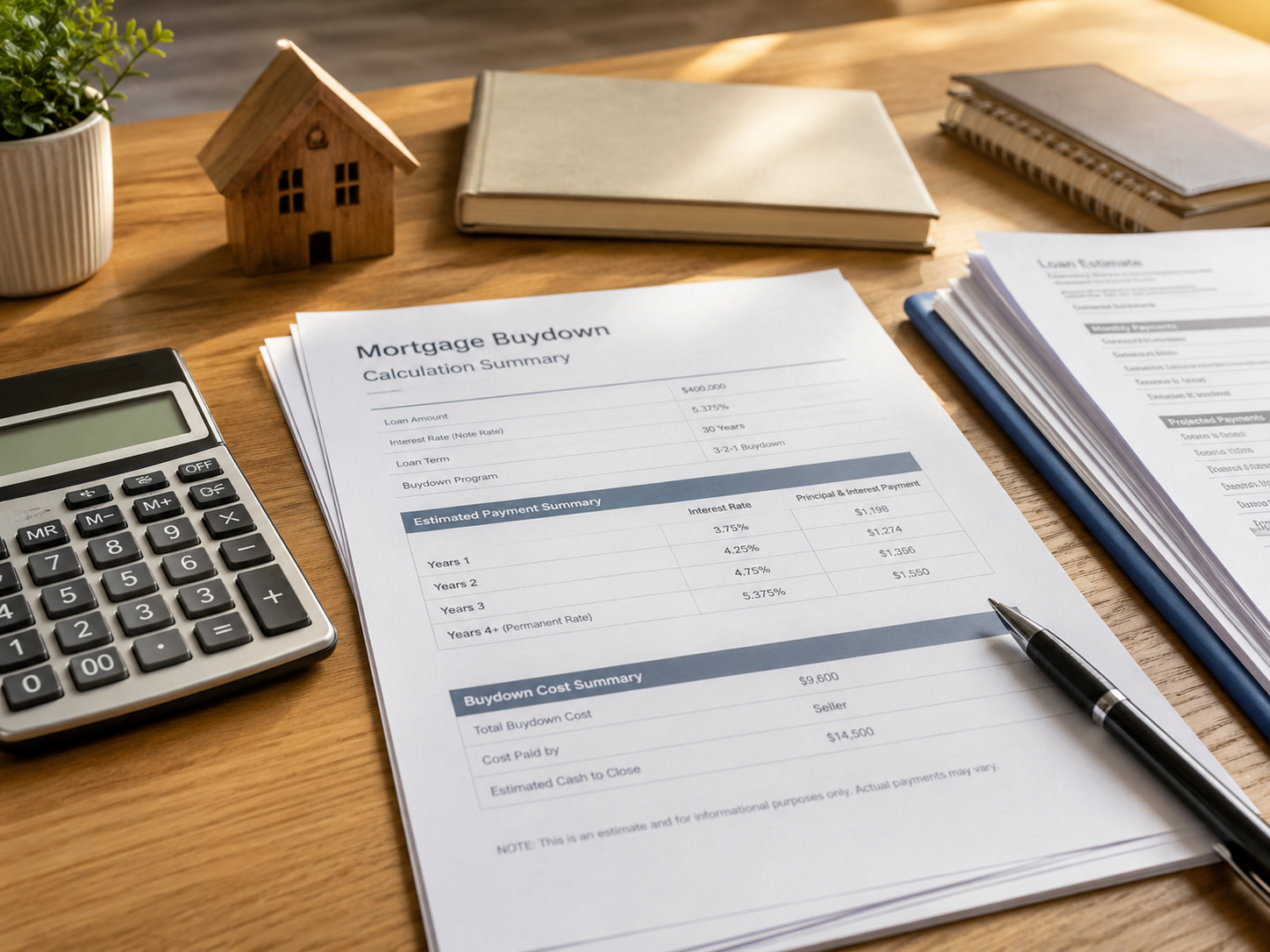 A seller-paid rate buydown in Woodland Hills 91364 and 91367 is not a charitable concession — it is a net-proceeds strategy that expands the qualified buyer pool, shortens DOM, and frequently produces more money at close than an equivalent price reduction.
The two primary buydown structures:
Structure 1 — The 2-1 Buydown (most common in Woodland Hills transactions): The buyer's interest rate is reduced by 2% in year one and 1% in year two. In year three and beyond, the rate returns to the original note rate. The seller funds the difference between the reduced rate and the actual rate for those two years — the money sits in an escrow account at close and is applied to the buyer's monthly payment each month during the buydown period.
Example for a Woodland Hills 91364 home:
- → Sale price: $1.35M
- → Buyer loan amount: $1.08M (20% down)
- → Note rate: 7.0%
- → Year 1 effective rate (2% reduction): 5.0% — buyer monthly payment approximately $5,791
- → Year 2 effective rate (1% reduction): 6.0% — buyer monthly payment approximately $6,476
- → Year 3+ rate: 7.0% — buyer monthly payment approximately $7,188
- → Seller cost to fund the 2-1 buydown: approximately $19,800–$22,000
For the buyer, the year-one payment relief is approximately $1,397/month compared to a full-rate payment — nearly $16,764 in year-one savings.
Structure 2 — The Permanent Buydown (also called buying down the rate): The seller pays discount points at closing to permanently reduce the buyer's interest rate for the life of the loan. Each point costs approximately 1% of the loan amount and typically reduces the rate by 0.25%. A 2-point permanent buydown on a $1.08M Woodland Hills loan costs approximately $21,600 and reduces the rate by 0.5% permanently — from 7.0% to 6.5%.
The permanent buydown makes the most mathematical sense for buyers who plan to hold the home long-term and are not counting on refinancing. The 2-1 temporary buydown makes the most sense for buyers who expect to refinance within 2–3 years if rates decline — which is a common buyer expectation in the current Woodland Hills market.
Structure 3 — The 3-2-1 Buydown (less common, higher seller cost): A three-year step structure — 3% reduction in year one, 2% in year two, 1% in year three, full rate from year four. Higher seller cost than the 2-1, but occasionally used for Woodland Hills 91364 listings above $1.5M where the payment relief in year one is particularly significant for the buyer's qualification threshold.
2. 💵 The Net Proceeds Math — Why Buydowns Often Beat Price Reductions
This is the section that changes how most Woodland Hills 91364 and 91367 sellers think about the rate buydown tool — because the instinctive comparison most sellers make is wrong. When a seller considers offering a $20,000 buydown contribution, they almost always compare it to a $20,000 price reduction and conclude they're equivalent. They're not — and the difference matters significantly to your net proceeds.
The comparison — $20,000 price reduction vs. $20,000 buydown contribution on a $1.3M Woodland Hills 91364 home:
Option A — $20,000 price reduction:
- → New list price: $1.28M
- → Buyer monthly payment at 7.0% on $1.024M loan: $6,811
- → What you gave up: $20,000 off your gross proceeds
- → What the buyer gained: $20,000 off the purchase price, approximately $133/month in payment reduction
- → Buyer pool impact: Buyers who couldn't qualify at $1.3M still may not qualify at $1.28M — a $20,000 price reduction doesn't move the needle on qualification thresholds for most buyers
Option B — $20,000 buydown contribution (2-1 buydown):
- → List price stays at $1.3M
- → Buyer monthly payment Year 1 at 5.0% on $1.04M loan: approximately $5,583
- → Buyer monthly payment Year 2 at 6.0%: approximately $6,236
- → What you gave up: $20,000 in seller concession at close
- → What the buyer gained: $1,605/month relief in year one, $952/month relief in year two — a total of approximately $30,500 in payment savings over 24 months
- → Buyer pool impact: Buyers who couldn't qualify at 7.0% may qualify at 5.0% — the buydown can meaningfully expand the number of buyers who can afford your Woodland Hills home
The critical difference: The price reduction gives the buyer $133/month. The buydown gives the buyer $1,605/month in year one. For the same $20,000 seller contribution, the buydown delivers 12x more monthly payment relief — which is why it attracts more buyers, generates more competition, and frequently results in a stronger gross sale price that more than offsets the buydown cost.
The net-proceeds calculation on a correctly structured Woodland Hills buydown consistently shows that sellers who offer a buydown instead of a price reduction net more at close — because the expanded buyer pool creates competitive pressure that drives the gross price up, while the price reduction simply gives money away without creating competition.
3. 🏡 The Woodland Hills Market Context — Why Buydowns Matter Here Specifically
Seller-paid rate buydowns are not equally relevant in every market. In Woodland Hills 91364 and 91367 specifically, the current market conditions make them particularly powerful — for reasons tied to the specific buyer profile and price band that defines most Woodland Hills transactions.
 Woodland Hills 91364 and 91367 attract a rate-sensitive buyer profile in the $900K–$1.5M range — the price band where monthly payment is most acutely felt and where a seller-paid rate buydown has the most direct impact on buyer qualification and competition.
Why Woodland Hills specifically:
- → 💰 The $900K–$1.5M price band is rate-sensitive: The Woodland Hills buyer in this range — typically a move-up family relocating from Northridge 91324, Reseda 91335, Canoga Park 91304, or West Hills 91307, or a Westside relocator stretching their budget — is making monthly payment decisions at a price point where a $1,400–$1,800/month difference in year-one payment is genuinely material. This buyer profile responds strongly to buydown-structured offers in a way that doesn't apply equally to cash-heavy buyers at the $2M+ tier.
- → 📊 Longer DOM than Sherman Oaks: Woodland Hills 91364 homes in the $1.1M–$1.5M range have been running 25–45 days on market in 2026 — longer than comparable Sherman Oaks 91403 homes, reflecting a slightly less compressed buyer pool. Extended DOM is the most reliable indicator that a buydown strategy is warranted — because it confirms that qualified buyers are evaluating the home but not pulling the trigger on payment grounds.
- → 🏘️ Competition from new listings: Woodland Hills 91364 carries more active listing inventory than Sherman Oaks 91403/91423 at comparable price points — which means your listing is competing against more alternatives. A seller-paid buydown differentiates your listing in a crowded field in a way that a comparable price reduction does not, because buyers scanning active listings see the buydown as immediate payment relief rather than a price concession they have to calculate.
- → 🌡️ The refinance expectation: Woodland Hills buyers in 2026 consistently express the expectation that they will refinance "when rates come down." The 2-1 buydown is specifically designed for this buyer — it delivers payment relief during the years when rates are highest, and the buyer refinances out of the note rate when rates improve. Sellers who frame the buydown this way in their marketing consistently find it resonates with the dominant Woodland Hills buyer mindset.
4. 🔧 How to Implement a Seller-Paid Buydown — The Practical Steps
Understanding how buydowns work conceptually is one thing. Knowing how to implement one correctly in a Woodland Hills 91364/91367 transaction — in the contract, in the marketing, and in the escrow — is what converts the strategy from theory to net proceeds.
Step 1 — Decide whether to offer proactively or reactively:
There are two approaches to the buydown in a Woodland Hills listing:
- → Proactive (built into the listing marketing): The listing description explicitly states "seller offering 2-1 buydown contribution" or "seller offering up to $X in buyer concessions applicable to rate buydown." This approach differentiates your listing from day one and attracts buyer attention before they've submitted an offer.
- → Reactive (negotiated in the offer): The listing doesn't advertise the buydown, but when a buyer submits an offer, the buydown contribution is negotiated as part of the counter. This approach is less effective at expanding the initial buyer pool but is appropriate for sellers who want to preserve maximum flexibility.
Our team typically recommends the proactive approach for Woodland Hills 91364/91367 listings in the $900K–$1.5M range where rate sensitivity is highest — the marketing signal attracts more buyers to the listing before they've filtered it out on payment grounds.
Step 2 — Determine the contribution amount:
The appropriate buydown contribution depends on your loan amount and the buydown structure you're offering:
- → 2-1 buydown on a $900K Woodland Hills sale (20% down, $720K loan): approximately $13,000–$15,000 seller contribution
- → 2-1 buydown on a $1.2M Woodland Hills sale (20% down, $960K loan): approximately $17,000–$20,000 seller contribution
- → 2-1 buydown on a $1.5M Woodland Hills sale (20% down, $1.2M loan): approximately $21,000–$25,000 seller contribution
These amounts are calculated by the buyer's lender at time of offer — the exact figure depends on the specific rate and loan product. Ask your listing agent to run the buydown math for your specific price point before deciding on a proactive offering amount.
Step 3 — Write it into the purchase contract correctly:
The seller-paid buydown contribution is written into the purchase agreement as a seller concession — a defined dollar amount that the seller contribuves to the buyer's loan costs at close. The language is specific: "Seller to contribute $[amount] toward buyer's closing costs and/or loan discount points/buydown costs." The buyer's lender then applies those funds to the buydown escrow account at closing.
Important: the concession must be within lender guidelines for seller contributions — typically capped at 2–6% of the purchase price depending on loan type and down payment percentage. Your lender and escrow officer confirm the specific cap applicable to the buyer's loan.
Step 4 — Market it correctly:
A seller-paid buydown that isn't communicated clearly in the listing description and agent remarks doesn't produce the buyer pool expansion it's designed to generate. The listing should state clearly:
- → What structure is being offered (2-1 buydown, permanent points, or dollar amount toward concessions)
- → The approximate monthly payment relief in year one
- → The specific contribution amount or ceiling
Buyers' agents who see a clearly communicated buydown offering will proactively bring it to their clients' attention as a payment-relief opportunity — generating showings from buyers who would otherwise have filtered the listing out on payment grounds.
5. 📊 When a Buydown Makes Sense — and When It Doesn't
 The seller-paid rate buydown works most effectively in Woodland Hills 91364 and 91367 when the listing has been on market 20+ days without an accepted offer — the signal that payment concerns, not price, are the primary buyer hesitation.
A seller-paid buydown is not the right tool in every Woodland Hills selling situation. Here's when it makes sense — and when it doesn't.
✅ When a buydown is the right strategy:
- → 🕐 When your listing has been on market 20–35 days without an offer: Extended DOM in Woodland Hills 91364/91367 most commonly reflects one of two problems — overpricing or payment hesitation. If your showing traffic is adequate (8+ showings in the first 21 days) but offers aren't materializing, payment hesitation is the more likely culprit. A buydown addresses payment hesitation directly; a price reduction alone does not.
- → 💼 When your target buyer profile is move-up or first-time: Move-up buyers relocating from Northridge 91324, West Hills 91307, or Canoga Park 91304 and first-time buyers entering the Woodland Hills market are the buyer profiles most sensitive to monthly payment. These buyers are running tight monthly payment calculations where $1,000–$1,500/month of year-one relief is genuinely decision-changing.
- → 📉 When rates are above 6.5%: The higher the prevailing rate, the more valuable the buydown. In a 7%+ rate environment, a 2-1 buydown's year-one 5% effective rate represents a meaningful lifestyle difference for most Woodland Hills buyers — not a marginal improvement.
- → 🏡 When you're competing against multiple active listings in your price band: If Woodland Hills 91364/91367 has 5+ comparable active listings in your price band, a buydown offering differentiates yours in a way that a $10,000–$15,000 price reduction does not. Buyers comparing listings side-by-side respond to the payment relief signal.
❌ When a buydown is NOT the right strategy:
- → ⚡ When you're already in a multiple-offer situation: If you have 3 competing offers in the first 7 days, you don't need a buydown — you need to let the competitive offer dynamic work. Proactively offering a buydown in a hot listing situation simply reduces your net proceeds without solving a problem that doesn't exist.
- → 💲 When your home is overpriced: A buydown does not fix an overpriced listing. Buyers who have identified that your Woodland Hills home is priced $50,000–$100,000 above comparable closed comps will not be converted by a $20,000 buydown contribution. Address the pricing problem first; consider a buydown after price is corrected.
- → 🏦 When the buyer is cash or near-cash: Cash buyers and buyers with very large down payments (40%+) don't need a rate buydown — their carrying cost is not rate-sensitive in the same way. For these buyers, a price reduction or closing cost credit is more motivating than a buydown.
- → 📋 When the buyer's loan type doesn't support it: Some loan products have specific limitations on seller concession amounts. VA loans, for example, have specific seller concession caps. Confirm with the buyer's lender that the buydown structure is compatible with their specific loan product before committing.
🚫 What NOT to Overdo
Don't offer a buydown as a substitute for correct pricing. This is the most important distinction in the entire rate buydown conversation for Woodland Hills sellers. A buydown expands the qualified buyer pool and addresses payment hesitation — but it cannot rescue a Woodland Hills 91364 or 91367 listing that is priced 8–12% above the comp-supported range. Buyers who recognize overpricing don't respond to a buydown — they wait for a price reduction. Get the pricing right first; use the buydown as a buyer attraction enhancement, not as a pricing problem solution.
Don't confuse the buydown contribution amount with your net cost. The gross cost of the buydown contribution is the seller concession amount. But the net cost to you — after factoring in the higher gross sale price that the expanded buyer pool generates, the reduced carrying costs from a faster sale, and the avoided price reduction — is frequently lower than the gross contribution and sometimes negative. Run the full net proceeds math before deciding the buydown is too expensive.
Don't over-structure the buydown beyond what the buyer's situation requires. A 3-2-1 buydown on a $1.1M Woodland Hills 91364 listing costs the seller $5,000–$8,000 more than a 2-1 buydown — and the incremental year-three payment relief it provides is usually less motivating to buyers than the first two years' relief already delivers. Match the buydown structure to the buyer profile your listing is actually attracting, not to the maximum structure available.
Don't promise a specific buydown in marketing without confirming lender compatibility. If your listing description states "seller offering 2-1 buydown," every buyer who inquires about your Woodland Hills home will expect that specific structure. If a buyer's particular loan type (FHA, VA, certain jumbo products) has seller concession restrictions that make the exact structure unavailable, you need either to revise the marketing language to "seller offering up to $X toward buyer's loan costs" — which gives lenders flexibility — or confirm compatibility before the listing goes live.
🏠 Real-World Scenario — Woodland Hills 91364
A seller in Woodland Hills 91364 had been on market for 31 days at $1.29M with solid showing traffic — 11 showings in the first three weeks — but no offers. The feedback from buyer's agents was consistent: "buyers love the home, concerned about the monthly payment at current rates."
The showing traffic ruled out a pricing problem — 11 showings in three weeks in Woodland Hills 91364 is adequate interest. The consistent feedback pointed to payment hesitation as the specific blocker.
We recommended converting from a passive to a proactive buydown offering. We updated the listing to include "seller offering 2-1 buydown — effective year-one rate approximately 5.0%" and calculated the specific monthly payment at the buydown rate for the listing description. The contribution amount: $21,500.
Within 9 days of the listing update, two offers came in. Both buyers cited the buydown as a material factor in their decision to submit — one buyer's agent specifically said her client had filtered out the listing on payment grounds before the buydown was advertised and re-engaged specifically because of it. Final accepted offer: $1.295M with the $21,500 buydown contribution. The seller's net proceeds after the buydown: effectively equivalent to a $1.273M clean sale — $16,000 more than what a straight $1.27M price reduction would have produced, and the home closed in 40 days total versus the extended DOM trajectory it had been on.
🏠 Real-World Scenario — Woodland Hills 91367
A seller in Woodland Hills 91367 was preparing to list a well-renovated 4-bedroom home at $1.15M and asked whether they should build a buydown into their listing strategy from day one or wait to see how the market responded.
We ran the math for their specific situation: the likely buyer profile at $1.15M in Woodland Hills 91367 was a move-up family from Northridge 91324 or Canoga Park 91304 with a budget ceiling driven by monthly payment rather than purchase price. For this buyer, a 2-1 buydown at 5.0% year-one produced a monthly payment of approximately $4,950 on a $920K loan — versus $6,100 at 7.0%. The $1,150/month difference was likely to be the difference between "we can make this work" and "we need to keep looking."
We recommended a proactive approach — listing at $1.15M with a prominently advertised buydown of up to $18,000. The home launched in April during the spring selling window and went under contract in 14 days with two competing offers. The final close was $1.165M with the seller contributing $17,200 to the buydown — net proceeds equivalent to $1.148M, versus the $1.13M–$1.14M clean sale the home would likely have generated without the buydown-driven competition.
❓ FAQ
Does a seller-paid buydown cost me money as a Woodland Hills seller? The gross cost is the concession amount — typically $13,000–$25,000 depending on the loan size and buydown structure for most Woodland Hills 91364/91367 price points. The net cost is frequently lower — and sometimes negative — because the buydown-expanded buyer pool generates competitive pressure that drives the gross sale price up, reducing or eliminating the effective cost of the concession. Run the full net proceeds math before concluding the buydown is expensive.
What's the difference between a seller-paid buydown and a price reduction? A price reduction gives the buyer a fixed reduction in purchase price — the payment benefit is modest ($100–$200/month on a $20,000 price reduction) and does not expand the buyer's qualification threshold. A buydown gives the buyer $1,000–$1,800/month in year-one payment relief on the same $20,000 seller contribution — 8–12x more monthly impact — and can move buyers from "can't qualify" to "can qualify." The buydown consistently outperforms the price reduction on net proceeds in Woodland Hills market conditions where rate sensitivity is the primary buyer hesitation.
Can a buyer use a seller-paid buydown with any loan type? Most conventional loan products support seller-paid buydowns within FNMA/FHLMC seller concession guidelines — typically capped at 3% of the purchase price for 10–25% down payment loans and 6% for loans with less than 10% down. FHA loans support buydowns within their seller concession limits. VA loans have specific seller concession caps that your lender will confirm. Jumbo loan products vary by lender. Always confirm compatibility with the specific buyer's lender before committing to a buydown offering in your listing.
What happens to the buydown funds if the buyer refinances early? In a 2-1 buydown, the funds are held in an escrow account and applied monthly to the buyer's payment during the buydown period. If the buyer refinances before the buydown period ends, the remaining funds in the escrow account are typically applied to the loan payoff or returned to the buyer — the specific terms are determined by the loan product and lender. This is a feature, not a bug, for buyers who expect to refinance — they get the payment relief during the high-rate period and refinance out when rates improve.
Should I advertise the buydown in my Woodland Hills listing or negotiate it privately? For most Woodland Hills 91364/91367 listings in the $900K–$1.5M range, proactive advertising in the listing description generates more buyer pool expansion than private negotiation — because buyers who have filtered your listing out on payment grounds never see the private offer. Advertising the buydown brings those buyers back to your listing before they've submitted offers on competing properties. The exception: if your listing is in a multiple-offer situation already, there's no need to advertise the concession publicly.
How does a seller-paid buydown affect my net sheet at closing? The buydown contribution appears on your closing disclosure as a seller credit to buyer — reducing your gross proceeds by the contribution amount. Your net sheet calculation: gross sale price minus agent commission, minus closing costs, minus buydown contribution, minus mortgage payoff equals net to seller. The buydown shows as a line item deduction. The net proceeds optimization comes from the higher gross price that the buydown-expanded competition produces — which is why the full analysis compares gross price scenarios, not just the concession line item.
Is a seller-paid buydown the same as seller concessions? Buydown contributions are a specific use of seller concessions — money the seller contributes at closing toward the buyer's loan costs. Other uses of seller concessions include closing cost credits, prepaid interest, and discount points. The term "seller concessions" is the umbrella; "buydown contribution" is the specific application. When a buyer's agent says "seller to contribute $X toward buyer's closing costs," they're often intending for some or all of that contribution to be applied to a buydown — but the specific application should be confirmed in writing.
🎯 Bottom Line
The seller-paid rate buydown is the most underused tool in the Woodland Hills 91364 and 91367 seller's toolkit — and the one that most directly addresses the primary obstacle preventing qualified buyers from making offers in the current rate environment. A correctly structured 2-1 buydown on a Woodland Hills listing delivers 8–12x more monthly payment relief to the buyer than an equivalent price reduction, expands the qualified buyer pool to include buyers who couldn't qualify at the prevailing rate, and consistently produces higher gross sale prices through the competition that expanded buyer pools generate.
The math is not complicated once you run it. A $20,000 buydown contribution that attracts two competing offers and drives your gross sale price $25,000–$40,000 above what a single clean offer at reduced price would have produced is a net-positive seller investment — not a concession. That distinction — buydown as investment, not concession — is the reframe that changes how Woodland Hills sellers approach the rate environment they're operating in.
At Parkway Estate Properties, rate buydown strategy is part of every listing conversation we have with Woodland Hills 91364 and 91367 sellers. Liana structures buydown offerings into the listing marketing, the offer negotiation, and the contract language — and the math for your specific home and price point is something we run before you make any decisions. Roman's renovation experience across the SFV means we also know exactly how your home's condition positions it in the current Woodland Hills competitive set, and how to price and position the buydown to attract the specific buyer profile your home will appeal to most.
📩 Want to Know If a Seller-Paid Buydown Makes Sense for Your Woodland Hills Home?
We'll run the net proceeds comparison — buydown vs. price reduction vs. current strategy — for your specific address and price point. Specific numbers, no generalizations.
Contact Liana Shersher at Parkway Estate Properties: 📧 liana@parkwayestate.com · 📞 (818) 208-5881 · 🌐 parkwayestate.com 15021 Ventura Blvd., Ste. 510, Sherman Oaks, CA 91403
About the Authors
Liana Shersher
Liana Shersher is a licensed real estate agent with Parkway Estate Properties Inc. and an Accredited Buyer's Representative (ABR) serving the San Fernando Valley — with a focus on Sherman Oaks, Encino, Tarzana, Woodland Hills, and Northridge (DRE# 02164224). Liana guides first-time homebuyers through every step of the purchase, from the first showing to the keys in hand, and represents move-up and repeat buyers across the Valley. For sellers, she builds the pricing and marketing strategy that positions a home to sell for top dollar, fast. Buyers and sellers work with Liana for clear communication, sharp local knowledge, and an agent who treats their goals like her own.
Roman Shersher
Roman Shersher is the broker-owner of Parkway Estate Properties Inc. and a real estate investor with 18 years of experience in the San Fernando Valley (DRE# 01855095). Roman has personally led or co-led renovations on dozens of properties across the Valley, including recent projects in Northridge (91324) and Woodland Hills (91364). That hands-on renovation and investment experience shapes every pricing conversation and days-on-market strategy at Parkway — sellers get a realistic read on what improvements actually return at resale, and buyers get an expert eye on a home's true condition and upside.
Parkway Estate Properties, Inc.
15021 Ventura Blvd., Ste. 510, Sherman Oaks, CA 91403 · (818) 208-5881 · parkwayestate.com · Broker License #: 01873092
Equal Housing Opportunity. Information herein is general and not legal, tax, or financial advice. Consult qualified professionals for your specific situation.
Categories
Recent Posts








Broker | Realtor ® License ID: 01873092
+1(818) 208-5881 | info@parkwayestate.com