
How Much Are Property Taxes in Granada Hills?

Property taxes in Granada Hills 91344 are calculated, structured, and paid through the same California framework that governs every SFV purchase — but the specific dollar amounts, the supplemental tax bill timing, and the long-term Proposition 13 protection that begins at close are all specific to the Granada Hills buyer's purchase price and the prior owner's assessment history, producing outcomes that vary by $6,000–$18,000/year across the neighborhood's $875,000–$1.8M price range.
Understanding the Granada Hills property tax picture before close — not after the first bill arrives — allows buyers to accurately budget their monthly carrying costs, plan for the supplemental tax bills that arrive 6–18 months after purchase, and evaluate the long-term tax advantages that California's Proposition 13 framework creates over a 10–20 year ownership period.
This article maps the complete Granada Hills property tax picture: the effective rate, the calculation mechanics, the specific dollar amounts at each price tier, the supplemental bill reality, the Proposition 13 and Proposition 19 frameworks, and the tax appeals process that buyers with above-market purchase prices occasionally need to navigate.
1. 🏛️ The California Property Tax Framework — What Granada Hills Buyers Actually Pay
Granada Hills 91344 property taxes are governed by the same California constitutional and statutory framework that applies to every SFV market — but the specific components of the tax bill and the specific assessment history of each parcel produce individualized outcomes that require the Granada Hills-specific analysis this article provides.
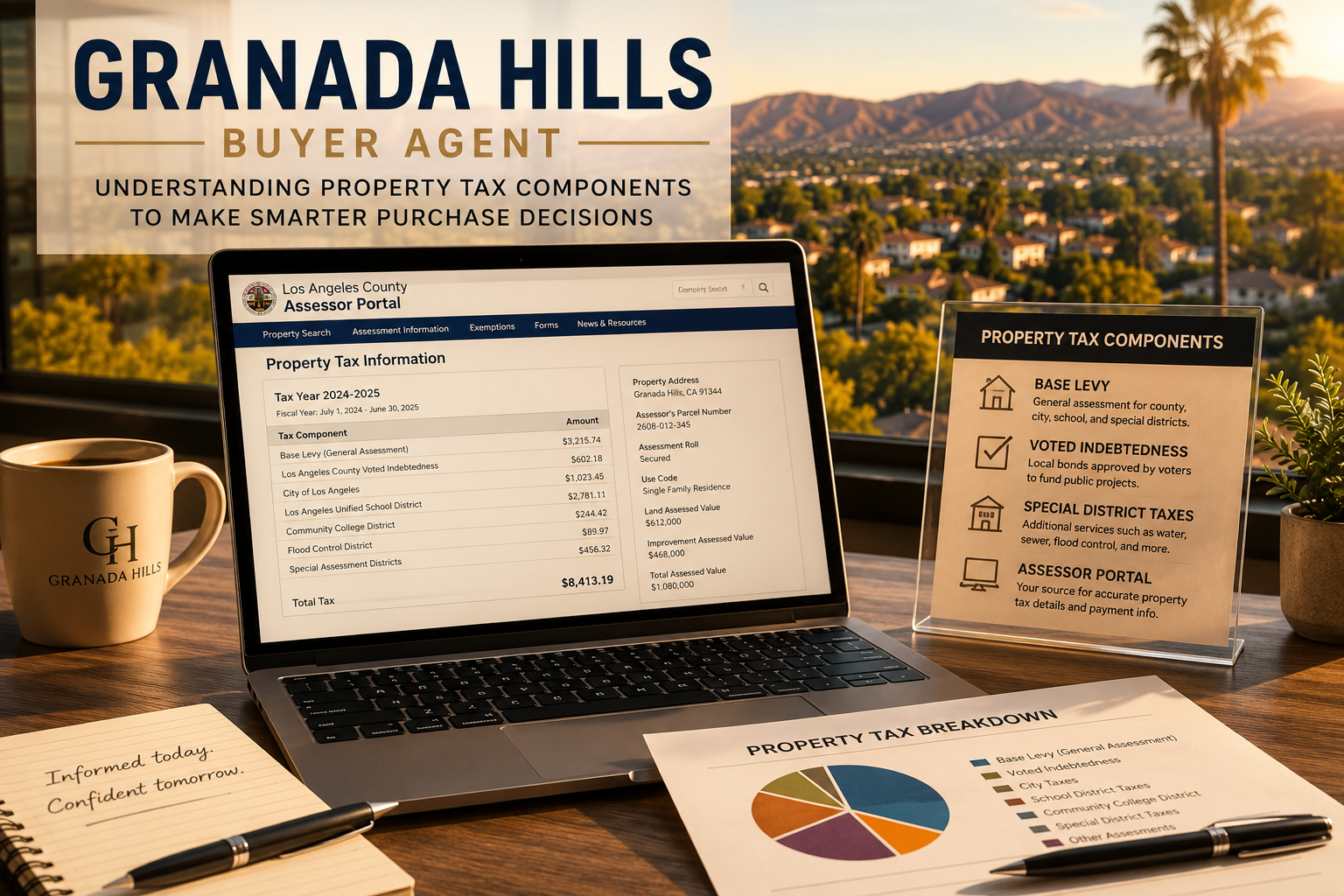 The Granada Hills property tax education conversation — the pre-close discussion that maps the full annual tax obligation including base levy, special district assessments, and parcel charges. At the GHCHS-premium tier ($1.1M–$1.35M), the annual tax bill of $12,980–$17,010 adds $1,082–$1,418/month to the housing cost alongside the mortgage payment. The buyer who plans for this monthly obligation from the beginning manages their Granada Hills ownership confidently; the buyer who discovers it at the first bill has budgeted incorrectly.
Component 1 — The Base 1% Levy:
California's Proposition 13 (1978) establishes the base property tax rate at 1.0% of the assessed value. For every Granada Hills purchase:
- → The assessed value at purchase equals the purchase price
- → The base levy = purchase price × 1.0%
- → At $1,100,000: base levy = $11,000/year
- → At $1,350,000: base levy = $13,500/year
Component 2 — Special District Assessments and Voter-Approved Bonds:
In addition to the base 1.0% levy, every Granada Hills 91344 parcel carries additional charges from special districts and voter-approved general obligation bonds. These vary by specific parcel but typically include:
LAUSD Bond Measures: Granada Hills is within the Los Angeles Unified School District — and LAUSD has passed multiple general obligation bond measures (Measure R, Measure K, and others) that appear as fixed annual charges on the property tax bill:
- → 💰 Estimated LAUSD bond charges: $450–$750/year depending on the specific bond measures active for the parcel
City of Los Angeles Bond Measures: Granada Hills 91344 addresses are within the City of Los Angeles, and various City-approved bond measures (affordable housing, infrastructure, parks) appear as annual charges:
- → 💰 City of Los Angeles bond measures: $200–$450/year combined
Los Angeles Community College District (LACCD) Bonds:
- → 💰 LACCD bond charges: $150–$280/year
Metropolitan Water District and Municipal Water District:
- → 💰 Water district assessments: $25–$65/year
Other Special Assessments: Depending on the specific Granada Hills parcel's location, additional assessments may include lighting and landscaping district charges, local improvement district levies, or other parcel-specific charges:
- → 💰 Other special assessments: $50–$200/year estimated
Total special assessments estimate for most Granada Hills 91344 parcels:
- → 💰 $875–$1,745/year in combined special assessments and bond charges above the base 1.0% levy
The effective rate result:
Base 1.0% + special assessments produce an effective rate of approximately 1.18%–1.26% for most Granada Hills 91344 parcels. The specific effective rate for any individual parcel is visible in the preliminary title report's tax schedule, which the buyer should request and review before removing contingencies.
Verifying your specific parcel's tax history:
The Los Angeles County Assessor's property tax portal (assessor.lacounty.gov) provides the current assessed value, prior year tax bill, and individual assessment components for any LA County parcel. Every Granada Hills buyer should verify the specific parcel's prior year tax bill before close to confirm the effective rate and identify any unusual assessments.
2. 💰 Granada Hills Property Tax by Purchase Price — The Complete Dollar Picture
With the effective rate framework established, the specific annual and monthly property tax obligations at Granada Hills's price tiers provide the actionable budget numbers every buyer needs.
Property tax calculations at Granada Hills 91344 price points:
All calculations use a 1.22% effective rate (midpoint of the 1.18%–1.26% range) for the base illustration, with the low and high range shown.
$875,000 purchase (volume tier, non-GHCHS premium addresses):
- → Annual property tax (1.22%): $10,675/year
- → Range (1.18%–1.26%): $10,325–$11,025/year
- → Monthly: $889/month (range: $860–$919)
- → Combined with a $700,000 conforming P&I payment ($4,777/month): total PITI approximately $5,841/month
$1,000,000 purchase:
- → Annual tax: $12,200/year
- → Monthly: $1,017/month
- → Combined with $800,000 conforming P&I ($5,459/month): total PITI approximately $6,651/month
$1,100,000 purchase (GHCHS-premium tier entry):
- → Annual tax: $13,420/year
- → Range: $12,980–$13,860/year
- → Monthly: $1,118/month (range: $1,082–$1,155)
- → Combined with $880,000 conforming P&I ($6,007/month): total PITI approximately $7,300/month
$1,250,000 purchase:
- → Annual tax: $15,250/year
- → Monthly: $1,271/month
- → Combined with $1,000,000 conforming P&I ($6,824/month): total PITI approximately $8,270/month
$1,400,000 purchase:
- → Annual tax: $17,080/year
- → Monthly: $1,423/month
- → Combined with $1,120,000 conforming P&I ($7,643/month): total PITI approximately $9,241/month
$1,600,000 purchase (luxury tier):
- → Annual tax: $19,520/year
- → Range: $18,880–$20,160/year
- → Monthly: $1,627/month (range: $1,573–$1,680)
- → Combined with $1,280,000 jumbo P&I at 7.50% ($8,959/month): total PITI approximately $11,111/month
$1,800,000 purchase:
- → Annual tax: $21,960/year
- → Range: $21,240–$22,680/year
- → Monthly: $1,830/month (range: $1,770–$1,890)
- → Combined with $1,440,000 jumbo P&I at 7.50% ($10,071/month): total PITI approximately $12,376/month
The property tax as a percentage of total PITI:
At Granada Hills's price range, property taxes represent approximately 15–18% of total PITI — a consistent and significant ownership cost component:
- → At $1,100,000: property taxes = 15.3% of total PITI
- → At $1,600,000: property taxes = 14.7% of total PITI
This proportion makes property taxes the third-largest monthly housing cost after principal and interest — larger than insurance, larger than HOA fees for most non-HOA Granada Hills properties, and specifically too large to exclude from affordability planning.
3. ⚠️ The Supplemental Tax Bill — Granada Hills's Most Important Post-Close Budget Item
The supplemental property tax bill is the most consistently unexpected post-close cost in any California purchase — and at Granada Hills's price points, where long-term homeowners have held under Proposition 13 protection for 15–35 years at assessed values far below current market, the supplemental bill magnitude is specifically large and specifically important to plan for.
What the supplemental tax bill is:
When a property sells, California reassesses the property from the prior owner's Proposition 13 protected assessed value to the buyer's new purchase price assessment. This reassessment difference produces a supplemental tax bill — a one-time additional charge covering the gap between what the prior owner was paying and what the new purchase-price assessment produces.
The supplemental bill calculation for Granada Hills:
Most Granada Hills long-term homeowners purchased 15–35 years ago and have benefited from Proposition 13's 2%/year maximum increase since their original purchase. Their current assessed value — the value appearing on the annual tax bill when you preview the property — is often $300,000–$600,000 below the current purchase price.
Example — $1,100,000 purchase, prior owner's assessed value $430,000:
- → Assessment increase: $1,100,000 - $430,000 = $670,000
- → Annual supplemental tax: $670,000 × 1.22% = $8,174/year
- → First supplemental bill (proration): depends on close month (see below)
- → Second supplemental bill: full-year amount
Supplemental bill proration by close month:
The supplemental tax bill covers only the portion of the tax year following the sale. California's property tax year runs July 1 through June 30:
- → ✅ Close in July (first day of tax year): Full supplemental year applies — largest possible supplemental bill
- → ✅ Close in January: Approximately 6 months remaining in the tax year — approximately half the annual supplemental amount in the first bill
- → ✅ Close in April: Approximately 3 months remaining — approximately 25% of the annual amount in the first bill, plus a second full-year bill the following tax year
- → 📊 Two bills total: The supplemental process typically produces two bills — a first supplemental covering the remaining months of the current tax year, and a second supplemental covering the first full tax year of ownership
Total supplemental tax exposure at Granada Hills price points:
$875,000 purchase (prior assessed value $330,000, holding 18 years):
- → Assessment increase: $545,000 × 1.22% = $6,649/year
- → Total supplemental (two bills combined): approximately $9,000–$11,000 depending on close month and proration
$1,100,000 purchase (prior assessed value $430,000, holding 22 years):
- → Assessment increase: $670,000 × 1.22% = $8,174/year
- → Total supplemental: approximately $11,000–$15,000
$1,350,000 purchase (prior assessed value $520,000, holding 25 years):
- → Assessment increase: $830,000 × 1.22% = $10,126/year
- → Total supplemental: approximately $13,500–$18,500
$1,600,000 purchase (prior assessed value $590,000, holding 28 years):
- → Assessment increase: $1,010,000 × 1.22% = $12,322/year
- → Total supplemental: approximately $16,000–$22,000
Planning for the supplemental bill:
- → ✅ Reserve $10,000–$22,000 in liquid savings specifically for the supplemental tax bills — this is in addition to the closing costs and post-close reserves discussed in the income article
- → ✅ Request the prior year's tax bill from the listing agent before making an offer — this shows the prior assessed value and allows you to estimate the supplemental bill magnitude
- → ✅ Confirm the prior assessed value through the LA County Assessor's portal at assessor.lacounty.gov
- → ⚠️ Don't use the prior year's tax bill as your ongoing tax estimate — the prior owner's Proposition 13 protected tax is dramatically below your purchase-price assessment and should never be used as your monthly budget figure
4. 🔒 Proposition 13 and Proposition 19 — The Long-Term Tax Framework
California's two most important property tax protection measures — Proposition 13 and Proposition 19 — create the long-term tax framework that makes Granada Hills ownership increasingly advantageous over time and that specifically benefits certain qualified buyer populations.
Proposition 13 — The Buyer's Long-Term Protection:
Once a Granada Hills purchase closes and the purchase-price assessment is established, Proposition 13 caps annual assessment increases at the lesser of 2% per year or the California Consumer Price Index increase. This protection:
- → ✅ Grows more valuable every year: A $1,100,000 Granada Hills purchase in 2026 at 1.22% effective rate produces $13,420/year in year-one taxes. After 20 years of 2%/year maximum increases, the assessed value is $1,100,000 × (1.02)^20 = approximately $1,632,000. At the same effective rate: $19,910/year in year-20 taxes.
- → ✅ Compare to market appreciation: If the same home appreciates at 4.0%/year over 20 years, its market value reaches approximately $2,406,000. A buyer in 2046 purchasing at that price pays taxes on $2,406,000 — approximately $29,353/year. The 2026 buyer who has held 20 years pays $19,910/year on the protected Proposition 13 assessed value — $9,443/year less in annual taxes despite owning an equivalent home.
- → ✅ The generational accumulation: The Granada Hills homeowner who purchased in 2006 at $750,000 has an assessed value in 2026 of approximately $1,115,000 (20 years of 2% increases) — paying taxes on $1,115,000 despite the market value being $1.5M+. This is the prior owner's Proposition 13 protection that the incoming buyer loses at purchase and rebuilds from their new purchase price.
The GHCHS premium Proposition 13 interaction:
For the Granada Hills buyer who purchases at the GHCHS-premium tier ($1,100,000–$1,350,000) and plans to hold for the duration of their children's K–12 education (10–14 years):
- → The Proposition 13 assessment cap produces a $13,420–$16,470/year year-one tax that grows to only $16,340–$20,044/year after 10 years of maximum increases — while the home's market value grows from $1.1M–$1.35M to approximately $1.63M–$2.0M
- → The growing divergence between assessed value and market value is the Proposition 13 benefit that makes long-term Granada Hills ownership progressively more tax-advantaged relative to comparable jurisdictions without assessment caps
Proposition 19 — The Qualified Buyer Transfer Benefit:
California's Proposition 19 (effective February 2021) allows specific qualified homeowners to transfer their existing base year value from a sold primary residence to a replacement primary residence anywhere in California:
Who qualifies:
- → ✅ Homeowners age 55 or older
- → ✅ Severely disabled homeowners
- → ✅ Victims of wildfire or natural disaster
How it works for the Granada Hills buyer:
A Granada Hills buyer who is 55+ and selling a longtime primary residence in another SFV community — Northridge 91324/91325, Reseda 91335, Sherman Oaks 91403/91423, or anywhere in California — with a low Proposition 13 assessed value can transfer that low base year value to their new Granada Hills purchase:
Example — 60-year-old buyer selling a Northridge 91324 home:
- → Northridge home: market value $950,000, prior assessed value (purchased 1998) approximately $320,000
- → Granada Hills purchase: $1,050,000
- → Without Proposition 19: Granada Hills taxes based on $1,050,000 assessment = $12,810/year
- → With Proposition 19 transfer: base year value adjusts to account for the price difference
- → Replacement value ($1,050,000) > original value ($950,000) by $100,000
- → New base year value = transferred base ($320,000) + difference ($100,000) = $420,000
- → Granada Hills taxes based on $420,000 assessment = $5,124/year
- → Annual tax savings vs. standard assessment: $7,686/year
- → ⚠️ Proposition 19 is complex: The calculation involves specific rules about primary residence designation, the timing of the sale and purchase, and the value comparison. Consult a California CPA or tax attorney before relying on Proposition 19 benefits in purchase planning — this is general information, not tax advice.
5. 🔍 Tax Appeals and Special Situations — When and How to Challenge Your Assessment
Granada Hills buyers who purchase at or near market peak conditions — or who close after market conditions have shifted — occasionally have grounds to challenge the County Assessor's assessment through the formal appeal process.
 The Granada Hills property tax appeal — the formal challenge process that allows buyers who purchased above supportable market value to present evidence and request an assessment reduction. While most Granada Hills purchases are at market-supported prices that align with the assessed value, buyers who purchased during competitive peak-market conditions and whose subsequent market data suggests a lower supportable value have successfully reduced assessments through the LA County Assessment Appeals Board process.
When a Granada Hills buyer might appeal:
- → ✅ Purchase during peak market competition: A buyer who paid $1,280,000 in a competitive spring market for a home whose comparable sales in the subsequent 6 months showed values of $1,170,000–$1,200,000 has potential grounds to appeal the $1,280,000 assessment
- → ✅ Post-close market decline: If the market has declined materially from the purchase price since close, the current market value may be below the assessed purchase price — producing grounds for a reduction
- → ✅ Property condition issues discovered after close: Significant condition issues not apparent at purchase (structural, environmental) that reduce market value may support an appeal
The appeal process:
- → 📋 File with the LA County Assessment Appeals Board: The formal appeal is filed with the Assessment Appeals Board at assessor.lacounty.gov — the same portal that provides current assessment information
- → 📅 Deadline: The appeal window is typically July 2 through November 30 of the tax year following assessment — verify current deadlines at the assessor's website
- → 📋 Evidence required: Comparable closed sales supporting a lower market value, appraisal report (optional but strengthens the case), property condition documentation
- → 💰 Potential savings: A successful appeal that reduces a $1,280,000 assessment to $1,175,000 produces $1,281/year in annual tax savings — modest but real, and compounding over the hold period under Proposition 13
The supplemental bill appeal:
Buyers who believe their supplemental assessment is incorrect have a separate appeal right for the supplemental bill — filed within 60 days of the supplemental bill date. The grounds are the same: the assessed value (purchase price) exceeds current market value at the time of reassessment.
The proactive planning alternative:
Rather than appealing after the fact, Granada Hills buyers purchasing in competitive conditions can specifically request that their purchase contract include language about the assessed value and request an independent appraisal before close. The appraisal contingency that protects the buyer's financing also provides market value evidence that may support a lower assessed value.
🚫 What NOT to Overdo
Don't budget monthly housing costs using the prior owner's tax bill. The prior owner's annual property tax bill — visible in the listing disclosures and sometimes referenced by listing agents as "current taxes are $X/year" — reflects their Proposition 13 protected assessment from their original purchase date. It has no relevance to your taxes as a new buyer. Your taxes are calculated from your purchase price. At a $1,100,000 Granada Hills purchase where the prior owner pays $4,800/year on a $390,000 assessed value, your annual taxes will be approximately $13,420/year — $8,620/year more than the prior bill shows. Always calculate your specific taxes from your purchase price × effective rate.
Don't ignore the supplemental tax bills in post-close budget planning. The supplemental bills that arrive 6–18 months after close are not included in the monthly PITI that the mortgage lender calculates — they arrive as separate, lump-sum bills. A Granada Hills buyer who closes in October and plans their first-year budget around the ongoing PITI receives a supplemental bill in approximately April–June of the following year for $8,000–$15,000. Budget for this specifically — in a dedicated savings reserve, not in the general monthly cash flow.
Don't assume the Proposition 19 transfer benefit applies without verifying the specific eligibility conditions. Proposition 19 requires: primary residence designation for both the sold and purchased properties, the buyer must be 55+ (or otherwise qualifying), and specific timing rules apply. The calculation of the new base year value when the replacement home costs more than the sold home involves a specific formula that a California tax professional should verify before any purchase planning relies on it. Use this article as a starting framework, not a definitive tax guidance source.
Don't pay for a property tax reduction service for a standard Granada Hills purchase. Various commercial services market themselves as "property tax reduction specialists" and charge fees to file appeals on behalf of homeowners. For a standard Granada Hills purchase at the market-supported price, there is typically no basis for appeal — and these services' fees often equal or exceed any achievable savings. The appeal process described above is straightforward and can be completed without a paid intermediary for most situations.
Don't confuse the property tax escrow impound with the actual annual obligation. Most Granada Hills mortgage lenders require property tax impounds — monthly contributions to an escrow account that the lender uses to pay the tax bills when due. The impound amount is approximately 1/12 of the estimated annual tax plus a 2-month cushion the lender maintains. The impound payment is the vehicle for funding the obligation — the obligation itself is the full annual tax described in this article. Confirm with the lender that the impound calculation uses your purchase-price assessment, not the prior owner's assessment.
🏠 Real-World Scenario — Granada Hills 91344
A couple — a firefighter with the City of Los Angeles and a school administrator with LAUSD, combined income $245,000/year — purchased a verified GHCHS-catchment Granada Hills 91344 home at $1,075,000. Their lender had estimated monthly PITI at approximately $8,200/month, which they had specifically budgeted for.
Two months after close, they received their first property tax statement showing their new assessed value of $1,075,000 and an estimated annual tax of $13,115 — $1,093/month. They called their lender and discovered their impound account was collecting $1,050/month based on the prior owner's partial-year bill that appeared at closing — not the full purchase-price assessment.
The lender immediately adjusted the impound to collect the correct amount going forward, but the 2-month shortfall in the impound account created a deficiency that the lender spread across the following 12 months — adding approximately $17/month to their payment for the next year.
More significantly, their first supplemental bill arrived 8 months after close: $9,845 — covering the proration of the assessment increase for the remaining months of the current tax year.
Their total first-year property tax cost: $13,115 (ongoing) + $9,845 (supplemental) = $22,960 in property tax in year one — approximately $7,000 more than they had specifically budgeted when they calculated the impound-based monthly payment.
The financial impact was manageable — they had $18,000 in emergency savings — but had they known the supplemental bill was coming and reserved for it specifically, the first-year surprise would have been eliminated entirely.
What they told us: "We wish someone had drawn a clear line between the impound payment and the supplemental bill before we closed. The lender talked about escrow impounds but never mentioned that there would be a separate supplemental bill for the assessment change. If we had known, we would have kept $10,000 in a dedicated property tax reserve instead of putting it toward furniture."
🏠 Real-World Scenario — Granada Hills 91344
A 57-year-old retired teacher — single, selling her Reseda 91335 home of 26 years (purchased 1999 at $278,000, current market value $910,000, current Proposition 13 assessed value $428,000) — was evaluating a move to a Granada Hills 91344 single-story home for accessibility reasons. Her target price: $1,050,000 for a verified GHCHS-catchment address (she had two grandchildren who would benefit from GHCHS enrollment through her address).
Standard assessment scenario:
- → Granada Hills purchase at $1,050,000
- → Annual tax at 1.22%: $12,810/year ($1,068/month)
Proposition 19 scenario (she qualified as 57-year-old selling primary residence):
- → Reseda market value: $910,000
- → Granada Hills purchase: $1,050,000 (replacement value exceeds original by $140,000)
- → Proposition 19 calculation: transferred base ($428,000) + excess ($140,000) = $568,000 new base year value
- → Annual tax on $568,000 assessment at 1.22%: $6,930/year ($578/month)
- → Annual savings versus standard assessment: $5,880/year
Over a 10-year projected hold period, the Proposition 19 benefit produces approximately $58,800 in total tax savings — compounding under Proposition 13's subsequent 2%/year cap.
We connected her with a California CPA who confirmed the Proposition 19 eligibility and the base year value calculation before she committed to the purchase. The CPA's specific guidance: ensure that the Reseda home is sold and the Granada Hills purchase closes within two years, and that both properties are designated as primary residences at close.
She sold the Reseda 91335 home for $905,000, purchased the Granada Hills 91344 GHCHS-catchment home at $1,040,000, and transferred the Proposition 19 base year value as planned. Her ongoing annual property tax: $6,930/year versus the $12,687 she would have paid on the standard $1,040,000 assessment.
The $5,757/year in annual tax savings — combined with the GHCHS enrollment benefit for her grandchildren — made the Granada Hills purchase specifically compelling for her situation in a way that a property tax education separate from the Proposition 19 framework would never have revealed.
❓ FAQ
How much are property taxes in Granada Hills CA? Annual property taxes in Granada Hills 91344 range from approximately $10,325–$11,025/year at the $875,000 entry tier to $21,240–$22,680/year at the $1,800,000 luxury tier. The effective rate for most 91344 parcels is approximately 1.18%–1.26% of the purchase price — the base 1.0% California levy plus special district assessments, school bond measures, and parcel charges specific to City of Los Angeles properties. Monthly, this produces approximately $860–$1,890/month in property taxes depending on the purchase price.
How is property tax calculated in Granada Hills? Property tax in Granada Hills is calculated as: (purchase price × effective rate). The effective rate is approximately 1.18%–1.26% for most 91344 parcels — the base 1.0% established by California Proposition 13 plus special district assessments including LAUSD bond measures, City of Los Angeles bond measures, LACCD bonds, and water district charges. Verify the specific effective rate for any target parcel through the LA County Assessor's portal at assessor.lacounty.gov — individual parcels may carry additional unique charges.
What is the supplemental property tax in Granada Hills? The supplemental tax bill is a one-time additional charge that arrives 6–18 months after closing — covering the assessment increase from the prior owner's Proposition 13 protected value to the buyer's new purchase-price assessment. At Granada Hills price points, the total supplemental tax exposure (typically two bills — one prorated and one full-year) ranges from approximately $9,000–$22,000 depending on the purchase price and how long the prior owner held the property. Budget for the supplemental bills specifically in post-close liquid reserves — they are not included in the monthly PITI impound calculation and arrive as separate lump-sum bills.
Does Proposition 13 protect my Granada Hills property taxes? Yes — immediately upon purchase. Once a Granada Hills home is purchased and the purchase-price assessment is established, California Proposition 13 caps annual assessment increases at the lesser of 2%/year or the California Consumer Price Index change. This cap means the assessed value grows slowly while market value may grow faster — producing a progressively more favorable effective tax rate over a 10–20 year hold period. After 15 years, a $1.1M Granada Hills purchase in 2026 has an assessed value of approximately $1,481,000 while the market value may be $1.8M+, and taxes are paid on the lower Proposition 13 value.
Can I qualify for Proposition 19 property tax transfer in Granada Hills? Proposition 19 allows homeowners 55+, severely disabled homeowners, and natural disaster victims to transfer their existing base year value from a sold California primary residence to a replacement primary residence anywhere in the state — including Granada Hills. If the replacement home costs more than the sold home, a specific formula adjusts the transferred base value. The benefit can produce significant annual tax savings — $4,000–$8,000+/year for typical Granada Hills purchases — for qualifying buyers who are selling a longtime appreciated home. Consult a California CPA or tax attorney to verify specific eligibility and calculate the transferred base value before relying on Proposition 19 in purchase planning.
Are property taxes in Granada Hills higher than other SFV cities? Granada Hills 91344 property taxes are broadly comparable to other SFV markets at equivalent purchase prices — all Los Angeles County properties share the same 1.0% base levy and similar special district assessment structures. Some variation exists based on the specific bond measures passed for each jurisdiction. Granada Hills's position within the City of Los Angeles (versus Calabasas 91302/91372, which is an incorporated city with its own tax structure) means the City of LA bond measures apply rather than a Calabasas-specific structure. For practical budgeting, the 1.18%–1.26% effective rate guidance applies broadly across the SFV, with minor parcel-specific variation.
🎯 Bottom Line
Granada Hills 91344 property taxes are a real, significant, and specifically plannable ownership cost — ranging from $860/month at the entry tier to $1,890/month at the luxury tier — that must be included in every affordability calculation alongside the mortgage payment and insurance. The supplemental tax bill that arrives 6–18 months after close adds $9,000–$22,000 in one-time costs that deserve a dedicated reserve, and the Proposition 19 opportunity that qualifying 55+ buyers can access produces $4,000–$8,000+/year in ongoing savings that change the financial logic of a Granada Hills move.
The buyer who understands all three dimensions of the Granada Hills property tax picture — the ongoing annual obligation from the purchase-price assessment, the supplemental bill timing and magnitude, and the long-term Proposition 13 protection — makes purchase and budgeting decisions with the complete financial picture. The buyer who discovers any of these as a post-close surprise has encountered the most avoidable category of financial stress in the home buying process.
At Parkway Estate Properties, Liana's buyer representation across Granada Hills 91344, Northridge 91324/91325, Reseda 91335, Sherman Oaks 91403/91423, Tarzana 91356, and the broader SFV means every Granada Hills buyer conversation includes the complete property tax education — the monthly obligation, the supplemental bill reserve, and the Proposition 13/19 framework — before any offer is written.
📩 Want a Personalized Property Tax Estimate for Any Granada Hills Address?
Tell us the specific address you're considering and we'll pull the prior year assessed value, estimate the supplemental bill magnitude, and give you the accurate monthly PITI including property taxes — before you've made any financial commitment.
Contact Liana Shersher at Parkway Estate Properties: 📧 liana@parkwayestate.com · 📞 (818) 208-5881 · 🌐 parkwayestate.com 15021 Ventura Blvd., Ste. 510, Sherman Oaks, CA 91403
About the Authors
Liana Shersher is a licensed real estate agent with Parkway Estate Properties Inc. and an Accredited Buyer's Representative (ABR) serving the San Fernando Valley — with a focus on Sherman Oaks, Encino, Tarzana, Woodland Hills, and Northridge (DRE# 02164224). Liana guides first-time homebuyers through every step of the purchase, from the first showing to the keys in hand, and represents move-up and repeat buyers across the Valley. For sellers, she builds the pricing and marketing strategy that positions a home to sell for top dollar, fast. Buyers and sellers work with Liana for clear communication, sharp local knowledge, and an agent who treats their goals like her own.
Roman Shersher is the broker-owner of Parkway Estate Properties Inc. and a real estate investor with 18 years of experience in the San Fernando Valley (DRE# 01855095). Roman has personally led or co-led renovations on dozens of properties across the Valley, including recent projects in Northridge (91324) and Woodland Hills (91364). That hands-on renovation and investment experience shapes every pricing conversation and days-on-market strategy at Parkway — sellers get a realistic read on what improvements actually return at resale, and buyers get an expert eye on a home's true condition and upside.
Parkway Estate Properties, Inc. · 15021 Ventura Blvd., Ste. 510, Sherman Oaks, CA 91403 · (818) 208-5881 · parkwayestate.com · Broker License #: 01873092 Equal Housing Opportunity. Information herein is general and not legal, tax, or financial advice. Consult qualified professionals for your specific situation.
Categories
Recent Posts











Broker | Realtor ® License ID: 01873092
+1(818) 208-5881 | info@parkwayestate.com