
How Much Are Property Taxes in Reseda?
Property taxes in Reseda 91335 are one of the most consistently miscalculated line items in the monthly payment analysis that first-time buyers and move-up families bring to their home search — and the miscalculation almost always runs in the same direction: underestimated. The buyer who budgets $600/month for property taxes on a $785,000 Reseda home and discovers at closing that the correct figure is $830/month has a $230/month shortfall in their payment planning that, at Reseda's price point, is the difference between a comfortable housing payment and a strained one.
This article gives Reseda buyers the complete property tax picture — how California's Proposition 13 system works, how to calculate the actual tax on any specific Reseda purchase, what supplemental taxes are and why they catch first-time buyers off guard, what exemptions reduce the tax burden, and the honest monthly payment math at Reseda's primary transaction price points. It is written for the buyer who wants to understand the numbers before they're in escrow, not discover them at the signing table.
1. 📚 How California Property Taxes Work — The Proposition 13 Foundation
California's property tax system is governed by Proposition 13, passed by voters in 1978 — a law that changed the relationship between property values and property taxes in a way that still defines the California real estate market nearly 50 years later. For Reseda buyers, understanding Proposition 13 is the foundation of every property tax calculation.
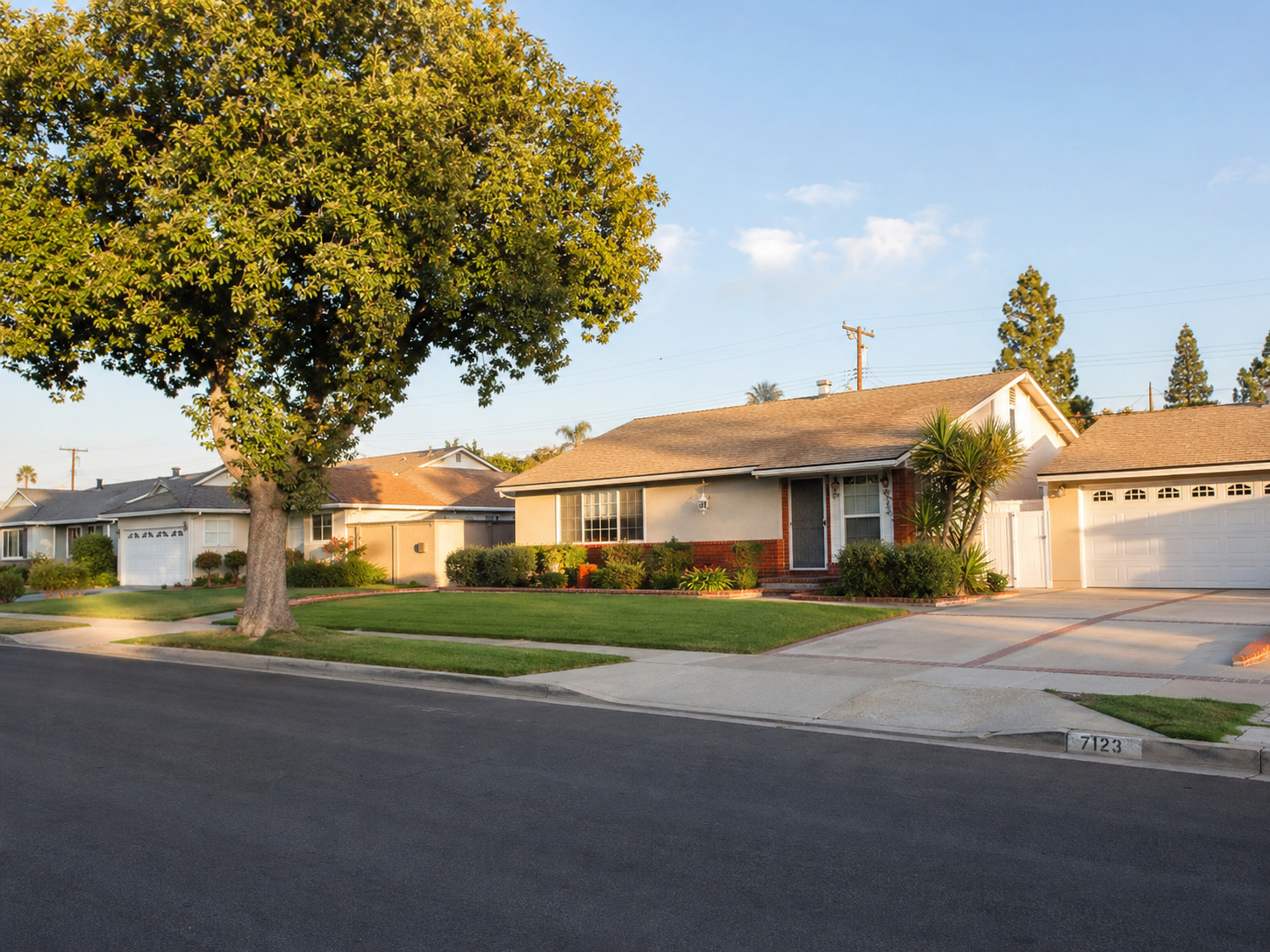 Reseda 91335 — the central Valley working-family market where property tax accuracy matters most. First-time buyers and move-up families at the $700K–$950K price point have less financial buffer for miscalculated monthly payments than higher-income buyer pools, making pre-purchase property tax calculation one of the most practically important due diligence steps in a Reseda purchase.
The Proposition 13 mechanics:
- → 📋 Assessment at purchase: When you purchase a home in Reseda 91335, the purchase price becomes the new "assessed value" — the taxable value on which all property taxes are calculated. This is the most important Proposition 13 concept for buyers: the purchase price IS the assessed value from day one of ownership.
- → 📈 Annual increase cap: After purchase, Proposition 13 limits the annual increase in assessed value to a maximum of 2% per year, regardless of how much the property's market value appreciates. This is the provision that has created the massive gap between long-term Reseda homeowners' property taxes and newly purchased Reseda homes' property taxes — a seller who has owned since 1994 may have an assessed value of $180,000 and pay $2,100/year; a buyer who purchases the same home for $820,000 in 2026 will have an assessed value of $820,000 and pay approximately $9,700/year from day one.
- → 🏠 Reassessment triggers: A Proposition 13 "base year value" reassessment occurs upon change of ownership (sale) or upon new construction. Cosmetic improvements — repainting, flooring replacement, appliance updates — do not trigger reassessment. Adding square footage through permitted addition does trigger reassessment of the added portion.
- → 📊 The base rate: The Proposition 13 base property tax rate is 1.0% of the assessed value annually. On a $785,000 Reseda purchase, the base tax is $7,850/year or approximately $654/month.
Why the prior owner's tax bill is irrelevant to your purchase:
This is the most important practical implication of Proposition 13 for Reseda buyers — and the one most frequently misunderstood:
A long-term Reseda 91335 homeowner who purchased in 1992 for $145,000 has an assessed value that has increased by 2% annually since then. By 2026, their assessed value is approximately $265,000 — far below the $820,000 current market value. Their annual property tax is approximately $3,100. Their monthly property tax payment is approximately $258.
When you purchase that home for $820,000 in 2026, your assessed value resets to $820,000. Your annual property tax is approximately $9,700. Your monthly payment is approximately $808.
The prior owner's $258/month property tax has zero relationship to your $808/month property tax. Buyers who ask the seller "what are your current property taxes?" and use the answer in their payment planning are making a significant budgeting error.
2. 💰 The Complete Reseda Property Tax Calculation — All Components
The 1.0% base rate is the largest component of Reseda property taxes but not the only one. Los Angeles County applies additional assessments — local bonds, special districts, and parcel taxes — that bring the effective total rate to approximately 1.15%–1.25% for most Reseda 91335 addresses.
The additional assessment components in Los Angeles County / Reseda 91335:
- → 🏫 LAUSD school bonds: Los Angeles Unified School District has passed multiple general obligation bonds over the years — for school construction, renovation, and technology. These bonds appear as line items on the Reseda property tax bill and add approximately $150–$300 annually to the total tax depending on assessed value and current bond obligations.
- → 🏛️ LA County general obligation bonds: Los Angeles County itself carries general obligation bond obligations that appear on property tax bills throughout the county — including Reseda 91335. These add approximately $100–$250 annually.
- → 🚒 Special district assessments: Fire protection, vector control, flood control, and other special district assessments appear on Reseda property tax bills. These are typically small ($50–$150 annually combined) but contribute to the total effective rate.
- → 🌊 LA River flood control: Properties near flood control infrastructure may carry specific assessments for the flood control district.
- → 📊 Combined additional assessments: For most Reseda 91335 addresses, the combined additional assessments beyond the 1.0% base rate add approximately $500–$1,200 annually — bringing the effective total annual tax to approximately 1.15%–1.25% of purchase price.
The complete Reseda property tax calculation at key price points:
$700,000 purchase price:
- → Base tax (1.0%): $7,000/year = $583/month
- → Additional assessments (approximately $750/year): $63/month
- → Total estimated annual: $7,750 | Total estimated monthly: $646
- → Homeowner's exemption savings: approximately -$70/year = -$5.83/month
- → Net monthly after exemption: approximately $640
$785,000 purchase price:
- → Base tax (1.0%): $7,850/year = $654/month
- → Additional assessments (approximately $900/year): $75/month
- → Total estimated annual: $8,750 | Total estimated monthly: $729
- → Net monthly after homeowner's exemption: approximately $723
$850,000 purchase price:
- → Base tax (1.0%): $8,500/year = $708/month
- → Additional assessments (approximately $1,000/year): $83/month
- → Total estimated annual: $9,500 | Total estimated monthly: $792
- → Net monthly after homeowner's exemption: approximately $786
$925,000 purchase price:
- → Base tax (1.0%): $9,250/year = $771/month
- → Additional assessments (approximately $1,100/year): $92/month
- → Total estimated annual: $10,350 | Total estimated monthly: $863
- → Net monthly after homeowner's exemption: approximately $857
⚠️ Important: These are estimates based on typical Reseda 91335 effective rates. The exact additional assessments on any specific Reseda address are available through the LA County Assessor's office (assessor.lacounty.gov) and the LA County Tax Collector (ttc.lacounty.gov). Always verify the specific parcel's tax history and current assessment components before finalizing payment calculations.
3. 📬 Supplemental Property Taxes — The First-Year Bill That Catches Buyers Off Guard
The supplemental property tax is the most frequently overlooked property tax obligation for Reseda buyers — and the one that most consistently produces a financial surprise in the first year of ownership. Understanding it before closing is the difference between a planned expense and an unexpected bill.
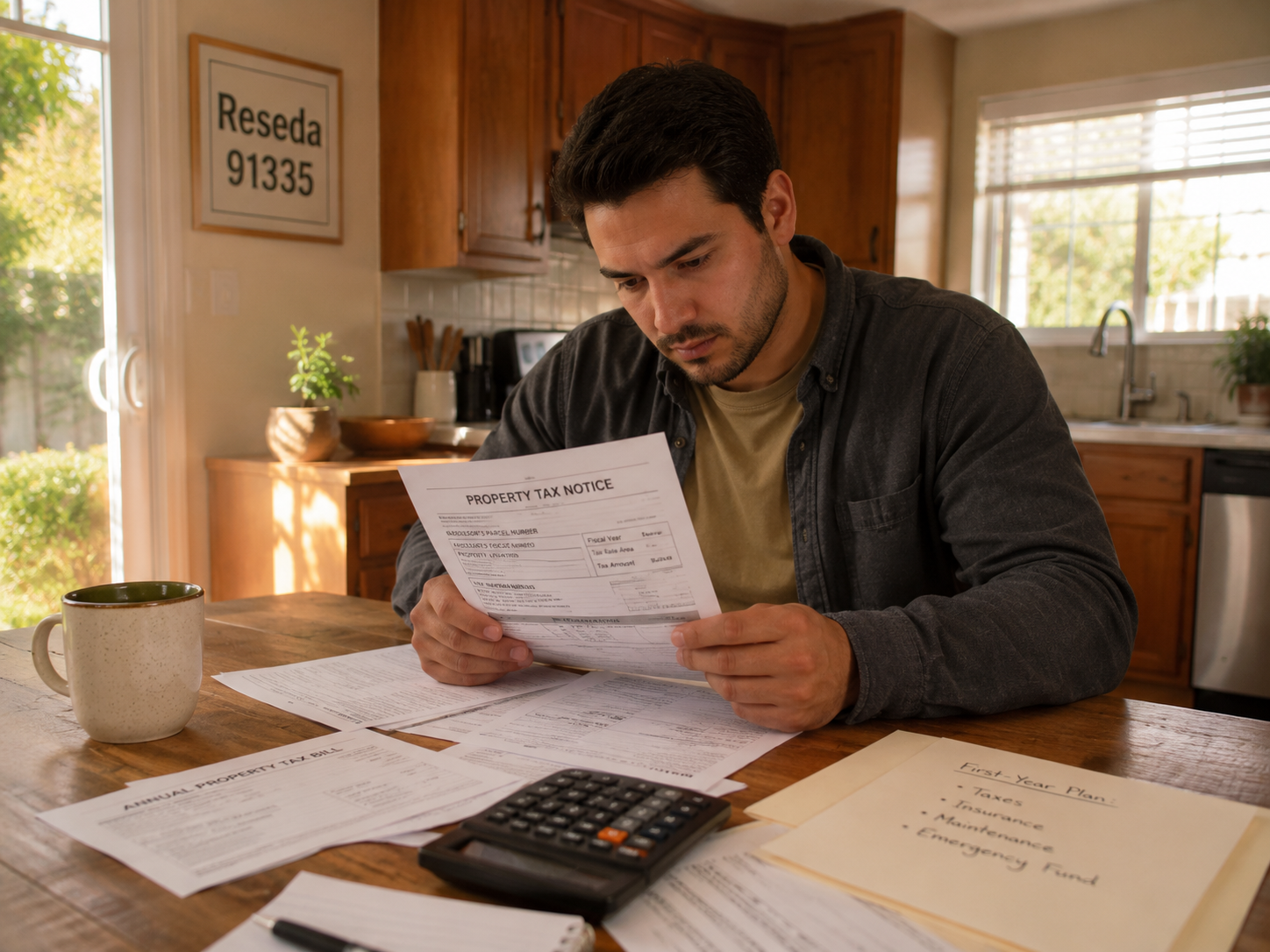 The Reseda first-year property tax reality — including the supplemental tax bill that most first-time buyers don't plan for. Understanding supplemental taxes before closing allows buyers to budget correctly from day one rather than facing an unexpected $4,000–$8,000 bill in their first year of Reseda homeownership.
What supplemental property taxes are:
When you purchase a Reseda home, the Los Angeles County Assessor's office reassesses the property at the purchase price. The prior owner had been paying taxes on a lower assessed value (for long-term owners, often dramatically lower). The difference between the prior assessed value and your new assessed value — prorated for the remaining months of the tax year — is billed as a supplemental property tax.
The supplemental tax calculation:
The supplemental assessment = (Your purchase price) - (Prior owner's assessed value) × (Months remaining in the tax year ÷ 12) × 1.0% base rate
Example at a $785,000 purchase with prior assessed value of $285,000:
- → Assessment difference: $785,000 - $285,000 = $500,000
- → Effective supplemental assessed value: $500,000
- → Base supplemental tax: $500,000 × 1.0% = $5,000
- → If purchase occurs in March (9 months remaining in tax year ending June 30): $5,000 × (9/12) = $3,750 supplemental tax due
Typical Reseda supplemental tax range:
For most Reseda 91335 purchases in the $700K–$950K range from long-term owners (20+ years of ownership), the supplemental tax bill typically runs:
- → 💰 $700,000 purchase (prior owner assessed at ~$200,000): Supplemental approximately $3,500–$4,500
- → 💰 $785,000 purchase (prior owner assessed at ~$250,000): Supplemental approximately $4,000–$5,300
- → 💰 $850,000 purchase (prior owner assessed at ~$300,000): Supplemental approximately $4,250–$5,500
- → 💰 $925,000 purchase (prior owner assessed at ~$350,000): Supplemental approximately $4,250–$5,750
When supplemental taxes arrive:
- → The supplemental tax bill arrives by mail approximately 4–8 months after the purchase close date — after the assessor's office processes the reassessment
- → The bill is due in two installments: first installment due November 1 (delinquent December 10), second installment due February 1 (delinquent April 10) — or, if the purchase close date puts you in the second half of the tax year, the billing cycle adjusts accordingly
- → If your lender has set up an impound/escrow account for property taxes, the supplemental tax is typically NOT included in the impound account — it is a separate bill you receive and pay directly. Confirm with your lender.
Budgeting for supplemental taxes:
Reseda buyers should set aside $4,000–$6,000 in liquid savings specifically for the supplemental tax bill that will arrive in their first year — separate from their down payment, closing costs, and moving expenses. This is not optional money; it is a legal tax obligation that arrives whether or not the buyer planned for it.
4. 🏠 Exemptions and Reductions — What Reseda Buyers Can Use to Lower Their Tax
California and Los Angeles County provide several property tax exemptions that reduce the assessed value on which tax is calculated. For Reseda buyers, the homeowner's exemption is the most universally applicable — and the most consistently unfiled.
✅ The Homeowner's Exemption:
- → What it is: A $7,000 reduction in assessed value available to owners who occupy their home as their primary residence
- → Savings: $7,000 × 1.0% = $70/year — approximately $5.83/month. Meaningful over time (30-year total: $2,100) but not life-changing on a monthly basis
- → How to apply: File a Claim for Homeowner's Property Tax Exemption with the LA County Assessor's office — available at assessor.lacounty.gov. The form can be filed online or by mail.
- → Filing deadline: File by February 15 for the full exemption for the coming fiscal year. Applications filed after February 15 but before December 1 receive 80% of the exemption for that year.
- → Automatic continuation: Once filed, the exemption continues automatically as long as you remain in the home as your primary residence — you do not re-file annually
- → ⚠️ New buyer timing: Many Reseda buyers close after February 15 and miss the full exemption for their first tax year. File as soon as possible after close — even a partial-year exemption saves something, and the following full year will be fully covered.
✅ The Disabled Veterans' Exemption:
- → What it is: Available to veterans with a service-connected disability rating, providing a reduction in assessed value ranging from approximately $100,000 to the full assessed value depending on disability rating and income
- → Eligibility: Service-connected disability, honorable discharge, California residency as primary residence
- → Application: LA County Assessor's office — significant savings for qualifying veterans purchasing in Reseda
✅ The Senior Citizen Property Tax Postponement Program:
- → What it is: A California state program allowing qualifying senior homeowners (62+) to defer property tax payments until the home is sold or transferred
- → Eligibility: Age 62+, equity in the home of at least 40%, income below $49,017 (verify current limits)
- → ⚠️ Relevance for buyers: This program is most relevant for existing senior Reseda homeowners rather than buyers, but Reseda buyers who are purchasing as seniors should be aware of the program for future reference
✅ The Proposition 19 Parent-Child and Grandparent-Grandchild Transfer:
Proposition 19 (passed 2020) significantly restricted but did not eliminate the parent-child assessed value transfer that previously allowed inherited properties to maintain the parent's low Proposition 13 assessed value.
- → Current rules (as of 2026): A child inheriting a parent's primary residence can maintain the parent's assessed value only if the child uses the inherited home as their own primary residence — and only up to $1,000,000 above the parent's assessed value. The prior unlimited transfer of assessed value regardless of use was eliminated by Proposition 19.
- → Relevance for Reseda buyers: Reseda buyers who are inheriting a family home should consult a qualified tax professional or estate attorney before completing the transfer — the Proposition 19 rules are complex and the decisions made at the time of transfer cannot be undone.
5. 📅 Property Tax Payment Schedule — How and When Reseda Taxes Are Paid
Understanding the California property tax payment schedule prevents the late payment penalties that catch new homeowners off guard — particularly buyers whose prior rental experience didn't require them to manage property tax deadlines independently.
The California property tax payment calendar — the two-installment schedule that Reseda homeowners must track whether they pay directly or through a lender impound account. Understanding the November 1 / February 1 due dates and the December 10 / April 10 delinquency dates prevents the 10% late payment penalty that applies automatically regardless of whether the homeowner received or opened the bill.
The California property tax calendar:
California property taxes are assessed annually for a fiscal year running July 1 through June 30. The annual tax is divided into two installments:
- → 📅 First installment: Covers July 1 – December 31
- Due: November 1
- Delinquent (10% penalty applies): December 10
- "If you don't pay by December 10, you pay a 10% penalty on the first installment regardless of why you didn't pay."
- → 📅 Second installment: Covers January 1 – June 30
- Due: February 1
- Delinquent (10% penalty applies): April 10
- "If you don't pay by April 10, you pay a 10% penalty on the second installment."
Impound accounts — the lender-managed payment option:
Most Reseda buyers with conventional financing have the option (and in some cases the requirement) of establishing an impound account — also called an escrow account — through which the lender collects monthly property tax payments as part of the total mortgage payment and remits the installment payments directly to LA County on the buyer's behalf.
- → ✅ Benefit: Automatic payment eliminates the risk of missed due dates and late penalties. Monthly budgeting is simplified — property taxes are included in the single monthly payment.
- → ✅ Who should use it: First-time Reseda buyers who prefer predictable monthly payments. Buyers at the upper end of their qualification who cannot absorb a large lump-sum payment.
- → ⚠️ Impound account setup: At closing, lenders typically collect 2–3 months of property tax into the impound account as a reserve — an upfront cost of approximately $1,400–$2,600 for most Reseda buyers. This is separate from the down payment and closing costs and should be anticipated.
- → ⚠️ Supplemental taxes not included: Impound accounts collect and pay the regular property tax installments. The supplemental tax bill that arrives in the first year is separate and must be paid directly by the buyer regardless of impound account status.
Direct payment — the self-managed option:
Reseda buyers who waive the impound account requirement (typically available to buyers with 20%+ down payment and good credit) pay property taxes directly to LA County:
- → 💻 Online: LA County Tax Collector at ttc.lacounty.gov — accepts credit card (convenience fee applies) or e-check (no fee)
- → 📬 Mail: Check payable to LA County Tax Collector, mailed to the address on the bill — allow 5 business days before the delinquency date
- → ⚠️ Critical: "I didn't receive the bill" is not an accepted basis for waiving the late penalty in California. Property owners are responsible for knowing the payment deadlines and paying on time regardless of whether the physical bill arrives.
What happens if Reseda property taxes aren't paid:
- → 10% penalty after December 10 (first installment) and April 10 (second installment)
- → If unpaid for five years, the property becomes subject to tax sale through the LA County Tax Collector
- → Tax liens appear on title and must be cleared before any subsequent sale or refinancing can close
🚫 What NOT to Overdo
Don't use the prior owner's property tax in your monthly payment calculation. This is the most commonly repeated buyer mistake in the Reseda 91335 market — and the most immediately correctable with basic Proposition 13 knowledge. Every Reseda listing on Zillow and Redfin displays the current owner's property tax. For long-term Reseda owners, this number is dramatically below what you will pay after purchase. Always calculate your own tax using the purchase price × 1.15%–1.25% effective rate ÷ 12 for the monthly figure.
Don't forget the supplemental tax in your first-year budget. Reseda buyers who close with their available cash fully deployed — down payment, closing costs, moving expenses, immediate home needs — and who haven't reserved $4,000–$6,000 for the supplemental tax bill are the buyers who face the most financial stress in their first year of ownership. The supplemental tax is not optional, it is not negotiable, and it arrives 4–8 months after close whether or not you budgeted for it.
Don't assume all Reseda addresses have identical effective tax rates. The base rate is uniform at 1.0% across all California residential property. The additional assessments — school bonds, county bonds, special districts — vary slightly by parcel depending on which specific bond measures apply to that address and what special district boundaries the property falls within. Two Reseda homes on the same block can have marginally different total effective rates. The only way to know your specific parcel's exact assessment components is to look up the address in the LA County Assessor's portal or request the prior year's tax bill from the seller.
Don't confuse property tax with Mello-Roos. Mello-Roos Community Facilities Districts are special tax districts that fund infrastructure in new developments — most commonly found in newer master-planned communities like Porter Ranch 91326 and parts of newer Calabasas 91302/91372 development. Reseda 91335, as an established 1950s–1970s central Valley neighborhood, has minimal Mello-Roos exposure — most 91335 parcels do not carry Mello-Roos assessments. However, verify for any specific parcel by reviewing the NHD disclosure and the LA County Assessor's assessment breakdown.
Don't file for the homeowner's exemption and then rent out the property. The homeowner's exemption requires the property to be your primary residence. If you purchase in Reseda, file the exemption, and then rent the property out — or list it as an Airbnb — the exemption is no longer valid and the County Assessor can retroactively apply back taxes and penalties. The exemption is specifically for owner-occupied primary residences.
🏠 Real-World Scenario — Reseda 91335
A first-time buyer couple was pre-approved for $795,000 at a 7.125% rate. Their lender had quoted them a total monthly payment of $5,890 — including principal and interest ($4,849 on $636,000 loan at 20% down), homeowner's insurance ($185), and property taxes ($856). They had budgeted their life around $5,900/month.
At closing, their impound account was set up using the seller's prior property tax history — a long-term Reseda owner who had owned since 1989 with an assessed value of $198,000 and annual taxes of $2,350. The lender's initial impound estimate, pulled from the tax records, set the monthly property tax reserve at $196/month — not $856.
The lender's pre-approval quote of $856/month for taxes had been correct based on the purchase price. The impound setup error pulled from current tax records rather than the post-purchase estimated tax. At their first impound account review (typically 12 months after close), the lender recalculated the property tax escrow based on the new assessed value and sent a notice of impound deficiency — requiring either a lump-sum catch-up payment of approximately $7,900 or a significant increase in monthly payment.
The buyers were financially stable enough to absorb the adjustment. But the first-year surprise — combined with the $5,200 supplemental tax bill that arrived in month 6 — produced approximately $13,100 in unexpected first-year property tax obligations that their closing budget hadn't anticipated.
The lesson: verify the impound account setup at closing reflects the post-purchase assessed value, not the prior owner's tax. Request that the lender calculate the impound reserve based on purchase price × effective rate, not on current tax records.
🏠 Real-World Scenario — Reseda 91335
A move-up buyer was purchasing a Reseda 91335 home at $865,000 — selling her prior Reseda condo and upgrading to a single-family home. She had owned the condo since 2018 and was familiar with property taxes from that experience. Her condo property taxes had been $620/month based on her 2018 purchase price of $485,000. She assumed the Reseda single-family home would be "about the same or a little more" — mentally budgeting $700/month for property taxes.
We walked through the correct calculation before she submitted her offer. On the $865,000 purchase:
- → Base tax (1.0%): $8,650/year = $721/month
- → Additional LA County assessments (estimated $1,050/year): $88/month
- → Total estimated monthly before exemption: $809/month
- → After homeowner's exemption: approximately $803/month
Her assumption of "about $700/month" was $103/month below the correct figure — a $1,236/year miscalculation that would have shown up as either an impound deficiency or a budget shortfall. At Reseda's price point and the buyer's specific financial situation, $103/month was meaningful.
We also walked through the supplemental tax. She had assumed the supplemental tax would be minimal because she was already a California homeowner. The supplemental tax is triggered by purchase, not by whether the buyer has previously owned. Her estimated supplemental bill: approximately $4,800 — the difference between the Reseda home's new $865,000 assessed value and the prior owner's approximately $385,000 assessed value, prorated for the 8 months remaining in the tax year at close.
She adjusted her closing cost reserve and her monthly budget accordingly. No surprises at closing, no impound deficiency in year one, no unexpected supplemental tax scramble. Accurate property tax knowledge produced exactly that — not a better outcome but the expected outcome, which is what accurate planning produces.
❓ FAQ
How are property taxes calculated in Reseda? Reseda 91335 property taxes are calculated using California's Proposition 13 system: your purchase price becomes the assessed value, and the base tax rate of 1.0% of that assessed value is applied annually. Additional Los Angeles County assessments — school bonds, county bonds, special district fees — add approximately 0.15%–0.25% to the effective rate. For most Reseda buyers, the total effective rate is approximately 1.15%–1.25% of purchase price annually. On a $785,000 purchase: approximately $9,025–$9,810 annually, or approximately $752–$818/month.
When are property taxes due in Reseda? California property taxes are due in two installments annually: ✓ First installment (July 1 – December 31): due November 1, delinquent after December 10. ✓ Second installment (January 1 – June 30): due February 1, delinquent after April 10. A 10% penalty applies automatically after each delinquency date regardless of reason. Buyers with lender impound accounts have taxes paid automatically; buyers without impound accounts are responsible for direct payment.
What is the property tax rate in Reseda CA? The base property tax rate in Reseda 91335 is 1.0% of assessed value — the Proposition 13 base rate applied uniformly across California. The total effective rate, including additional LA County bond assessments and special district fees, is approximately 1.15%–1.25% for most Reseda parcels. There is no separate Mello-Roos assessment on most Reseda 91335 parcels — verify for any specific address through the LA County Assessor at assessor.lacounty.gov.
How much are property taxes on a $800,000 home in Reseda? On an $800,000 Reseda 91335 purchase: ✓ Base tax (1.0%): $8,000/year = $667/month. ✓ Additional LA County assessments (estimated $950/year): $79/month. ✓ Total estimated: $8,950/year = $746/month. ✓ After homeowner's exemption (-$70/year): approximately $740/month net. Plus: a first-year supplemental tax of approximately $3,800–$5,500 depending on the prior owner's assessed value — due separately from the regular installments.
What is a supplemental property tax in California? A supplemental property tax is the one-time additional bill triggered when you purchase a California home — representing the difference between the prior owner's assessed value and your new purchase price, prorated for the remaining months of the tax year. It is billed by the LA County Assessor 4–8 months after your close date and is due separately from regular property tax installments. For most Reseda buyers purchasing from long-term owners, the supplemental tax runs $3,500–$6,000. It is not included in lender impound accounts — you receive and pay the bill directly.
Is Reseda subject to Mello-Roos taxes? Most Reseda 91335 parcels are not subject to Mello-Roos Community Facilities District assessments — Reseda is an established 1950s–1970s residential neighborhood without the new development infrastructure financing that Mello-Roos typically funds. Verify the specific parcel's assessment components through the LA County Assessor's detailed property tax breakdown at assessor.lacounty.gov or by reviewing the Natural Hazard Disclosure report and prior year's tax bill. Properties at Reseda's boundaries with newer development areas should be verified specifically.
How do I appeal my property tax assessment in Reseda? Property tax assessments can be appealed through the LA County Assessment Appeals Board if you believe the assessed value exceeds your home's fair market value at the time of purchase. For new buyers, this is rarely relevant — your purchase price IS the assessed value under Proposition 13, and the county assessor uses that price directly. Assessment appeals are more relevant for situations where the county has assessed the property above what the sale price reflects (uncommon) or for existing owners who believe their annual 2% increase has pushed assessed value above current market value. The appeal filing period runs July 2 through November 30 annually.
🎯 Bottom Line
Reseda 91335 property taxes are not complicated — but they are consistently miscalculated by buyers who rely on the prior owner's tax bill, who forget the supplemental tax, or who haven't applied the full effective rate including LA County assessments to their monthly payment planning. The math is specific and learnable before closing, which is the only useful time to learn it.
The Reseda buyer who correctly budgets $750–$820/month for property taxes on a $785,000 purchase, reserves $4,500–$5,500 for the first-year supplemental bill, understands that the prior owner's $210/month property tax bill is irrelevant to their purchase, and files the homeowner's exemption immediately after close is the buyer who experiences no property tax surprises in their first year of Reseda homeownership. That buyer is not doing anything extraordinary — they're simply doing the calculation accurately before they need to.
At Parkway Estate Properties, every Reseda buyer we work with gets the property tax calculation for their specific target properties before they're in contract — not as a closing day disclosure but as a pre-offer planning input that shapes the monthly payment analysis and the total first-year cost of ownership. Liana's buyer work across Reseda 91335, Tarzana 91356, Northridge 91324/91325, Canoga Park 91304, and the broader central SFV means every property tax question gets a specific, accurate answer for the specific address — not a generic estimate that produces a first-year surprise.
📩 Want an Accurate Property Tax Calculation for Any Reseda Home You're Evaluating?
Give us the address and the purchase price and we'll produce the complete first-year property tax picture — monthly installment amount, estimated supplemental tax, impound account setup requirements, and homeowner's exemption filing guidance — before you submit any offer.
Contact Liana Shersher at Parkway Estate Properties: 📧 liana@parkwayestate.com · 📞 (818) 208-5881 · 🌐 parkwayestate.com 15021 Ventura Blvd., Ste. 510, Sherman Oaks, CA 91403
About the Authors
Liana Shersher Liana Shersher is a licensed real estate agent with Parkway Estate Properties Inc. and an Accredited Buyer's Representative (ABR) serving the San Fernando Valley — with a focus on Sherman Oaks, Encino, Tarzana, Woodland Hills, and Northridge (DRE# 02164224). Liana guides first-time homebuyers through every step of the purchase, from the first showing to the keys in hand, and represents move-up and repeat buyers across the Valley. For sellers, she builds the pricing and marketing strategy that positions a home to sell for top dollar, fast. Buyers and sellers work with Liana for clear communication, sharp local knowledge, and an agent who treats their goals like her own.
Roman Shersher Roman Shersher is the broker-owner of Parkway Estate Properties Inc. and a real estate investor with 18 years of experience in the San Fernando Valley (DRE# 01855095). Roman has personally led or co-led renovations on dozens of properties across the Valley, including recent projects in Northridge (91324) and Woodland Hills (91364). That hands-on renovation and investment experience shapes every pricing conversation and days-on-market strategy at Parkway — sellers get a realistic read on what improvements actually return at resale, and buyers get an expert eye on a home's true condition and upside.
Parkway Estate Properties, Inc. 15021 Ventura Blvd., Ste. 510, Sherman Oaks, CA 91403 · (818) 208-5881 · parkwayestate.com · Broker License #: 01873092 Equal Housing Opportunity. Information herein is general and not legal, tax, or financial advice. Consult qualified professionals for your specific situation.
Categories
Recent Posts











Broker | Realtor ® License ID: 01873092
+1(818) 208-5881 | info@parkwayestate.com