
How Much Does It Cost to Sell a Home in the San Fernando Valley?
The total cost of selling a home in the San Fernando Valley — across Reseda 91335, Northridge 91324/91325, Granada Hills 91344, Lake Balboa 91406/91411, Tarzana 91356, Studio City 91604/91602, Encino 91316/91436, Sherman Oaks 91403/91423, Woodland Hills 91364/91367, and Calabasas 91302/91372 — ranges from approximately 7%–12% of the sale price when all costs are accounted for. At the median SFV transaction price of approximately $900,000, this means a seller is typically netting $81,000–$108,000 less from the gross sale price than the listing price suggests.
Most SFV sellers dramatically underestimate this cost — partly because the commission component is the most visible andthe additional costs are discovered incrementally through the transaction, and partly because the pre-sale preparation costs (which range from $0 for an as-is sale to $85,000–$200,000 for a comprehensively renovated south-of-Ventura Studio City or Encino listing) are variable and often incorrectly treated as separate from the "cost of selling."
This article gives SFV sellers across all markets the complete cost picture — every cost category, the specific dollar ranges by SFV price tier, the new commission landscape post-NAR settlement, the discretionary versus required cost distinction, and the net proceeds calculator framework that allows any SFV seller to estimate their actual take-home before committing to a listing strategy.
1. 💼 Real Estate Commission — The Post-NAR Settlement Landscape
Real estate commission is the largest single cost of selling a home in the San Fernando Valley — and the commission structure has changed meaningfully since the NAR settlement's implementation in August 2024. Understanding what commission looks like now, how it is negotiated, and what it covers is the foundation of any SFV seller cost analysis.
 The SFV seller cost education conversation — the pre-listing discussion that itemizes every cost category from commission through carrying costs and produces the accurate net proceeds estimate that sellers need before committing to a listing price, a preparation scope, and a timing strategy. At 7%–12% of the sale price, the total cost of selling is large enough to require specific planning, not post-close discovery.
The pre-NAR settlement commission structure:
Historically, the standard SFV listing commission was 5%–6% of the sale price — typically split approximately evenly between the listing agent's brokerage and the buyer's agent's brokerage. This structure was largely non-negotiated and non-transparent to buyers, with the seller effectively paying for both the listing agent's services and the buyer's agent's services as part of the transaction.
The post-NAR settlement commission structure:
Following the National Association of Realtors settlement that took effect August 17, 2024, the commission structure has changed in two specific ways:
Change 1 — Buyer agent compensation is separately negotiated: Buyer agent compensation can no longer be offered through the MLS as a standard, non-negotiated term. Sellers now separately negotiate whether and how much they offer to buyer's agents — and buyers and their agents separately negotiate their own compensation agreement.
Change 2 — Increased transparency and variability: Commission structures are now more explicitly negotiated and more variable across transactions. Some SFV sellers are offering buyer agent compensation concessions as a seller credit; others are not offering buyer agent compensation at all, leaving the buyer to pay their agent directly; others are offering a specific dollar amount or percentage.
What this means for SFV sellers in practice:
- → 📊 Listing agent commission: 2.0%–3.0% of the sale price is the current range for listing agent compensation in most SFV markets. At a $950,000 sale: $19,000–$28,500 to the listing agent's brokerage. At a $1.75M sale: $35,000–$52,500.
- → 📊 Buyer agent compensation (if offered by seller): 2.0%–2.5% of the sale price, offered as a seller credit or concession to the buyer for their agent compensation. At a $950,000 sale: $19,000–$23,750. At a $1.75M sale: $35,000–$43,750.
- → 📊 Total commission if seller pays both: 4.0%–5.5% of the sale price — modestly compressed from the historical 5%–6% range.
- → ⚠️ The buyer agent compensation decision: SFV sellers who choose not to offer buyer agent compensation may access a narrower buyer pool — specifically excluding buyers whose agents require seller-paid compensation and buyers who cannot afford to pay their agent separately in addition to their down payment. In competitive spring market conditions, some sellers can successfully decline to offer buyer agent compensation; in slower summer and fall markets, the competitive dynamics favor offering it.
Commission by SFV price tier:
Central Valley ($700K–$1.0M — Reseda 91335, Northridge 91324/91325, Lake Balboa 91406/91411):
- → Total commission (listing + buyer agent): $42,000–$55,000 on a $750,000 sale ($52,500–$68,750 if offering 5.5%–6.0%)
- → More likely to offer full buyer agent compensation to access the broadest buyer pool at this price tier
Western Valley premium ($1.0M–$1.5M — Tarzana 91356, Granada Hills 91344, Encino north-of-Ventura 91316):
- → Total commission: $45,000–$67,500 on a $1.1M sale
- → Buyer agent compensation commonly offered at 2.0%–2.5%
Premium ($1.5M–$2.5M — Studio City 91604, Encino south-of-Ventura 91316/91436, Sherman Oaks 91403/91423):
- → Total commission: $67,500–$125,000 on a $1.75M–$2.5M sale
- → More negotiating room on commission percentage at this price tier
Luxury/western ($2.0M–$3.5M+ — Woodland Hills 91364/91367, Calabasas 91302/91372):
- → Total commission: $90,000–$175,000 on a $2.0M–$3.5M sale
- → Listing agent commission frequently negotiated below 3.0% at this price tier
2. 🏦 Closing Costs — The Seller's Specific Obligations
Beyond commission, California sellers carry specific closing costs that are distinct from the buyer's closing costs — and that vary by SFV market and by the specific transaction structure.
California transfer tax:
California imposes a documentary transfer tax on the sale of real property:
- → 💰 County transfer tax: $1.10 per $1,000 of sale price — $990 on a $900,000 sale; $1,925 on a $1.75M sale
- → 💰 City of Los Angeles transfer tax (for LA City addresses — most SFV cities): $4.50 per $1,000 of sale price up to $5M — $4,050 on a $900,000 sale; $7,875 on a $1.75M sale
- → ⚠️ Measure ULA — "Mansion Tax" (effective April 2023 for LA City addresses): Properties selling above $5,000,000 in the City of Los Angeles pay an additional 4% transfer tax on the portion above $5M. Most SFV residential transactions are below this threshold, but Encino 91436 hillside and Calabasas 91302/91372 luxury transactions may reach the Measure ULA threshold in some cases. Verify for any transaction approaching $5M.
- → 📌 Cities with separate transfer taxes: Verify whether the specific SFV address is within the City of Los Angeles or within an unincorporated county area or a separate city (Calabasas is an incorporated city with its own transfer tax structure — verify current Calabasas transfer tax rates with a title company).
Escrow fees:
California escrow fees are split between buyer and seller in most transactions — with the seller typically paying approximately half the total escrow fee:
- → 💰 Seller's escrow fee: $1,500–$3,500 on a $700K–$1.5M SFV transaction; $2,500–$5,500 on a $1.5M–$3.5M transaction. Escrow companies charge based on transaction size and complexity.
Title insurance:
The seller in California typically pays for the owner's title insurance policy that protects the buyer:
- → 💰 Owner's title insurance: $1,800–$4,500 on a $700K–$1.5M transaction; $3,500–$8,000 on a $1.5M–$3.5M transaction. Premium rates are regulated by California and vary modestly by title company.
Natural Hazard Disclosure (NHD) report:
- → 💰 Cost: $100–$250 — a required seller disclosure in California identifying fire hazard zones, earthquake fault zones, flood zones, and other natural hazard designations. Calabasas 91302/91372 and Woodland Hills 91364's canyon-adjacent sub-neighborhoods are particularly likely to have VHFHSZ and other disclosures.
HOA transfer fees (if applicable):
For sellers in HOA communities (Calabasas gated communities, some Sherman Oaks and Encino complexes):
- → 💰 HOA transfer fee: $300–$1,500 — the fee the HOA charges to transfer documents, reserve fund disclosure, and community information to the new buyer. Some HOAs also charge demand fees, document preparation fees, and move-out fees.
Seller credits to buyer:
As part of the negotiated offer, sellers frequently agree to provide credits to buyers for inspection-identified repairs, closing cost assistance, or buyer-agent compensation (post-NAR settlement):
- → 💰 Repair credits: $2,000–$25,000 depending on what the inspection reveals and the negotiation outcome. HVAC replacement, roofing work, and deferred maintenance items are the most common credit categories.
- → 💰 Closing cost credits: Sometimes offered by sellers as an alternative to price reductions — typically 1%–3% of the sale price as a credit toward buyer closing costs.
Total closing costs (excluding commission and preparation):
- → 💰 Central Valley SFV ($700K–$1.0M): $8,500–$16,000
- → 💰 Western Valley premium ($1.0M–$1.5M): $12,000–$22,000
- → 💰 Premium ($1.5M–$2.5M): $18,000–$38,000
- → 💰 Luxury/western ($2.0M–$3.5M+): $28,000–$65,000+
3. 🏠 Pre-Sale Preparation Costs — The Variable That Most Affects Net Proceeds
Pre-sale preparation — the inspection, repairs, cosmetic improvements, staging, and professional photography that prepare a home for market — is the most variable cost category in the SFV seller's cost structure, and the one where preparation investment decisions most directly determine the net proceeds outcome.
The pre-sale preparation cost spectrum by SFV market:
Central Valley working-family markets (Reseda 91335, Northridge 91324/91325, Lake Balboa 91406/91411):
- → 💰 Pre-listing inspection: $400–$650 — the non-negotiable first investment
- → 💰 Deferred maintenance remediation (if needed): $0–$35,000 for HVAC, roofing, electrical panel, plumbing issues that the inspection identifies
- → 💰 Focused cosmetic scope (paint, flooring, hardware, curb appeal): $18,000–$45,000 for the improvement scope that reaches the market's comp ceiling at these price tiers
- → 💰 Professional staging: $2,500–$6,000 for vacant staging; $800–$2,500 for occupied staging consultation
- → 💰 Professional photography: $450–$900 including aerial if applicable
- → 📊 Total typical preparation range: $5,000–$85,000 (as-is through fully prepared)
Western Valley premium markets (Tarzana 91356, Granada Hills 91344, Encino north-of-Ventura 91316):
- → 💰 Focused improvement scope: $35,000–$85,000 for the semi-custom specification improvements that reach these markets' comp ceilings
- → 💰 Professional photography and marketing: $800–$1,500 including aerial and video walkthrough
- → 📊 Total typical preparation range: $8,000–$110,000
Premium markets (Studio City 91604, Encino south-of-Ventura 91316/91436, Sherman Oaks 91403/91423):
- → 💰 Custom specification renovation scope: $85,000–$200,000+ for the full custom kitchen, spa primary suite, wide-plank white oak flooring, and outdoor entertaining space that these markets' comp ceilings support
- → 💰 Premium staging: $6,000–$16,000 for vacant staging at premium price points
- → 💰 Premium photography, video, and 3D tour: $1,500–$3,500
- → 📊 Total typical preparation range: $12,000–$220,000+
Luxury/western markets (Woodland Hills 91364/91367, Calabasas 91302/91372):
- → 💰 Improvement scope (varies dramatically by condition): $0 (as-is) to $180,000+ for a fully prepared luxury listing
- → 💰 Luxury staging: $8,000–$25,000+
- → 💰 Professional photography, video, aerial, and virtual tour: $2,500–$5,000+
- → 📊 Total typical preparation range: $15,000–$200,000+
The preparation ROI discipline:
As described in the city-specific improvement articles, the correct preparation scope is determined by the sub-neighborhood comp gap — the difference between the as-is value and the renovated comp ceiling. The preparation investment that fits within approximately 50%–65% of the comp gap midpoint produces positive ROI; preparation above the ceiling produces diminishing or negative returns. Every SFV seller should run the sub-neighborhood comp gap analysis before committing any preparation scope above $20,000.
4. ⏰ Carrying Costs — The Cost Category Most Sellers Forget
Carrying costs — the ongoing monthly ownership obligations the seller continues to pay from the decision to sell through the closing date — are the most consistently underestimated cost category in the SFV seller's financial planning. At SFV price points, carrying costs run $4,500–$18,000/month and accumulate to $20,000–$100,000+ over the preparation and listing period.
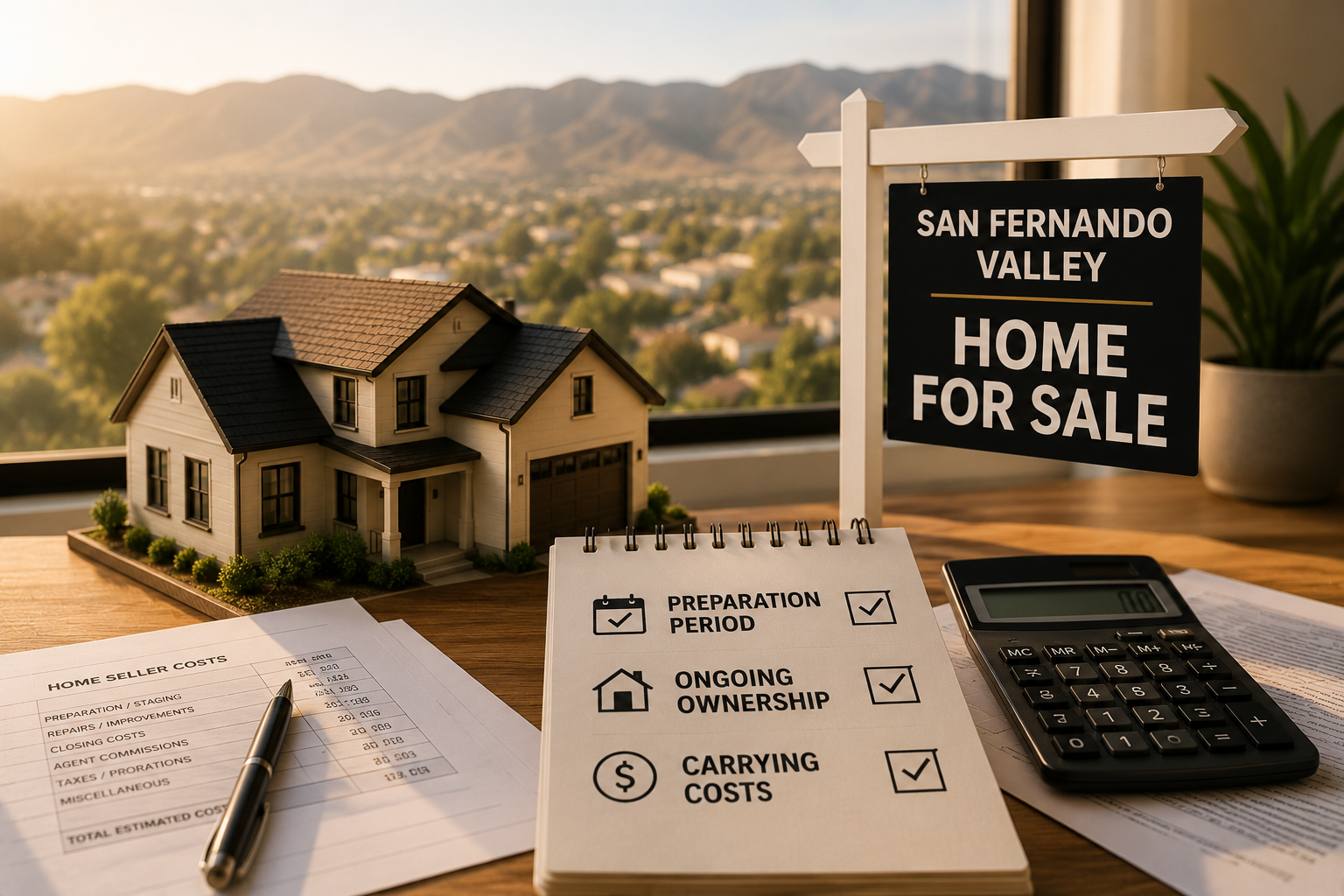 The SFV seller carrying cost timeline — the monthly ownership obligations that accumulate from the decision to prepare and list through the closing date. At $4,500–$18,000/month across the SFV price spectrum, the 10–16 weeks between preparation start and close produces $15,000–$60,000+ in carrying costs that belong in the net proceeds calculation, not in the post-close surprise category.
Monthly carrying cost components:
Mortgage payment (if the home is leveraged): The largest carrying cost for most SFV sellers. A seller with a $600,000 mortgage balance at 4.0% (a common Proposition 13-vintage loan on an older SFV home) pays approximately $2,860/month in P&I — a carrying cost that accumulates whether the home is on market for 20 days or 90 days.
Property taxes:
- → 💰 Central Valley ($700K–$950K assessed): $700–$1,150/month in property taxes
- → 💰 Western Valley premium ($950K–$1.4M assessed): $950–$1,650/month
- → 💰 Premium ($1.4M–$2.5M assessed): $1,400–$2,600/month
- → 💰 Luxury/western ($2.0M–$3.5M+ assessed): $2,000–$3,800/month
Homeowners insurance:
- → 💰 Central Valley: $90–$130/month
- → 💰 Premium markets: $150–$320/month
- → 💰 Calabasas/Woodland Hills (wildfire-zone): $300–$1,500+/month depending on FAIR Plan status
HOA fees (where applicable):
- → 💰 Calabasas gated communities: $400–$1,200/month
- → 💰 Other SFV HOA communities: $200–$600/month
Utilities:
- → 💰 Typical monthly utilities for a staged/vacant SFV home: $150–$400/month
The carrying cost by timeline:
At the all-in monthly carrying cost for a central Valley SFV seller ($4,500–$6,000/month):
- → 6-week timeline (fast spring market): $6,750–$9,000 in carrying costs
- → 10-week timeline (standard preparation + spring listing): $11,250–$15,000
- → 16-week timeline (extended preparation or slower market): $18,000–$24,000
At the all-in monthly carrying cost for a Calabasas or premium Encino seller ($10,000–$18,000/month):
- → 10-week timeline: $25,000–$45,000 in carrying costs
- → 16-week timeline: $40,000–$72,000
Why carrying costs matter for pricing strategy:
Every additional month of market exposure from overpricing costs the seller carrying costs that the eventual negotiated-down close price doesn't recover. A Tarzana 91356 seller carrying $6,500/month who overprices by $50,000 and accumulates 45 additional days on market has spent $9,750 in additional carrying costs — before the negotiated price reduction that the accumulated DOM enables. The overpricing that "left room for negotiation" cost the seller $59,750 more than correct pricing from launch would have.
5. 📊 The Net Proceeds Calculator — Building Your Specific SFV Estimate
With all cost categories mapped, the SFV seller can build a specific net proceeds estimate by inserting their actual numbers. The framework below covers every cost component.
Net proceeds formula:
NET PROCEEDS = Sale Price - Commission - Transfer Taxes - Escrow/Title - Repair Credits/Concessions - Mortgage Payoff - Pre-Sale Preparation - Carrying Costs
SFV net proceeds worksheets by price tier:
Central Valley — $750,000 sale (Reseda 91335, Northridge 91324/91325):
- → Sale price: $750,000
- → Listing commission (2.5%): -$18,750
- → Buyer agent compensation (2.0%): -$15,000
- → Transfer taxes (LA City — $5.60/$1,000): -$4,200
- → Escrow fee (seller's share): -$1,800
- → Title insurance (owner's policy): -$2,200
- → NHD and other disclosures: -$200
- → Repair credits (estimate): -$5,000
- → Pre-sale preparation (focused scope): -$35,000
- → Carrying costs (10 weeks at $5,200/month): -$13,000
- → Gross costs before mortgage payoff: -$95,150
- → Gross proceeds before mortgage payoff: $654,850
- → After $350,000 mortgage payoff: $304,850 net
Western Valley premium — $1,100,000 sale (Tarzana 91356, Granada Hills 91344):
- → Sale price: $1,100,000
- → Listing commission (2.5%): -$27,500
- → Buyer agent compensation (2.0%): -$22,000
- → Transfer taxes: -$6,160
- → Escrow fee (seller's share): -$2,400
- → Title insurance: -$3,000
- → NHD and disclosures: -$200
- → Repair credits: -$8,000
- → Pre-sale preparation: -$55,000
- → Carrying costs (12 weeks at $7,000/month): -$21,000
- → Gross costs: -$145,260
- → Gross proceeds: $954,740
Premium — $1,750,000 sale (Studio City 91604, Sherman Oaks 91403, Encino 91316):
- → Sale price: $1,750,000
- → Listing commission (2.5%): -$43,750
- → Buyer agent compensation (2.0%): -$35,000
- → Transfer taxes: -$9,800
- → Escrow fee: -$3,800
- → Title insurance: -$5,500
- → NHD and disclosures: -$250
- → Repair credits: -$12,000
- → Pre-sale preparation (renovated): -$120,000
- → Carrying costs (14 weeks at $11,500/month): -$40,250
- → Gross costs: -$270,350
- → Gross proceeds: $1,479,650
Luxury/western — $2,200,000 sale (Woodland Hills 91364, Calabasas 91302):
- → Sale price: $2,200,000
- → Listing commission (2.5%): -$55,000
- → Buyer agent compensation (2.0%): -$44,000
- → Transfer taxes: -$12,320
- → Escrow fee: -$4,800
- → Title insurance: -$7,500
- → NHD and disclosures: -$300
- → Repair credits: -$15,000
- → Pre-sale preparation: -$85,000
- → Carrying costs (12 weeks at $14,000/month): -$42,000
- → Gross costs: -$265,920
- → Gross proceeds: $1,934,080
Important caveats on the worksheets:
These are illustrative estimates using typical values — the seller's specific numbers will vary based on their actual mortgage balance, their specific preparation scope, their negotiated commission terms, and the specific repair credits and concessions their transaction produces. Build the worksheet with the seller's actual numbers, not the estimates above.
🚫 What NOT to Overdo
Don't calculate net proceeds from the listing price — calculate from the realistic close price. The SFV seller who estimates net proceeds from their $1.15M listing price but closes at $1.09M — after 45 days of DOM, a $40,000 price reduction, and a $20,000 repair credit — has a different net than the listing price-based calculation suggested. Build net proceeds estimates from the realistic close price (the comp ceiling for the specific home, not the aspirational list price) rather than the listing price.
Don't treat commission as the only negotiable cost. Many SFV sellers focus exclusively on commission negotiation while accepting standard rates on every other cost category. Escrow companies, title companies, and service providers involved in the transaction all have some fee flexibility — particularly at the premium and luxury price tiers where the transaction size supports it. Ask specifically about rate flexibility rather than assuming posted rates are fixed.
Don't underestimate the cost of selling as-is versus preparing. The SFV seller who lists as-is at $720,000 instead of preparing and listing at $810,000 saves the $40,000 preparation cost but nets approximately $50,000–$70,000 less in gross proceeds — a negative trade when the comp gap supports the preparation investment. Run the comp gap analysis before concluding that as-is is the lower-cost path. As the city-specific improvement articles document, the correctly specified preparation investment in Tarzana, Studio City, or Encino consistently produces positive ROI when the comp gap supports it.
Don't overlook capital gains tax implications at premium SFV price points. For SFV sellers who have owned for many years and whose Proposition 13 assessed value is far below the current market value, the capital gain on the sale may be substantial. California's capital gains rate (up to 13.3% state + 20% federal for long-term gains above the $250,000/$500,000 primary residence exclusion) is a real cost that belongs in the net proceeds calculation for sellers at premium price points who have held long-term. This is not legal or tax advice — consult a qualified California tax professional before closing on any SFV transaction with a substantial gain. The interaction between Proposition 13's low assessed value, long-term appreciation, and the primary residence exclusion is specifically complex at Encino, Studio City, Sherman Oaks, and Calabasas price points.
Don't sign a listing agreement without understanding the specific commission structure you're agreeing to. The post-NAR settlement commission landscape requires sellers to specifically negotiate and document whether buyer agent compensation is being offered, in what form, and at what amount. Read the listing agreement's commission section specifically — not the general summary — and confirm with the listing agent exactly what the total commission obligation is under different buyer agent compensation scenarios.
🏠 Real-World Scenario — Northridge 91324
A Northridge 91324 seller — a 4-bedroom original-condition home, long-term owner, no mortgage — had planned her retirement around the proceeds from the sale. Her expectation: close to $1.0M in proceeds from a $1.0M sale.
We built the specific cost analysis before the listing:
- → Realistic close price (original condition, specific sub-neighborhood comp ceiling): $880,000
- → Listing commission (2.5%): -$22,000
- → Buyer agent compensation (2.0%): -$17,600
- → Transfer taxes: -$4,928
- → Escrow/title: -$3,800
- → NHD: -$200
- → Pre-listing inspection (deferred maintenance revealed): -$550
- → HVAC replacement (required by inspection findings): -$13,200
- → Focused cosmetic scope (paint, flooring, curb appeal): -$32,000
- → Staging: -$4,500
- → Photography: -$750
- → Carrying costs (11 weeks, no mortgage — only taxes + insurance + utilities): -$5,800
- → Repair credit to buyer at inspection: -$6,500
- → Total costs: -$111,828
- → Net proceeds on $880,000 close: $768,172
Her expectation of "close to $1.0M in proceeds from a $1.0M sale" was off by approximately $231,828 — the combined effect of the realistic close price being $120,000 below her assumed $1.0M, the preparation and repair costs she hadn't planned for, and the commission and closing costs she had underestimated.
The net proceeds conversation — conducted before the listing rather than revealed at the close — allowed her to adjust her retirement planning to the realistic number. She ultimately chose a modified approach: reduced preparation scope ($22,000 instead of $32,000 for cosmetics, declining the staging) that produced a slightly lower close price ($862,000) but higher net proceeds ($751,000) than the full preparation scope would have produced at the same close price with higher preparation costs.
The seller who understood the complete cost picture before listing made a better preparation scope decision than the seller who discovers the costs at closing.
🏠 Real-World Scenario — Encino 91316
An Encino 91316 south-of-Ventura seller — a comprehensively renovated 4-bedroom, long-term owner who had completed the renovation 3 years prior — had a specific question: should they sell now or wait 2 more years to sell?
We modeled both scenarios:
Sell now (2026):
- → Realistic close price (renovated comp ceiling, current market): $2.15M
- → Total selling costs (commission, closing, carrying — no additional preparation needed): $138,500
- → Mortgage payoff (outstanding balance): $485,000
- → Net proceeds 2026: $1,526,500
Sell in 2 years (2028), holding assumptions:
- → Projected close price (3.5% annual appreciation on $2.15M × 2 years): $2.302M
- → Total selling costs (2028 estimate, 5% cost inflation): $148,000
- → Mortgage payoff (2028 balance after 24 months of amortization): $458,000
- → Carrying costs for 2 additional years of ownership (mortgage + taxes + insurance + HOA at $13,500/month): $324,000
- → Net proceeds 2028: $1,372,000
The 2-year wait scenario produces $154,500 less in net proceeds than selling now — because the 2 additional years of carrying costs ($324,000) exceed the appreciation gain plus mortgage paydown over the same period ($152,000 + $27,000 = $179,000).
For a seller without a specific lifestyle reason to delay (no timing constraint, no rental income offset), selling now in a seller-favorable spring market window produced $154,500 more in net proceeds than waiting for an anticipated appreciation gain that the carrying costs outpaced.
The seller sold in spring 2026. Net proceeds: $1,524,000 (slightly below the estimate due to a $2,500 additional repair credit). Their retirement account gained $154,500 more than the 2028 scenario would have produced — money that, invested immediately at close, will compound at market rates for the 2 years the alternative scenario would have spent on carrying costs.
❓ FAQ
How much does it cost to sell a house in the San Fernando Valley? The total cost of selling a home in the SFV ranges from approximately 7%–12% of the sale price across all markets and price tiers. At the central Valley entry tier ($700K–$950K in Reseda 91335, Northridge 91324/91325, Lake Balboa 91406/91411): total costs of approximately $75,000–$110,000 on a $750,000–$900,000 sale. At the western Valley premium tier ($950K–$1.4M in Tarzana 91356, Granada Hills 91344): $95,000–$155,000 on a $1.0M–$1.4M sale. At the premium tier ($1.4M–$2.5M in Studio City 91604, Encino 91316, Sherman Oaks 91403): $150,000–$285,000 on a $1.5M–$2.5M sale.
What is the real estate commission in the San Fernando Valley? Post-NAR settlement (August 2024), SFV real estate commission is negotiated rather than standardized. Listing agent commission currently ranges from 2.0%–3.0% of the sale price. Buyer agent compensation (if offered by the seller) ranges from 1.5%–2.5%. Total commission if the seller pays both: 3.5%–5.5% — compressed from the historical 5%–6% range. At a $900,000 SFV sale with 4.5% total commission: $40,500. At a $1.75M premium market sale at 4.5%: $78,750.
What closing costs do sellers pay in California? California sellers typically pay: ✓ Documentary transfer tax ($1.10/county per $1,000 of sale price + $4.50/City of LA per $1,000 for most SFV addresses). ✓ Escrow fees (seller's share, approximately half total). ✓ Owner's title insurance policy for the buyer. ✓ Natural Hazard Disclosure report. ✓ HOA transfer fees (if applicable). ✓ Any agreed-upon repair credits or buyer concessions. Total closing costs (excluding commission and preparation): $8,500–$38,000+ depending on price tier.
How do I calculate my net proceeds from a home sale in the SFV? Net proceeds = Sale price - commission - transfer taxes - escrow and title fees - repair credits - mortgage payoff - pre-sale preparation costs - carrying costs. Build the estimate using your realistic close price (the comp ceiling for your specific home and sub-neighborhood, not your aspirational list price), your actual mortgage payoff balance (call your lender for a payoff quote), your specific negotiated commission terms, and estimates for each cost category based on your specific market tier.
What is the cheapest way to sell a home in the San Fernando Valley? The lowest-cost path to selling (as-is, minimal commission negotiation, no preparation) is not always the highest net proceeds path. The as-is sale that saves $45,000 in preparation costs but closes at $85,000 below the renovated comp ceiling produces $40,000 less in net proceeds than the prepared sale. The correct "cheapest way to sell" evaluation compares total net proceeds across scenarios — as-is versus prepared, full preparation versus targeted preparation — and identifies the path that maximizes net proceeds rather than minimizes gross costs. For most SFV sellers whose comp gap supports a focused preparation scope, the correctly specified preparation investment produces better net proceeds than the as-is alternative.
Do I have to pay capital gains tax when I sell my SFV home? If the SFV home is your primary residence and you have lived in it for at least 2 of the last 5 years, you qualify for the primary residence capital gains exclusion: $250,000 for single filers, $500,000 for married filing jointly. Gains below these thresholds are typically not taxable. Gains above these thresholds — common for long-term SFV owners in premium markets where appreciation has been substantial — are taxable at the federal long-term capital gains rate (0%, 15%, or 20% depending on income) plus California's income tax rate (up to 13.3%). Consult a qualified California CPA or tax attorney before any SFV sale with a substantial gain — the interaction between Proposition 13 assessment history, long-term appreciation, and the primary residence exclusion requires professional analysis for each specific situation.
🎯 Bottom Line
The cost of selling a home in the San Fernando Valley is not a single number — it is a set of specific, knowable, partially controllable variables across commission, closing costs, preparation, carrying costs, and concessions that total 7%–12% of the sale price across the SFV's price spectrum from Reseda 91335 through Calabasas 91302/91372. The sellers who build their net proceeds calculation accurately — from the realistic close price rather than the aspirational list price, with all cost categories included rather than only commission — make better pricing decisions, better preparation scope decisions, and better timing decisions than those who discover the costs at or after close.
The most important seller cost insight across every SFV market is that net proceeds is the correct optimization target — not gross sale price and not minimized costs individually. The seller who achieves a $10,000 higher gross sale price through correct preparation and marketing but spends $8,000 more in preparation to get there has still netted $2,000 more than the alternative. The seller who saves $40,000 in preparation costs but closes at $70,000 below the renovated comp ceiling has netted $30,000 less. Every cost decision should be evaluated against its net proceeds impact — not its gross cost in isolation.
At Parkway Estate Properties, Liana's seller representation across every SFV market from Reseda 91335 through Calabasas 91302/91372, paired with Roman's hands-on renovation experience across dozens of SFV properties in Northridge 91324 and Woodland Hills 91364, means every seller cost conversation is grounded in the specific market data, the honest preparation scope analysis, and the net proceeds optimization framework that produces the best possible outcome for each specific SFV seller's situation.
📩 Want a Personalized Net Proceeds Estimate for Your Specific SFV Home?
We'll build the complete cost analysis for your specific address, price tier, preparation scope, and market conditions — and give you the accurate net proceeds estimate before you commit to a listing strategy.
Contact Liana Shersher at Parkway Estate Properties: 📧 liana@parkwayestate.com · 📞 (818) 208-5881 · 🌐 parkwayestate.com 15021 Ventura Blvd., Ste. 510, Sherman Oaks, CA 91403
About the Authors
Liana Shersher is a licensed real estate agent with Parkway Estate Properties Inc. and an Accredited Buyer's Representative (ABR) serving the San Fernando Valley — with a focus on Sherman Oaks, Encino, Tarzana, Woodland Hills, and Northridge (DRE# 02164224). Liana guides first-time homebuyers through every step of the purchase, from the first showing to the keys in hand, and represents move-up and repeat buyers across the Valley. For sellers, she builds the pricing and marketing strategy that positions a home to sell for top dollar, fast. Buyers and sellers work with Liana for clear communication, sharp local knowledge, and an agent who treats their goals like her own.
Roman Shersher is the broker-owner of Parkway Estate Properties Inc. and a real estate investor with 18 years of experience in the San Fernando Valley (DRE# 01855095). Roman has personally led or co-led renovations on dozens of properties across the Valley, including recent projects in Northridge (91324) and Woodland Hills (91364). That hands-on renovation and investment experience shapes every pricing conversation and days-on-market strategy at Parkway — sellers get a realistic read on what improvements actually return at resale, and buyers get an expert eye on a home's true condition and upside.
Parkway Estate Properties, Inc. · 15021 Ventura Blvd., Ste. 510, Sherman Oaks, CA 91403 · (818) 208-5881 · parkwayestate.com · Broker License #: 01873092 Equal Housing Opportunity. Information herein is general and not legal, tax, or financial advice. Consult qualified professionals for your specific situation.
Categories
Recent Posts










Broker | Realtor ® License ID: 01873092
+1(818) 208-5881 | info@parkwayestate.com