
How Much Income Do I Need to Buy a Home in Encino?
Encino 91316 and 91436 present the most financially complex income qualification picture in the PEP SFV coverage area — not because the qualification framework is inherently more difficult than other markets, but because the specific combination of price points ($1.15M–$2.5M+), jumbo financing requirements, Encino's entertainment and tech-heavy buyer income profiles, and the specific capital requirements that jumbo lenders impose produces a qualification picture that is meaningfully different from the working-family FHA market of Northridge or the conforming market of Tarzana.
The buyer who arrives at the Encino market understanding only their monthly gross income and their approximate credit score has completed roughly half of the pre-qualification assessment that Encino's price points require. The other half — the income documentation stability analysis (how lenders treat RSU income, production bonuses, and self-employment income), the reserve requirement (the liquid assets required post-close beyond the down payment), and the jumbo appraisal constraint (which limits the offer-to-appraisal relationship in ways that the conforming market doesn't) — is the terrain that Encino buyers most frequently encounter as surprises rather than planned-for realities.
This article maps the complete Encino income and qualification picture — the gross income required at each price point, the documentation requirements for variable and self-employed income, the capital requirements beyond the income qualification, and the specific Encino sub-market income thresholds that reflect the price variation between north-of-Ventura, south-of-Ventura, and Encino Hills.
1. 💳 The Jumbo Financing Framework — How Encino Qualification Works
Every Encino purchase above approximately $1.1M–$1.3M requires jumbo financing — the mortgage product that defines the qualification mechanics every Encino buyer must understand before beginning an active search.
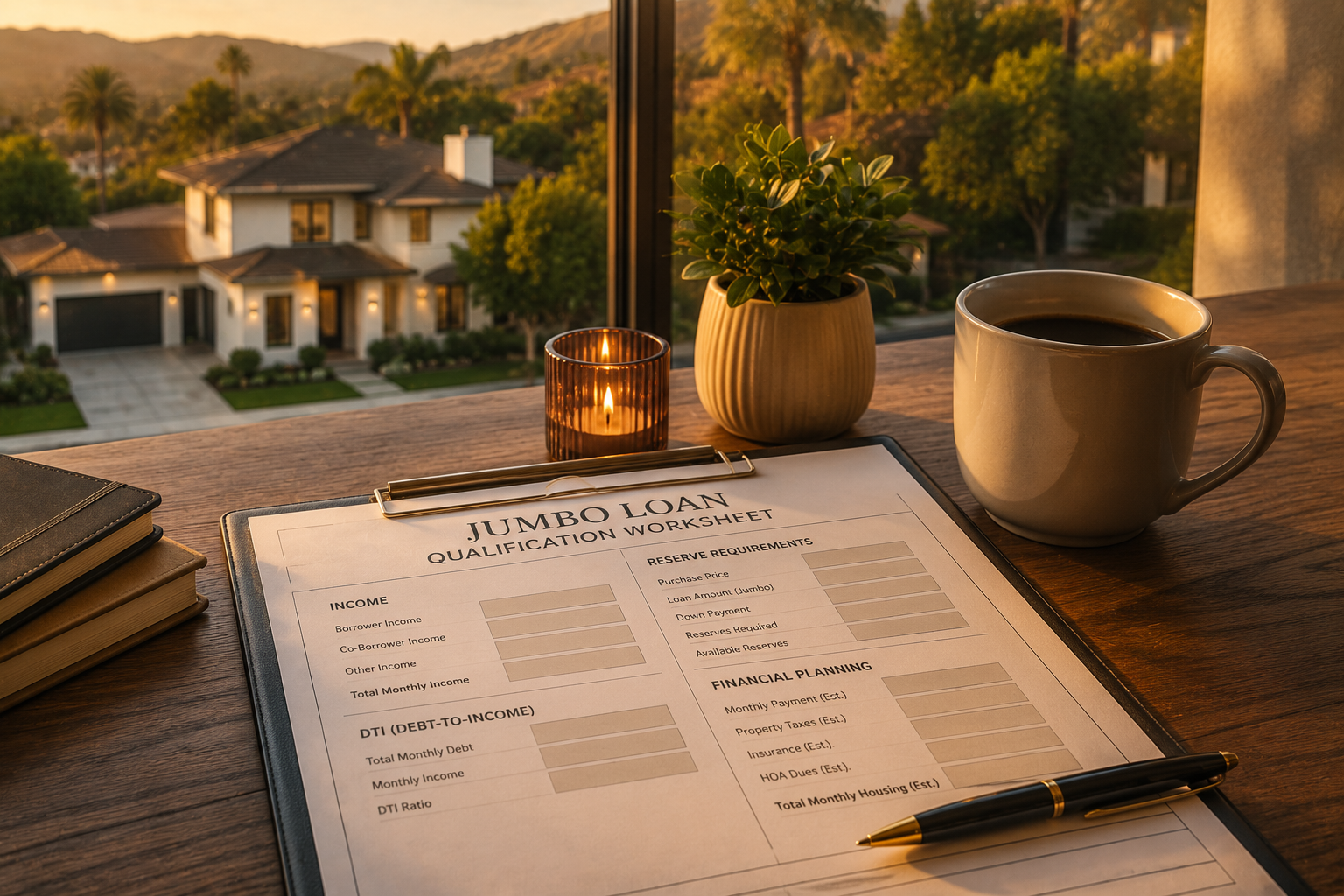 The Encino jumbo qualification conversation — the financial planning meeting that every Encino buyer should complete before beginning an active home search. At Encino's $1.15M–$2.5M+ price points, the income, documentation, and reserve requirements that jumbo lenders impose are materially different from the conforming loan qualification that lower-price SFV markets require. The buyer who understands these requirements before searching makes offers confidently; the buyer who discovers them mid-escrow faces the most stressful version of the home buying process.
What makes a loan "jumbo" in the Encino context:
The conforming loan limit for high-cost California counties in 2026 — the maximum loan amount eligible for purchase by Fannie Mae and Freddie Mac — is approximately $1,089,300 (verify current limits at fhfa.gov before any purchase planning, as limits adjust annually). At Encino's entry price tier:
- → $1.15M purchase at 20% down: $920,000 loan — below conforming limit, potentially conforming
- → $1.35M purchase at 20% down: $1,080,000 loan — approaching conforming limit
- → $1.5M purchase at 20% down: $1,200,000 loan — jumbo
- → $2.0M purchase at 20% down: $1,600,000 loan — clearly jumbo
- → $2.5M purchase at 20% down: $2,000,000 loan — super-jumbo in some lender categories
The five jumbo qualification differences that Encino buyers must understand:
Difference 1 — Income documentation (2-year requirement): Jumbo lenders require 2 years of income documentation at the qualifying level. For W-2 employees with consistent salary: straightforward. For the entertainment industry professional, tech employee with variable RSU vesting, or self-employed buyer: the 2-year documentation requirement produces the specific challenges described in Section 2.
Difference 2 — Reserve requirement: Jumbo lenders at Encino's loan sizes require 12 months of PITI in liquid reserves post-close. These reserves must be liquid (not retirement accounts at face value), verifiable, and available after the down payment and closing costs are paid.
At a $1.6M Encino purchase (20% down, $1.28M loan at 7.25%):
- → Monthly P&I: $8,735
- → Property taxes: $1,600
- → Insurance: $200
- → Monthly PITI: $10,535
- → 12-month reserve requirement: $126,420
Difference 3 — DTI requirements: Jumbo lenders typically cap debt-to-income (DTI) at 43% total (all debts including the housing payment); some portfolio lenders allow up to 45% with compensating factors. At the most aggressive 43% total DTI:
$1.6M purchase PITI ($10,535) + other debts ($1,500/month assumed: car payment, student loans) = $12,035/month required maximum total debt obligation.
At 43% DTI: $12,035 / 0.43 = $28,012/month gross income required = $336,144/year minimum qualifying income.
At 28% front-end DTI (housing only, more conservative/comfortable): $10,535 / 0.28 = $37,625/month = $451,500/year for comfortable qualification.
Difference 4 — Credit score sensitivity: Jumbo lenders price rates by credit tier more aggressively than conforming lenders:
- → 760+: Best available jumbo rate
- → 740–759: Modest rate premium (~0.125%)
- → 720–739: More significant rate premium (~0.25–0.375%)
- → Below 720: Material rate increase; some lenders add overlays
Difference 5 — Appraisal constraint: Jumbo appraisals use a more limited comparable sale set than conforming appraisals. At Encino's price points, appraisals are performed by specialized jumbo appraisers whose comparable sale requirements can produce appraisal gaps on overpriced listings — the specific risk described in the Encino pricing article.
2. 💼 Income Documentation — The Encino Buyer's Specific Challenge
Encino's buyer population includes a higher concentration of entertainment industry professionals, technology employees with equity-heavy compensation, and self-employed individuals than any other PEP SFV market — and these income profiles have specific documentation requirements that standard W-2 employment qualification doesn't produce.
Entertainment industry income documentation:
The showrunner, director, producer, writer, or agent whose income varies substantially by project, deal, or production cycle faces the most complex jumbo qualification scenario:
The 2-year averaging requirement:
Jumbo lenders use the 2-year average for variable income — and the entertainment professional's income varies significantly:
- → 📋 Writer on a network series (2024: $820,000; 2023: $195,000): 2-year average = $507,500. Qualifies at the average, not the current-year income.
- → 📋 Director with a feature (2024: $1.4M; 2023: $285,000): 2-year average = $842,500. Better qualification than the 2023-only window.
- → 📋 Showrunner in development (2025: $390,000; 2024: $1.1M): 2-year average = $745,000. The development year is being averaged with the running year.
The timing strategy:
For entertainment professionals with variable income, the timing of the home purchase relative to the 2-year income window is a specific financial planning consideration:
- → ✅ Optimal timing: Purchase after 2 consecutive high-income years are documented — both years' tax returns show income at the qualifying level, producing the strongest possible 2-year average
- → ⚠️ Challenging timing: Purchasing during or immediately after a low-income development or between-project year that will appear in the 2-year average
- → ✅ The documentation solution: WGA, DGA, and SAG-AFTRA contract documentation, project-by-project deal memos, and continuation letters from production companies can supplement tax return documentation for some lenders — work with a lender who specifically has entertainment industry income documentation experience
Technology employee income documentation (RSU-heavy compensation):
The technology professional at a major tech company (Google, Apple, Meta, Netflix, Amazon) whose compensation package includes a substantial base salary supplemented by Restricted Stock Unit (RSU) vesting has specific documentation requirements:
Base salary documentation:
- → ✅ Standard W-2 documentation — straightforward
- → The base salary alone may or may not support Encino qualification
RSU income documentation:
- → RSU vesting is includable in qualifying income if 2 years of RSU vesting history is documented and the employer's RSU program is confirmed as continuing
- → The lender requires: 2 years of W-2s showing RSU vesting income, employer verification that the RSU program continues, and typically a continuation letter or equity award schedule showing future vesting
- → ⚠️ The cliff vesting issue: Some tech employees have RSU packages that vest on a cliff schedule — large grants vesting in one year followed by smaller or no grants. The year with no vesting doesn't support RSU income qualification for that 2-year window.
Self-employed income documentation:
Encino has a meaningful self-employed buyer population — the physician in private practice, the attorney with their own firm, the entertainment business manager or agent with their own company. Self-employment income documentation for jumbo qualification:
- → 📋 2 years of federal tax returns (personal and business): The primary documentation source
- → 📋 Year-to-date P&L statement (if partial year): May be required by some jumbo lenders for very recent self-employment
- → ⚠️ The tax write-down problem: The self-employed buyer who aggressively minimizes taxable income through legitimate business deductions may show a net income on their tax return that is significantly below their actual available cash flow. Jumbo lenders use the net income from the tax return (with specific add-backs for depreciation and other non-cash deductions), not the gross revenue. The physician who earns $850,000/year but writes down to $380,000 taxable income may qualify based on a lower income than their lifestyle and financial resources suggest.
- → ✅ The bank statement loan alternative: Some portfolio jumbo lenders offer bank statement loan programs for self-employed borrowers — qualifying based on 24 months of business bank statement deposits rather than tax return income. These products carry higher rates but allow the self-employed buyer with aggressive tax minimization to qualify at a level closer to their actual cash flow.
3. 💰 Income Required by Encino Sub-Market — The Complete Picture
With the jumbo qualification mechanics and income documentation requirements established, the specific income requirements by Encino sub-market and price tier provide the actionable answer to the "how much income do I need" question.
North-of-Ventura 91316 — The Entry Tier:
At $1.15M purchase (20% down, $920,000 loan — potentially conforming, verify limits):
- → 💳 Monthly P&I (7.25%): $6,277
- → 🏛️ Property taxes (1.20%): $1,150/month
- → 🏠 Insurance: $145/month
- → Monthly PITI: $7,572
- → 💰 Comfortable income (32% front-end DTI): $284,000/year
- → 💰 Minimum qualifying (38% front-end, no other debts): $239,000/year
- → 💰 Minimum qualifying (43% total DTI, $1,500/month other debts): $256,000/year
At $1.35M purchase (20% down, $1,080,000 loan):
- → 💳 Monthly P&I: $7,371
- → Monthly PITI: $8,671
- → 💰 Comfortable income: $325,000/year
- → 💰 Minimum qualifying: $273,000/year
At $1.55M purchase (20% down, $1,240,000 loan):
- → 💳 Monthly P&I: $8,462
- → Monthly PITI: $9,912
- → 💰 Comfortable income: $372,000/year
- → 💰 Minimum qualifying: $312,000/year
South-of-Ventura 91316 — The Large-Lot Premium Tier:
At $1.75M purchase (20% down, $1.4M loan):
- → 💳 Monthly P&I: $9,553
- → 🏛️ Property taxes: $1,750/month
- → 🏠 Insurance: $225/month
- → Monthly PITI: $11,528
- → 💰 Comfortable income (32%): $432,000/year
- → 💰 Minimum qualifying (43% total DTI): $324,000/year (with minimal other debts)
At $2.0M purchase (20% down, $1.6M loan):
- → 💳 Monthly P&I: $10,919
- → Monthly PITI: $13,169
- → 💰 Comfortable income: $494,000/year
- → 💰 Minimum qualifying: $370,000/year
At $2.4M purchase (20% down, $1.92M loan):
- → 💳 Monthly P&I: $13,103
- → Monthly PITI: $15,703
- → 💰 Comfortable income: $589,000/year
- → 💰 Minimum qualifying: $441,000/year
Encino Hills 91436 — The Hillside Premium:
At $2.5M purchase (20% down, $2.0M loan):
- → 💳 Monthly P&I: $13,649
- → 🏛️ Property taxes: $2,500/month
- → 🏠 Insurance (VHFHSZ-aware): $400–$1,200/month
- → Monthly PITI (admitted market insurance): $16,549–$17,349
- → 💰 Comfortable income: $621,000–$652,000/year
- → 💰 Minimum qualifying: $465,000–$490,000/year
At $3.5M purchase (25% down, $2.625M loan):
- → 💳 Monthly P&I: $17,914
- → Monthly PITI (estimated): $21,914+
- → 💰 Comfortable income: $822,000+/year
4. 🏦 The Total Capital Requirement — Beyond the Income Qualification
Income qualification is necessary but not sufficient for Encino purchase readiness. The total capital requirement — combining down payment, closing costs, post-close reserves, and the supplemental tax reserve — is frequently 2–3× what buyers initially budget when they calculate only the down payment.
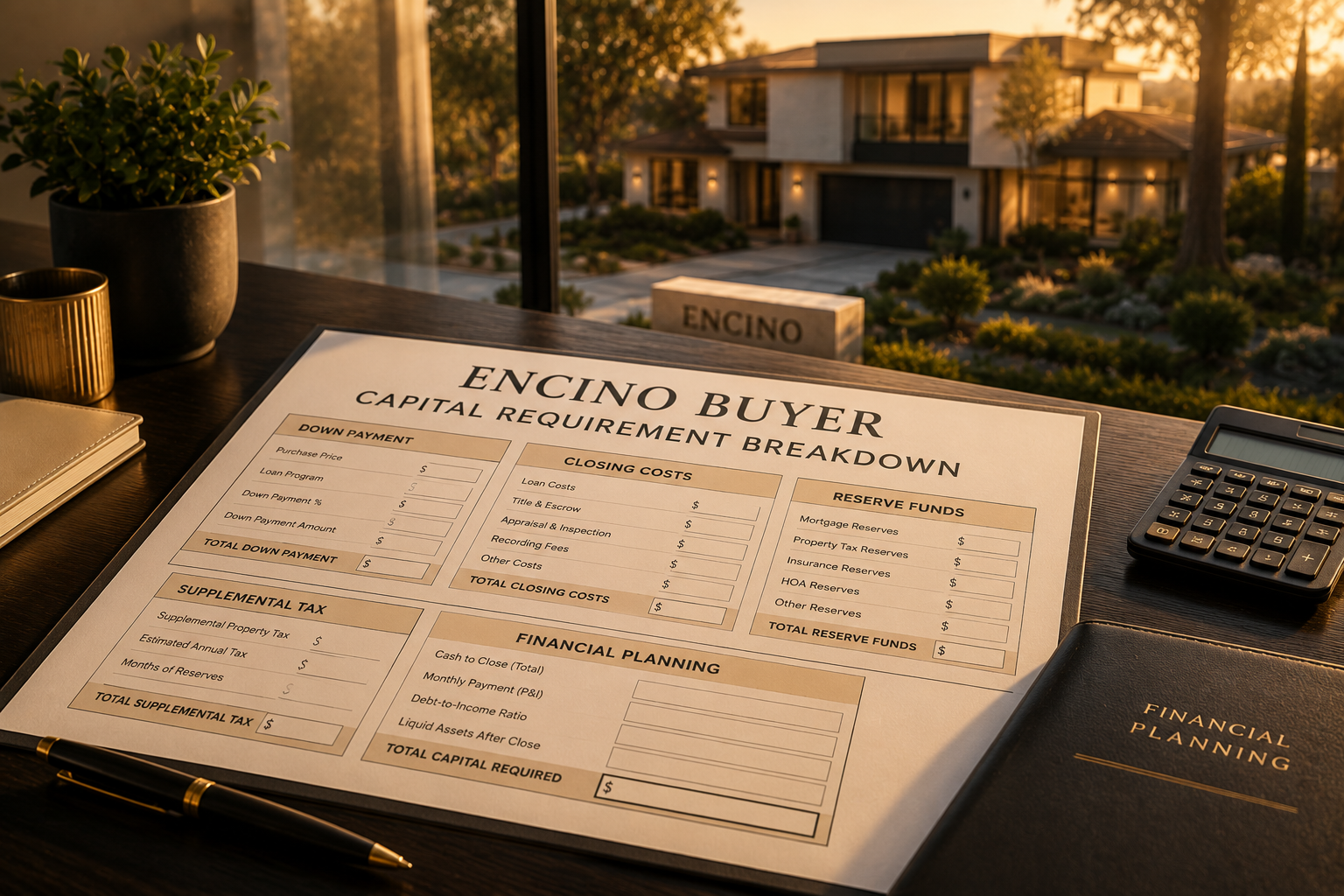 The complete Encino capital requirement — the four-component total that every Encino buyer must specifically plan for before any offer is written. At a $1.75M south-of-Ventura purchase, the total liquid capital required at close exceeds $570,000 — approximately 3× the down payment alone. The buyer who plans for the down payment without the full capital picture encounters the reserve requirement surprise that most commonly delays Encino purchase timelines.
The four capital components:
Component 1 — Down payment:
- → $1.15M at 20%: $230,000
- → $1.5M at 20%: $300,000
- → $1.75M at 20%: $350,000
- → $2.0M at 20%: $400,000
- → $2.5M at 20%: $500,000
- → $3.5M at 25%: $875,000
Component 2 — Closing costs:
California seller pays more of the closing costs than the buyer in most Encino transactions, but the buyer's closing costs include:
- → Lender origination fee: $3,500–$8,500
- → Appraisal (jumbo): $1,200–$1,800
- → Title insurance (lender's policy): $1,800–$4,500
- → Escrow fees (buyer's share): $1,500–$3,500
- → Recording fees: $200–$400
- → Pre-paid interest: $500–$3,500 depending on close date
- → Pre-paid property taxes (depending on close month): $0–$8,000
- → Pre-paid homeowners insurance (first year): $2,400–$18,000 (admitted market vs. FAIR Plan for Encino Hills 91436 positions)
- → 💰 Total buyer closing costs: $15,000–$48,000 depending on price tier and insurance situation
Component 3 — Post-close reserves (the most consistently underplanned requirement):
Jumbo lenders require 12 months of PITI in liquid reserves post-close. These must be liquid and verifiable AFTER the down payment and closing costs have been paid:
- → At $1.15M purchase: 12-month PITI reserve approximately $91,000
- → At $1.5M purchase: approximately $119,000
- → At $1.75M purchase: approximately $138,000
- → At $2.0M purchase: approximately $158,000
- → At $2.5M purchase: approximately $198,000
Component 4 — Supplemental tax reserve:
As established in the Studio City property taxes article and applicable to all Encino purchases: the supplemental tax bill arrives 6–18 months after close and covers the difference between the seller's prior assessed value and the buyer's new purchase-price assessment.
At a $1.75M Encino purchase where the seller's assessed value was $680,000:
- → Assessment increase: $1,070,000 × 1.0% = $10,700/year supplemental tax
- → Proration (if closed October 1, 9 months remaining): $8,025 first supplemental bill
- → Second supplemental bill (full year): approximately $10,700
- → Total supplemental tax reserve: approximately $19,000
The total capital requirement — complete picture:
$1.15M north-of-Ventura purchase:
- → Down payment: $230,000
- → Closing costs: $22,000
- → Post-close reserves: $91,000
- → Supplemental tax reserve: $11,000
- → Total liquid capital required: approximately $354,000
$1.75M south-of-Ventura purchase:
- → Down payment: $350,000
- → Closing costs: $35,000
- → Post-close reserves: $138,000
- → Supplemental tax reserve: $19,000
- → Total liquid capital required: approximately $542,000
$2.5M Encino Hills purchase:
- → Down payment: $500,000
- → Closing costs: $48,000
- → Post-close reserves: $198,000
- → Supplemental tax reserve: $27,000
- → Total liquid capital required: approximately $773,000
5. 🎯 The Practical Qualification Pathway — What to Do Before Beginning an Encino Search
With the income requirements, documentation challenges, and capital requirements mapped, the Encino buyer who is 6–18 months from readiness needs a specific action pathway.
Step 1 — Get the jumbo pre-approval before any active search:
A jumbo pre-approval — which requires income documentation, credit review, asset verification, and underwriting — is non-negotiable for Encino offer submission at any price tier. The pre-approval process takes:
- → ✅ 5–10 business days for a prepared W-2 buyer with all documentation ready
- → ✅ 2–5 weeks for variable income buyers (entertainment, RSU-heavy tech, self-employed) who need to assemble multi-year documentation
- → ⚠️ 3–8 weeks for self-employed buyers with complex entity structures or aggressive tax minimization who need to explore bank statement loan alternatives
Step 2 — Select the right lender:
Not all lenders offer competitive jumbo products at Encino's price points. The Encino buyer who uses the lender the referral source suggested without comparison shopping may pay a 0.25–0.50% rate premium that costs $250–$500/month at this loan size. Comparative lender evaluation:
- → ✅ Regional bank portfolio lenders (Wells Fargo, JPMorgan Chase, US Bank): competitive rates, established jumbo underwriting
- → ✅ Specialty jumbo mortgage banks: sometimes more flexible on documentation, competitive on rates
- → ✅ Entertainment industry-specific lenders: specifically experienced with production income documentation, WGA/DGA income patterns, and the variable income qualifying framework that entertainment professionals require
Step 3 — Assess income documentation early:
The entertainment or variable-income buyer who discovers a 2-year income documentation problem mid-search has done the pre-approval in the wrong sequence. Assess income documentation stability before beginning active search:
- → ✅ Review the last 2 years' tax returns — what income do they show, and how does the 2-year average support qualification?
- → ✅ For RSU-heavy tech employees: review the vesting schedule and assess whether 2 years of RSU documentation is available
- → ✅ For self-employed buyers: discuss with a CPA whether the tax return income (after write-downs) supports qualification or whether a bank statement loan alternative is needed
Step 4 — Accumulate the complete capital requirement:
The Encino buyer whose liquid savings equal the down payment but not the total capital requirement (down payment + closing costs + reserves + supplemental tax) is not purchase-ready. The specific capital accumulation target:
- → For north-of-Ventura $1.15M–$1.5M: accumulate $354,000–$460,000 in liquid assets (not retirement accounts at face value)
- → For south-of-Ventura $1.65M–$2.0M: accumulate $500,000–$620,000
- → For Encino Hills $2.0M+: accumulate $650,000–$800,000+
Step 5 — Understand the Encino sub-market before writing offers:
The Encino pricing article's five-filter comp analysis and the new construction vs. resale article's sub-market framework provide the market knowledge foundation. The buyer who understands the north-of-Ventura/south-of-Ventura/Encino Hills price tier difference, the condition-tier spread, and the jumbo appraisal constraint writes offers confidently and avoids the appraisal gap problem that overpriced offers in jumbo markets produce.
🚫 What NOT to Overdo
Don't begin active Encino search based on income alone without completing the documentation assessment. The entertainment industry buyer whose current-year income is $1.2M but whose prior year was $280,000 has a $740,000 2-year average — not the $1.2M they assume qualifies them for the south-of-Ventura position they have been touring. The documentation assessment that takes 3 days with a qualified jumbo lender prevents the escrow that falls apart at underwriting because the income average doesn't support the loan.
Don't treat the reserve requirement as the lender's problem to solve at underwriting. The 12-month PITI reserve that jumbo lenders require is a hard requirement that the lender verifies at the time of underwriting, not a negotiating point. The buyer who reaches underwriting with $380,000 in liquid assets on a $1.75M purchase (enough for down payment + closing costs but not reserves) will not close the loan without either additional liquid capital sourcing or a loan restructure that the timeline may not allow. Build the reserve into the capital planning before making any offer.
Don't use retirement account balances at face value in capital planning. The buyer whose $400,000 in 401k savings and $250,000 in down payment savings assumes $650,000 in available capital is incorrectly accounting for the 401k. Most jumbo lenders accept 60–70% of vested retirement account balances as reserve assets (not down payment) — and 401k withdrawal for down payment purposes triggers income taxes and penalties that reduce the net available amount significantly. Plan on liquid taxable accounts (brokerage, savings) for down payment and closing costs; retirement accounts may partially satisfy reserve requirements at discounted values.
Don't overlook the Encino Hills 91436 wildfire insurance capital impact. As established in the Encino new construction vs. resale article, some Encino Hills 91436 addresses face FAIR Plan-only insurance access at $8,000–$18,000+/year versus the admitted market's $3,500–$6,500/year. At $12,000/year FAIR Plan premium, the monthly insurance cost of $1,000/month adds to the PITI and changes both the income qualification calculation (higher PITI requires higher income to qualify at the same DTI) and the reserve calculation (12 months of higher PITI requires more reserve capital). Obtain the binding insurance quote before finalizing income qualification calculations for any Encino Hills position.
Don't assume that a high current-year income eliminates the 2-year documentation requirement. The jumbo underwriter evaluating a $2.0M Encino purchase is required to document 2 years of income regardless of how impressive the current-year income appears. The entertainment buyer who earned $2.8M this year on a major feature sale and $220,000 the prior year does not have a $1.51M 2-year average that supports the $2.0M purchase qualification at comfortable DTI. They have a $1.51M average that does support $2.0M qualification at maximum DTI — but the underwriter evaluates the average, not the current year.
🏠 Real-World Scenario — Encino 91316
A couple — a tech product manager at a major streaming company and a dermatologist in a group practice — had been researching Encino specifically for the south-of-Ventura large-lot lifestyle described in the Encino buyer's guides. Their target: a renovated 4-bedroom on a 14,000 sq ft lot with established pool, approximately $2.0M.
Their income profile:
- → Tech product manager: Base salary $285,000 + RSU vesting $240,000/year average + annual bonus $55,000 = total W-2 approximately $580,000/year in a good year
- → Dermatologist: W-2 from group practice $340,000/year consistent
- → Combined: approximately $920,000/year in strong years
The income documentation assessment:
The tech partner's income had a specific complication: their RSU grant was front-loaded — a large initial grant that had been vesting over 4 years was nearing completion, with a smaller follow-on grant not yet vested. The 2024 RSU vesting was $285,000; the 2025 RSU vesting was $148,000 (partial-year completion of the large grant plus early vesting of the smaller follow-on). The 2-year average RSU income: $216,500. Total 2-year average qualifying income for the tech partner: base $285,000 + RSU average $216,500 + bonus $55,000 = $556,500.
Combined with the dermatologist's consistent $340,000: total qualifying income = $896,500/year 2-year average.
The $2.0M qualification:
At $2.0M (20% down, $1.6M loan at 7.25%):
- → Monthly PITI: $13,174
- → At 32% front-end DTI: requires $494,250/year — met ($896,500 > $494,250 ✓)
- → Additional debt obligations: $2,100/month (car payments, student loans)
- → Total monthly obligations: $15,274
- → At 43% total DTI: requires $426,000/year — met ✓
- → Income qualification: passed
The capital requirement:
- → Down payment (20%): $400,000
- → Closing costs: $38,000
- → Post-close reserves (12 months × $13,174): $158,088
- → Supplemental tax reserve: $22,000
- → Total capital required: $618,088
Their liquid assets: $485,000 in combined taxable brokerage accounts + $180,000 in the tech partner's ESPP account (liquid, recently vested).
Total liquid: $665,000 — sufficient for the $618,088 requirement with a $46,912 buffer.
The outcome: They qualified for the $2.0M south-of-Ventura Encino purchase. The documentation process required the RSU vesting schedule, two years of W-2s for both partners, and a continuation letter from the tech employer confirming the ongoing equity grant program. Close at a south-of-Ventura Encino 91316 4-bedroom at $1.97M, 30 days from offer acceptance.
🏠 Real-World Scenario — Encino 91316
A self-employed entertainment business manager — managing the financial affairs of multiple entertainment industry clients, income of $680,000/year in gross fees, operating through an S-corporation — was evaluating a north-of-Ventura Encino 91316 purchase at $1.45M.
The self-employment income challenge:
The business manager's tax return showed $680,000 in S-corporation gross revenue but after deductible business expenses — office rent, staff salaries, professional subscriptions, business meals, travel — showed approximately $315,000 in K-1 ordinary income passed through to the personal return. The standard jumbo underwriting analysis of the tax return income: $315,000/year qualifying income (with some add-backs for depreciation).
The $1.45M qualification at $315,000:
At $1.45M (20% down, $1.16M loan at 7.25%):
- → Monthly PITI: $10,213
- → At 32% front-end DTI with $315,000 income: $315,000 × 32% / 12 = $8,400/month maximum housing — insufficient for $10,213 PITI
- → At 38% front-end DTI (maximum stretch): $315,000 × 38% / 12 = $9,963/month — still below the $10,213 PITI
- → Standard tax return qualification: does not support the $1.45M purchase at any comfortable DTI
The bank statement loan solution:
We connected the business manager with a portfolio jumbo lender offering a 24-month business bank statement program:
- → 24 months of business bank deposits: approximately $680,000/year × 2 = $1,360,000 total
- → Lender's income calculation (50% of business deposits as income for a service business): $680,000 × 50% = $340,000 qualifying income
- → Rate premium for bank statement program vs. standard jumbo: approximately 0.50%
- → Monthly P&I at 7.75% (bank statement rate): $8,293 vs. $7,918 at 7.25% standard rate — $375/month premium
The $1.45M qualification at $340,000 bank statement income:
- → Monthly PITI at bank statement rate: $10,543
- → At 38% front-end DTI: $340,000 × 38% / 12 = $10,767/month — sufficient ✓
- → Bank statement program qualification: passed at maximum stretch DTI
The business manager purchased in north-of-Ventura Encino 91316 at $1.43M using the bank statement jumbo program. The $375/month rate premium on the bank statement product added approximately $4,500/year in additional interest cost — a real but manageable cost relative to the alternative (not purchasing and continuing to rent at equivalent monthly cost without equity accumulation).
The self-employed buyer who discovered the bank statement loan option early in the process rather than mid-search made the correct lender selection before any offer was written. The buyer who discovers the tax-return income qualification shortfall after writing an offer at $1.45M with standard income documentation encounters the cancellation scenario that no one wants.
❓ FAQ
How much do you need to make to afford a home in Encino? It depends significantly on which Encino sub-market: ✓ North-of-Ventura 91316 ($1.15M–$1.65M): $280,000–$560,000/year gross household income for comfortable qualification; $240,000–$430,000/year minimum qualifying. ✓ South-of-Ventura 91316 ($1.65M–$2.5M): $430,000–$900,000/year for comfortable qualification; $324,000–$700,000/year minimum. ✓ Encino Hills 91436 ($2.0M–$5M+): $620,000–$1.8M+/year for comfortable qualification. These ranges reflect 7.25% jumbo rates, 20% down, and the 28–38% front-end DTI range. Verify with a jumbo lender for current rates and your specific debt obligation profile.
What credit score do I need to buy in Encino? For jumbo financing at Encino's loan sizes: ✓ 760+ FICO: Best available jumbo rate and most flexible underwriting. ✓ 740–759: Modest rate premium (~0.125–0.25%); qualification remains strong. ✓ 720–739: More significant rate premium; some lenders add overlay requirements. ✓ Below 720: Material rate increase; some jumbo lenders decline; bank statement and portfolio products may still be available at higher rates. Buyers currently below 740 should prioritize credit score improvement — paying revolving balances below 30% of limits and avoiding new credit applications for 6 months before mortgage application can produce 20–40 point improvements.
How much do I need for a down payment in Encino? Standard jumbo financing requires 20% down for most Encino purchases — some portfolio lenders offer 10–15% down products at higher rates and with additional qualification requirements. At 20%: ✓ $1.15M: $230,000. ✓ $1.5M: $300,000. ✓ $1.75M: $350,000. ✓ $2.0M: $400,000. ✓ $2.5M: $500,000. Important: the down payment is only one component of the total capital required. Add closing costs ($15,000–$48,000), post-close reserves ($91,000–$198,000+), and supplemental tax reserve ($11,000–$27,000+) to the down payment for the complete capital picture.
Can entertainment industry professionals qualify for a home in Encino? Yes — and many entertainment industry professionals specifically choose Encino for its large-lot lifestyle and studio district commute access. The qualification requirements for variable entertainment income: 2 years of tax returns showing income at the qualifying level, documentation of the income source (WGA minimum fees, production company payment records, agent commissions), and ideally 2 consecutive high-income years to maximize the 2-year average. Working with a lender specifically experienced in entertainment industry income documentation is strongly recommended — these lenders understand the specific patterns of production cycles, development deals, and episodic compensation that standard underwriters sometimes misinterpret.
What are the income requirements for Encino Hills 91436? Encino Hills 91436 is the most premium Encino sub-market — hillside positions with views and the most dramatic residential character, at prices of $2.0M–$5M+. Income requirements: ✓ $2.0M purchase: approximately $620,000/year for comfortable qualification. ✓ $3.0M purchase: approximately $930,000+/year. ✓ $4.0M purchase: approximately $1.25M+/year. Additional consideration: wildfire insurance (VHFHSZ designation for some 91436 addresses) may increase the monthly insurance cost to $700–$1,200+/month (versus $200–$325 for standard Encino flatland), which increases the PITI and thus the income required for the same DTI. Obtain a binding insurance quote during the inspection period and recalculate PITI with the actual insurance cost before finalizing income qualification for any 91436 position.
How long does the jumbo pre-approval take for an Encino purchase? The jumbo pre-approval timeline depends on income type: ✓ W-2 employees with consistent income: 5–10 business days with all documentation ready. ✓ RSU-heavy tech employees: 10–18 business days to gather vesting schedules and employer continuation documentation. ✓ Entertainment industry variable income: 2–4 weeks to gather 2-year tax returns, project documentation, and navigate lender income averaging. ✓ Self-employed buyers (tax return qualification): 2–4 weeks. ✓ Self-employed buyers (bank statement program): 4–6 weeks for the 24-month bank statement compilation and lender review. Begin the pre-approval process before beginning active Encino search — the documentation gaps that delay pre-approval are better discovered before any offer deadline pressure exists.
🎯 Bottom Line
The income required to buy a home in Encino 91316 or 91436 ranges from $240,000/year (minimum qualifying for the north-of-Ventura entry tier at maximum DTI) to $930,000+/year (comfortable qualification for the Encino Hills premium tier) — and the income alone is only half the readiness picture. The complete readiness assessment for any Encino buyer adds the income documentation stability analysis (2-year averaging for variable income), the full capital requirement calculation (down payment + closing costs + 12-month PITI reserves + supplemental tax reserve), and the credit score assessment to the gross income number.
The Encino buyer who completes all four components of this readiness assessment before beginning active search — income qualification at the target price tier, income documentation review with a lender experienced in their specific income type, capital accumulation to the full requirement, and credit profile optimization — makes offers from a position of certainty rather than hope. The Encino buyer who discovers any of these four requirements as a surprise in the middle of an active escrow experiences the most stressful version of the process and sometimes the most costly outcome.
At Parkway Estate Properties, Liana's buyer representation across Encino 91316/91436, Sherman Oaks 91403/91423, Tarzana 91356, Woodland Hills 91364/91367, and Northridge 91324/91325 means every Encino buyer conversation begins with the honest financial readiness assessment — the income, documentation, capital, and credit picture that produces confident offers and successful closes at Encino's price points.
📩 Want a Personalized Income and Qualification Assessment for Encino?
Tell us your income profile (W-2, variable, self-employed), your target price tier, and your current capital position — and we'll connect you with a jumbo lender experienced in your income type and give you the honest qualification picture before you've toured a single home.
Contact Liana Shersher at Parkway Estate Properties: 📧 liana@parkwayestate.com · 📞 (818) 208-5881 · 🌐 parkwayestate.com 15021 Ventura Blvd., Ste. 510, Sherman Oaks, CA 91403
About the Authors
Liana Shersher is a licensed real estate agent with Parkway Estate Properties Inc. and an Accredited Buyer's Representative (ABR) serving the San Fernando Valley — with a focus on Sherman Oaks, Encino, Tarzana, Woodland Hills, and Northridge (DRE# 02164224). Liana guides first-time homebuyers through every step of the purchase, from the first showing to the keys in hand, and represents move-up and repeat buyers across the Valley. For sellers, she builds the pricing and marketing strategy that positions a home to sell for top dollar, fast. Buyers and sellers work with Liana for clear communication, sharp local knowledge, and an agent who treats their goals like her own.
Roman Shersher is the broker-owner of Parkway Estate Properties Inc. and a real estate investor with 18 years of experience in the San Fernando Valley (DRE# 01855095). Roman has personally led or co-led renovations on dozens of properties across the Valley, including recent projects in Northridge (91324) and Woodland Hills (91364). That hands-on renovation and investment experience shapes every pricing conversation and days-on-market strategy at Parkway — sellers get a realistic read on what improvements actually return at resale, and buyers get an expert eye on a home's true condition and upside.
Parkway Estate Properties, Inc. · 15021 Ventura Blvd., Ste. 510, Sherman Oaks, CA 91403 · (818) 208-5881 · parkwayestate.com · Broker License #: 01873092 Equal Housing Opportunity. Information herein is general and not legal, tax, or financial advice. Consult qualified professionals for your specific situation.
Categories
Recent Posts









Broker | Realtor ® License ID: 01873092
+1(818) 208-5881 | info@parkwayestate.com