
Sherman Oaks Real Estate Market Update — 2026 Quarter-by-Quarter Outlook

The Sherman Oaks 91403 and 91423 market in 2026 operates at the highest price tier and the highest buyer sophistication level of any neighborhood in the PEP SFV coverage area — and the quarterly intelligence that allows buyers, sellers, and market observers to navigate it correctly requires more sub-market precision than any other PEP market update.
Sherman Oaks is simultaneously three markets: the north-of-Ventura working-professional and entertainment-adjacent volume tier ($1.15M–$1.65M), the south-of-Ventura luxury residential tier ($1.55M–$2.4M) where the entertainment industry executive and Westside transplant compete for the outdoor-living-scale homes that the sub-market's lot configurations produce, and the north-of-Mulholland premium tier ($1.8M–$3.5M+) where the buyer pool thins and the specification and view standards are the most specific in the series. Each tier has a different seasonal pattern, a different buyer pool motivation, and a different quarterly intelligence requirement.
The additional Sherman Oaks market dynamic that no other PEP market update addresses is the cross-hill buyer — the Westside professional who begins their home search on the Westside, exhausts their budget at 1,400 square feet in Brentwood or 1,600 square feet in Mar Vista, and arrives at Sherman Oaks discovering that the same budget produces 3,200 square feet south-of-Ventura with a pool. This buyer activates in every quarter, is specifically motivated by the 405/101 commute access, and is frequently the most decisive and fastest-moving buyer in the market once they make the cross-hill decision.
1. 📊 Market Foundation — The Sherman Oaks Three-Tier Picture Entering 2026
Sherman Oaks's three-tier market structure requires the most specific sub-market baseline analysis in the PEP market update series — because the north-of-Ventura, south-of-Ventura, and north-of-Mulholland markets are operating on different supply-demand dynamics entering 2026.
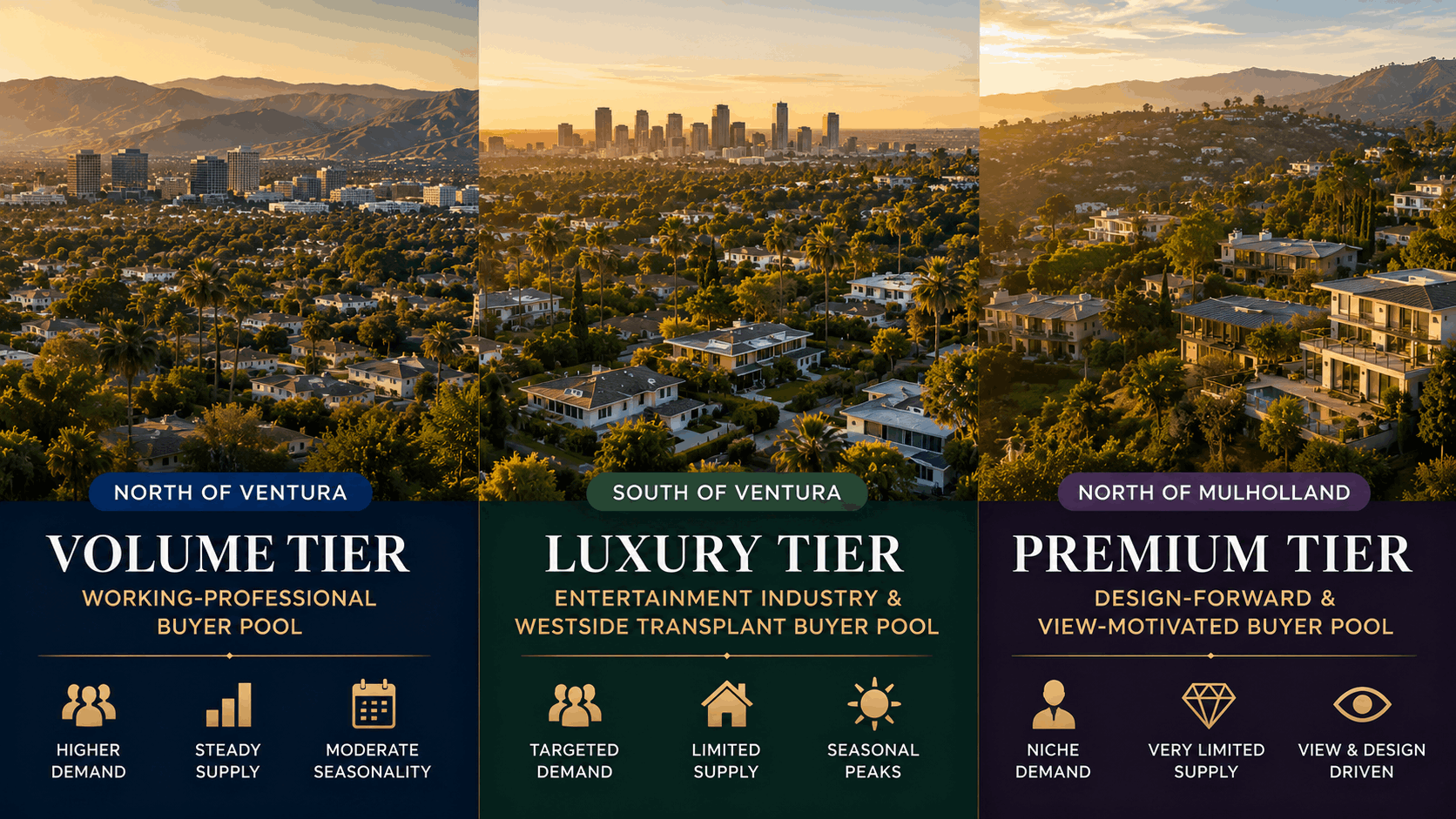 The Sherman Oaks three-tier market entering 2026 — each sub-market operating on different supply, demand, and seasonal dynamics that require separate quarterly intelligence. The north-of-Ventura volume tier's working-professional buyer pool, the south-of-Ventura luxury tier's entertainment industry and Westside transplant buyer pool, and the north-of-Mulholland premium tier's design-forward and view-motivated buyer pool each produce different showing patterns, different DOM profiles, and different pricing pressures that the single "Sherman Oaks market" framing consistently obscures.
North-of-Ventura volume tier entering 2026:
- → 💰 Improved condition 3-bedroom: $1.28M–$1.45M
- → 💰 Renovated 3-bedroom: $1.42M–$1.60M
- → 💰 Original condition 3-bedroom: $1.15M–$1.30M
- → 📊 5-year net appreciation from 2020: approximately 22–28%
- → 📊 2022–2023 correction depth: 8–11% from peak
- → 📊 2026 recovery position: 85–92% of 2022 peak recovery — approaching but not yet exceeding peak at the volume tier
- → ✅ Structural demand: The 405/101 commute position sustains the north-of-Ventura buyer pool through rate cycles because the working-professional buyer who specifically wants this commute access has limited adjacent alternatives that provide comparable freeway convenience
South-of-Ventura luxury tier entering 2026:
- → 💰 Improved condition 4-bedroom: $1.78M–$2.05M
- → 💰 Renovated 4-bedroom: $2.05M–$2.35M
- → 💰 Original condition 4-bedroom: $1.55M–$1.85M
- → 📊 5-year net appreciation from 2020: approximately 28–38% — the strongest appreciation in the PEP SFV coverage area for any non-hillside sub-market
- → 📊 2022–2023 correction depth: 7–10% from peak — shallower than the north-of-Ventura tier, reflecting the south-of-Ventura buyer's financial resilience and the Westside transplant demand floor
- → ✅ The Westside transplant demand floor: South-of-Ventura Sherman Oaks has a structural demand floor from the Westside transplant buyer that no other SFV luxury sub-market replicates — the buyer who discovers that the same budget produces 3,200+ sq ft south-of-Ventura versus 1,600 sq ft in Mar Vista is a motivated and specific buyer who activates in all seasons
North-of-Mulholland premium tier entering 2026:
- → 💰 Renovated 4–5 bedroom: $2.5M–$3.5M+
- → 📊 DOM range (year-round): 30–65 days — reflecting the thinner buyer pool
- → ✅ The buyer profile: The most design-forward and specification-selective buyer in the Sherman Oaks market — the entertainment industry senior executive, the technology executive, and the financial services professional whose standard of reference is Beverly Hills or Bel Air and who arrives at north-of-Mulholland Sherman Oaks through the same cross-hill value realization that brings the south-of-Ventura buyer from Mar Vista
2. 📅 Q1 2026 (January–March) — The Cross-Hill Activation and Spring Build
Q1 is Sherman Oaks's most strategically important pre-season quarter — containing the winter dormancy that characterizes most SFV markets in January and the specific Sherman Oaks market dynamic that begins to differentiate this market from comparable-price SFV markets by February: the cross-hill buyer activation.
January 2026 — The Cross-Hill Pre-Activation:
The Sherman Oaks January market is not as dormant as the standard SFV January characterization suggests — because the Westside transplant buyer's search timeline doesn't follow the standard SFV seasonal calendar.
The Westside transplant buyer who begins their home search in October on the Westside:
- → October–November: Active Westside search — Santa Monica, Mar Vista, Culver City, Brentwood — discovering that $2.0M–$2.2M produces 1,600–1,900 sq ft at these addresses
- → December: Pause for holidays but continued online search frustration
- → January: Cross-hill discovery — the buyer whose Westside agent suggests Sherman Oaks, or who finds south-of-Ventura Sherman Oaks listings during a price-range search, or who a friend or colleague has previously moved to 91403/91423
This January cross-hill discovery produces the most motivated buyer in the Sherman Oaks market — the buyer who has spent 3 months frustrated on the Westside and who is experiencing the south-of-Ventura value revelation for the first time.
- → 📊 January DOM (north-of-Ventura correctly priced): 38–58 days
- → 📊 January DOM (south-of-Ventura correctly priced): 35–52 days — the cross-hill buyer specifically reduces January DOM below the standard SFV winter dormancy level
- → ✅ For sellers who must list in January: The south-of-Ventura listing that is correctly priced and specifically markets the lot scale, the outdoor living, and the commute access is speaking directly to the January cross-hill buyer's motivation. This buyer is not waiting for spring to activate — they're in the market now.
February 15 — Spring Activation:
- → 📊 DOM (north-of-Ventura, correctly priced improved condition): 22–38 days — the spring buyer pool begins its full activation
- → 📊 DOM (south-of-Ventura, correctly priced renovated): 20–35 days — the entertainment industry pre-production buyer who has resolved their winter project commitments begins active search
- → ✅ The entertainment industry pre-production buyer: January–March is the entertainment industry's development season — pilots and series are in pre-production, writers rooms are organizing, and the entertainment professional whose schedule has production clarity is also the one who has headspace for a serious home search. This is the most decisive and most time-available entertainment industry buyer window of the year.
March 2026 — Full Spring Activation:
- → 📊 DOM (north-of-Ventura): 15–28 days — the strongest DOM performance of the year
- → 📊 DOM (south-of-Ventura): 18–35 days — competitive spring conditions at the luxury tier
- → 📊 Both buyer pools simultaneously active: The entertainment industry pre-production buyer, the cross-hill Westside transplant, and the SFV-internal move-up buyer are all simultaneously most active
- → 💰 Price support: Maximum of the year — correctly priced renovated south-of-Ventura listings generate multiple first-week offers in the most competitive spring conditions
- → 📅 The seller preparation timeline: The Sherman Oaks seller targeting March 1 launch must begin preparation in early November — accounting for the south-of-Ventura's 14–16 week renovation critical path (custom cabinetry lead times, natural stone sourcing) and the north-of-Ventura's 12–14 week preparation sequence
3. 📅 Q2 2026 (April–June) — The Primary Window and the Production Season Transition
Q2 is Sherman Oaks's highest-volume seller quarter — but it contains an important internal transition that the seller who doesn't account for it specifically discovers as an avoidable DOM problem.
April 2026 — Peak Spring Conditions:
- → 📊 DOM (north-of-Ventura): 15–30 days — the year's best DOM performance at the volume tier
- → 📊 DOM (south-of-Ventura): 18–38 days — competitive conditions with multiple buyer pools simultaneously active
- → ✅ Multiple offer dynamics: Correctly priced, well-prepared south-of-Ventura listings in April generate the year's highest probability of multiple offers — the entertainment industry buyer who hasn't closed in spring and the cross-hill Westside buyer who has just made the decision compete for the best south-of-Ventura listings
- → ✅ The cross-hill spring surge: The Westside spring market produces its own frustrated buyers — the buyer who competed for but didn't win a Brentwood or Pacific Palisades home in February–April frequently re-emerges in the Sherman Oaks market in April–May as the cross-hill decision accelerates
The April seller's specific advantage:
The south-of-Ventura Sherman Oaks seller who launches April 1 with a correctly priced, complete renovation and a listing that specifically markets:
- → The lot scale and outdoor living (the primary cross-hill motivator)
- → The 405/101 commute access (the primary commute-motivated decision driver)
- → The Ventura Boulevard lifestyle (the secondary lifestyle motivator)
...is speaking directly to three distinct buyer pools simultaneously — the entertainment industry buyer, the cross-hill Westside transplant, and the SFV internal move-up buyer — producing the spring competition that maximizes close price.
May 2026 — The Late Spring Transition:
- → 📊 DOM (all tiers): 22–45 days — the spring buyer pool begins to exhaust; the entertainment industry buyer pool begins transitioning to production season
- → ⚠️ The production season early signal: The entertainment industry buyer who is in active production (series filming, post-production, the development grind) has less capacity for showings in May than in March. Listing activity from this buyer pool begins to slow.
- → ✅ Still excellent conditions: The May listing that is correctly priced generates strong buyer engagement — just with modestly less first-week competition than the April equivalent.
June 15 — The Production Season Transition:
- → 📊 DOM (north-of-Ventura): 30–52 days — entering summer moderation
- → 📊 DOM (south-of-Ventura): 35–60 days — the entertainment industry production season begins its most acute impact
- → ⚠️ The June 15 threshold: The Sherman Oaks seller who has not launched by June 15 is entering summer conditions. The seller who is not under contract by June 15 is accumulating DOM in the summer moderation window.
- → ✅ The cross-hill compensator: Unlike Studio City 91604/91602, whose buyer pool is more entertainment-industry-concentrated, Sherman Oaks's Westside transplant and professional buyer pools partially compensate for the entertainment industry summer thinning. The June–August Sherman Oaks market is not as impacted as Studio City's summer window.
4. 📅 Q3 2026 (July–September) — The Summer Navigation
Q3 is Sherman Oaks's most nuanced quarter — the entertainment industry production season's impact is real and measurable, but the Westside transplant buyer's year-round activation partially offsets it in ways that no other SFV luxury market produces at the same scale.
 Sherman Oaks in Q3 summer conditions — the market where the entertainment industry production season thinning is real but where the Westside transplant buyer's year-round activation partially compensates, producing summer DOM of 35–60 days rather than the 45–75 days that a more entertainment-industry-concentrated market like Studio City 91604/91602 experiences in the same window.
July–August 2026 — The Summer Navigation:
- → 📊 DOM (north-of-Ventura, without specific buyer activation strategy): 38–60 days
- → 📊 DOM (south-of-Ventura, without specific buyer activation strategy): 45–70 days — the entertainment industry production season at its most acute
- → ✅ The cross-hill summer buyer: The Westside transplant buyer who discovered Sherman Oaks's value proposition in Q2 but didn't transact in the spring — or who began their Westside search in spring and completed the cross-hill discovery in summer — is specifically active in Q3 regardless of the entertainment industry calendar. This buyer's search timeline is driven by their own Westside search frustration, not by production schedules.
- → 📊 DOM with cross-hill-targeted marketing: 30–55 days — listings that specifically market the outdoor living scale, the commute access, and the Westside comparison value to the cross-hill buyer pool generate better summer engagement than listings marketed generically
The summer Sherman Oaks seller strategy:
The Sherman Oaks seller who must list in summer has a specific strategic toolkit that the entertainment-industry-only market framing misses:
- → ✅ Target the cross-hill buyer explicitly: The summer listing that specifically documents the 405 South commute time in the listing remarks ("35 minutes to Century City at 7 AM — verified regularly"), that specifically showcases the south-of-Ventura outdoor living scale with morning photography of the pool and entertaining area, and that explicitly cites the Westside-comparison value in the agent notes is specifically speaking to the buyer who is in the market year-round.
- → ✅ Morning showings only: The south-of-Ventura backyard and outdoor entertaining space that is the primary cross-hill motivator photographs and shows at its best in the 7:00–10:00 AM morning window before the July heat peaks. Schedule all showings in this window and specifically promote the morning showing as the time when the outdoor space is experienced at its most appealing.
- → ✅ The seller-paid buydown for north-of-Ventura: At the north-of-Ventura volume tier where FHA and conventional buyers are more rate-sensitive, the seller-paid 2-1 buydown ($12,000–$15,000) specifically reactivates the payment-hesitant buyer in summer. The south-of-Ventura tier's jumbo buyer is less payment-sensitive relative to income — the buydown is less impactful here than in Northridge or Reseda.
September 2026 — Fall Pre-Activation:
- → 📊 DOM (all tiers): 30–50 days — the fall window begins to open as production schedules wrap
- → ✅ The post-production re-engagement: The entertainment industry buyer who was in production June–August and who was actively looking before production started re-emerges in September with renewed urgency — they didn't close in spring, they didn't transact in summer, and the fall window is their last opportunity before the December dormancy
- → ✅ The September decision urgency: The entertainment industry buyer who re-engages in September has a specific closing pressure — close by November 10 or wait until February. This urgency produces faster offer submission than the leisurely spring buyer.
5. 📅 Q4 2026 (October–December) — The Fall Window and the November Cutoff
Q4's October–November 10 window is Sherman Oaks's most urgency-concentrated seller period for the south-of-Ventura and north-of-Mulholland tiers — because the post-production entertainment industry buyer re-engagement produces a buyer with both the motivation and the urgency that spring's leisurely competition sometimes lacks.
October 2026 — Fall Secondary Peak:
- → 📊 DOM (north-of-Ventura): 18–32 days — approaching spring peak conditions
- → 📊 DOM (south-of-Ventura): 20–42 days — the fall secondary window for the entertainment industry post-production buyer
- → ✅ The re-engaged entertainment industry buyer: The buyer who was actively searching in Q1–Q2 but didn't close has been through a summer production cycle and returns in October with specific urgency. They know the market, they've done the research, and they're ready to make a decision before the December dormancy.
- → ✅ The cross-hill fall buyer: The Westside transplant whose spring and summer Westside search was unsuccessful arrives at Sherman Oaks in October through the same cross-hill discovery process documented in Q1 — with the added urgency of the fall window's approaching close.
- → 💰 Seller concession availability: The fall seller who has been unable to close since spring is more concession-flexible than the spring seller competing with multiple offers — the fall buyer who requests the seller-paid buydown or a closing cost credit has more negotiating room than their spring equivalent.
November 10 — The Fall Cutoff:
As established throughout the PEP DOM series, the SFV fall window closes at approximately November 10. For Sherman Oaks specifically:
- → ✅ The entertainment industry awards season pressure: The November–December period is specifically busy for the entertainment industry professional with awards campaign commitments, holiday travel, and year-end production management. The entertainment industry buyer who hasn't closed by November 10 is typically not closing until February.
- → ✅ The November 10 seller decision: The south-of-Ventura listing that reaches November 10 without an accepted offer has two options — reduce meaningfully (5–7%) before November 10 to capture the urgency of the fall window's remaining active buyers, or withdraw and re-launch in the February spring activation. Carrying through December at the current price typically produces neither a close nor the January reset the seller needs.
December — The Strategic Withdrawal and Pre-Spring Preparation:
- → 📊 DOM for December new listings: 65–95+ days
- → ✅ The correct December strategy for spring sellers: Use December for the pre-listing inspection, renovation contractor engagement (take advantage of contractor availability that spring's competition for contractor time eliminates), and the preparation that positions the listing for a February 15 spring launch rather than a March 15 one. The seller who begins December preparation captures the February 15 spring activation that is the year's highest-urgency buyer window.
The south-of-Ventura seller's strategic calendar for 2026:
|
Target launch |
Begin preparation |
Key milestones |
|
February 15 |
October 15 |
Inspection by Nov 1, cabinet order by Nov 15, renovation complete by Feb 1 |
|
March 1 |
November 1 |
Inspection by Nov 15, cabinet order by Dec 1, renovation complete by Feb 15 |
|
April 1 |
December 1 |
Inspection by Dec 15, cabinet order by Jan 1, renovation complete by Mar 15 |
|
October 1 (fall) |
June 1 |
Inspection by June 15, cabinet order by July 1, renovation complete by Sep 15 |
🚫 What NOT to Overdo
Don't apply Studio City's entertainment-industry-only seasonal analysis to Sherman Oaks. Studio City 91604/91602's buyer pool is more entertainment-industry-concentrated than Sherman Oaks's — producing more acute summer production-season thinning and a more pronounced fall post-production re-engagement. Sherman Oaks's Westside transplant and professional buyer pools partially compensate for the entertainment industry production season, producing better summer DOM than the Studio City pattern suggests. Apply the Sherman Oaks-specific cross-hill buyer awareness to every quarterly strategy rather than assuming the Studio City seasonal calendar is directly transferable.
Don't wait for the north-of-Mulholland premium tier to generate spring volume-tier showing traffic. The north-of-Mulholland buyer pool is genuinely thin — 8–15 actively searching households in any given spring or fall window. The correctly priced north-of-Mulholland listing in spring generates 3–6 first-week showings from the right buyers — not the 8–15 showings that the south-of-Ventura spring listing produces. Interpreting 3–6 first-week showings as a pricing problem at the north-of-Mulholland tier is misreading the thin-market signal for the overpricing signal. Apply the correct tier-specific showing traffic benchmark before any price reduction decision.
Don't list a south-of-Ventura Sherman Oaks luxury home in September without the complete renovation executed before photos. The fall window's October–November 10 duration is only 40 days — and the south-of-Ventura buyer who views the listing in October and finds a mid-renovation or incompletely renovated property doesn't return after the renovation is complete in November, because November 10 closes the window. The fall south-of-Ventura seller must launch with the complete renovation executed, the professional photography capturing the listing at its best, and the outdoor living space specifically showcased in the fall-morning light that makes the backyard its most photogenic in October.
Don't price a north-of-Ventura Sherman Oaks listing to the south-of-Ventura comp set. The Sherman Oaks sub-market pricing error that is documented throughout the renovation article is equally present in the market timing context — the north-of-Ventura seller who prices to the south-of-Ventura equivalent (because "it's Sherman Oaks") generates zero first-week showings from the north-of-Ventura buyer pool that has filtered the listing at the search stage, and zero south-of-Ventura showings from buyers who see the north-of-Ventura location and know it doesn't match the south-of-Ventura comp set. Apply the 91403/91423-filtered sub-market comp set — north-of-Ventura comps for north-of-Ventura listings, south-of-Ventura comps for south-of-Ventura listings — with no cross-sub-market pricing references.
Don't assume the cross-hill buyer has done the Westside-to-Sherman Oaks comparison independently. The most underutilized marketing element in the Sherman Oaks listing is the explicit Westside comparison value that speaks to the cross-hill buyer's primary discovery motivation. The listing that simply describes the home's features is speaking to the buyer who has already made the cross-hill decision. The listing that explicitly notes "3,400 sq ft on 11,500 sq ft lot with pool — comparable Brentwood homes start at $5.5M+" is speaking to the buyer who is still on the Westside, converting their initial curiosity into the motivated cross-hill search that produces the showing. Use the Westside comparison intelligently in listing remarks, agent notes, and marketing material.
🏠 Real-World Scenario — Sherman Oaks 91403 (Seller)
A south-of-Ventura Sherman Oaks 91403 seller — a comprehensively renovated 4-bedroom on a 13,500 sq ft lot with pool (renovation completed in 2024, asking $2.28M) — listed in mid-June, assuming that the spring market's activity level would continue through summer.
The Q3 reality:
First two weeks in late June: 7 showings — better than expected. No offers. Buyer feedback: "Loved the home, the outdoor space is spectacular. Our clients need to think about it."
July: 3 showings in 4 weeks. The entertainment industry buyers who toured in late June had entered production — their "thinking about it" became "we'll look again in September." No offers through July.
August: 1 showing. Extended DOM accumulation beginning.
By September 1: 45 days of DOM. The fall window was approaching but the listing had accumulated the DOM history that informed buyers use as evidence of a pricing or condition problem — even when the real cause was pure seasonal timing.
The missed opportunity:
A cross-hill buyer from Brentwood who specifically found the listing in late July loved the outdoor living scale and the 13,500 sq ft lot — exactly the cross-hill motivation that drove her search to Sherman Oaks. Her agent submitted an offer at $2.09M (citing the 45-day DOM as justification for a $190,000 below-list offer). Counter at $2.20M. Accepted at $2.16M — $120,000 below the spring equivalent that a March launch would have generated.
The lesson: A March 1 spring launch — requiring November 1 preparation start — would have captured the spring buyer pool at peak competition. The $120,000 in net proceeds difference represented approximately 3 times the cost of having launched 3 months earlier.
🏠 Real-World Scenario — Sherman Oaks 91423 (Buyer)
A couple — a tech startup founder and her partner, a nurse practitioner at Cedars-Sinai (West Hollywood 90048) — began their home search in February in West Hollywood and Santa Monica. Budget: $2.1M–$2.4M.
The Westside search (February–April):
Toured 14 homes across West Hollywood 90046/90048, Santa Monica 90402, and Mar Vista 90066. The best home they found in their budget: a 2,100 sq ft renovated 3-bedroom with a small backyard and street parking in Santa Monica at $2.2M. They liked it but didn't love it — too small for the startup founder's home office needs and no garage for the nurse practitioner's commute car.
The cross-hill discovery (April):
Their Santa Monica agent mentioned Sherman Oaks as "a lot more house for the money." Initially skeptical — "We've never lived in the Valley." They toured 3 south-of-Ventura Sherman Oaks 91423 listings in mid-April.
First showing: a renovated 3,600 sq ft south-of-Ventura home on an 11,000 sq ft lot with pool and a 3-car garage at $2.19M.
The startup founder's reaction at the first showing: "Wait. This is $2.19M? The Santa Monica house was $2.2M and it was half the size. What am I missing?"
What she was missing: nothing. The commute math worked — the nurse practitioner to Cedars-Sinai West Hollywood: 35 minutes via 101 East at 7 AM versus 22 minutes from Santa Monica. The additional 13 minutes daily was the specific trade-off. The tech startup founder worked from home 4 days a week.
The offer:
They made an offer at $2.18M on day 12 of the listing. Competing offer at $2.15M was present. They offered $2.22M with a 21-day close. Accepted.
Their post-move assessment at 18 months:
"We have a 3,600 sq ft house, a pool, a 3-car garage, and 11,000 sq ft of outdoor space. We spent 3 months frustrated by what $2.2M bought us in Santa Monica. We drove over the hill once and found this. The 13 additional minutes to Cedars is nothing. The additional 1,500 sq ft and the backyard and the garage is everything. We should have crossed the hill in February."
The cross-hill buyer's experience — replicated across dozens of Westside-to-Sherman Oaks buyers annually — is the specific market dynamic that makes south-of-Ventura Sherman Oaks's demand floor more durable than any other SFV luxury sub-market's.
❓ FAQ
What is the Sherman Oaks real estate market like in 2026? Sherman Oaks 91403/91423 operates as three markets: ✓ North-of-Ventura ($1.15M–$1.65M): seller-favorable in spring and fall peak windows with DOM of 15–35 days for correctly priced improved and renovated listings. ✓ South-of-Ventura ($1.55M–$2.4M): balanced-to-seller-favorable with DOM of 18–45 days; the entertainment industry buyer pool's production-season calendar creates the most pronounced seasonal variation. ✓ North-of-Mulholland ($1.8M–$3.5M+): balanced with DOM of 30–65 days reflecting the thinner buyer pool. Annual appreciation projected at 3.5–5.5% depending on tier. The cross-hill Westside transplant buyer provides a structural demand floor for the south-of-Ventura tier that non-Westside-adjacent luxury markets don't produce.
When is the best time to sell in Sherman Oaks? The primary seller window is March 1–April 30 — when the entertainment industry pre-production buyer, the cross-hill Westside transplant, and the SFV internal move-up buyer simultaneously activate. February 15 captures the early-activating entertainment industry buyer before spring inventory competition arrives. October 1–November 10 is the fall secondary window — particularly strong for south-of-Ventura as the post-production entertainment industry buyer returns from summer production commitments. Summer (June 15–September 15) is manageable in Sherman Oaks because the cross-hill Westside buyer's year-round activation partially compensates for the entertainment industry production season, but launching spring or fall produces meaningfully better DOM outcomes.
Is Sherman Oaks a buyer's or seller's market in 2026? Sherman Oaks is tier-specific in 2026: the north-of-Ventura volume tier is seller-favorable in spring and fall windows and balanced in summer and winter. The south-of-Ventura luxury tier is balanced-to-seller-favorable in spring (the entertainment industry and cross-hill buyer pools competing simultaneously) and balanced in summer and fall. The north-of-Mulholland premium tier is balanced year-round, with the thin buyer pool requiring patient pricing rather than competitive multiple-offer expectations. The overall market character benefits from the cross-hill buyer's year-round demand floor — producing fewer buyer-favorable periods than markets without this structural demand driver.
What are home prices doing in Sherman Oaks in 2026? Sherman Oaks 91403/91423 prices are rising modestly in 2026 — projected at 3.5–5.5% annually depending on tier. South-of-Ventura renovated 4-bedroom: $2.05M–$2.35M. North-of-Ventura renovated 3-bedroom: $1.42M–$1.60M. North-of-Mulholland renovated 4–5 bedroom: $2.5M–$3.5M+. Both tiers have recovered from the 2022–2023 correction — the south-of-Ventura tier's shallower correction (7–10% from peak) reflects the Westside transplant demand floor's durability. The forward trajectory is positive and supported by structural demand from both the entertainment industry professional buyer and the cross-hill Westside transplant.
Why do Westside buyers move to Sherman Oaks? The Westside buyer's Sherman Oaks motivation is almost universally the value comparison: the same $2.0M–$2.4M budget produces 1,600–2,000 sq ft in Santa Monica, Mar Vista, or Culver City versus 3,200–3,800 sq ft on a 10,000–14,000 sq ft lot with pool south-of-Ventura Sherman Oaks. The 405/101 commute position — 35–55 minutes to most Westside employment destinations — is the specific commute infrastructure that makes the cross-hill decision rational rather than a sacrifice for the professional whose employment is 405-accessible. The Ventura Boulevard lifestyle corridor further validates the trade for the commercially-oriented household. The buyers who make this discovery consistently describe it as the best real estate decision they've ever made.
What is the entertainment industry buyer's impact on Sherman Oaks real estate? The entertainment industry professional is the defining premium buyer in Sherman Oaks — particularly at the south-of-Ventura and north-of-Mulholland tiers. Their production calendar creates the most pronounced seasonal DOM variation in the market: lowest activity June–August (peak production), highest activity January–April (pre-production and development season) and October–November (post-production). The entertainment industry buyer specifically values the south-of-Ventura outdoor living scale, the 405/101 Burbank commute access, and the Ventura Boulevard lifestyle infrastructure. Understanding the production calendar and positioning listings in the pre-production and post-production windows maximizes the probability of engaging this buyer pool at peak motivation.
🎯 Bottom Line
The 2026 Sherman Oaks market offers quarterly-calibrated opportunity for buyers, sellers, and market observers who understand the entertainment industry production calendar, the cross-hill Westside transplant buyer's year-round activation, and the three-tier sub-market structure that produces meaningfully different quarterly conditions at each price level.
For sellers: The February 15–April 30 primary window — when the entertainment industry pre-production buyer and the cross-hill Westside transplant simultaneously activate — is the year's best opportunity for south-of-Ventura sellers. The preparation timeline that reaches this window requires October–November initiation for the complete renovation scope. The October 1–November 10 fall secondary window offers the post-production entertainment buyer's urgency for sellers who can't reach the spring. Both windows reward the complete renovation, the sub-market-correct pricing, and the cross-hill buyer-targeted marketing that speak to Sherman Oaks's most specific demand drivers.
For buyers: The February early-activation window offers the cross-hill buyer the opportunity to get ahead of spring inventory competition. The fall October window offers better seller concession availability than spring's competitive dynamics allow. The summer window — specifically for south-of-Ventura — offers the cross-hill buyer genuine negotiating room from sellers who have accumulated summer DOM and who are motivated to close before the November 10 fall cutoff.
For market observers: Sherman Oaks's structural demand durability — the 405/101 commute position that no adjacent SFV market replicates at comparable commercial lifestyle quality, and the Westside transplant demand floor that activates year-round rather than seasonally — positions the market for consistent 3.5–5.5% annual appreciation at both the volume and luxury tiers with the correction protection that a diverse, multi-motivated buyer pool specifically provides.
At Parkway Estate Properties — based at 15021 Ventura Blvd., Ste. 510 in the heart of Sherman Oaks 91403 — Liana's seller and buyer representation across Sherman Oaks 91403/91423, Encino 91316/91436, Studio City 91604/91602, Tarzana 91356, and Northridge 91324/91325 means every Sherman Oaks market conversation is grounded in the sub-market-specific data, the entertainment industry calendar awareness, and the cross-hill buyer intelligence that produces correct decisions for every Sherman Oaks market participant in every quarter.
📩 Want a Personalized 2026 Sherman Oaks Market Strategy?
Whether you're planning a spring listing at the south-of-Ventura tier, evaluating a fall buyer entry at the north-of-Ventura tier, or analyzing the cross-hill comparison for your specific Westside budget — we'll give you the sub-market-specific 2026 intelligence and the quarterly timing strategy before any decision is made.
Contact Liana Shersher at Parkway Estate Properties: 📧 liana@parkwayestate.com · 📞 (818) 208-5881 · 🌐 parkwayestate.com 15021 Ventura Blvd., Ste. 510, Sherman Oaks, CA 91403
About the Authors
Liana Shersher is a licensed real estate agent with Parkway Estate Properties Inc. and an Accredited Buyer's Representative (ABR) serving the San Fernando Valley — with a focus on Sherman Oaks, Encino, Tarzana, Woodland Hills, and Northridge (DRE# 02164224). Liana guides first-time homebuyers through every step of the purchase, from the first showing to the keys in hand, and represents move-up and repeat buyers across the Valley. For sellers, she builds the pricing and marketing strategy that positions a home to sell for top dollar, fast. Buyers and sellers work with Liana for clear communication, sharp local knowledge, and an agent who treats their goals like her own.
Roman Shersher is the broker-owner of Parkway Estate Properties Inc. and a real estate investor with 18 years of experience in the San Fernando Valley (DRE# 01855095). Roman has personally led or co-led renovations on dozens of properties across the Valley, including recent projects in Northridge (91324) and Woodland Hills (91364). That hands-on renovation and investment experience shapes every pricing conversation and days-on-market strategy at Parkway — sellers get a realistic read on what improvements actually return at resale, and buyers get an expert eye on a home's true condition and upside.
Parkway Estate Properties, Inc. · 15021 Ventura Blvd., Ste. 510, Sherman Oaks, CA 91403 · (818) 208-5881 · parkwayestate.com · Broker License #: 01873092 Equal Housing Opportunity. Information herein is general and not legal, tax, or financial advice. Consult qualified professionals for your specific situation.
Categories
Recent Posts











Broker | Realtor ® License ID: 01873092
+1(818) 208-5881 | info@parkwayestate.com