
Should I Move to the San Fernando Valley? Pros and Cons in 2026
The San Fernando Valley question — "should I actually move there?" — is one of the most loaded residential decisions in greater Los Angeles, carrying decades of cultural baggage, a persistent stigma among certain buyer populations, and a set of genuine lifestyle trade-offs that deserve honest evaluation rather than either reflexive dismissal or boosterish overselling.
The SFV is not monolithic. The buyer comparing Reseda 91335 ($650,000–$950,000, working-family central Valley, "Little Lima" cultural food corridor) to Calabasas 91302/91372 ($1.3M–$3.5M+, LVUSD school district, Santa Monica Mountains adjacency, The Commons lifestyle hub) is not comparing two versions of the same neighborhood — they are comparing two undamentally different residential experiences that happen to share a geographic designation. Between those poles, the SFV contains Studio City 91604/91602 (entertainment industry professional, Carpenter Elementary, design-forward Ventura Boulevard), Sherman Oaks 91403/91423 (central Valley premium, best Ventura Boulevard access, 405/101 interchange), Encino 91316/91436 (large-lot outdoor living, jumbo buyer, southwest Valley premium), Granada Hills 91344 (GHCHS school anchor, northern Valley suburban), Northridge 91324/91325 (CSUN-adjacent, working-family, The Soraya performing arts), Tarzana 91356 (ECR Charter, western Valley family community, Ventura Boulevard access), Woodland Hills 91364/91367 (Topanga State Park adjacency, LVUSD boundary, Warner Center proximity), Lake Balboa 91406/91411 (Sepulveda Basin outdoor access, BRRRR investor market, working-family), and the emerging western markets of West Hills 91307, Chatsworth 91311, Porter Ranch 91326, and North Hills 91343.
This article addresses the SFV as a region-level decision — the honest pros and cons that apply across the entire Valley, the specific buyer profiles that consistently find the SFV to be the right answer, the equally specific profiles for whom it is genuinely wrong, and the neighborhood-matching framework that helps buyers locate themselves in the right SFV sub-market before any showing is scheduled.
1. 💰 The Value Proposition — What the SFV Delivers Per Dollar That LA Alternatives Don't
The SFV's most durable and most specific advantage over comparable-quality Los Angeles alternatives is the value per dollar it consistently delivers — and at 2026 prices, this advantage is real, persistent, and large enough to represent a fundamentally different residential quality for buyers at any budget level.
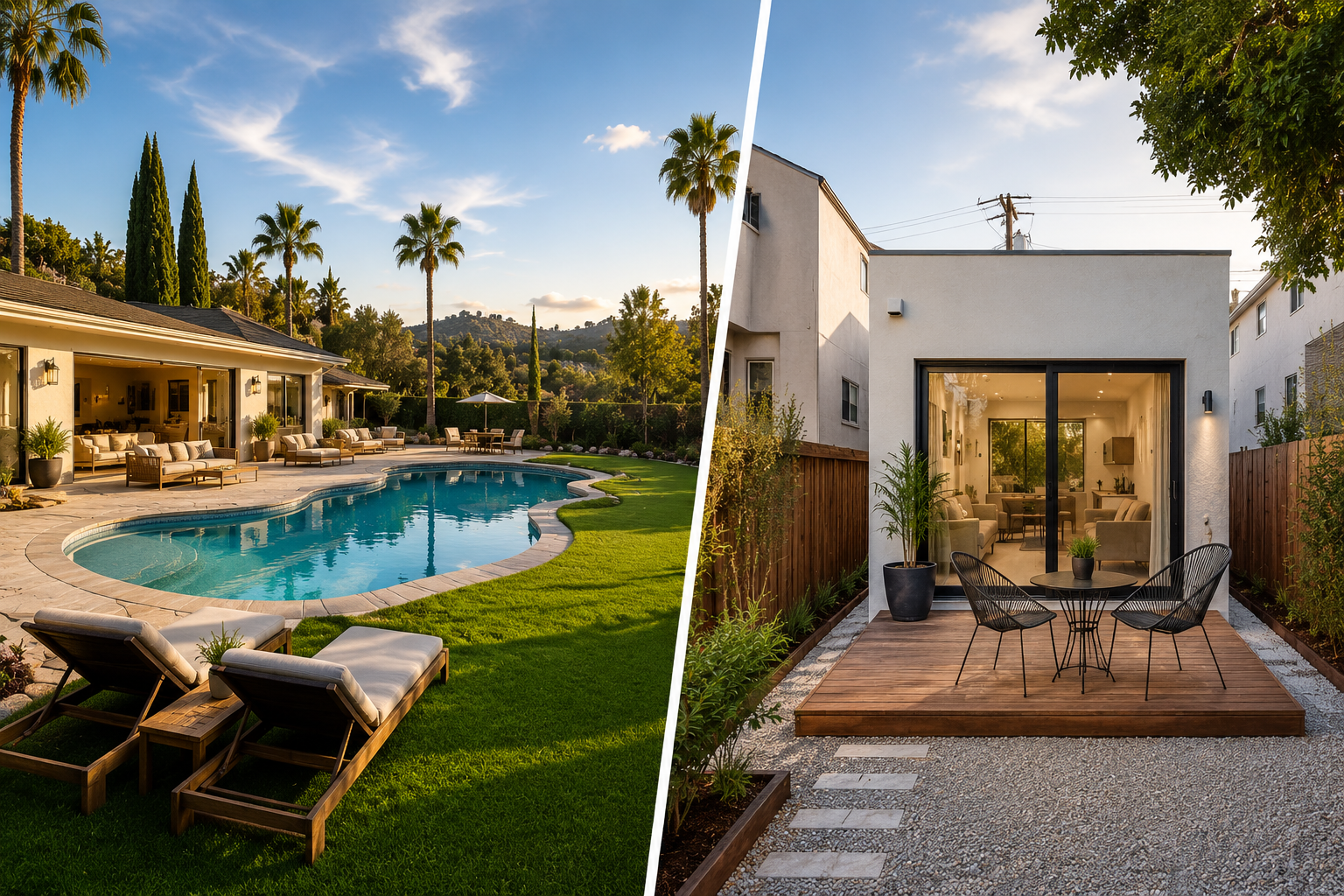 The SFV value proposition at $1.6M — what the same budget reaches on the Westside versus in the Valley. The gap in square footage, lot size, and outdoor living space between a Santa Monica or Brentwood purchase and a comparable-quality Sherman Oaks 91403 or Encino 91316 purchase at the same price is large enough to represent a fundamentally different daily residential life. This gap is the primary reason buyers who make the comparison honestly consistently find the SFV more compelling than their pre-comparison assumptions suggested.
The value gap at specific SFV price points:
At $900,000:
- → 💰 SFV (Reseda 91335, Northridge 91324, Lake Balboa 91406): A renovated 3-bedroom on a 7,500–9,000 sq ft lot with an updated kitchen, new flooring, and a functional backyard
- → 💰 Westside alternative at $900,000: A 1-bedroom or small 2-bedroom condominium in a dated building, or a 900–1,200 sq ft house on a minimal lot in a less-established area of Mar Vista or Palms
- → 📊 The gap: The SFV buyer gets a single-family home on a real lot; the Westside buyer gets a condo or a very small house. This is not a marginal quality difference — it is a fundamentally different daily residential experience.
At $1.4M:
- → 💰 SFV (Tarzana 91356, Studio City north-of-Ventura 91604, Granada Hills 91344): A comprehensively renovated 3–4 bedroom on a 9,000–14,000 sq ft lot with an updated kitchen, primary bath, and established outdoor space
- → 💰 Westside alternative at $1.4M: A small 2-bedroom house in a modest location, or a 2-bedroom condo with parking
- → 📊 The gap: 40–55% more indoor square footage and 200–400% more outdoor space per dollar in the SFV at this price tier
At $2.0M:
- → 💰 SFV (Encino south-of-Ventura 91316, Woodland Hills 91364, Calabasas 91302): A renovated 4-bedroom on a 14,000–20,000 sq ft lot with established pool, mature privacy landscaping, and the large-lot outdoor living proposition
- → 💰 Westside alternative at $2.0M: A mid-size house on a minimal lot in a premium Westside location, or a premium condominium
- → 📊 The gap at $2.0M: The SFV buyer gets a genuine estate-scale outdoor living experience; the Westside buyer at $2.0M rarely reaches the lot size that produces it
The school quality value:
Beyond the physical value gap, the SFV offers specific school quality anchors that the Westside's private-school-dependent culture charges $30,000–$60,000/year per child to access through private institutions:
- → 🏫 LVUSD (Calabasas 91302/91372, Woodland Hills 91364 LVUSD-boundary): Top 5–10% of LA County public school districts — the school quality that equivalent Westside buyers achieve through Harvard-Westlake or other private institutions
- → 🏫 GHCHS (Granada Hills 91344): Consistently rated among the top public high schools in LA County
- → 🏫 ECR Charter (Tarzana 91356, Woodland Hills 91367 eligible addresses): Strong public high school with motivated enrollment-driven demand
- → 🏫 Carpenter Elementary (Studio City 91604 south-of-Ventura catchment): The elementary school quality anchor that produces $140,000–$280,000 in address premium
- → 💰 The private school cost avoided: A family with two children who moves to a LVUSD-catchment address in Calabasas instead of paying private school tuition in a Westside neighborhood saves $60,000–$120,000/year — an annual savings that substantially changes the effective price comparison between an SFV purchase and a Westside purchase
2. 🗺️ The SFV Neighborhood Spectrum — Finding the Right Sub-Market for Your Household
The buyer who is evaluating "the SFV" needs to rapidly locate themselves within the neighborhood spectrum that best matches their specific budget, school priorities, lifestyle, and commute needs. This section maps the primary SFV sub-markets with the decision criteria that distinguish each.
The entry tier ($650,000–$950,000) — Central Valley working-family markets:
Reseda 91335: The most value-per-dollar in the PEP SFV coverage area. "Little Lima" cultural food corridor on Reseda Boulevard. Working-family community. BRRRR investor market. LAUSD with ECR Charter adjacency for some southern 91335 addresses. Best for: first-time buyers prioritizing value and cultural food diversity.
Northridge 91324/91325: CSUN-adjacent. The Soraya performing arts venue. Strong first-time buyer market. LAUSD. Working-family to professional-household demographic. Best for: first-time buyers who value the CSUN community resource and the family-oriented neighborhood fabric.
Lake Balboa 91406/91411: Sepulveda Basin Recreation Area front-door access. Working-family to move-up. Active BRRRR investor market. LAUSD. The outdoor lifestyle proposition of the Balboa park system is the defining neighborhood feature. Best for: active-lifestyle families and outdoor-oriented first-time buyers; BRRRR investors.
The mid-tier ($850,000–$1.5M) — Western Valley premium and school-anchored markets:
Tarzana 91356: ECR Charter High School anchor. Ventura Boulevard access. Family-oriented western Valley community. The school community social fabric that produces strong neighborhood belonging for families with ECR-pipeline children. Best for: families with school-age children specifically targeting ECR Charter.
Granada Hills 91344: GHCHS anchor. Northern Valley suburban character. Two-speed market (volume tier $875K–$1.15M, premium tier $1.2M–$1.8M). Best for: families targeting GHCHS and buyers who want northern Valley's more spacious, less commercially dense character.
Studio City north-of-Ventura 91604/91602: Entertainment industry professional community. The most walkable Ventura Boulevard character in the SFV. Carpenter Elementary catchment for south-of-Ventura addresses. Best for: entertainment industry professionals and design-forward buyers who want urban-adjacent SFV lifestyle.
The premium tier ($1.4M–$2.8M) — Large-lot luxury and school-premium markets:
Sherman Oaks 91403/91423: The SFV's most central and most connected premium market. Best Ventura Boulevard access in the Valley. 405/101 interchange proximity. Best for: Westside commuters who are making the SFV move and who want the easiest Westside access from within the Valley; entertainment industry professionals commuting east through the Cahuenga Pass.
Encino 91316/91436: Large-lot outdoor living. South-of-Ventura premium positions with 12,000–20,000 sq ft lots and established pools. Encino Hills 91436 for hillside-and-view buyers. Best for: buyers specifically motivated by outdoor living scale and privacy at a price that produces it.
Studio City south-of-Ventura 91604: The highest-specification renovation market in the SFV. Carpenter Elementary school premium. Entertainment industry buyer concentration. Best for: entertainment industry households at the $1.8M–$2.8M+ tier who want the SFV's most design-forward residential product.
The luxury and western tier ($1.5M–$3.5M+) — Mountain-adjacent and large-lot premium:
Woodland Hills 91364/91367: Topanga State Park front-door access from western 91364. LVUSD boundary for some addresses. Warner Center proximity. 15–22% less expensive than Calabasas for comparable quality. Best for: outdoor-lifestyle buyers who want mountain access at a Calabasas alternative price; families targeting LVUSD at a value advantage.
Calabasas 91302/91372: LVUSD universal access. The Commons lifestyle hub. Gated community availability. Mountain adjacency. The western Valley's premium brand. Best for: families specifically wanting universal LVUSD access and The Commons lifestyle, and who can manage the distance from central LA.
3. 🌡️ The Honest SFV Limitations — What Every Buyer Must Know Before Moving
An honest "should I move to the SFV" analysis requires the same specificity on the limitations that the value proposition section applied to the advantages. The buyers who thrive in the SFV are those who entered with accurate expectations on both sides.
Summer heat — the adjustment most buyers underestimate:
The SFV's inland position produces summer temperatures that are categorically different from the coastal markets many LA buyers come from:
- → 🌡️ Central Valley (Reseda 91335, Northridge 91324, Van Nuys 91401): July–August daily highs regularly 92–104°F; Santa Ana events push to 108–112°F+
- → 🌡️ Western Valley (Tarzana 91356, Woodland Hills 91364, Calabasas 91302): Slightly moderated by proximity to the Santa Monica Mountains — typically 88–100°F in peak summer, with Santa Ana events still producing 100–108°F+
- → 🌡️ The coastal comparison: Santa Monica, Brentwood, and Pacific Palisades summer temperatures run 70–80°F with natural cooling from the ocean — a 20–30°F temperature difference from the central Valley in peak summer
- → ✅ The practical reality: Every SFV home should have functioning central air conditioning. The SFV summer lifestyle shifts to pool and indoor activity from approximately 11:00 AM through 6:00 PM from late June through mid-September. Morning outdoor activity (before 9:00 AM) and evening outdoor activity (after 6:00 PM) remain pleasant throughout the summer.
- → ⚠️ For buyers from coastal LA markets: The summer heat adjustment is more significant than pre-move research typically conveys. The buyer who visits Encino 91316 in October (high of 75°F, beautiful fall light) is not experiencing the neighborhood's July character (high of 98°F). Visit in July before purchasing if summer heat is a potential dealbreaker.
Car dependency:
The SFV is broadly car-dependent — with the specific exception of Studio City 91604/91602's Ventura Boulevard pedestrian corridor and Sherman Oaks 91403/91423's walkable commercial access, essentially every daily commercial, recreational, and social activity in the SFV requires a car.
- → ⚠️ Walk Scores: Most SFV residential neighborhoods have Walk Scores of 40–65 — "Car-Dependent" to "Somewhat Walkable" in the Walk Score framework
- → ✅ For buyers from walkable markets: The car dependency adjustment is real but manageable. The buyer who builds their SFV daily routine around their car rather than fighting the car-dependency consistently adapts without the frustration that the buyer who tries to replicate a walking lifestyle experiences.
The Westside commute:
The SFV's relationship with Westside employment is the limitation that most frequently produces buyer regret after the move:
- → 🚗 Sepulveda Pass (405 northbound to I-405 southbound): 35–55 minutes in peak morning, 40–65 minutes in peak evening from Sherman Oaks and Encino. 45–70 minutes from Tarzana and Woodland Hills. 55–80 minutes from Calabasas.
- → 🚗 Cahuenga Pass (101 eastbound): 20–35 minutes from Studio City 91604 to Hollywood and West Hollywood. The shortest Valley-to-Westside-adjacent commute available.
- → ✅ The realistic commute management: Buyers with daily Westside employment who purchase in Sherman Oaks 91403 (the closest SFV market to the Sepulveda Pass) and who depart before 7:30 AM or after 9:30 AM consistently manage the commute as a tolerable lifestyle trade-off for the value they receive. Buyers who purchase in Calabasas 91302 with daily Westside employment discover that the 55–80 minute commute accumulates to 8–12 hours of additional weekly driving that significantly changes their quality of life.
The "Valley stigma":
The SFV carries a cultural stigma — the "Valley girl" cultural association, the broad perception as a less prestigious LA address than the Westside, and the specific social dynamic that comes with telling certain LA social circles "I live in the Valley." This stigma is:
- → ✅ Fading: The SFV has gained significant residential credibility over the past decade as Westside prices have pushed more buyer populations into honest comparison with the Valley's value
- → ⚠️ Still real: For buyers whose social or professional identity is specifically tied to address prestige, the Valley stigma remains a genuine social factor. A Calabasas 91302 or Studio City 91604 address carries substantially less stigma than a Reseda 91335 or Van Nuys 91401 address.
- → 📌 The honest take: Buyers who are purchasing for what the neighborhood actually delivers — the home, the schools, the community, the lifestyle — find the stigma irrelevant within 6 months of moving. Buyers who are purchasing partly for address identity find the stigma persistently frustrating.
4. 👥 Buyer Profiles — Who the SFV Is Right For and Who It's Wrong For
The SFV is specifically right for certain buyer profiles and genuinely wrong for others — and the analysis that identifies which profile a specific buyer occupies is more valuable than any general "the SFV is great" or "avoid the Valley" recommendation.
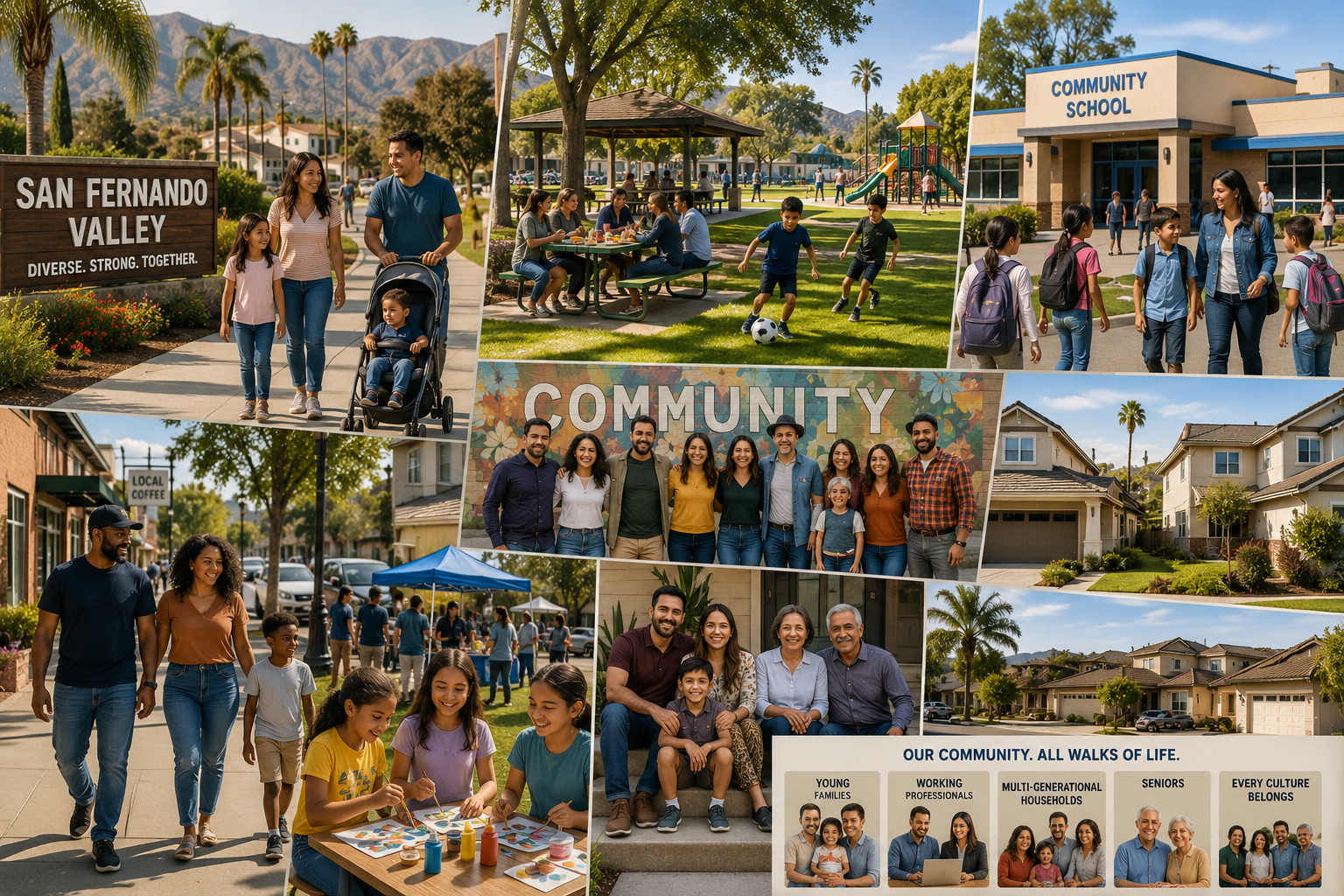 The SFV buyer profile diversity — the full range of households the Valley's sub-market spectrum serves, from the working-family first-time buyer in Reseda 91335 to the luxury family in Calabasas 91302, from the entertainment industry professional in Studio City 91604 to the BRRRR investor in Lake Balboa 91406. The buyer who matches their specific priorities to the specific SFV sub-market that serves them consistently finds the Valley to be the right answer.
Buyer profiles the SFV specifically serves:
✅ The school-quality family at the working-family budget:
The family with school-age children whose budget reaches $850,000–$1.35M and who is comparing: a small house in a less-established Westside neighborhood with LAUSD assignment to a lower-performing school, versus a well-prepared 3-bedroom in a GHCHS-catchment Granada Hills 91344 address or an ECR-Charter-catchment Tarzana 91356 address. The SFV consistently delivers better school quality at the working-family budget than the Westside alternatives — and this is the buyer for whom the SFV's value advantage is most specific and most impactful.
✅ The large-lot outdoor living buyer:
The family or professional household whose primary purchase motivation is genuine outdoor space — the 14,000–20,000 sq ft lot with established pool, mature privacy landscaping, and the ability to host dinner outdoors without neighbors 12 feet away. At $1.6M–$2.2M, the SFV (Encino south-of-Ventura 91316, Woodland Hills 91364, Calabasas 91302) delivers this outdoor living proposition consistently. The Westside at $1.6M–$2.2M does not.
✅ The Warner Center or Valley employment professional:
The professional whose workplace is in Warner Center 91367, Northridge Hospital 91325, CSUN 91330, Burbank, or anywhere in the Valley employment corridor — whose commute from the SFV is 10–25 minutes rather than the 40–65 minutes the Westside produces — and whose budget reaches meaningfully more home in the SFV than in a Westside neighborhood equally convenient to the same workplace. The SFV purchase for this buyer is the objectively better commute and the objectively better value.
✅ The remote work or hybrid professional:
The professional who works from home 3–5 days per week and whose commute is a 2-day-per-week event rather than a daily obligation. For this buyer, the SFV's commute limitation is compressed to 2 days; the value advantage is full-time. The remote work shift has produced significant buyer flow into the SFV from Westside renters who previously couldn't justify the commute — and who now find the SFV's value proposition compelling when the commute is 2 days rather than 5.
✅ The SFV move-up buyer:
The household that currently rents or owns in Reseda 91335, Van Nuys 91401/91405/91406, Canoga Park 91304, or another central Valley neighborhood and is making their first or second equity step into a more established neighborhood. The SFV move-up market — Reseda to Tarzana, Van Nuys to Sherman Oaks, Canoga Park to Woodland Hills — produces the specific equity ladder that has driven the Valley's residential quality upward over decades. These buyers know the Valley; they are choosing within it rather than across a region comparison.
Buyer profiles the SFV genuinely doesn't serve:
❌ The daily Westside commuter who hasn't tested the commute:
The buyer who is attracted to the SFV value and imagines managing the Westside commute without having tested it at their actual commute time is the buyer most likely to regret the Valley purchase. The buyer who tests the Sepulveda Pass at 8:15 AM on a Tuesday and is prepared for 50 minutes of traffic can build their life around it. The buyer who assumes the commute will be manageable without testing it often cannot.
❌ The walkable-urban lifestyle buyer:
The buyer who is accustomed to walking to their coffee shop, their grocery, their friends' dinner — the specific pedestrian lifestyle of Silver Lake, Los Feliz, WeHo, or walkable Westside neighborhoods — will find the SFV's car dependency a persistent daily frustration unless they specifically and intentionally build their lifestyle around the car-dependent format. Studio City 91604's Ventura Boulevard is the SFV's best walkability option; every other SFV neighborhood requires the car for virtually every destination.
❌ The buyer purchasing primarily for address prestige:
The buyer whose social or professional identity is specifically tied to address prestige — for whom "I live in Brentwood" is a meaningful social signal and "I live in Northridge" is a meaningful social cost — will find the SFV's address identity persistently frustrating regardless of the home quality, the school quality, or the lifestyle they actually enjoy in the neighborhood. This is not a judgment; it is an honest recognition that address prestige is a real motivation for some buyers, and the SFV at most price points does not satisfy it in the way the Westside does.
5. 🏡 Making the SFV Decision — The Framework That Works
With the value proposition, the neighborhood spectrum, the limitations, and the buyer profiles mapped, the buyer who is genuinely evaluating the SFV move benefits from a specific decision framework rather than a general "weigh the pros and cons" instruction.
The five-question SFV decision framework:
Question 1 — What is your primary workplace and how often do you go there?
If the answer is "Warner Center 91367, Burbank, Northridge, or the broader Valley corridor, daily" — the SFV is the objectively better commute choice, and the value advantage is a bonus.
If the answer is "Century City, Brentwood, Santa Monica, or the Westside, daily" — test the specific commute from the specific SFV neighborhoods you are considering at your actual commute time before any offer. The commute reality is the most important single variable for buyers with daily Westside employment.
If the answer is "remote, 1–2 days/week in [location]" — the SFV's value advantage is available at minimal commute cost. The specific 1–2 day destination informs which SFV neighborhood optimizes the remaining commute.
Question 2 — Do you have school-age children and what are their school priorities?
If yes, with LVUSD school quality as a specific priority: → Calabasas 91302/91372 (universal LVUSD) or Woodland Hills 91364 (LVUSD-boundary addresses, verify at lvusd.org).
If yes, with GHCHS as a specific priority: → Granada Hills 91344 (verify address at lausd.net/schoolfinder).
If yes, with ECR Charter as a specific priority: → Tarzana 91356 or Woodland Hills 91367 ECR-eligible addresses (verify at lausd.net/schoolfinder).
If yes, with Carpenter Elementary as a specific priority: → Studio City 91604 south-of-Ventura (verify at lausd.net/schoolfinder).
If no children or school is not a primary factor: → Budget optimization guides the sub-market selection; the school premium addresses are also appropriate without the school motivation.
Question 3 — What is your budget and what does it need to produce?
- → $650K–$950K needing a single-family home on a real lot: → Reseda 91335, Northridge 91324/91325, Lake Balboa 91406/91411
- → $850K–$1.35M needing a well-prepared home in a school-quality community: → Tarzana 91356, Granada Hills 91344, Northridge 91324/91325 renovated
- → $1.35M–$2.0M needing premium renovation quality and large-lot character: → Studio City north-of-Ventura 91604, Sherman Oaks 91403, Encino north-of-Ventura 91316, Woodland Hills 91364 flatland
- → $1.8M–$3.5M+ needing large-lot outdoor living and premium specification: → Encino south-of-Ventura 91316, Woodland Hills 91364 hillside, Calabasas 91302/91372, Studio City south-of-Ventura 91604
Question 4 — What does your outdoor lifestyle require?
- → Front-door wilderness trail access: → Western Woodland Hills 91364 canyon-adjacent, Calabasas 91302 canyon-adjacent
- → Sepulveda Basin park/cycling/outdoor recreation access: → Lake Balboa 91406/91411
- → Large backyard, pool, outdoor entertaining at scale: → Encino south-of-Ventura 91316, Woodland Hills 91364 south-of-Ventura, Calabasas 91302 flatland
- → Standard Valley park and recreational access: → Any SFV sub-market
Question 5 — What does your commercial lifestyle require daily?
- → The most walkable Ventura Boulevard access: → Studio City 91604/91602, Sherman Oaks 91403/91423
- → The Commons-caliber lifestyle hub: → Calabasas 91302/91372
- → Cultural food diversity and community authenticity over polish: → Reseda 91335
- → Premium retail and lifestyle commercial within the Valley: → Encino 91316, Sherman Oaks 91403
🚫 What NOT to Overdo
Don't make the SFV decision based on a single weekend visit in ideal conditions. The most common SFV buyer regret comes from buyers who visited in October (gorgeous weather, light traffic, beautiful fall character), purchased, and then discovered the July reality (102°F, heavier traffic, pools closed by afternoon heat). Visit the specific SFV neighborhood you are targeting during the peak summer conditions if heat is a potential dealbreaker — a Saturday in July at 2:00 PM is the honest preview of what your life will feel like in your most challenging season.
Don't apply a single SFV narrative to neighborhoods with fundamentally different characters. The buyer who read one "should I move to the SFV?" article and formed a view of the entire Valley based on one sub-market's character has formed an inaccurate view. Calabasas 91302 and Reseda 91335 are not the same neighborhood with a price difference — they are fundamentally different communities, different school landscapes, different commercial characters, different outdoor propositions, and different daily lifestyle experiences. Research the specific sub-market you are targeting with the same depth the SFV-wide article provides.
Don't assume the SFV is uniformly car-dependent. Studio City's Ventura Boulevard corridor, the Sepulveda Basin cycling infrastructure in Lake Balboa 91406/91411, and the trail system access in western Woodland Hills 91364 and Calabasas 91302 all provide specific active lifestyle and commercial access that standard car-dependency narratives miss. The buyer who assumes the SFV is uniformly hostile to walkable lifestyle should evaluate Studio City 91604's Tujunga Village sub-neighborhood and Sherman Oaks's Ventura Boulevard-adjacent streets before concluding.
Don't use a single commute test to evaluate the SFV's commute reality. The Sepulveda Pass at 7:00 AM on a Monday and at 10:30 AM on a Wednesday are different experiences — meaningfully so. The honest commute evaluation requires testing the specific route from the specific SFV neighborhood to the specific workplace destination at the actual departure time on an actual Tuesday or Wednesday, not on an optimistic 7:30 AM Sunday test drive.
Don't let the "Valley stigma" drive the decision in either direction. Buyers who avoid the SFV specifically because of address prestige concerns may be paying a 40–65% premium to avoid a stigma that their actual life experience in the Westside neighborhood will not justify. Buyers who move to the SFV partly to prove they are immune to address prestige concerns and discover that they actually care more than they thought have made the same mistake in the opposite direction. Be honest about whether address prestige is a genuine factor in your decision — and if it is, include it in the analysis rather than suppressing it.
🏠 Real-World Scenario — San Fernando Valley
A couple — a film editor at a major studio in Burbank and a dermatologist with a practice in Encino 91316, combined income $620,000, renting in Silver Lake 90026 — had spent three years deciding whether to buy in Silver Lake, Los Feliz, or "look at the Valley" (which they had consistently deprioritized as "not what they imagined for themselves").
Their Silver Lake and Los Feliz budget: $1.3M reached a 2-bedroom older house on a minimal lot or a 3-bedroom that needed significant work.
A colleague mentioned that Encino south-of-Ventura reached a renovated 4-bedroom on a 14,000 sq ft lot with an established pool at $1.7M — and that both their workplaces were closer from Encino than from Silver Lake.
They researched with skepticism. What they found:
The commute comparison:
- → Silver Lake to Burbank studio (current): 22 minutes off-peak, 35–45 minutes peak
- → Encino 91316 to Burbank studio: 18 minutes via 134 freeway (better, not worse)
- → Silver Lake to Encino practice (current): 35 minutes off-peak, 50–65 minutes peak
- → Encino 91316 to Encino practice: 8 minutes (dramatically better)
The value comparison at $1.7M:
- → Silver Lake $1.7M: a 3-bedroom, approximately 1,900 sq ft, on a 4,800 sq ft lot with no pool and a 5% slope. Walkable to bars and restaurants.
- → Encino south-of-Ventura $1.7M: a renovated 4-bedroom, approximately 2,600 sq ft, on a 15,200 sq ft lot with an established pool, mature privacy hedging, and an outdoor dining area.
The honest lifestyle comparison:
- → Silver Lake: walkable weekend mornings, restaurant discovery culture, urban energy, the Silver Lake Reservoir walk, their established social infrastructure
- → Encino: The Ventura Boulevard dining corridor (15 restaurants within a 10-minute drive), weekend mornings in the pool, the specific outdoor entertaining lifestyle that the large lot enabled, and the specific absence of the urban walkability they had valued in Silver Lake
They visited Encino on a Saturday in March (pleasant, not representative of summer). They visited again on a Friday in August at 3:00 PM (97°F). Their response to the August visit: "This is genuinely hot. We would not be walking anywhere in the afternoon. But we'd be in the pool."
They purchased in Encino south-of-Ventura 91316 at $1.68M. The dermatologist's commute went from 50 minutes to 8 minutes. The editor's commute improved by 7 minutes. The pool was in use by day 30 of ownership. Their Silver Lake social world moved with them — "people come to us now, because they want to be at the pool."
Two years in: "We don't think about Silver Lake anymore. We think about Encino. The heat is real — we adapted. Everything else has exceeded what we expected."
🏠 Real-World Scenario — San Fernando Valley
A single buyer — a 31-year-old software engineer at a remote-first tech company, purchasing their first home alone, income $185,000, $210,000 saved — had been renting in West Hollywood and had decided to purchase. Their West Hollywood budget: $650,000 reached a 1-bedroom condominium in a building with HOA fees and minimal outdoor space.
They asked the honest question: "What does $650,000 reach in the SFV versus West Hollywood?"
The SFV alternative at $650,000: A renovated 2-bedroom, 1,100 sq ft house on a 6,800 sq ft lot in Reseda 91335 — updated kitchen, new floors, a functional backyard with room for a garden, and no HOA.
The daily life comparison:
- → West Hollywood: highly walkable, dense restaurant and social infrastructure, their existing social world
- → Reseda: car-dependent, the "Little Lima" food corridor (which the buyer had specifically researched and found compelling), quiet residential streets, the garden that the backyard enabled
The commute: Full remote — 0 days in any office. The commute was not a factor.
The honest pre-purchase SFV assessment: We walked through the Reseda food corridor with them before any home tour. Their response: "I had no idea this existed. This is where I would eat all the time."
We were also honest about what Reseda didn't deliver: "Your West Hollywood social life is 35 minutes away. Your friends aren't going to come to Reseda for a Tuesday dinner. You're going to drive to them more than they drive to you. Your neighborhood social life will be built from scratch here."
Their response: "I'm 31 and remote. I'm building new social infrastructure wherever I buy. West Hollywood's social infrastructure belongs to my 20s. I want a house with a backyard."
They purchased in core Reseda 91335 at $638,000 — a renovated 2-bedroom with a real backyard. Planted a vegetable garden in month 2. Is a Friday regular at two Reseda Boulevard Peruvian restaurants. Drives to West Hollywood for dinner with old friends every 2–3 weeks.
One year in: "The backyard changed my life more than I expected. The neighborhood surprised me — the food corridor is genuinely extraordinary. I don't miss the walkability as much as I thought I would. I do miss the density of seeing people I know. But I knew that going in."
The buyer who researched the SFV honestly — understanding what they were gaining and what they were trading — made a decision they have not regretted.
❓ FAQ
Is the San Fernando Valley a good place to live? Yes — for specific buyer profiles and with accurate expectations. The SFV consistently delivers more home per dollar than comparable Westside alternatives, specific school quality anchors (LVUSD in Calabasas 91302/91372 and Woodland Hills 91364, GHCHS in Granada Hills 91344, ECR Charter in Tarzana 91356, Carpenter Elementary in Studio City 91604) that rival private school quality at public school cost, and large-lot outdoor living propositions that comparable Westside budgets don't produce. The SFV is genuinely not ideal for daily Westside commuters, buyers who require walkable urban lifestyle, or buyers whose purchase motivation includes address prestige.
How does the SFV compare to the Westside? The SFV delivers 40–65% more home per dollar than comparable-quality Westside neighborhoods at every budget level — a gap that represents a fundamentally different daily residential quality at the same purchase price. The Westside delivers walkability, milder summer temperatures (20–30°F cooler than the central Valley), and the specific coastal and urban lifestyle that the SFV cannot replicate. The correct comparison depends on which variables matter more to the specific buyer's daily life.
What are the best neighborhoods in the San Fernando Valley? "Best" depends entirely on the buyer's specific priorities. For school quality and mountain lifestyle: Calabasas 91302/91372 and Woodland Hills 91364. For Ventura Boulevard lifestyle and entertainment industry community: Studio City 91604/91602 and Sherman Oaks 91403/91423. For large-lot outdoor living: Encino south-of-Ventura 91316. For value and cultural food diversity: Reseda 91335. For school quality at the working-family budget: Granada Hills 91344 (GHCHS) and Tarzana 91356 (ECR Charter). For outdoor lifestyle and first-time buyers: Lake Balboa 91406/91411. No single SFV neighborhood is universally best — the correct answer is buyer-priority specific.
Is the Valley too hot in the summer? The SFV summer is significantly hotter than coastal Los Angeles — central Valley temperatures regularly reach 92–104°F in July and August, with Santa Ana events pushing to 108–112°F+. Western Valley neighborhoods (Tarzana 91356, Woodland Hills 91364, Calabasas 91302) run slightly cooler due to Santa Monica Mountains proximity. Every SFV home should have functioning central air conditioning; pools are common for good reason. Buyers from coastal LA markets consistently find the heat adjustment more significant than they anticipated. Visit in July before purchasing if summer heat is a potential dealbreaker.
What is the commute from the San Fernando Valley to the Westside? The Sepulveda Pass (405 freeway) commute from the SFV to Westside destinations runs 35–55 minutes in peak morning conditions from Sherman Oaks and Encino, 45–70 minutes from Tarzana and Woodland Hills, and 55–80 minutes from Calabasas. Studio City 91604 via the Cahuenga Pass (101 eastbound) reaches Hollywood and West Hollywood in 20–35 minutes. Test your specific route from your specific target neighborhood to your specific workplace at your actual commute time before purchasing — the commute is the most consistently underestimated lifestyle variable among buyers making the Westside-to-Valley transition.
Is the San Fernando Valley affordable? Relative to the Westside, yes — significantly so. A $900,000 budget reaches a single-family home on a real lot in Reseda 91335, Northridge 91324/91325, or Lake Balboa 91406/91411, while the same budget reaches a condominium or very small house in most Westside neighborhoods. At $1.4M, the SFV reaches a comprehensively renovated 3–4 bedroom with outdoor space in Tarzana 91356 or Granada Hills 91344, while Westside alternatives at this price are severely constrained in size and quality. The SFV is not "affordable" in an absolute sense — median SFV home prices range from $700,000 in the central Valley to $2.0M+ in premium western markets — but it consistently delivers significantly more per dollar than Los Angeles alternatives at every budget level.
🎯 Bottom Line
The SFV move is right for buyers who have evaluated it honestly — who have tested the commute at their actual departure time, visited in July as well as October, researched the specific sub-market rather than the Valley in aggregate, and confirmed that the home, the school quality, the outdoor space, and the community they will actually live in justifies the trade-offs they are making from a more central LA location.
The SFV move is wrong for buyers who are making it primarily as a financial optimization without genuine lifestyle alignment — who will spend the first year of ownership resenting the heat, the car dependency, and the distance from their social world rather than building the new life the neighborhood makes possible. The value is real. The lifestyle alignment must be equally real.
The SFV contains approximately 20 distinct sub-markets ranging from Reseda 91335's working-family cultural corridor to Calabasas 91302/91372's semi-rural mountain-adjacent luxury — each with a specific buyer profile, a specific school landscape, a specific lifestyle character, and a specific price tier. The buyer who finds the sub-market that matches their specific household will find the SFV to be one of Los Angeles's most compelling residential decisions. The buyer who moves to "the Valley" without finding their specific neighborhood within it will find it merely adequate.
At Parkway Estate Properties, Liana's buyer representation across the entire SFV — from Reseda 91335 through Calabasas 91302/91372, from Lake Balboa 91406/91411 through Studio City 91604/91602 — means every SFV buyer conversation begins with the honest lifestyle assessment, the sub-market matching, and the commute reality check that produces the correct purchase decision for each specific household.
📩 Want an Honest Assessment of Which SFV Neighborhood Is Right for Your Specific Household?
Tell us your workplace, your budget, your school priorities, your outdoor lifestyle requirements, and your commercial lifestyle needs — and we'll match you to the specific SFV sub-market that serves all of them, before you've scheduled a single showing.
Contact Liana Shersher at Parkway Estate Properties: 📧 liana@parkwayestate.com · 📞 (818) 208-5881 · 🌐 parkwayestate.com 15021 Ventura Blvd., Ste. 510, Sherman Oaks, CA 91403
About the Authors
Liana Shersher is a licensed real estate agent with Parkway Estate Properties Inc. and an Accredited Buyer's Representative (ABR) serving the San Fernando Valley — with a focus on Sherman Oaks, Encino, Tarzana, Woodland Hills, and Northridge (DRE# 02164224). Liana guides first-time homebuyers through every step of the purchase, from the first showing to the keys in hand, and represents move-up and repeat buyers across the Valley. For sellers, she builds the pricing and marketing strategy that positions a home to sell for top dollar, fast. Buyers and sellers work with Liana for clear communication, sharp local knowledge, and an agent who treats their goals like her own.
Roman Shersher is the broker-owner of Parkway Estate Properties Inc. and a real estate investor with 18 years of experience in the San Fernando Valley (DRE# 01855095). Roman has personally led or co-led renovations on dozens of properties across the Valley, including recent projects in Northridge (91324) and Woodland Hills (91364). That hands-on renovation and investment experience shapes every pricing conversation and days-on-market strategy at Parkway — sellers get a realistic read on what improvements actually return at resale, and buyers get an expert eye on a home's true condition and upside.
Parkway Estate Properties, Inc. · 15021 Ventura Blvd., Ste. 510, Sherman Oaks, CA 91403 · (818) 208-5881 · parkwayestate.com · Broker License #: 01873092 Equal Housing Opportunity. Information herein is general and not legal, tax, or financial advice. Consult qualified professionals for your specific situation.

Broker | Realtor ® License ID: 01873092
+1(818) 208-5881 | info@parkwayestate.com