
Should I Renovate My Home Before Selling in Sherman Oaks?

The renovation decision for Sherman Oaks 91403 and 91423 sellers is the most internally variable in the PEP SFV seller coverage area — because Sherman Oaks's three-tier internal market produces fundamentally different renovation ROI thresholds, different buyer specification expectations, and different optimal renovation scopes depending on whether the seller is in the north-of-Ventura working-professional tier, the south-of-Ventura entertainment industry and luxury buyer tier, or the north-of-Mulholland premium position.
The question isn't simply "should I renovate?" — it's "which tier am I in, what does the comp gap in my specific sub-market support, and am I prepared to complete the full scope that reaches the renovated ceiling rather than stopping at the partial renovation that creates the most specific and most costly Sherman Oaks seller error?"
The partial renovation trap is the concept that defines the Sherman Oaks renovation conversation more than any other market in the series. The Sherman Oaks seller who renovates the kitchen to the entertainment buyer's standard ($35,000 custom cabinetry, Calacatta quartzite, Sub-Zero refrigerator, Wolf range), renovates the primary bath to the spa level, and then stops — leaving the 1980s carpet in the secondary bedrooms, the popcorn ceilings in the hallways, the dated secondary baths, and the original tile in the guest bathroom — has created a home that confuses the buyer. The buyer who expects a renovated Sherman Oaks home at the price that the kitchen and primary bath suggest arrives to find a partially renovated property that doesn't reach the renovated comp ceiling because the incomplete scope tells the story of a renovation that ran out of time, budget, or both. The buyer reduces their offer to the midpoint between the renovated ceiling and the original condition floor — producing the worst single net proceeds outcome in the Sherman Oaks market.
1. 📊 The Sherman Oaks Comp Gap — Three Tiers, Three Different Decisions
The Sherman Oaks renovation analysis begins with identifying the correct tier — because the comp gap, the buyer pool's renovation expectations, and the renovation scope that reaches the ceiling differ substantially across the three internal Sherman Oaks sub-markets.
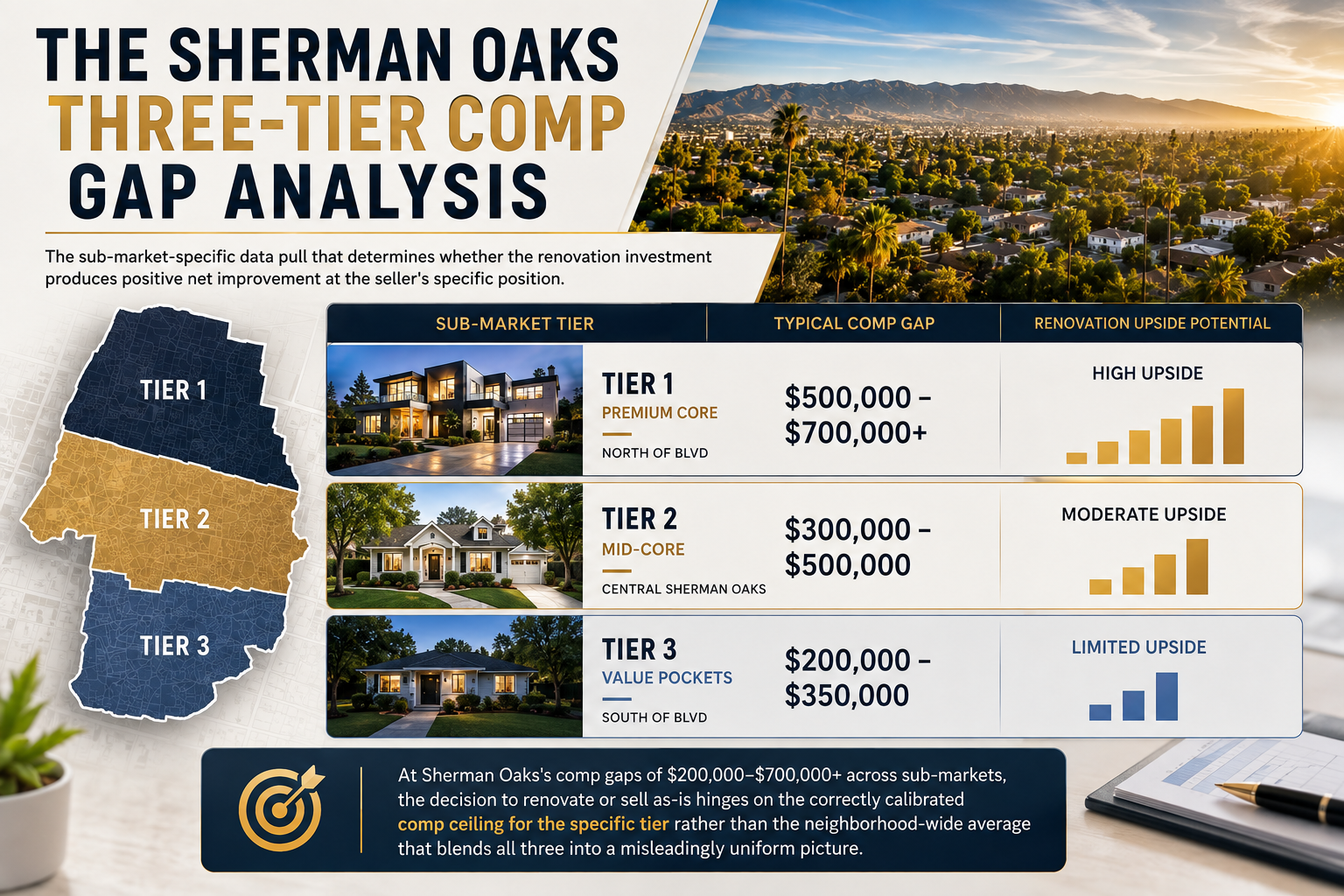 The Sherman Oaks three-tier comp gap analysis — the sub-market-specific data pull that determines whether the renovation investment produces positive net improvement at the seller's specific position. At Sherman Oaks's comp gaps of $200,000–$700,000+ across sub-markets, the decision to renovate or sell as-is hinges on the correctly calibrated comp ceiling for the specific tier rather than the neighborhood-wide average that blends all three into a misleadingly uniform picture.
Tier 1 — North-of-Ventura 91403 (Volume Tier, $1.15M–$1.65M):
The most transaction-active Sherman Oaks sub-market — serving the working-professional household, the entertainment industry support professional, and the move-up buyer from Northridge 91324/91325, Reseda 91335, or Van Nuys 91401/91405/91406.
- → 💰 Original condition baseline: $1.15M–$1.35M for a standard 3–4 bedroom in original condition
- → 💰 Renovated comp ceiling: $1.4M–$1.65M for comprehensively renovated to the north-of-Ventura standard
- → 📊 Comp gap: $200,000–$300,000
- → 💡 Maximum renovation investment: $65,000–$110,000 for the scope that reaches this ceiling without exceeding it
- → ✅ The north-of-Ventura buyer's renovation expectations: The working-professional buyer at $1.4M–$1.65M has calibrated their expectations against north-of-Ventura comps — they want move-in ready with an updated kitchen, refreshed primary bath, consistent flooring, and neutral paint throughout. They are not expecting the Wolf/Sub-Zero/Calacatta specification of the south-of-Ventura entertainment buyer; they are expecting the Thermador/quartz/frameless-shower specification that the volume tier supports at the correct cost.
Tier 2 — South-of-Ventura 91403/91423 ($1.55M–$2.4M+):
The Sherman Oaks sub-market that produces the most specific entertainment industry buyer concentration and the most specification-aware buyer pool in the PEP seller coverage area.
- → 💰 Original condition baseline: $1.55M–$1.85M
- → 💰 Renovated comp ceiling: $2.0M–$2.6M for comprehensively renovated to the south-of-Ventura entertainment buyer standard
- → 📊 Comp gap: $350,000–$550,000 — the most compelling renovation ROI opportunity in Sherman Oaks
- → 💡 Maximum renovation investment: $120,000–$195,000
- → ✅ The south-of-Ventura buyer's renovation expectations: The entertainment industry buyer, the Westside transplant, and the design-forward professional household who defines the south-of-Ventura buyer pool has toured comparable homes in Studio City 91604/91602, Encino 91316/91436, and the Westside markets — and they have calibrated their renovation expectations to the specification that those markets produce. Custom cabinetry, natural stone, Wolf or professional-grade range, wide-plank white oak flooring, spa primary bath with rain shower, and the exterior curb appeal that photographs as a compelling listing — these are the standard expectations for the renovated south-of-Ventura sale at $2.0M–$2.4M.
Tier 3 — North-of-Mulholland Premium ($1.8M–$3.5M+):
The Sherman Oaks sub-market for the hillside and canyon-adjacent positions above the south-of-Ventura flatland — the premium tier whose comp gap is the most compelling and whose buyer pool is the most sophisticated.
- → 💰 Original condition baseline: $1.8M–$2.3M
- → 💰 Renovated comp ceiling: $2.4M–$3.5M+ for comprehensively renovated premium positions
- → 📊 Comp gap: $400,000–$700,000+
- → 💡 Maximum renovation investment: $160,000–$275,000
- → ✅ The north-of-Mulholland buyer's renovation expectations: At Sherman Oaks's most premium tier, the buyer pool overlaps with the Calabasas hillside buyer and the Studio City south-of-Ventura buyer — design-forward, specification-aware, and specifically evaluating the renovation quality against the most demanding comparable set in the SFV. The north-of-Mulholland renovation that reaches the ceiling requires the full custom specification: marble or quartzite primary bath, custom millwork, designer fixtures, and the outdoor entertaining space that the hillside position's lot configuration can support.
2. ⚠️ The Partial Renovation Trap — Sherman Oaks's Most Costly Seller Error
The partial renovation trap is documented in the session summary as the Sherman Oaks seller error that produces the worst net proceeds outcome in the market — and it requires specific treatment beyond the standard renovation article because it is so common and so specifically damaging in Sherman Oaks.
What the partial renovation trap looks like:
The Sherman Oaks south-of-Ventura seller invests $85,000–$110,000 in:
- → ✅ Custom kitchen renovation (Calacatta quartzite, custom cabinetry, Wolf range)
- → ✅ Primary bath spa renovation (rain shower, soaking tub, designer tile)
- → ❌ Secondary bedrooms: original 1980s carpet
- → ❌ Hallways and living areas: original flooring (tile, dated hardwood, or worn carpet)
- → ❌ Interior walls: original paint (not neutral, not fresh, not cohesive)
- → ❌ Secondary baths: original tile and fixtures
- → ❌ Exterior: dated paint, tired landscaping, original front door
What the buyer experiences:
The south-of-Ventura buyer arrives expecting a renovated Sherman Oaks home at the $2.1M–$2.3M price the stunning kitchen and primary bath suggest. They tour:
- → The kitchen: extraordinary — the most impressive kitchen they've seen at this price point
- → The primary bath: spa-level — exactly what they expected
- → The secondary bedroom: 1980s carpet. Pause.
- → The hallway: dated tile transitioning from the kitchen's wide-plank oak. Confusion.
- → The secondary bath: original 1980s tile and fixtures. The renovation clearly stopped.
- → The exterior: tired landscaping and original paint. The listing photos had used wide-angle interior shots to minimize the exterior.
The buyer's pricing response:
This buyer doesn't offer at the $2.1M–$2.3M renovated ceiling. They don't offer at the $1.7M–$1.85M original-condition floor. They offer at the midpoint — approximately $1.9M–$2.0M — because:
- → The kitchen and primary bath are genuinely excellent and have real value
- → The incomplete scope creates uncertainty about the renovation's total cost to complete
- → The partial renovation creates a negotiating position that the fully renovated home doesn't allow: "I'll pay for what's done but not for what's not done at the fully renovated price"
The net proceeds calculation:
The partial renovation scenario:
- → Renovation investment: $95,000 (kitchen + primary bath, partial scope)
- → Close price: $1.95M (midpoint pricing from confused buyer)
- → Net after commission and costs: approximately $1.77M
The full renovation scenario (same kitchen + primary bath + flooring + paint + secondary baths + exterior):
- → Renovation investment: $145,000 (full scope)
- → Close price: $2.25M (renovated comp ceiling, correctly priced and presented)
- → Net after commission and costs: approximately $2.02M
Net improvement from completing the full scope vs. partial: ($2.02M - $95,000 savings in renovation) - ($1.77M - $145,000) = the full scope produces approximately $205,000 more in net proceeds than the partial renovation — for $50,000 more in renovation investment that produces a $300,000+ close price improvement.
The Sherman Oaks seller who invested $95,000 in partial renovation would have been better served by either selling as-is ($1.7M close price, $1.55M net) — saving the $95,000 renovation cost entirely — or completing the full $145,000 scope and reaching the renovated ceiling. The partial renovation occupied the worst position between these two strategies.
3. ✅ The Correct Sherman Oaks Renovation Specification by Tier
North-of-Ventura volume tier specification ($65,000–$110,000 scope):
The north-of-Ventura buyer's renovation expectations are specific and achievable at a scope that doesn't require the premium specification of the south-of-Ventura tier:
- → ✅ Kitchen: Custom or semi-custom cabinetry (not stock), quartz countertops, Thermador or comparable professional-adjacent appliances, tile backsplash to ceiling above range, new fixtures — the specification that reads as "renovated" to the north-of-Ventura buyer without the Wolf/Sub-Zero premium
- → ✅ Primary bath: Frameless shower enclosure, updated vanity and fixtures, large-format tile — the spa-adjacent finish that completes the primary suite without the Calacatta marble budget
- → ✅ Flooring: Wide-plank LVP or engineered hardwood (6.5-inch minimum) throughout all main floor living areas AND secondary bedrooms — the continuity that prevents the partial renovation trap
- → ✅ Interior repaint: Warm white or greige throughout — every room, every hallway, every ceiling in the renovation scope
- → ✅ Secondary baths: Cosmetic refresh minimum (new vanity light, new mirror, new faucet, fresh grout) — not a full gut, but not untouched
- → ✅ Curb appeal: Exterior paint or stain on front-facing surfaces, updated entry door, drought-tolerant landscaping refresh
- → 💰 Total scope: $65,000–$110,000
South-of-Ventura entertainment tier specification ($120,000–$195,000 scope):
The entertainment industry buyer at $2.0M–$2.4M has a specific reference set that the south-of-Ventura renovation must match:
- → ✅ Kitchen: Custom cabinetry (integrated panel refrigerator or Sub-Zero/Wolf at the ceiling tier), Calacatta or comparable natural stone, professional appliances, large-format natural stone backsplash or tile to ceiling, statement light fixture over the island
- → ✅ Primary bath: Full spa — rainfall shower head, freestanding or built-in soaking tub, heated floors (at the ceiling tier), designer fixtures (Waterworks, Restoration Hardware, or comparable), large-format stone or porcelain tile, custom vanity with integrated lighting
- → ✅ Secondary baths: Full update — not cosmetic. Frameless enclosure, updated vanity, large-format tile, new fixtures. The entertainment buyer tours secondary baths and makes a renovation completeness assessment there.
- → ✅ Flooring: Wide-plank white oak (7-inch minimum) or premium engineered hardwood throughout — main floor AND all bedrooms for the south-of-Ventura renovated ceiling
- → ✅ Interior repaint: Warm white throughout — every surface
- → ✅ Outdoor space: The south-of-Ventura buyer specifically evaluates outdoor entertaining space. Pool resurfacing if needed, outdoor dining structure if absent, landscape design that frames the outdoor space photographically
- → ✅ Curb appeal: Exterior paint full home (not just front-facing), modern entry door, statement landscape, updated exterior lighting
- → 💰 Total scope: $120,000–$195,000
4. 📅 The Renovation Timeline — Building the Spring Launch Plan
Sherman Oaks's spring primary window (February 15–April 30) produces the year's most motivated buyer pool — the entertainment industry professional returning from winter production, the Westside transplant who has activated their Sherman Oaks search in earnest, and the move-up buyer from the eastern Valley who has timed their search to the spring window.
The seller who wants to capture this window must work backward from the target launch date:
Target launch: March 1:
- → October 1: Pre-listing inspection ($400–$650). Non-negotiable first step.
- → October 1–15: Deferred maintenance remediation if inspection reveals items (HVAC servicing or replacement, roofing assessment, electrical panel evaluation).
- → October 15–November 30: Kitchen renovation — the longest single-scope item requiring custom cabinetry lead time (8–12 weeks from order to installation).
- → November 1–December 31: Primary bath renovation — the second-longest scope item; can run concurrently with kitchen in a skilled contractor's schedule.
- → November 15–January 15: Flooring throughout — the scope that most Sherman Oaks sellers underestimate for timeline because flooring requires all furniture to be removed, all baseboards to be replaced, and often the trim painting to follow.
- → January 1–February 1: Interior repaint throughout. Secondary bath refresh. Exterior curb appeal package.
- → February 1–15: Staging and professional photography (3D tour, drone for south-of-Ventura and north-of-Mulholland positions).
- → March 1: MLS launch.
The cabinetry lead time problem:
The Sherman Oaks seller who decides to renovate in January for a March launch discovers the most common Sherman Oaks renovation timing error: custom cabinetry lead time of 8–12 weeks from order to delivery eliminates any possibility of a March 1 launch if the cabinet order isn't placed before December. The seller who begins planning in January is planning for a May–June launch at the earliest — potentially missing the spring window entirely.
Semi-custom cabinetry with shorter lead times (4–6 weeks) is available and appropriate for the north-of-Ventura tier. At the south-of-Ventura tier, the custom cabinetry requirement for the entertainment buyer's specification standard means the October–November order timeline is essential.
5. 💡 When the Sherman Oaks As-Is Sale Is the Correct Choice
 The Sherman Oaks as-is sale is the correct answer for a specific and identifiable set of sellers — and the article that presents only the renovation case without the as-is counterargument is doing those sellers a disservice.
As-is is correct when:
The timeline is under 45 days: A Sherman Oaks south-of-Ventura seller with a 30-day requirement to close cannot execute a kitchen renovation. The correctly priced as-is listing at the original-condition comp floor ($1.6M–$1.85M) attracts the renovation-ready conventional buyer who is specifically searching for the improvement opportunity in a desirable Sherman Oaks sub-neighborhood. This buyer closes in 30–45 days because they are purchasing the renovation opportunity, not a finished product.
The capital for the full scope is not available: The Sherman Oaks seller who has $60,000 available for renovation at the south-of-Ventura tier should not execute a partial renovation with $60,000 — the partial renovation trap is the likely outcome. The options: sell as-is at the original-condition comp floor, use the $60,000 to fund the limited scope items with the highest per-dollar return (exterior curb appeal, interior repaint throughout, basic flooring), or explore renovation financing options (renovation loans, home equity lines) to fund the full scope that reaches the ceiling.
The comp gap doesn't support the investment: At the north-of-Ventura tier, if the filtered comp set shows a ceiling of $1.42M and the original-condition floor at $1.22M, the $200,000 comp gap supports a renovation scope of approximately $65,000–$70,000. The seller who has received a contractor estimate of $130,000 for the planned renovation scope is above the investment threshold — either the scope must be reduced to what the comp gap supports, or the as-is sale at $1.22M–$1.25M is the better financial outcome.
The home has an unusual configuration or significant deferred maintenance: The Sherman Oaks home with an unusual floor plan, a pool in poor condition, or significant deferred maintenance that the renovation scope would expose (roofing issues, electrical panel concerns, plumbing) may produce a renovation ROI below the volume threshold when the deferred maintenance remediation costs are added to the cosmetic renovation scope. Identify and quantify all deferred maintenance before committing to the renovation path.
🚫 What NOT to Overdo
Don't renovate the kitchen and primary bath and stop. The partial renovation trap is the most specific, most common, and most costly Sherman Oaks seller error in the PEP coverage area — and its frequency reflects a budget and timeline management failure rather than a planning failure. The Sherman Oaks seller who renovates correctly plans the full scope from the beginning, budgets for the full scope, and executes the full scope rather than running out of budget or time after the two highest-profile rooms. If the full scope is not fundable, sell as-is rather than executing a partial renovation.
Don't install the south-of-Ventura entertainment tier specification in a north-of-Ventura volume tier home. The north-of-Ventura buyer at $1.4M–$1.65M will not pay a premium for the Wolf/Sub-Zero/Calacatta specification that the south-of-Ventura entertainment buyer values — because the comp set that the north-of-Ventura buyer uses as their price reference doesn't contain homes with this specification at their price tier. The $185,000 south-of-Ventura renovation scope applied to a north-of-Ventura home produces a net renovation cost of approximately $120,000 above the correctly scoped $65,000 alternative — and the comp ceiling doesn't return the extra $120,000. Calibrate the specification to the tier.
Don't skip the pre-listing inspection before any renovation commitment. The Sherman Oaks home that reveals an aging HVAC (flaggable by FHA or conventional lender), a roofing concern, or an electrical panel with documented safety concerns during a buyer's inspection — after the renovation is complete and the listing has launched — faces the most specific leverage transfer in the PEP seller coverage area: a buyer who has been attracted by the renovation quality and who now uses the deferred maintenance items discovered in the inspection to negotiate a repair credit that was not budgeted into the net proceeds plan. Inspect first. Know what the renovation scope must also remediate.
Don't launch the renovation without the staging and photography budget as a line item. The Sherman Oaks renovation investment of $95,000–$195,000 is partially defeated by the listing photography that doesn't present the completed renovation at its highest quality. Staging for a south-of-Ventura Sherman Oaks renovation listing: $4,500–$8,500. Architectural photography with 3D tour: $1,800–$2,800. Drone: $800–$1,200. The $7,000–$12,500 in staging and photography is not a luxury for the Sherman Oaks renovation listing — it is the vehicle through which the renovation investment reaches the buyer's attention before the first showing.
Don't use Encino 91316/91436 or Studio City 91604/91602 comps to set the Sherman Oaks price after renovation. As established in the pricing articles throughout the PEP content library, the Sherman Oaks comp set must be filtered to 91403 and 91423 — specifically within the correct sub-market tier (north-of-Ventura, south-of-Ventura, or north-of-Mulholland). Encino south-of-Ventura 91436 renovated comps are not appropriate for Sherman Oaks south-of-Ventura pricing; the buyer pools are related but distinct, and the Encino premium ($200,000–$350,000 above comparable Sherman Oaks positions) reflects the 91436 address's own sub-market premium that the Sherman Oaks comp set doesn't replicate.
🏠 Real-World Scenario — Sherman Oaks 91403
A north-of-Ventura Sherman Oaks 91403 seller — a 3-bedroom original condition home, owned 17 years, HVAC replaced 2021, roofing 2019, electrical panel updated 2018 — was evaluating the renovation decision. They had received one quote from a contractor for $187,000 covering the kitchen, primary bath, all three secondary baths, flooring throughout, and interior repaint.
The pre-renovation comp gap analysis:
- → Original condition comp ceiling (91403 north-of-Ventura, filtered): $1.24M–$1.28M
- → Renovated comp ceiling (same filter): $1.44M–$1.58M
- → Comp gap: $200,000–$300,000
- → Maximum renovation investment: $65,000–$100,000
The contractor's $187,000 quote was $87,000–$122,000 above the maximum investment threshold that the north-of-Ventura comp gap supports.
The scope recalibration:
We worked with the seller to identify which scope items produced the highest per-dollar return within the $75,000 cap that the comp gap specifically supported:
- → Kitchen semi-custom: $28,000 (semi-custom cabinets, quartz countertop, Thermador appliances, tile backsplash)
- → Primary bath targeted refresh: $18,500 (frameless enclosure, new vanity, new fixtures, tile)
- → Flooring throughout (LVP, main floor and all bedrooms): $12,800
- → Interior repaint throughout: $8,200
- → Secondary bath cosmetic refreshes (3 baths, fixtures and mirrors only): $4,500
- → Curb appeal package: $7,200
- → Total: $79,200 — within the comp gap investment threshold
The correctly scoped outcome:
Launched in March at $1.43M. First week: 7 showings from the north-of-Ventura buyer pool. Two offers by day 11. Accepted at $1.45M.
Net after commission ($52,200 combined), closing costs ($18,400), renovation ($79,200), inspection ($550), carrying costs ($8,100): approximately $1.29M net.
What the $187,000 full-contractor-scope outcome would have produced:
If the seller had invested $187,000 — $107,800 above the correct threshold — the renovated close would have been approximately the same $1.45M (the north-of-Ventura comp ceiling, not affected by over-renovation) with an additional $107,800 in renovation costs. Net: approximately $1.18M — $110,000 less than the correctly scoped renovation.
The scope recalibration produced $110,000 in net proceeds improvement by staying within the comp gap's investment threshold.
🏠 Real-World Scenario — Sherman Oaks 91423
A south-of-Ventura Sherman Oaks 91423 seller — a 4-bedroom, 2,600 sq ft home with pool, original condition throughout including the original 1988 kitchen and primary bath — received competing advice: sell as-is to a renovation-ready buyer at approximately $1.72M, or renovate and list at the $2.1M–$2.3M south-of-Ventura renovated comp ceiling.
The financial analysis:
As-is path:
- → Close price: $1.72M
- → Commission + closing: $92,000
- → Pre-listing inspection: $500
- → Carrying costs (spring close in 30 days): $13,800
- → Net: approximately $1.61M
Full renovation path:
- → Renovation scope: kitchen (Wolf range, custom cabinetry, Calacatta quartzite) + primary bath (spa, rain shower, heated floors) + all secondary baths (full update) + wide-plank white oak throughout + exterior full repaint + landscape design + pool resurfacing
- → Renovation cost: $178,000
- → Carrying costs (14-week preparation + spring close in 25 days): $28,500
- → Close price: $2.22M (renovated comp ceiling)
- → Commission + closing: $120,000
- → Net: approximately $1.89M
Net improvement from renovation: $1.89M - $1.61M = $280,000 — on a $178,000 renovation investment, producing $102,000 in net improvement above the renovation cost.
The critical additional question: did the seller have the $178,000 renovation capital available without borrowing?
Answer: Yes — long-term ownership with no mortgage, $350,000 in liquid savings. The renovation was fully fundable from existing capital.
The partial renovation risk assessment:
They asked: "What if we only renovate the kitchen and primary bath? That's $95,000. Will we still net better than the as-is?"
The partial renovation estimate:
- → Investment: $95,000
- → Close price (partial renovation midpoint pricing): approximately $1.92M–$1.98M
- → Commission + closing: $104,000
- → Carrying: $24,000
- → Net partial renovation: approximately $1.76M–$1.81M
The partial renovation path netted $150,000–$200,000 more than as-is but $80,000–$130,000 less than the full scope — confirming that the partial renovation was neither as good as the full renovation nor as clean as the as-is sale. They executed the full scope.
Close: $2.20M on day 19 of the spring launch. Net: approximately $1.88M.
❓ FAQ
Should I renovate my Sherman Oaks home before selling? For most Sherman Oaks sellers with adequate timeline and full-scope capital: yes — if and only if the full scope is completed. Partial renovation is the one outcome to specifically avoid. The comp gap at the three Sherman Oaks tiers supports: ✓ North-of-Ventura: $65,000–$110,000 full scope producing $200,000–$300,000 in comp ceiling improvement. ✓ South-of-Ventura: $120,000–$195,000 full scope producing $350,000–$550,000 improvement. ✓ North-of-Mulholland: $160,000–$275,000 full scope producing $400,000–$700,000+ improvement. Each tier rewards the complete scope; none reward the partial.
What is the partial renovation trap in Sherman Oaks? The partial renovation trap is the most specific Sherman Oaks seller error — executing the kitchen and primary bath renovation to the ceiling specification while leaving secondary bedrooms, secondary baths, hallways, and exterior in original condition. The buyer prices the partially renovated home at the midpoint between the renovated ceiling and original condition floor — producing net proceeds below both the correctly priced as-is sale and the full-scope renovation. Specifically: the south-of-Ventura seller who invests $95,000 in a partial renovation typically closes at approximately $1.92M–$1.98M versus $1.72M as-is (only $200,000–$260,000 close price improvement from a $95,000 investment that costs $125,000–$180,000 less than the full scope return of $2.20M+).
How long does it take to renovate a Sherman Oaks home for sale? For a north-of-Ventura complete scope: 8–11 weeks from start to photography. For a south-of-Ventura complete scope with custom cabinetry: 12–16 weeks — the custom cabinetry lead time of 8–12 weeks is the longest single timeline item, requiring cabinet orders by November at the latest for a March spring launch. The seller targeting the spring primary window (February 15–April 30) must begin preparation no later than October–November of the prior year to accommodate the cabinetry lead time.
What renovations add the most value in Sherman Oaks? By tier: ✓ North-of-Ventura: Kitchen semi-custom (highest ROI per dollar at this tier), flooring continuity throughout (essential for avoiding partial renovation trap), primary bath targeted refresh, interior repaint throughout. ✓ South-of-Ventura: Kitchen custom (Wolf/Sub-Zero specification returns at this tier), primary bath spa-level, secondary bath full updates, wide-plank flooring throughout, outdoor entertaining space. The flooring continuity investment is the most consistently underestimated value addition — the $10,000–$15,000 flooring scope that runs through all living areas and bedrooms transforms the isolated room renovations into a unified "renovated home" perception that the comp ceiling requires.
Should I sell my Sherman Oaks home as-is or renovate? As-is is correct when: timeline is under 45 days; full-scope renovation capital is not available; or the comp gap analysis shows the renovation investment threshold cannot be met by the specific sub-neighborhood's ceiling. Renovation is correct when: the full scope is funded; the timeline allows 10–16 weeks; and the specifically filtered comp ceiling at the seller's tier supports the investment with at least 1.5x return. The specifically wrong choice: renovating the kitchen and primary bath only (the partial renovation trap) at any Sherman Oaks tier.
How much does it cost to renovate a Sherman Oaks home before selling? The correctly calibrated renovation scope by tier: ✓ North-of-Ventura (91403 working-professional tier): $65,000–$110,000 total scope. ✓ South-of-Ventura (91403/91423 entertainment and luxury buyer tier): $120,000–$195,000. ✓ North-of-Mulholland (premium position): $160,000–$275,000. These ranges reflect the scope that reaches the renovated comp ceiling for each tier — not the scope that renovates only the showcase rooms. Anything above these ranges begins producing diminishing returns against the specific sub-market's comp ceiling.
🎯 Bottom Line
The Sherman Oaks renovation decision comes down to two choices: sell as-is at the original condition comp floor, or renovate completely to the tier-appropriate specification that reaches the renovated ceiling. The partial renovation — the third option that is neither as clean nor as profitable as either of the correct choices — is the specific outcome to avoid.
The Sherman Oaks seller who completes the pre-listing inspection, identifies the correct sub-market tier, filters the comp set to that tier's 90-day closed sales, calibrates the renovation scope to the investment threshold the comp gap supports, orders the cabinetry 10–12 weeks before the target launch date, completes the full scope including flooring continuity and secondary baths, and stages and photographs to the entertainment buyer's visual standard — produces the renovated comp ceiling outcome that Sherman Oaks's three-tier market specifically rewards.
At Parkway Estate Properties, Liana's seller representation across Sherman Oaks 91403/91423, Encino 91316/91436, Tarzana 91356, Studio City 91604/91602, and Northridge 91324/91325, combined with Roman's hands-on renovation experience from 30+ SFV properties, means every Sherman Oaks renovation conversation includes the tier-specific comp gap analysis, the partial renovation trap identification, and the full-scope calibration that produces the strongest achievable net proceeds for each specific Sherman Oaks seller.
📩 Want a Personalized Renovation Analysis for Your Sherman Oaks Home?
We'll identify your specific sub-market tier, pull the 91403/91423-filtered comp set, calculate the renovation investment threshold, and give you the honest recommendation — full scope, as-is, or the specific scope recalibration that maximizes your net proceeds without exceeding what the comp ceiling returns.
Contact Liana Shersher at Parkway Estate Properties: 📧 liana@parkwayestate.com · 📞 (818) 208-5881 · 🌐 parkwayestate.com 15021 Ventura Blvd., Ste. 510, Sherman Oaks, CA 91403
About the Authors
Liana Shersher is a licensed real estate agent with Parkway Estate Properties Inc. and an Accredited Buyer's Representative (ABR) serving the San Fernando Valley — with a focus on Sherman Oaks, Encino, Tarzana, Woodland Hills, and Northridge (DRE# 02164224). Liana guides first-time homebuyers through every step of the purchase, from the first showing to the keys in hand, and represents move-up and repeat buyers across the Valley. For sellers, she builds the pricing and marketing strategy that positions a home to sell for top dollar, fast. Buyers and sellers work with Liana for clear communication, sharp local knowledge, and an agent who treats their goals like her own.
Roman Shersher is the broker-owner of Parkway Estate Properties Inc. and a real estate investor with 18 years of experience in the San Fernando Valley (DRE# 01855095). Roman has personally led or co-led renovations on dozens of properties across the Valley, including recent projects in Northridge (91324) and Woodland Hills (91364). That hands-on renovation and investment experience shapes every pricing conversation and days-on-market strategy at Parkway — sellers get a realistic read on what improvements actually return at resale, and buyers get an expert eye on a home's true condition and upside.
Parkway Estate Properties, Inc. · 15021 Ventura Blvd., Ste. 510, Sherman Oaks, CA 91403 · (818) 208-5881 · parkwayestate.com · Broker License #: 01873092 Equal Housing Opportunity. Information herein is general and not legal, tax, or financial advice. Consult qualified professionals for your specific situation.
Categories
Recent Posts











Broker | Realtor ® License ID: 01873092
+1(818) 208-5881 | info@parkwayestate.com