
Should I Sell My Sherman Oaks Home As-Is or Fix It Up?

The as-is versus fix-it-up decision for Sherman Oaks 91403 and 91423 sellers is more nuanced than for most SFV markets — because Sherman Oaks occupies a specific position where the location premium (the 405/101 interchange, the best Ventura Boulevard access in the Valley, the entertainment industry community proximity) is strong enough to support as-is sales that would struggle in more remote or less-established markets, while the south-of-Ventura large-lot sub-market and the north-of-Mulholland canyon-adjacent positions have comp gaps large enough that correctly specified renovation produces some of the strongest improvement ROI in the SFV.
The Sherman Oaks seller who makes this decision correctly — whether that means launching as-is at a price that attracts the investor or renovation-ready buyer efficiently, or executing the focused preparation scope that captures the comp gap without exceeding the ceiling — consistently nets more than the seller who defaults to the partial renovation: the most common and most costly Sherman Oaks seller mistake. The partial renovation — the refreshed kitchen with original bathrooms, the new floors with dated paint, the curb appeal package without the interior update — produces a home that is priced above the as-is investor baseline but below the renovated comp ceiling, attracting neither the motivated cash buyer who wants the full discount nor the owner-occupant who wants the fully updated product. It is the worst of both options and the outcome that the correct as-is vs. fix-it-up analysis specifically prevents.
1. 📊 The Sherman Oaks Comp Gap Analysis — Three Sub-Markets, Three Decisions
Before any Sherman Oaks seller commits to an as-is or renovation path, the sub-market-specific comp gap analysis must be completed — because the three Sherman Oaks sub-markets produce comp gaps that differ enough to change the correct answer.
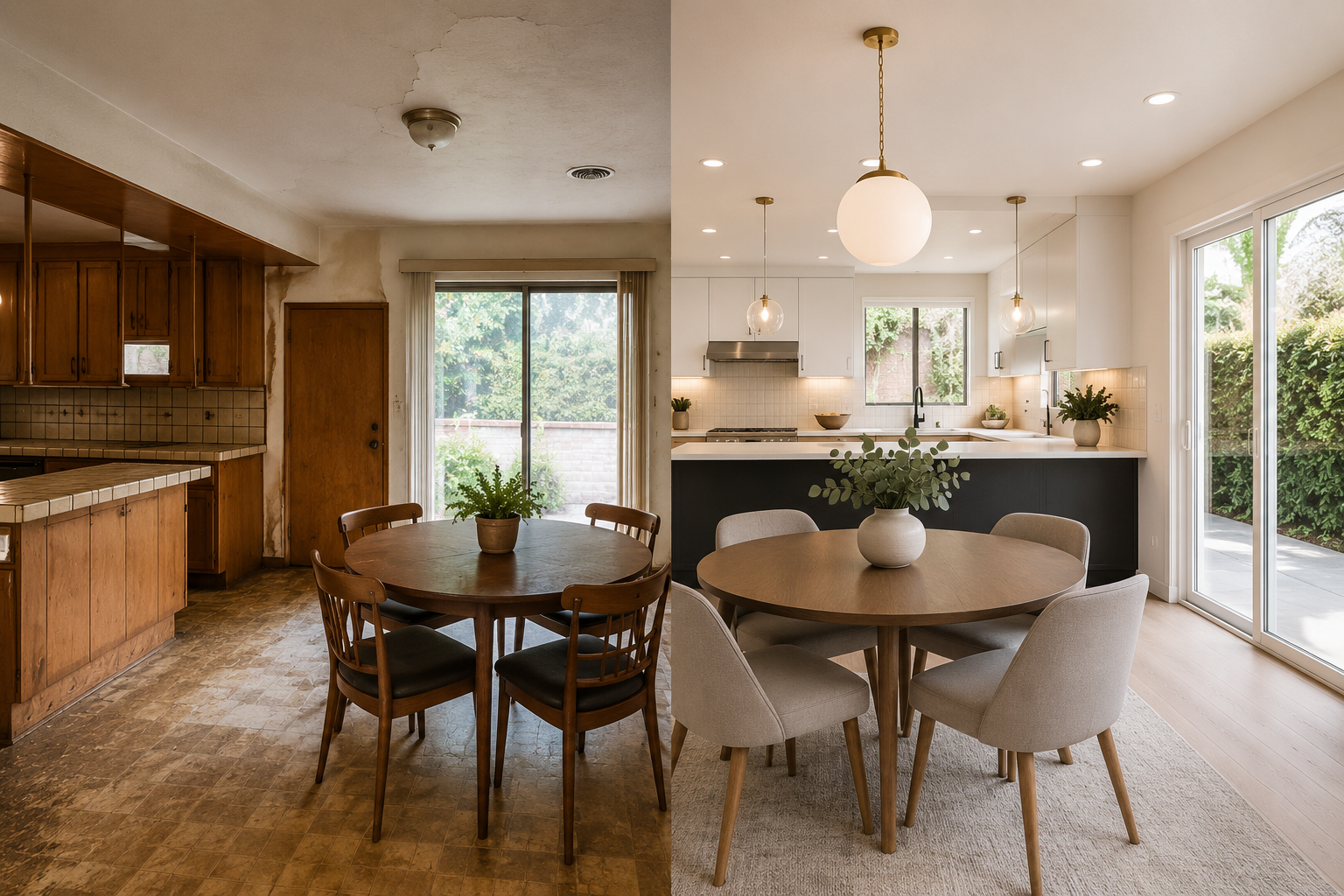 The Sherman Oaks pre-decision comp gap analysis — the sub-market-specific comparison that determines whether the as-is path (pricing to attract the investor and renovation-ready buyer efficiently) or the renovation path (executing the scope that captures the comp gap) produces better net proceeds for the specific Sherman Oaks home. At south-of-Ventura comp gaps of $300,000–$500,000+, correctly specified renovation consistently produces $150,000–$250,000 in additional net proceeds over the as-is alternative when the timeline and capital allow it.
The comp gap by Sherman Oaks sub-market:
North-of-Ventura 91403 (the volume tier):
The most active Sherman Oaks transaction sub-market — 3-bedroom homes north of Ventura Boulevard in the established 91403 residential grid.
- → 💰 Original condition baseline: $1.15M–$1.35M for a standard 3-bedroom in typical as-is condition
- → 💰 Renovated comp ceiling: $1.4M–$1.65M for comprehensively renovated to the correct Sherman Oaks north-of-Ventura specification
- → 📊 Comp gap: $180,000–$280,000 — the renovation margin available in this sub-market
- → 💡 Maximum improvement investment that pencils: $60,000–$110,000 for the focused scope that captures this gap without exceeding it
- → 📋 The as-is case in this sub-market: Given the 405/101 interchange proximity, north-of-Ventura Sherman Oaks as-is listings attract a consistent buyer pool — investors seeking BRRRR opportunities, renovation-ready owner-occupants, and spec-builders evaluating the teardown-rebuild potential of older homes. The location premium supports as-is sales at the correct price more reliably than comparable-quality but more remote SFV markets.
South-of-Ventura flatland 91403/91423 (the large-lot premium tier):
The south-of-Ventura Sherman Oaks sub-market — large lots, established pools, mature privacy landscaping, and the outdoor living proposition that defines Sherman Oaks's most specifically valuable residential product.
- → 💰 Original condition baseline: $1.45M–$1.85M for original-condition 4-bedroom on a 12,000–18,000 sq ft lot with pool
- → 💰 Renovated comp ceiling: $1.85M–$2.5M+ for comprehensively renovated to the south-of-Ventura Sherman Oaks specification
- → 📊 Comp gap: $300,000–$500,000+ — the widest renovation margin in the standard Sherman Oaks sub-market inventory
- → 💡 Maximum improvement investment: $100,000–$175,000 for the scope that reaches this ceiling
- → ✅ The renovation case in this sub-market: The $300,000–$500,000+ comp gap produces one of the strongest renovation ROI cases in the SFV when correctly executed. A focused $120,000–$145,000 renovation scope producing $350,000 in comp ceiling recovery generates $180,000–$220,000 in net improvement — among the best improvement economics available in the PEP coverage area.
North-of-Mulholland canyon-adjacent 91423 (the premium canyon tier):
The north-of-Mulholland sub-market — canyon-adjacent positions, views, larger lots, and the proximity to Mulholland Drive that produces Sherman Oaks's most distinctive and most individually variable luxury positions.
- → 💰 Original condition baseline: $1.55M–$2.2M — varies dramatically by view quality and lot position
- → 💰 Renovated comp ceiling: $2.0M–$3.2M+ — the widest range in any Sherman Oaks sub-market, reflecting the dramatic variation in view premium and lot character
- → 📊 Comp gap: $350,000–$600,000+ for the most premium positions — but requiring the most individualized comp analysis because the comparable sale set for canyon-adjacent positions is often thin (3–6 genuinely comparable closed sales in a 12-month period)
- → ⚠️ Special consideration: The north-of-Mulholland as-is versus renovation decision requires a comp analysis that is more position-specific than any other Sherman Oaks sub-market — the view premium and lot character produce comp sets that may not support straightforward comp ceiling identification without specific position-by-position analysis.
2. ✅ When As-Is Is the Right Sherman Oaks Decision
The Sherman Oaks as-is sale is not a default chosen by sellers who couldn't prepare — it is a specifically correct strategy for Sherman Oaks sellers whose specific circumstances make it the better net proceeds path.
The circumstances that favor as-is in Sherman Oaks:
🚀 Timeline under 30 days:
A correctly priced Sherman Oaks as-is listing — priced at the original-condition comp floor for the specific sub-market — attracts a buyer pool that can close in 21–25 days: cash investors, pre-qualified renovation-ready buyers, and spec-builders who don't require the seller to complete any preparation. For sellers with genuine timeline constraints (estate sales with court approval deadlines, sellers who have already contracted on a replacement home, sellers managing a relocation with a specific departure date), the as-is path's speed advantage is real and frequently worth $50,000–$100,000 in reduced net proceeds.
🔧 Complex deferred maintenance that exceeds cosmetic scope:
Some Sherman Oaks homes — particularly the original-condition 1950s–1970s inventory in all three sub-markets — have deferred maintenance complexity that a cosmetic renovation scope cannot address without a full structural engagement: foundation issues, significant roof structure problems, extensive unpermitted work that requires disclosure and remediation, or pool equipment and deck conditions that require full replacement.
- → ✅ The as-is advantage for complex deferred maintenance: The investor buyer who purchases as-is at the correct price specifically prices in the complex deferred maintenance at their own renovation cost estimates — which are typically lower than what a seller would pay through a general contractor because investors have direct contractor relationships and renovation volume discounts. The seller who attempts to remediate complex deferred maintenance before listing often spends more per dollar of remediation than the investor would have discounted.
💰 Narrow comp gap (under $150,000):
In north-of-Ventura 91403 sub-neighborhoods where the as-is baseline is already approaching the renovated comp ceiling — the smaller, lower-condition homes where even a fully renovated product has limited upside — the comp gap may be $100,000–$150,000. At that gap, a $70,000–$90,000 focused renovation scope produces limited net improvement after renovation cost and carrying costs. The as-is sale at the correct price and the renovation sale at the correct price may produce comparable net outcomes — in which case the as-is path is simpler, faster, and lower-risk.
🔑 The 405/101 location premium:
Sherman Oaks's specific location advantage — the 405/101 interchange proximity that makes it the most Westside-accessible of all SFV markets — produces a location-motivated buyer pool that is specifically less condition-sensitive than buyers in more remote SFV markets. An original-condition Sherman Oaks 91403 home that is correctly priced relative to as-is comps will attract buyers who are specifically purchasing for the location and who are willing to absorb the renovation as a known, priced-in condition of the purchase.
How to execute the as-is sale correctly in Sherman Oaks:
- → ✅ Price to the as-is comp floor, not the midpoint: The as-is pricing mistake in Sherman Oaks is pricing above the original-condition comp floor hoping to find a buyer who will "see the potential." The investor buyer who is actually motivated by the as-is discount understands the comp ceiling precisely and discounts from it systematically. Price to attract the motivated investor buyer immediately rather than accumulating DOM while waiting for a buyer who doesn't exist at the above-floor price.
- → ✅ Complete the pre-listing inspection and disclose fully: An as-is sale does not mean an uninspected sale. Order the pre-listing inspection, review the findings, and disclose all material conditions in the seller's disclosures. The as-is disclosure strategy — complete transparency, accurate pricing that accounts for known issues — produces faster and cleaner escrows than the as-is sale that withholds information and produces renegotiation demands mid-escrow.
- → ✅ Market the renovation opportunity explicitly: The Sherman Oaks as-is listing should describe the renovation opportunity, the comp ceiling for renovated product in the specific sub-neighborhood, and the renovation scope that the buyer would need to execute to reach that ceiling. This marketing gives the investor buyer the analysis they would have done themselves — saving them time and making the listing more competitive than comparable as-is listings that don't provide this context.
3. 🔨 When Renovation Is the Right Sherman Oaks Decision
The circumstances that favor renovation in Sherman Oaks are the mirror of the as-is circumstances — and in the south-of-Ventura and north-of-Mulholland sub-markets, they align sufficiently frequently that the correctly specified renovation is the right answer for the majority of sellers with timeline flexibility and renovation capital.
The circumstances that favor renovation in Sherman Oaks:
📊 Large comp gap that supports the investment:
At south-of-Ventura comp gaps of $300,000–$500,000+ and north-of-Mulholland gaps of $350,000–$600,000+, the renovation math consistently supports a focused scope of $100,000–$175,000 that produces $200,000–$350,000 in net improvement over the as-is alternative. This is the most basic and most important renovation trigger: when the comp gap is large enough that a correctly sized renovation scope produces meaningful positive net improvement.
📅 Timeline of 8–14 weeks available:
The correctly executed Sherman Oaks renovation requires:
- → Pre-listing inspection (week 1): identifies deferred maintenance before cosmetic investment begins
- → Deferred maintenance remediation if needed (weeks 2–4): HVAC, roofing, electrical if required
- → Kitchen renovation (weeks 3–8): the critical Sherman Oaks renovation investment
- → Primary bath renovation (weeks 4–9): the secondary room that determines owner-occupant offer behavior
- → Flooring and paint (weeks 6–10): the visual continuity improvements
- → Curb appeal package (weeks 8–11): the photography-ready exterior
- → Professional staging and photography (week 12): the marketing preparation
- → MLS launch (week 13–14)
Sellers with 8–14 weeks of timeline before their required move-out date have the renovation path available. Sellers with fewer than 6 weeks do not.
The correct Sherman Oaks renovation specification:
The Sherman Oaks renovation specification that reaches the renovated comp ceiling is market-position-specific:
North-of-Ventura 91403 specification:
- → ✅ Semi-custom to custom cabinetry in white or warm wood tone (not stock; not painted original)
- → ✅ Premium quartz countertops (natural stone acceptable but not required to reach the comp ceiling)
- → ✅ Professional-adjacent appliances (Thermador, Bosch) — not consumer-grade, not Wolf/Sub-Zero (which exceeds the north-of-Ventura ceiling)
- → ✅ Wide-plank LVP or engineered hardwood (6.5-inch minimum, warm wood tone)
- → ✅ Interior repaint warm white throughout
- → ✅ Primary bath: frameless shower enclosure, updated vanity, new fixtures, large-format tile
- → ✅ Curb appeal package
- → 💰 Total north-of-Ventura scope: $70,000–$110,000
South-of-Ventura 91403/91423 specification:
- → ✅ Custom cabinetry — the step above semi-custom that the south-of-Ventura Sherman Oaks buyer expects at $1.8M–$2.4M
- → ✅ Natural stone or premium quartz — Calacatta-look quartzite or equivalent
- → ✅ Professional-grade appliances — Wolf range acceptable at $2.0M+; Thermador at $1.75M
- → ✅ Wide-plank white oak flooring (7-inch minimum) throughout main floor
- → ✅ Primary bath to the south-of-Ventura specification: frameless enclosure or soaking tub, large-format tile, designer fixtures, heated floors at $2.0M+
- → ✅ Outdoor entertaining space update: hardscape refresh, outdoor dining structure where lot supports it
- → ✅ Full exterior and curb appeal
- → 💰 Total south-of-Ventura scope: $110,000–$175,000
4. ❌ The Partial Renovation — The Sherman Oaks Seller's Most Costly Mistake
The partial renovation — the most common and most costly as-is versus fix-it-up error in Sherman Oaks — occurs when a seller updates some but not all of the critical improvement categories, producing a home that occupies the uncomfortable middle ground between the as-is investor product and the renovated owner-occupant product.
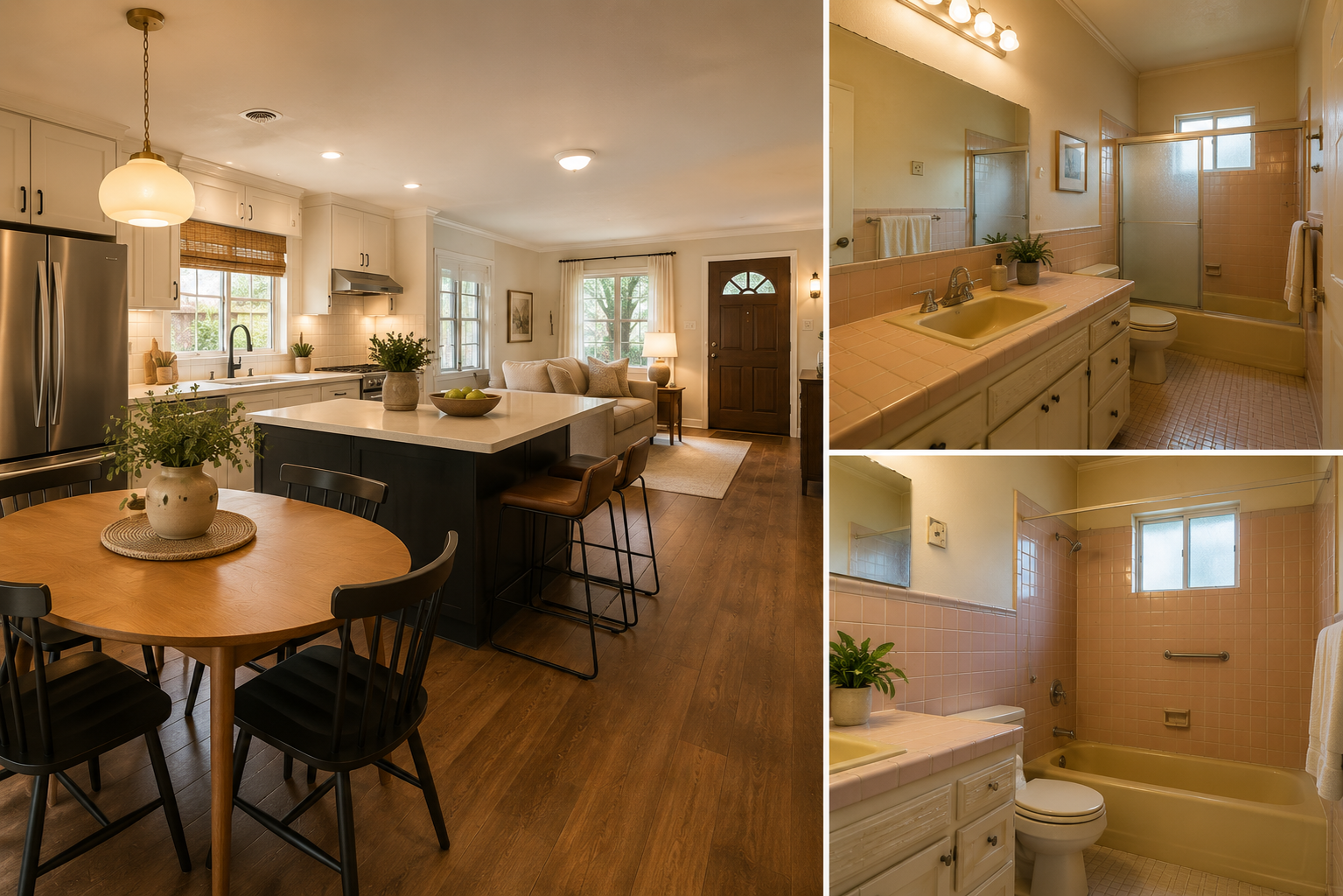 The Sherman Oaks partial renovation trap — the updated kitchen with original bathrooms, the new floors with dated paint, the curb appeal package without the interior update. The partially renovated Sherman Oaks home is priced above the as-is investor baseline (eliminating the investor buyer who needs the full discount to execute their renovation math) and below the renovated comp ceiling (falling short of the specification the owner-occupant buyer expects at $1.6M–$2.0M). It produces more DOM, lower final prices, and more frustration than either correctly executed alternative.
The three most common Sherman Oaks partial renovation patterns:
Pattern 1 — The updated kitchen with original bathrooms:
The Sherman Oaks seller who renovates the kitchen to a good specification but leaves the primary bath untouched has created the most common partial renovation trap in this market. At $1.6M–$2.0M in Sherman Oaks, the buyer who has toured 25 homes has a specific reference set for what a renovated kitchen with a dated bathroom means: "We love the kitchen. We'd need to do the bathrooms — probably $45,000–$65,000. Can we discount accordingly?"
The buyer's discount request for an original primary bath at the Sherman Oaks premium tier is $40,000–$70,000. The seller who could have spent $35,000–$45,000 on a focused primary bath renovation during the preparation period receives a negotiated discount of $50,000–$65,000 post-offer — spending more on the discount than the renovation would have cost and losing 3–4 weeks of escrow negotiation time in the process.
Pattern 2 — The new floors with dated paint:
The Sherman Oaks seller who installs new wide-plank flooring without repainting the interior has improved one visual element while leaving the dated paint — original colors, worn trim, dated ceiling — as the most immediately visible feature of every room. The floor-paint sequence matters: paint before flooring, always. But the seller who installs flooring first and then doesn't budget for paint has a home that photographs inconsistently — the beautiful new floors in rooms with dated olive-green walls from 1988.
Pattern 3 — The curb appeal package without the interior update:
The reverse partial renovation — a beautifully updated exterior (new door, fresh paint, updated landscaping, excellent listing photography) that brings buyers in the door to discover an original-condition interior. The showing feedback from this pattern is specific and consistent: "The exterior brought us in. We were surprised by the inside." The buyer who expected interior quality commensurate with the exterior presentation immediately recalibrates their offer price downward.
The financial consequence of the partial renovation:
At a south-of-Ventura Sherman Oaks 91403 home where the correct comp gap is $380,000:
As-is path (correctly executed):
- → As-is price: $1.55M
- → No preparation cost
- → Close price: $1.53M (modest negotiation)
- → Net proceeds after commission and closing: approximately $1.40M
Full renovation path (correctly executed):
- → Renovation cost: $130,000
- → Carrying costs (12 weeks): $22,000
- → Launch price: $2.05M
- → Close price: $1.99M
- → Net proceeds after commission, closing, renovation, carrying: approximately $1.75M
- → Net improvement over as-is: $350,000
Partial renovation path (updated kitchen only, $48,000):
- → Partial renovation cost: $48,000
- → Carrying costs (14 weeks — extended DOM from stranded pricing): $25,700
- → Launch price: $1.78M (above as-is, below renovated)
- → First-week feedback: "Love the kitchen. Disappointed by the bathrooms and the condition overall."
- → Day 35: price reduction to $1.69M
- → Day 52: accepted at $1.64M from buyer who used DOM as negotiating leverage
- → Net proceeds after commission, closing, partial renovation, carrying: approximately $1.47M
- → Net improvement over as-is: $70,000 — compared to the $350,000 improvement the full renovation would have produced, for an improvement of $282,000 less on $82,000 more in investment
The partial renovation at $48,000 produced $70,000 more than as-is — a net improvement of $22,000. The full renovation at $130,000 would have produced $350,000 more than as-is — a net improvement of $220,000 more per dollar invested. The partial renovation was not a compromise between two good options; it was the worst outcome of both options combined.
5. 🌟 The Location Premium Factor — What Sherman Oaks's Position Does to the As-Is Case
Sherman Oaks's specific geographic position — the 405/101 interchange, the best Ventura Boulevard access in the Valley, the entertainment industry community proximity, and the central SFV premium location — creates a buyer motivation layer that most SFV markets don't have at the same intensity: the location-first buyer.
The location-first buyer and the Sherman Oaks as-is sale:
The location-first buyer — the Westside professional who specifically needs the 405 access, the entertainment industry professional who is transitioning from a West Hollywood or Silver Lake rental and specifically wants the neighborhood's community density, the buyer who has been evaluating Sherman Oaks specifically because of The Galleria, the Ventura Boulevard lifestyle, and the 405/101 position — is specifically less condition-sensitive than the buyer for whom the neighborhood is one of several comparable alternatives.
This buyer will tour and offer on original-condition Sherman Oaks homes that they would pass over in Northridge, Granada Hills, or Reseda — because the location is so specifically what they want that the renovation project is an acceptable condition of access. The as-is Sherman Oaks listing that is correctly priced and is well-located relative to the specific access points that drive Sherman Oaks buyer motivation (Ventura Boulevard walkability, 405/101 proximity, the entertainment industry social fabric) has a more active as-is buyer pool than comparable as-is listings in markets without the same location intensity.
The implication for Sherman Oaks as-is pricing:
The location premium doesn't mean the as-is seller can price above the original-condition comp floor — the comp floor is the comp floor regardless of the buyer's motivation. What it means is that the time-to-offer at the correct as-is price is shorter in Sherman Oaks than in comparable-quality markets that don't have the same location intensity. A correctly priced as-is listing in north-of-Ventura Sherman Oaks 91403 should generate investor and renovation-ready buyer showing traffic in the first 10–14 days; a comparable as-is listing in Northridge 91324/91325 may take 18–28 days to generate equivalent interest.
The faster as-is absorption rate in Sherman Oaks compresses the carrying cost difference between the as-is and renovation paths — making the as-is path marginally more competitive here than in other markets where the as-is listing sits for 30–40 days before the correct buyer appears.
🚫 What NOT to Overdo
Don't attempt the partial renovation. The single most important Sherman Oaks seller guidance from this article: if you are going to renovate, commit to the complete scope that reaches the comp ceiling. If you cannot commit to the complete scope — because the budget isn't available, the timeline is insufficient, or the deferred maintenance complexity makes a full scope impractical — sell as-is at the correct price. The partial renovation produces the worst financial outcome in almost every Sherman Oaks as-is versus fix-it-up analysis, and the sellers who choose it almost always do so because they are trying to find a middle path that doesn't exist at the returns they expect.
Don't renovate above the Sherman Oaks sub-market ceiling. The south-of-Ventura Sherman Oaks renovation ceiling ($1.85M–$2.5M) is meaningful below Studio City's south-of-Ventura Carpenter-catchment ceiling ($2.1M–$3.5M+). A seller who renovates a south-of-Ventura Sherman Oaks home to the full Studio City specification — Wolf/Sub-Zero appliances, natural stone throughout, soaking tub wet room — at a cost of $170,000–$185,000 has invested $30,000–$45,000 above what the Sherman Oaks comp ceiling returns. The Thermador appliance package, the premium quartz countertop, and the frameless shower — all correct Sherman Oaks specification — produce 90–95% of the comp ceiling recovery at 65–70% of the Studio City specification cost.
Don't list as-is above the original-condition comp floor. The Sherman Oaks seller who lists as-is at $1.72M when the original-condition comp floor for their specific sub-neighborhood is $1.58M is not "leaving room for negotiation" — they are pricing above the investor buyer's acquisition threshold and will not attract the as-is buyer pool they need. The investor who would have offered $1.53M on a $1.58M as-is list price will not tour a $1.72M as-is listing. The seller accumulates DOM, reduces to $1.62M, and eventually accepts $1.52M from the investor who now uses 45 days of DOM as negotiating leverage — closing below where correct as-is pricing from day one would have landed.
Don't begin any renovation scope without the pre-listing inspection completed first. The Sherman Oaks seller who commits to a $120,000 south-of-Ventura renovation without first ordering a $550 inspection and discovering a $22,000 HVAC replacement requirement has changed the renovation math fundamentally — the $120,000 scope is now $142,000 before carrying costs. The inspection that precedes every renovation commitment is the most important single investment in any Sherman Oaks preparation sequence.
Don't use the location premium as a substitute for correct pricing. The 405/101 proximity and the Ventura Boulevard access that distinguish Sherman Oaks from more remote SFV markets are real buyer motivations that support as-is sales at the correct price. They do not support as-is sales at prices above the correct comp floor. The location-motivated buyer still has a comp set, still has a price ceiling for the condition tier, and still uses DOM as a negotiating tool when the list price doesn't reflect that ceiling.
🏠 Real-World Scenario — Sherman Oaks 91403
A seller in north-of-Ventura Sherman Oaks 91403 — a 3-bedroom, 1,650 sq ft, updated in patches over the years (kitchen refreshed in 2018 with semi-custom cabinets and quartz, primary bath untouched since 1975, new LVP installed in 2021 in the living room but original carpet in the bedrooms, exterior painted in 2022) — was evaluating their as-is versus renovation options before listing.
The home's condition was precisely the partial renovation trap pattern: several improvements completed at different times, producing a home that didn't read as "as-is original" (which would attract the investor buyer at the correct floor price) or as "fully renovated" (which would attract the owner-occupant at the renovated comp ceiling). It was stranded in the middle.
The comp analysis for their specific sub-neighborhood:
- → Original-condition closed sales (2 comps, last 90 days): $1.195M, $1.21M — as-is floor approximately $1.20M
- → Fully renovated closed sales (3 comps, last 90 days): $1.425M, $1.44M, $1.47M — renovated ceiling approximately $1.45M
- → Partially updated closed sales (1 comp): $1.31M — the "middle" outcome
Path analysis:
Path 1 — List as-is at the original-condition floor ($1.20M): The listing would price at or near the original-condition comps. The investor buyer pool is activated. Close expected at $1.18M–$1.21M. Net after commission and closing: approximately $1.08M.
Path 2 — List "as-is" at the partially-updated midpoint ($1.35M — where seller wanted to list): The investor buyer pool is not activated (price exceeds their acquisition threshold). The owner-occupant buyer pool tours and discovers the original primary bath, the bedroom carpet, and the uneven improvement quality. Likely outcome: accumulate 35–50 days of DOM, reduce to $1.28M–$1.30M, close in the low $1.27M range after DOM-leveraged negotiation. Net: approximately $1.16M — the worst outcome.
Path 3 — Execute the focused completion scope ($42,000) and list at the renovated ceiling: The seller's home needed: primary bath renovation (frameless shower, updated vanity, new fixtures, large-format tile: $28,000), bedroom carpet replacement with LVP to match existing living room ($8,500), interior repaint to unify the color palette ($6,500). Total: $43,000.
With the scope completed: the home reads as consistently updated throughout. List at $1.42M (approaching the renovated ceiling). First-week showing traffic from owner-occupants. Accepted at $1.39M at day 18. Carrying costs (8 weeks): $7,200. Net after commission, closing, renovation ($43,000), carrying ($7,200): approximately $1.26M.
The net proceeds comparison:
- → Path 1 (correct as-is): $1.08M
- → Path 2 (partial renovation / stranded pricing): $1.16M — the seller's default instinct
- → Path 3 (completion scope to renovated ceiling): $1.26M
The seller who had been instinctively reaching for Path 2 — the partially-updated midpoint price — would have produced $80,000 less than the $43,000 completion scope that moved the home from stranded condition to the renovated ceiling. The $43,000 renovation investment produced $180,000 in additional net proceeds over the as-is path and $100,000 more than the partial renovation default.
They executed Path 3. Accepted at $1.38M on day 21.
🏠 Real-World Scenario — Sherman Oaks 91403
A south-of-Ventura Sherman Oaks 91403 seller — a 4-bedroom, 2,400 sq ft original-condition home on a 15,500 sq ft lot with established pool, long-term owner of 27 years, estate sale administered by two siblings — was evaluating as-is versus renovation for a home they needed to sell within 90 days of probate court approval.
The timeline constraint made the full renovation path immediately relevant: at 90 days from probate approval, a 12-week full renovation scope would leave essentially no marketing time before the deadline. A 6–8 week focused scope was potentially achievable.
The comp analysis:
- → Original-condition south-of-Ventura comps (3 comps, 4-bedroom comparable lot size, 90 days): $1.62M, $1.68M, $1.71M — as-is floor approximately $1.67M
- → Renovated comp ceiling (4-bedroom, comparable lot, 90 days): $2.14M, $2.21M, $2.28M — renovated ceiling approximately $2.21M
- → Comp gap: approximately $540,000
Path analysis under timeline constraint:
Path 1 — As-is at the original-condition floor ($1.65M): Investor buyer pool activated immediately. Expected close: $1.60M–$1.67M. Timeline: 30 days to close. Within the 90-day window. Net: approximately $1.47M.
Path 2 — Focused 7-week scope ($95,000) and list at partial renovation ceiling: Kitchen: semi-custom cabinets, quartz, professional appliances (not Wolf — timeline doesn't allow custom order): $68,000. Interior repaint: $12,000. Curb appeal: $9,000. Staging: $6,000. Total: $95,000. Timeline: 7 weeks preparation + 3 weeks on market + 21 days close = 73 days total. Within the 90-day window, but tight.
The focused scope produces a home that is updated kitchen, fresh paint, and appealing exterior but with original primary bath. This is the partial renovation pattern — does it avoid the trap in this specific case?
At the south-of-Ventura tier, the partially updated comp (kitchen only, no bath) was the one that closed at $1.31M in the north-of-Ventura analysis but produces a different result in south-of-Ventura where the comp gap is larger: partially updated south-of-Ventura comparable: $1.89M (one comp found). The $1.89M outcome versus the $1.65M as-is is a $240,000 improvement on $95,000 investment — a $145,000 net improvement over as-is. Better than as-is but not a stranded-pricing disaster.
The south-of-Ventura as-is-versus-partial analysis produces a different result from north-of-Ventura because the comp gap is large enough that even a partial renovation captures meaningful comp ceiling recovery — unlike north-of-Ventura where the narrower gap makes partial renovation less economically defensible.
Path 3 — Full renovation (impossible at this timeline): A $140,000 full renovation scope would require 12–14 weeks — exceeding the probate timeline.
Recommendation: Path 2 (the focused 7-week scope) — accepting the partial renovation limitation specifically because the south-of-Ventura comp gap is large enough to justify even the partial investment, the timeline specifically prevents the full scope, and the risk of stranded pricing is lower at this price tier than at north-of-Ventura.
They executed the focused scope in 7.5 weeks. Listed at $1.92M. Accepted at $1.875M on day 24. Carrying costs (10 weeks): $19,000. Net after commission, closing, renovation, carrying: approximately $1.66M — $190,000 more than the as-is alternative would have produced.
The south-of-Ventura comp gap is large enough that even a correctly understood partial renovation — one that the seller approached with clear eyes about what it would and wouldn't produce — generated meaningful net improvement over as-is. The difference from north-of-Ventura is the gap size: $540,000 versus $220,000.
❓ FAQ
Should I sell my Sherman Oaks home as-is or renovate before selling? The correct answer is sub-market and condition specific. For south-of-Ventura Sherman Oaks 91403/91423 with comp gaps of $300,000–$500,000+, a correctly specified renovation scope of $100,000–$175,000 consistently produces $150,000–$250,000 in net improvement over the as-is alternative — making renovation the clearly better path when timeline and capital allow. For north-of-Ventura 91403 with narrower comp gaps of $180,000–$280,000, the renovation case is less automatic — the focused scope of $70,000–$110,000 still typically produces positive net improvement, but the margin is tighter and the timeline sensitivity higher. For any Sherman Oaks home in any condition: avoid the partial renovation, which produces the worst outcome in almost every analysis.
What repairs should I make before selling in Sherman Oaks? The highest-return improvements in Sherman Oaks by sub-market: ✓ North-of-Ventura: Professional interior repaint ($11,000–$16,000), LVP flooring unification ($12,000–$18,000), kitchen cosmetics ($30,000–$55,000), primary bath refresh ($20,000–$35,000), curb appeal ($6,000–$12,000). ✓ South-of-Ventura: Custom kitchen renovation ($65,000–$110,000), primary bath renovation ($35,000–$60,000), wide-plank white oak flooring ($20,000–$32,000), outdoor entertaining space update ($15,000–$35,000), interior repaint and curb appeal. The pre-listing inspection is the non-negotiable first investment regardless of which scope follows.
How much can I get for a fixer-upper in Sherman Oaks? The as-is market in Sherman Oaks is specifically active due to the location premium — the 405/101 interchange proximity, the Ventura Boulevard lifestyle access, and the entertainment industry community character create a consistent investor and renovation-ready buyer pool. Original-condition north-of-Ventura 91403 homes typically close at $1.15M–$1.35M. Original-condition south-of-Ventura 91403/91423 homes with large lots and pools typically close at $1.45M–$1.85M. The specific price depends on sub-neighborhood, bedroom count, lot size, and the specific deferred maintenance conditions revealed at inspection.
How long does it take to prepare a Sherman Oaks home for sale? A complete focused renovation scope for Sherman Oaks takes 10–14 weeks from pre-listing inspection through MLS launch. The critical path: inspection (week 1) → deferred maintenance remediation if needed (weeks 2–4) → kitchen renovation (weeks 3–8) → primary bath (weeks 4–9) → flooring and paint (weeks 6–10) → curb appeal and exterior (weeks 8–11) → staging and photography (week 12) → pre-marketing and MLS launch (weeks 13–14). Sellers with fewer than 8 weeks of available timeline should evaluate whether the as-is path produces better net proceeds given the timeline constraint.
Is there demand for fixer-uppers in Sherman Oaks? Yes — specifically more demand for correctly priced as-is Sherman Oaks homes than for comparable-quality as-is inventory in more remote SFV markets. The 405/101 location, the Ventura Boulevard lifestyle, and the entertainment industry community proximity create a buyer pool that is specifically motivated by the Sherman Oaks location and willing to undertake renovation as the price of access. Correctly priced as-is listings in north-of-Ventura Sherman Oaks 91403 typically generate investor showing activity within 10–15 days; south-of-Ventura correctly priced as-is listings generate investor and renovation-ready owner-occupant showing activity within 12–20 days.
What is the biggest mistake Sherman Oaks sellers make when deciding to fix up or sell as-is? The partial renovation — updating some but not all of the critical improvement categories (typically updating the kitchen but leaving the primary bath, or installing new flooring without repainting, or improving the exterior without addressing the interior). The partial renovation produces a home that is priced above the as-is investor floor (eliminating the motivated cash buyer) and below the renovated comp ceiling (falling short of the specification the owner-occupant buyer expects). It consistently produces more DOM, lower final prices relative to investment, and more seller frustration than either correctly executed alternative.
🎯 Bottom Line
The Sherman Oaks as-is versus fix-it-up decision resolves differently across the three sub-markets — and always resolves into one of two correct answers: a correctly priced as-is sale that attracts the location-motivated investor or renovation-ready buyer efficiently, or a correctly specified renovation that captures the comp gap without exceeding the ceiling. The incorrect answer is always the partial renovation — the middle path that produces a home stranded between the investor's required discount and the owner-occupant's required specification, generating more DOM, more price reductions, and less net proceeds than either alternative.
Sherman Oaks's specific location premium — the 405/101 interchange, the Ventura Boulevard lifestyle access, the entertainment industry community — makes the as-is path more viable here than in most SFV markets. It doesn't make an overpriced as-is listing viable. The as-is path that works in Sherman Oaks is the one that prices to the original-condition comp floor, discloses fully, and markets the renovation opportunity explicitly to the buyer who is already motivated by the location and who will pay the correct price for an as-is product at the correct price.
At Parkway Estate Properties, Liana's seller representation across Sherman Oaks 91403/91423, Studio City 91604/91602, Encino 91316/91436, Tarzana 91356, and Northridge 91324/91325, combined with Roman's hands-on renovation experience across dozens of SFV properties, means every Sherman Oaks as-is versus fix-it-up conversation is grounded in the sub-market-specific comp gap analysis, the correct renovation specification for each Sherman Oaks tier, and the net proceeds comparison that produces the highest-return decision for each specific seller's situation.
📩 Want a Personalized As-Is vs. Renovation Analysis for Your Sherman Oaks Home?
We'll run the sub-neighborhood comp gap analysis, identify the correct renovation scope and specification if the renovation path is right, and give you the honest net proceeds comparison — before you've committed to any preparation dollar or signed any listing agreement.
Contact Liana Shersher at Parkway Estate Properties: 📧 liana@parkwayestate.com · 📞 (818) 208-5881 · 🌐 parkwayestate.com 15021 Ventura Blvd., Ste. 510, Sherman Oaks, CA 91403
About the Authors
Liana Shersher is a licensed real estate agent with Parkway Estate Properties Inc. and an Accredited Buyer's Representative (ABR) serving the San Fernando Valley — with a focus on Sherman Oaks, Encino, Tarzana, Woodland Hills, and Northridge (DRE# 02164224). Liana guides first-time homebuyers through every step of the purchase, from the first showing to the keys in hand, and represents move-up and repeat buyers across the Valley. For sellers, she builds the pricing and marketing strategy that positions a home to sell for top dollar, fast. Buyers and sellers work with Liana for clear communication, sharp local knowledge, and an agent who treats their goals like her own.
Roman Shersher is the broker-owner of Parkway Estate Properties Inc. and a real estate investor with 18 years of experience in the San Fernando Valley (DRE# 01855095). Roman has personally led or co-led renovations on dozens of properties across the Valley, including recent projects in Northridge (91324) and Woodland Hills (91364). That hands-on renovation and investment experience shapes every pricing conversation and days-on-market strategy at Parkway — sellers get a realistic read on what improvements actually return at resale, and buyers get an expert eye on a home's true condition and upside.
Parkway Estate Properties, Inc. · 15021 Ventura Blvd., Ste. 510, Sherman Oaks, CA 91403 · (818) 208-5881 · parkwayestate.com · Broker License #: 01873092 Equal Housing Opportunity. Information herein is general and not legal, tax, or financial advice. Consult qualified professionals for your specific situation.
Categories
Recent Posts











Broker | Realtor ® License ID: 01873092
+1(818) 208-5881 | info@parkwayestate.com