
How Do Seller-Paid Rate Buydowns Work in Tarzana?
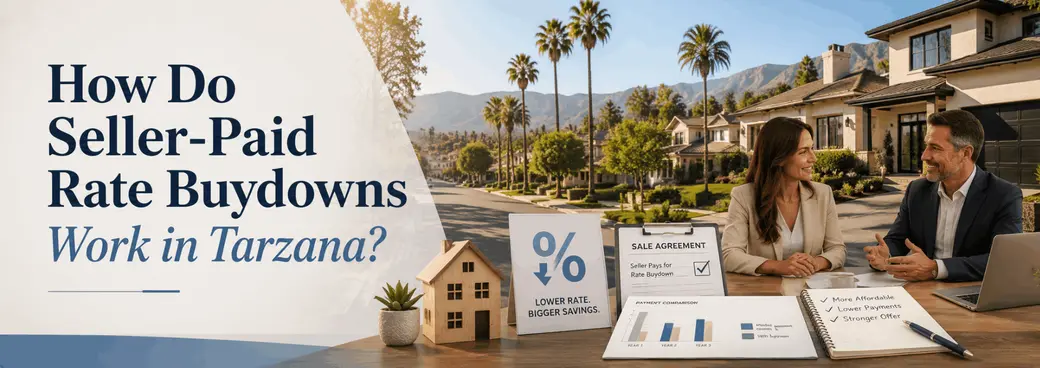
Tarzana sits at a specific price point in the San Fernando Valley — the $850K–$1.4M range where buyers are genuinely rate-sensitive, where the difference between a 7.0% mortgage payment and a 5.0% first-year payment is $600–$1,100 per month, and where that monthly difference frequently determines whether a qualified buyer stretches to your asking price or pulls back to something more conservative.
Seller-paid rate buydowns are not a new concept — they have existed in real estate finance for decades. What is new in Tarzana in 2026 is how consistently effective they have become as a selling tool for sellers in the $900K–$1.3M range who are competing against other listings in a buyer pool that is more payment-conscious than any Tarzana market in recent memory. This article explains exactly how they work, what they cost the seller, what they deliver for the buyer, and why the math consistently justifies the investment in the Tarzana market specifically.
1. 📋 The Mechanics — How a Seller-Paid Rate Buydown Actually Works
Before evaluating whether a buydown makes sense for your Tarzana 91356 home, you need to understand the mechanics precisely — because the buydown is one of the most misunderstood tools in residential real estate, and sellers who have heard the concept but haven't seen the numbers frequently have incorrect assumptions about what they're actually committing to.
 The seller-paid rate buydown in Tarzana 91356 is most powerful when deployed proactively — advertised in the listing marketing before buyers make their first visit — because it changes the buyer's payment calculation at the moment they're deciding whether to schedule a showing, not after they've already eliminated the listing based on payment concerns.
The 2-1 Buydown Structure — the most common Tarzana format:
A 2-1 buydown works as follows:
Step 1 — The seller contributes funds at closing: The seller deposits a specific dollar amount into an escrow account at closing — this is the buydown cost. The funds stay in escrow and are applied to the buyer's monthly mortgage payment during the buydown period.
Step 2 — The buyer's effective rate is reduced for the first two years:
- → 🕐 Year 1: Buyer's effective rate is reduced by 2% below the note rate. On a 7.0% note rate loan, the year-one effective rate is 5.0%.
- → 🕑 Year 2: Buyer's effective rate is reduced by 1% below the note rate. On a 7.0% note rate loan, the year-two effective rate is 6.0%.
- → 🕒 Year 3 and beyond: The loan returns to the full note rate — 7.0%. The buydown period is complete.
Step 3 — The buydown cost is calculated: The buydown cost equals the sum of the monthly payment differences across the two-year period. This is not a rough estimate — it is a precise calculation based on the specific loan amount, note rate, and buydown structure.
The buydown calculation for a $1.1M Tarzana 91356 sale with 20% down:
- → Loan amount: $880,000
- → Note rate: 7.0%
- → Full-rate monthly P&I: $5,858/month
- → Year-one payment at 5.0% effective rate: $4,723/month — savings of $1,135/month
- → Year-two payment at 6.0% effective rate: $5,278/month — savings of $580/month
- → Total buydown cost: ($1,135 × 12) + ($580 × 12) = $13,620 + $6,960 = $20,580
The buydown calculation for a $950K Tarzana 91356 sale with 20% down:
- → Loan amount: $760,000
- → Note rate: 7.0%
- → Full-rate monthly P&I: $5,059/month
- → Year-one payment at 5.0%: $4,083/month — savings of $976/month
- → Year-two payment at 6.0%: $4,559/month — savings of $500/month
- → Total buydown cost: ($976 × 12) + ($500 × 12) = $11,712 + $6,000 = $17,712
How the funds flow:
The seller's buydown contribution flows through escrow — it is a closing cost contribution, not a cash payment made at any other point in the transaction. From the seller's perspective, it reduces net proceeds at close by the buydown amount. From the buyer's perspective, it reduces their monthly payment in year one and year two without any change to the loan amount, the purchase price, or the down payment.
2. 💵 The Price Reduction Comparison — Why the Buydown Wins in Tarzana
The seller who is considering how to move their listing — facing 25–35 days of DOM in Tarzana without an offer — has two primary tools: a price reduction or a seller-paid buydown. Understanding why the buydown consistently outperforms the price reduction for Tarzana buyers in the $900K–$1.3M range is the most important piece of financial analysis in this article.
The math comparison on a $1.1M Tarzana listing:
Option A — $15,000 price reduction (to $1,085,000):
- → New loan amount at 20% down: $868,000
- → Monthly P&I at 7.0%: $5,779/month
- → Monthly savings vs. original: $79/month
- → Total savings over 30-year loan: approximately $28,440
- → Buyer's perceived benefit: "The seller came down $15,000 — but my payment only dropped $79/month."
Option B — $15,000 seller-paid 2-1 buydown (price stays at $1,100,000):
- → Year-one monthly P&I at 5.0%: $4,723/month
- → Year-one monthly savings vs. full rate: $1,135/month
- → Total two-year buyer savings: approximately $20,580
- → Buyer's perceived benefit: "My payment drops $1,135/month in year one."
The comparison:
Same $15,000 cost to the seller. The price reduction delivers $79/month in payment relief. The buydown delivers $1,135/month in year-one payment relief. The buydown delivers 14x more monthly payment impact per seller dollar in year one.
Why monthly payment impact dominates the Tarzana buyer decision:
Tarzana buyers in the $900K–$1.3M range are predominantly:
- → 👨👩👧 Move-up families from Reseda 91335 and Canoga Park 91304: These buyers are bringing prior equity to the transaction but are stretching on income to reach the Tarzana price level. They are genuinely payment-constrained — the monthly number they can sustain is more binding than the purchase price ceiling.
- → 🏠 First-time buyers at maximum budget: Households whose $175,000–$210,000 combined income puts them at or near the top of their comfortable monthly payment range. For these buyers, $1,135/month in year-one relief means they don't need a co-borrower, they don't need to reduce their target price, and they can qualify for the home they want.
- → 🌊 Westside relocators who can't quite reach Encino 91316: Buyers whose budget reaches Tarzana 91356 but falls short of Encino 91316 south-of-Ventura — who are payment-sensitive because they're already at the top of their range.
For all three profiles, the $1,135/month in year-one payment relief is not a nice-to-have — it is often the difference between "we can make this work" and "we need to look at something lower."
3. 🎯 The Tarzana Market Context — Why Buydowns Work So Well Here
The seller-paid rate buydown works well in many markets, but it works particularly well in Tarzana 91356 for specific reasons that are worth understanding if you're a Tarzana seller evaluating whether to deploy it.
 Tarzana 91356's $850K–$1.3M buyer pool is among the most rate-sensitive in the PEP SFV coverage area — the move-up families, maximum-budget first-time buyers, and Westside relocators who define Tarzana demand are all operating near their monthly payment ceiling, making the $700–$1,100/month relief a 2-1 buydown delivers more impactful here than in lower-rate-sensitivity markets.
The Tarzana buyer pool rate sensitivity:
Rate sensitivity is highest when buyers are operating near their income qualification ceiling — when the monthly payment difference between 5.0% and 7.0% is the difference between qualifying and not qualifying, or between a sustainable monthly obligation and a stretched one. Tarzana's $850K–$1.3M buyer pool is, on average, closer to this ceiling than Encino 91316 buyers (who have more financial depth at comparable price points) or Northridge 91324/91325 buyers (who are at a lower absolute price point where the dollar impact is smaller).
The competitive inventory dynamic:
Tarzana 91356's active listing inventory in the $900K–$1.3M range typically includes:
- → Listings at the price ceiling without seller concessions
- → Listings with extended DOM that have accumulated buyer leverage
- → New listings that may or may not have proactive buydown marketing
A Tarzana seller who proactively advertises a seller-paid 2-1 buydown in their listing marketing is immediately differentiated from the other available inventory — the buyer who has been filtering Tarzana listings based on payment calculations will route toward the buydown listing first because it changes their payment math before they've invested the time and emotional energy of a showing.
The DOM trigger pattern in Tarzana:
Most Tarzana sellers discover the buydown tool after 25–35 days of DOM without an offer — using it reactively as a price reduction alternative once buyer feedback confirms the payment concern. This reactive deployment works — but produces meaningfully weaker outcomes than proactive deployment.
The proactive Tarzana buydown strategy:
- → List with the buydown advertised from day one
- → The listing marketing reads: "Seller offering 2-1 rate buydown — effective rate as low as 5.0% in year one. Ask agent for details."
- → This message changes the showing request calculation for payment-sensitive buyers before they've eliminated the listing
The reactive Tarzana buydown strategy:
- → List without buydown marketing
- → Accumulate 25–30 days of DOM and showing feedback confirming payment concerns
- → Add buydown to the listing at day 30 as a concession offer
Both strategies produce buydown-related offers eventually. The proactive strategy produces them in week two. The reactive strategy produces them in week five — after $12,000–$18,000 in additional carrying costs have accumulated.
4. 📊 The Seller's Net Proceeds Calculation — Does the Buydown Actually Pay?
The central question for every Tarzana seller evaluating a buydown is not "does the buydown help buyers" — it does, clearly. The question is: does the buydown improve my net proceeds relative to the alternatives? The answer, in the Tarzana market, is almost always yes — but the math is worth running explicitly.
Scenario A — Overpriced launch at $1.15M, no buydown, 55-day DOM:
A Tarzana 91356 seller lists at $1.15M based on aspirational pricing. Correct market range: $1.08M–$1.12M. Buyer feedback through showing agents: "pricing feels above market, payment is high."
Day 30: Price reduction to $1.10M. Days 30–55: offers begin. Accepted at $1.09M.
Net calculation:
- → Gross sale: $1,090,000
- → Commission (5.5%): -$59,950
- → Closing costs: -$15,000
- → Carrying costs (55 days at $7,500/month): -$13,750
- → Pre-sale preparation: -$55,000
- → Mortgage payoff: -$680,000
- → Net proceeds: approximately $266,300
Scenario B — Correctly priced at $1.10M with proactive 2-1 buydown:
Same home, same seller, same $680,000 mortgage. Correctly priced at $1.10M with a $17,000 seller-paid 2-1 buydown advertised in listing marketing from day one.
Day 12: Multiple showing inquiries from payment-sensitive buyers drawn by the buydown marketing. Day 18: Offer at $1.095M. Counter-accepted at $1.10M.
Net calculation:
- → Gross sale: $1,100,000
- → Commission (5.5%): -$60,500
- → Closing costs: -$15,000
- → Buydown cost: -$17,000
- → Carrying costs (22 days at $7,500/month): -$5,500
- → Pre-sale preparation: -$55,000
- → Mortgage payoff: -$680,000
- → Net proceeds: approximately $267,000
The comparison: The correctly priced listing with the proactive buydown produced approximately the same net proceeds as the overpriced listing with the forced price reduction — in 22 days instead of 55, with $8,250 in carrying cost savings that were almost exactly offset by the $17,000 buydown cost minus the $9,000 higher gross sale price. The buyer got $17,000 in payment relief. The seller got a clean 22-day transaction without the stress, buyer leverage accumulation, and carrying cost drain of the overpriced strategy.
Where the buydown clearly wins:
The buydown outperforms the price reduction most clearly when the seller is correctly priced and simply needs to activate a rate-sensitive buyer pool that is present but hesitating on payment concerns. In this scenario:
- → Seller doesn't reduce price (maintains $1.10M versus a $1.085M reduction alternative)
- → Seller pays $17,000 in buydown
- → Seller receives full list price rather than a reduced price
- → Net advantage of buydown over price reduction: the $15,000 price gap minus the $17,000 buydown cost = approximately -$2,000 net on the purchase price, but with the clean transaction, shorter DOM, and preserved carrying costs that make the net outcome favorable
5. 🔧 How to Structure the Buydown Request — Mechanics for Tarzana Sellers
Understanding the buydown concept is useful. Understanding how to structure it correctly — in the listing marketing, in the listing agreement, and in the purchase contract — is what makes it executable.
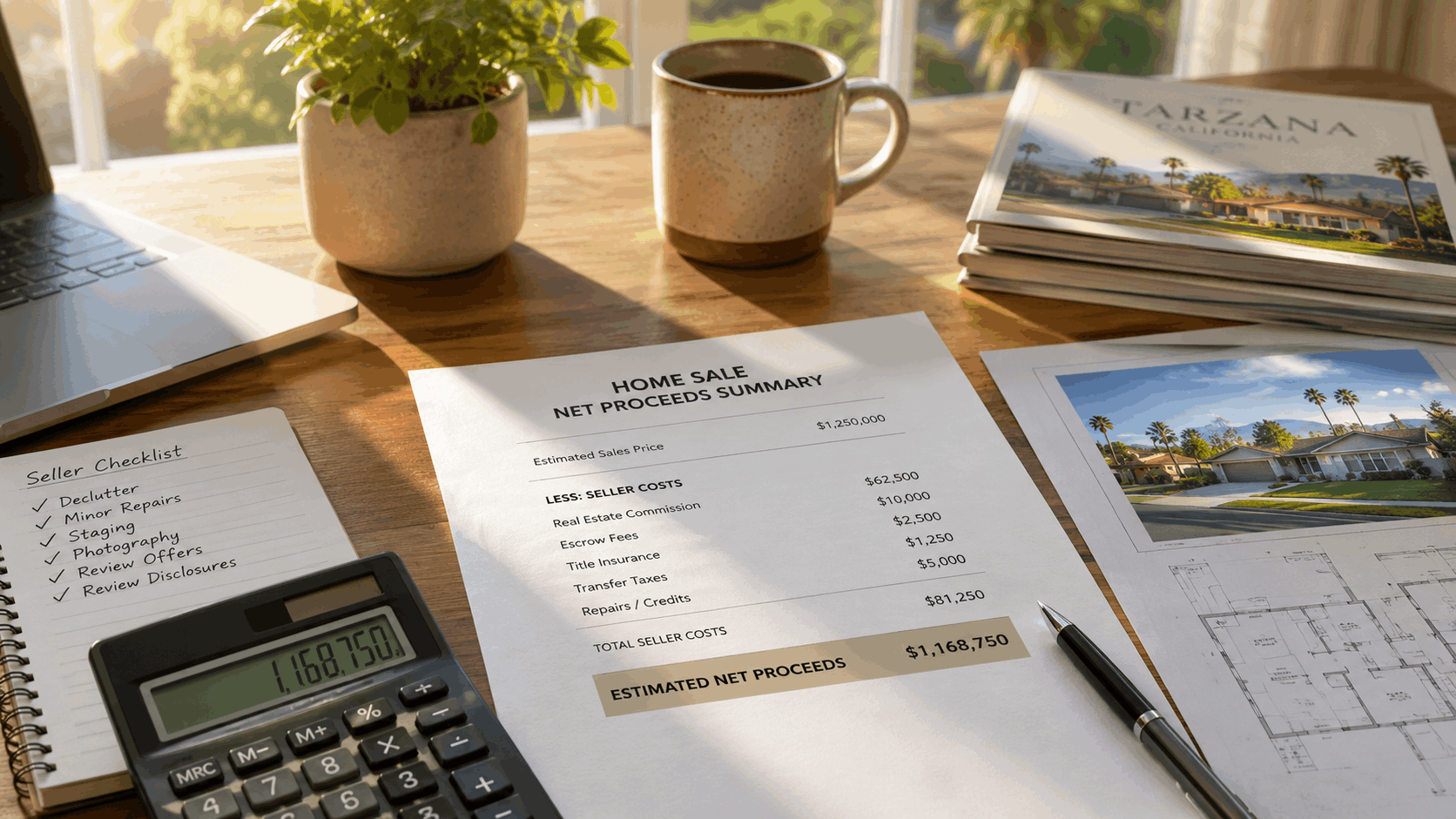 The proactive buydown decision in Tarzana is a listing strategy conversation — made before the home goes on market, integrated into the listing marketing from day one, and structured correctly in the purchase contract so the funds flow cleanly through escrow.
The listing marketing language:
When advertising a seller-paid buydown in Tarzana listing marketing, the language should be:
- → ✅ Accurate and specific: "Seller offering up to $[amount] toward buyer closing costs including rate buydown. Ask agent for details."
- → ✅ Or the payment-focused version: "Seller offering 2-1 rate buydown — buyer's effective rate as low as 5.0% in year one at [list price] with [down payment]."
- → ❌ Avoid vague language: "Seller may offer concessions" — this communicates willingness to negotiate from a position of weakness rather than a proactive value-add
The contract language:
In the purchase contract, the seller-paid buydown is structured as:
"Seller to contribute $[amount] toward buyer's closing costs and/or loan buydown costs."
The specific amount is determined by your lender's buydown calculation for the buyer's specific loan — which varies slightly based on rate environment, loan amount, and buydown structure. The buyer's agent and lender calculate the exact buydown cost; the seller agrees to fund it up to the stated maximum.
The lender qualification question:
Different lenders treat buydowns differently for qualification purposes:
- → ✅ Lenders who qualify at the buydown rate: Some loan products allow lenders to qualify the buyer at the year-one reduced rate (5.0%) rather than the note rate (7.0%). This meaningfully expands the qualifying buyer pool — buyers who can't technically qualify at 7.0% may qualify at 5.0%.
- → ⚠️ Lenders who qualify at the note rate: Other products require qualification at the full 7.0% note rate regardless of the buydown. In this case, the buydown helps with payment sustainability but doesn't change technical qualification.
- → 📋 Confirm with the buyer's lender: Sellers should ask their agent to confirm the buyer's lender's buydown qualification treatment early in the offer acceptance process — the qualification treatment affects which buyers are most effectively served by the buydown structure.
The 1-0 buydown alternative:
For sellers whose budget for the contribution is more limited, a 1-0 buydown — reducing the effective rate by 1% in year one only — costs approximately half the 2-1 buydown while still delivering meaningful first-year payment relief:
On a $1.0M Tarzana purchase with 20% down ($800K loan at 7.0%):
- → 1-0 buydown year-one savings: $504/month
- → 1-0 buydown total cost: approximately $6,048
- → 2-1 buydown year-one savings: $1,008/month (plus $504/month year two)
- → 2-1 buydown total cost: approximately $15,000
For Tarzana sellers at the $850K–$950K price point where the full 2-1 buydown cost runs $14,000–$18,000 and where margins are tighter, the 1-0 buydown at $6,000–$8,000 provides meaningful buyer benefit at a more accessible seller cost.
🚫 What NOT to Overdo
Don't deploy the buydown as a substitute for correct pricing. A seller-paid buydown on an overpriced Tarzana listing attracts buyer attention but not buyer offers — because buyers can calculate that the payment relief doesn't compensate for a price that is $60,000–$80,000 above market. The buydown works when the price is defensible and the payment is the barrier; it doesn't work when the price itself is the barrier. Correct pricing is the foundation. The buydown is the accelerant.
Don't wait until 30 days of DOM to offer the buydown. The reactive buydown — offered after the listing has accumulated showing feedback confirming payment concerns — works, but costs the seller 30+ days of carrying costs that the proactive buydown avoids. At a Tarzana monthly carrying cost of $6,500–$8,500/month, a 30-day delay in deploying the buydown costs approximately $6,500–$8,500 in additional carrying costs — significantly more than the marginal psychological advantage of starting negotiations without the buydown disclosed.
Don't confuse the buydown contribution cap with the actual buydown cost. Some Tarzana sellers advertise a buydown contribution cap that is lower than the actual cost of the buydown structure they're promising. If you advertise "2-1 rate buydown available" but your maximum contribution is $8,000 on a $1.1M loan where the actual 2-1 buydown costs $20,580, you are creating a marketing message that will disappoint buyers when they calculate the actual available relief. Know the exact buydown cost for your loan amount before advertising a specific structure.
Don't assume the buydown eliminates the need for pre-sale preparation. The buydown attracts payment-sensitive buyers to your listing — but they still need to be converted by the showing experience. A Tarzana home with an attractive buydown offer and dated, unprepared presentation will generate showing traffic and lose offers to better-prepared competing listings. The buydown and the pre-sale preparation work together; neither substitutes for the other.
Don't offer the buydown on a listing with significant undisclosed deferred maintenance. The buydown-attracted Tarzana buyer who enters the inspection contingency and discovers $35,000 in deferred HVAC, roof, and electrical issues is not going to absorb those costs on top of a purchase price their income barely supports. The deferred maintenance will kill the transaction — and you'll have paid for the buydown (or structured a contract that collapses) without closing. Disclose known issues before listing; address the highest-priority ones if the budget allows.
🏠 Real-World Scenario — Tarzana 91356
A seller in Tarzana 91356 had been on market 28 days at $1.095M — 11 showings, zero offers, consistent agent feedback: "buyers love the home, the payment feels high for the area." The seller's mortgage balance was $590,000. Monthly carrying cost: approximately $7,200.
We were brought in for a pricing and strategy consultation. Our analysis: the home was priced correctly — the $1.08M–$1.11M range was defensible for the condition and sub-neighborhood. The barrier was not price but payment — Tarzana 91356 buyers in this range were payment-sensitive and the 7.0% rate environment was compressing their qualifying room.
We recommended two changes: add a proactive 2-1 buydown at $16,800 to the listing marketing, and refresh the listing with new photography that showed the recently landscaped front yard that hadn't been photographed for the original listing.
Day 29 relaunch with buydown marketing and new photography. Within the first week: 7 new showings — 5 from buyers who had previously seen the listing and returned when the buydown marketing appeared. Three offers by day 38. Accepted at $1.097M with the $16,800 buydown included.
Net to seller: $1,097,000 gross - $60,335 commission (5.5%) - $14,000 closing costs - $16,800 buydown - $43,200 carrying costs (38 days × $7,200/day rate equivalent) - $590,000 mortgage payoff = approximately $372,665.
Versus continuing without the buydown at the original strategy — projecting a likely 60-day total DOM, $15,000 price reduction to $1.08M, and close at $1.075M:
$1,075,000 gross - $59,125 commission - $14,000 closing costs - $0 buydown - $72,000 carrying costs (60 days) - $590,000 mortgage = approximately $339,875.
The buydown strategy produced approximately $32,790 more in net proceeds than the continued-without-buydown trajectory — on a $16,800 buydown investment.
🏠 Real-World Scenario — Tarzana 91356
A different Tarzana 91356 seller was launching a newly renovated 3-bedroom home at $1.175M — a price that was at the top of the defensible range for their sub-neighborhood. They had invested $82,000 in the renovation and wanted to maximize net proceeds from the top-of-range launch.
We recommended a proactive 2-1 buydown at $18,500 as part of the launch marketing — the logic: at the top of the defensible range, the payment at 7.0% was going to be the primary buyer objection. The buydown was the tool that made the top-of-range price work for the buyer's monthly math.
Launch with buydown marketing on March 15. First week: 14 showings — the strongest first-week traffic on a comparable Tarzana listing in the preceding quarter. Three offers by day 10. Best offer: $1.19M with the $18,500 buydown accepted as a seller contribution.
The proactive buydown strategy produced a first-week multiple-offer outcome at the top of the defensible range — the outcome that correctly priced, well-prepared, proactively marketed listings consistently produce in Tarzana's spring window when the buyer pool is deepest.
Net to seller: $1,190,000 gross - $65,450 commission (5.5%) - $15,500 closing costs - $18,500 buydown - $7,500 carrying costs (14 days) - $620,000 mortgage payoff - $82,000 renovation = approximately $381,050 — meaningfully stronger than the as-is launch alternative would have produced.
❓ FAQ
What is a seller-paid rate buydown in Tarzana? A seller-paid rate buydown is a closing cost contribution from the seller that temporarily reduces the buyer's mortgage interest rate — lowering their monthly payment during the first one or two years of the loan. The most common structure in Tarzana 91356 is a 2-1 buydown: the buyer's effective rate is reduced by 2% in year one and 1% in year two, returning to the full note rate in year three. The seller funds the difference between the reduced payments and the full-rate payments through an escrow account at closing.
How much does a seller-paid buydown cost in Tarzana? The cost depends on the loan amount and the buydown structure. For common Tarzana price points: ✓ $850K sale (20% down, $680K loan, 7.0% rate, 2-1 buydown): approximately $14,200. ✓ $950K sale (20% down, $760K loan): approximately $15,900. ✓ $1.1M sale (20% down, $880K loan): approximately $18,400. ✓ $1.3M sale (20% down, $1.04M loan): approximately $21,700. These are estimates — your lender will calculate the exact buydown cost for your specific transaction.
Is a seller-paid buydown better than a price reduction in Tarzana? For most Tarzana 91356 sellers in the $900K–$1.3M range — yes, by a significant margin. A $15,000 price reduction delivers approximately $79–$100/month in payment savings at current rates. A $15,000 buydown contribution delivers $700–$1,135/month in year-one payment savings. Same seller cost, dramatically different buyer impact. The buydown wins because Tarzana's rate-sensitive buyer pool responds to monthly payment changes, not to small purchase price adjustments.
Does a seller-paid buydown affect the buyer's qualification? It depends on the lender and loan product. ✓ Some lenders qualify buyers at the buydown rate (5.0% in year one of a 2-1 buydown) — this meaningfully expands the qualifying buyer pool and is the most buyer-favorable treatment. ⚠️ Other lenders qualify at the note rate (7.0%) regardless of the buydown — in this case, the buydown improves payment sustainability but doesn't change technical qualification. Confirm the specific lender's treatment early in the offer evaluation process.
When should a Tarzana seller offer a buydown? ✅ Proactively at launch — the optimal timing. A buydown advertised in the listing marketing from day one attracts payment-sensitive buyers before they eliminate the listing based on payment calculations. ✅ Reactively after 20–30 days of DOM without offers — the standard corrective deployment when showing feedback confirms payment concerns as the barrier. ❌ Never as a substitute for correct pricing — the buydown works when the price is defensible and payment is the barrier; it doesn't overcome a price that is above market.
What happens to the buydown funds if the buyer refinances? If the buyer refinances within the two-year buydown period, the unused portion of the buydown funds typically reverts to the buyer — not the seller. This is a buyer benefit (they receive remaining funds at refinance) and is not a seller concern at the time of the original transaction.
How do I negotiate a buydown in a Tarzana offer? The standard approach: the offer letter includes language such as "Seller to contribute $[amount] toward buyer's closing costs including loan buydown costs." The specific amount matches the calculated cost of the buydown structure being requested. Your listing agent and the buyer's agent negotiate the contribution amount as part of the overall offer terms — it is most often accepted when the purchase price is at or near asking and the buydown is a concession offered in lieu of a price reduction.
🎯 Bottom Line
Seller-paid rate buydowns work exceptionally well in Tarzana 91356 because the neighborhood's $850K–$1.3M buyer pool is rate-sensitive in a way that makes monthly payment relief a more powerful offer generator than equivalent price reductions. The 2-1 buydown structure — reducing the buyer's effective rate by 2% in year one and 1% in year two — delivers $700–$1,100/month in first-year payment savings at common Tarzana price points, at a seller cost of $14,000–$22,000 that is consistently recouped through shorter DOM, cleaner transactions, and preserved purchase prices that price reductions would have eroded.
The two things that determine whether the buydown produces the outcome Tarzana sellers want: correct pricing as the foundation (the buydown activates a buyer pool for a correctly priced home — it doesn't rescue an overpriced one), and proactive deployment in the listing marketing from day one (not reactive deployment at day 30 after carrying costs have accumulated).
At Parkway Estate Properties, we structure seller-paid buydown strategies into Tarzana listing plans as a standard tool — not an occasional concession. Liana deploys them consistently across Tarzana 91356, Woodland Hills 91364/91367, Encino 91316/91436, Sherman Oaks 91403/91423, and Northridge 91324/91325 — and the results across the SFV consistently confirm that the buydown-plus-correct-pricing combination outperforms the price-reduction-only strategy for rate-sensitive buyer pools. Roman's market intelligence from the renovation and investment side of the business informs every carrying cost calculation and net proceeds analysis we bring to Tarzana seller conversations.
📩 Want to Know Whether a Seller-Paid Buydown Makes Sense for Your Tarzana Home?
We'll run the buydown math for your specific price point, calculate your net proceeds under buydown vs. price reduction scenarios, and tell you whether the proactive buydown strategy is the right tool for your listing — before you've committed to any approach.
Contact Liana Shersher at Parkway Estate Properties: 📧 liana@parkwayestate.com · 📞 (818) 208-5881 · 🌐 parkwayestate.com 15021 Ventura Blvd., Ste. 510, Sherman Oaks, CA 91403
About the Authors
Liana Shersher Liana Shersher is a licensed real estate agent with Parkway Estate Properties Inc. and an Accredited Buyer's Representative (ABR) serving the San Fernando Valley — with a focus on Sherman Oaks, Encino, Tarzana, Woodland Hills, and Northridge (DRE# 02164224). Liana guides first-time homebuyers through every step of the purchase, from the first showing to the keys in hand, and represents move-up and repeat buyers across the Valley. For sellers, she builds the pricing and marketing strategy that positions a home to sell for top dollar, fast. Buyers and sellers work with Liana for clear communication, sharp local knowledge, and an agent who treats their goals like her own.
Roman Shersher Roman Shersher is the broker-owner of Parkway Estate Properties Inc. and a real estate investor with 18 years of experience in the San Fernando Valley (DRE# 01855095). Roman has personally led or co-led renovations on dozens of properties across the Valley, including recent projects in Northridge (91324) and Woodland Hills (91364). That hands-on renovation and investment experience shapes every pricing conversation and days-on-market strategy at Parkway — sellers get a realistic read on what improvements actually return at resale, and buyers get an expert eye on a home's true condition and upside.
Parkway Estate Properties, Inc. 15021 Ventura Blvd., Ste. 510, Sherman Oaks, CA 91403 · (818) 208-5881 · parkwayestate.com · Broker License #: 01873092 Equal Housing Opportunity. Information herein is general and not legal, tax, or financial advice. Consult qualified professionals for your specific situation.
Categories
Recent Posts










Broker | Realtor ® License ID: 01873092
+1(818) 208-5881 | info@parkwayestate.com