
How Much Are Property Taxes in Calabasas?
Property taxes are one of the most consequential and most frequently miscalculated line items in a Calabasas home purchase — and the miscalculation almost always runs in the same direction: buyers who estimate their taxes based on the prior owner's bill and discover after closing that their actual tax obligation is significantly higher.
This article gives Calabasas buyers the complete property tax picture — how California's tax system works, what the actual effective rate is for a new purchase in Calabasas 91302 and 91372, what additional assessments and bond measures add to the base rate, how to calculate your specific tax obligation before making an offer, and the Proposition 13 dynamics that make California property taxes simultaneously one of the most misunderstood and most important financial variables in a Calabasas purchase.
1. 📚 How California Property Taxes Work — The Proposition 13 Foundation
California's property tax system operates under rules established by Proposition 13 — the 1978 ballot measure that fundamentally restructured how real property is assessed and taxed in the state. Understanding Proposition 13 is not optional background knowledge for a Calabasas buyer — it is the foundational framework that explains why the prior owner's property tax bill has essentially no relationship to what you will pay, and why California property taxes behave differently from nearly every other state.
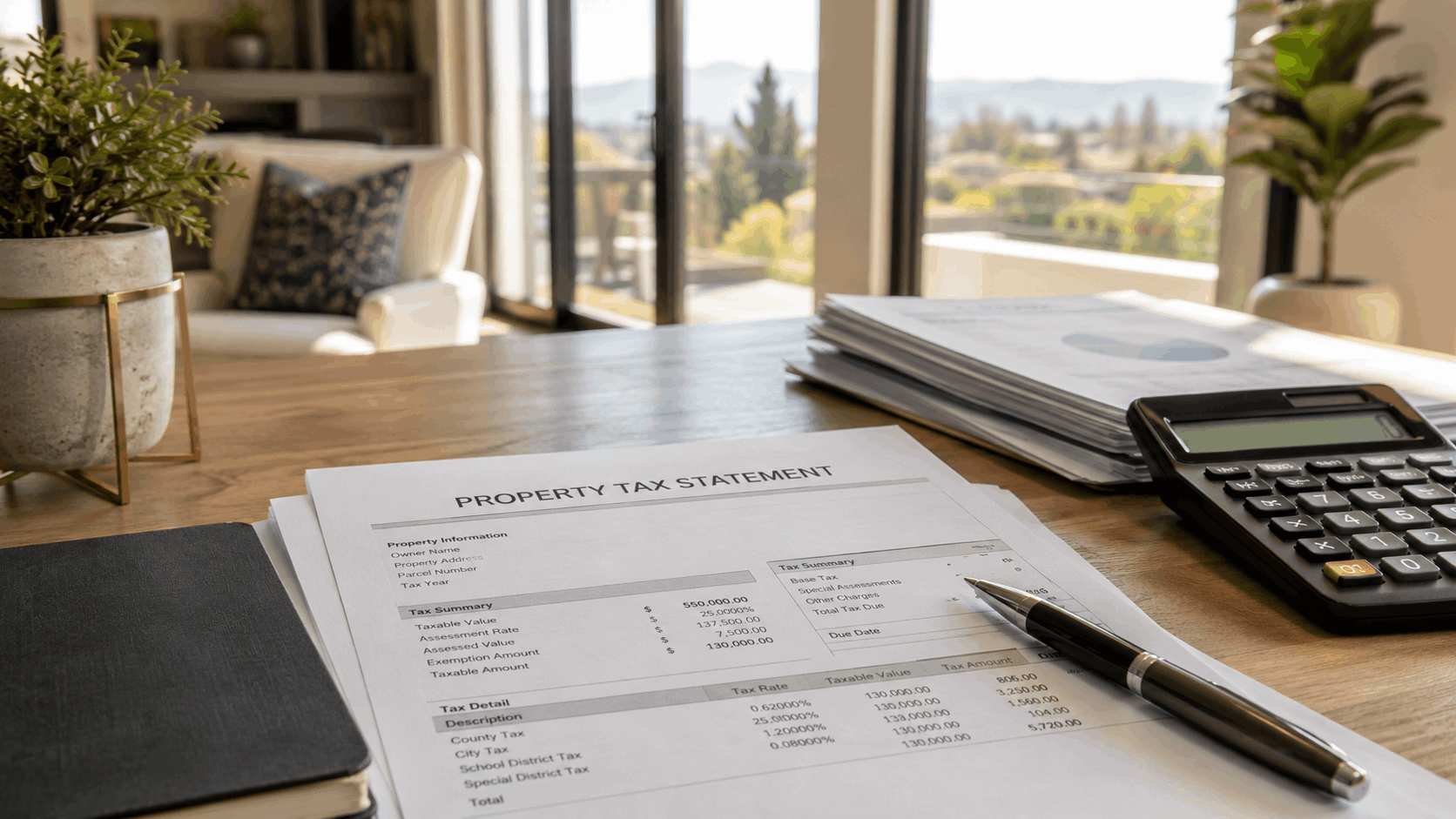 Property tax calculation in Calabasas 91302 and 91372 begins with one foundational rule: your assessed value is your purchase price, not the prior owner's assessed value. Proposition 13's reassessment-at-sale mechanism means every Calabasas buyer starts their tax obligation fresh — at full current market value.
The core Proposition 13 rules:
- → 📋 Assessment at purchase: When you buy a home in Calabasas 91302 or 91372, your property is reassessed to its full market value — which in practice means your purchase price. This becomes your new base assessed value for tax purposes.
- → 📈 Annual increase cap: After the initial assessment, Proposition 13 limits the annual increase in assessed value to a maximum of 2% per year — regardless of how fast actual market values are rising. This is the mechanism that produces the dramatic gap between current owners' tax bills (based on years or decades of capped 2% increases from a lower base) and new buyers' tax bills (based on full current market value).
- → 🔄 Reassessment triggers: The full market value reassessment is triggered by a "change in ownership" — which generally includes standard arm's-length sales. Certain transfers between spouses, parents and children, and grandparents and grandchildren may qualify for exclusion from reassessment under specific conditions — consult a tax professional for your specific situation.
- → 💰 Base tax rate: The base property tax rate in California is 1.0% of assessed value — set by Proposition 13 and applied uniformly across California, including Calabasas 91302 and 91372.
The Proposition 13 gap — why the prior owner's bill is irrelevant:
This is the most practically important Proposition 13 dynamic for Calabasas buyers to internalize. A Calabasas homeowner who purchased their home in 2005 for $1.1M has an assessed value in 2026 of approximately $1.1M × (1.02)^21 = approximately $1.63M — if they've received the maximum 2% annual increase every year. Their annual property tax on $1.63M assessed value at 1.25% effective rate is approximately $20,375/year.
You are buying that same home in 2026 for $2.3M. Your assessed value on day one: $2.3M. Your annual property tax at 1.25% effective rate: approximately $28,750/year. The prior owner's $20,375/year bill had essentially no predictive value for your actual tax obligation.
This gap is larger in Calabasas 91302 and 91372 — where long-term homeowners are particularly prevalent due to the LVUSD school quality keeping families in the neighborhood through their children's full K-12 years — than in higher-turnover markets. It is not uncommon to find Calabasas homes whose prior owners have assessed values 40–60% below the current purchase price, producing buyer tax obligations that are 40–60% higher than what a naive comparison to the prior bill would suggest.
2. 📊 The Effective Tax Rate in Calabasas — What You Actually Pay
 The 1.0% base rate established by Proposition 13 is not your total property tax obligation in Calabasas 91302 and 91372. The effective total rate — the percentage of your purchase price that you will actually pay annually in property taxes — is higher, reflecting additional voter-approved bond measures and special assessments that are levied on top of the base rate.
Components of the Calabasas effective tax rate:
🏛️ Base rate (Proposition 13): 1.0% of assessed value Applied uniformly across all Calabasas 91302 and 91372 properties.
🏫 Las Virgenes Unified School District bonds: LVUSD has passed multiple general obligation bond measures over the years to fund school facility improvements, technology upgrades, and capital projects. These bonds add to the property tax obligation for all Calabasas 91302 and 91372 properties within the LVUSD boundary — which is virtually the entire Calabasas residential area. The specific bond amounts vary by assessed value and bond measure status.
Bond contributions to the Calabasas effective rate: typically 0.03%–0.06% of assessed value annually, varying by specific bond measures currently in repayment.
🏘️ Los Angeles County special assessments: Various county-level assessments — including flood control, library, and other special district levies — add to the effective rate for Calabasas 91302 properties within LA County jurisdiction.
LA County assessment contribution: typically 0.04%–0.08% of assessed value annually.
🚒 Special district assessments: Calabasas 91302 properties may be subject to additional special district assessments — including fire protection district contributions that have become more relevant given the neighborhood's wildfire interface positioning.
Special district contribution: typically 0.02%–0.05% annually.
The effective rate calculation:
Adding the components above produces an effective total rate for most Calabasas 91302 and 91372 addresses of:
- → 1.0% (base) + 0.03–0.06% (LVUSD bonds) + 0.04–0.08% (county assessments) + 0.02–0.05% (special districts) = approximately 1.09%–1.19% effective rate
In practice, most Calabasas 91302 buyers budget 1.15%–1.25% of purchase price for annual property taxes — an estimate that is appropriate for most addresses but should be verified with a specific tax rate area analysis for your exact property before closing.
Annual and monthly tax by purchase price:
|
Purchase Price |
Effective Rate 1.15% |
Effective Rate 1.25% |
Monthly (at 1.20%) |
|
$1.4M |
$16,100/yr |
$17,500/yr |
$1,400/mo |
|
$1.6M |
$18,400/yr |
$20,000/yr |
$1,600/mo |
|
$1.8M |
$20,700/yr |
$22,500/yr |
$1,800/mo |
|
$2.0M |
$23,000/yr |
$25,000/yr |
$2,000/mo |
|
$2.5M |
$28,750/yr |
$31,250/yr |
$2,500/mo |
|
$3.0M |
$34,500/yr |
$37,500/yr |
$3,000/mo |
These are estimates for budgeting purposes. Verify the specific tax rate area rate for your exact Calabasas address through the LA County Assessor or your escrow officer.
3. 🏘️ HOA Fees — The Additional Obligation That Varies Dramatically in Calabasas
Property taxes are not the only recurring ownership obligation that varies significantly by Calabasas sub-neighborhood — HOA fees add a parallel monthly cost that can range from $0 to $800+/month depending on which Calabasas 91302 or 91372 community you purchase in.
 HOA fees in Calabasas 91302 and 91372 range from $0 in non-HOA sub-neighborhoods to $400–$800+/month in gated communities — a monthly cost variable that significantly affects the total carrying cost calculation and should be factored into buyer budgets alongside property taxes.
HOA landscape in Calabasas 91302 and 91372:
- → 🏡 Non-HOA sub-neighborhoods: Many Calabasas 91302 residential streets outside the formal gated community and planned unit development structures have no HOA — $0/month. The Las Virgenes Road corridor, portions of the Calabasas Country Club area streets, and various other 91302 sub-neighborhoods fall into this category. Verify HOA status for any specific property through the listing agent and/or title report.
- → 🏘️ Standard HOA communities: A meaningful share of Calabasas 91302 planned unit developments and age-restricted communities carry HOAs of $150–$350/month — covering common area maintenance, landscaping, and community infrastructure without the gate access infrastructure.
- → 🏰 Gated community HOAs (91372 and select 91302 communities): The gated communities of Calabasas — including Mountain Gate and communities adjacent to the Hidden Hills boundary in 91372 — carry HOA fees of $400–$800+/month that fund gate security staffing, guard services, common area infrastructure, and the private road and facility maintenance that defines the gated community experience.
The total carrying cost with HOA:
For a buyer purchasing a $1.8M home in a Calabasas 91372 gated community with a $550/month HOA:
- → Mortgage P&I (7.0%, $1.44M loan): approximately $9,581/month
- → Property taxes (1.20% annual rate): $1,800/month
- → HOA: $550/month
- → Homeowner's insurance: $450–$600/month
- → Maintenance reserve (1% annually): $1,500/month
- → Total monthly carrying cost: approximately $13,881–$14,031/month
The HOA adds $550/month — $6,600/year — to the carrying cost that a comparable non-HOA property in the same price range doesn't carry. This is a real cost that belongs in every Calabasas buyer's budget analysis, particularly for buyers who are at or near their maximum comfortable payment threshold.
4. 🔮 Supplemental Tax Bills — The Post-Closing Surprise That Catches Buyers Off Guard
This section covers the Calabasas property tax variable that most frequently produces genuine buyer surprise — and occasionally financial stress — in the months following close of escrow.
What is a supplemental tax bill?
When a property is sold in California, the county assessor reassesses the property to its new purchase price. The difference between the prior assessed value and the new purchase price is taxable — and the county collects this difference through a "supplemental tax bill" that is separate from the regular annual property tax bill.
How supplemental taxes work in Calabasas:
Assume you purchase a Calabasas 91302 home for $1.9M. The prior owner's assessed value was $1.1M (they purchased in 2008 and have received 2% annual increases since then).
- → New assessed value: $1.9M
- → Prior assessed value: $1.1M
- → Assessment increase: $800,000
- → Supplemental tax at 1.20% effective rate: $9,600 for the full year
- → Prorated for portion of tax year: Depending on when in the fiscal year (July 1 – June 30) the sale closes, the supplemental bill is prorated. A sale closing in October produces approximately 9 months of supplemental tax: $7,200.
Timing of supplemental bills:
Supplemental tax bills typically arrive 3–6 months after close of escrow — sometimes two separate bills if the sale straddles a fiscal year boundary. Many first-time California homebuyers and buyers relocating from other states are not expecting these bills and are not financially prepared for them. Building the anticipated supplemental tax amount into your post-closing financial planning — before you need it — is one of the most practical pieces of financial preparation our team provides to every Calabasas buyer.
How to estimate your supplemental tax obligation:
The formula: (Your purchase price - prior assessed value) × effective tax rate × proration factor = your supplemental tax obligation
Your escrow officer can provide the prior assessed value from the county records at the time of opening escrow — this is the most reliable source. LA County Assessor's website also provides current assessed values for any Calabasas property by APN (Assessor's Parcel Number).
5. 💡 Tax Planning Considerations — What Calabasas Buyers Should Know
Property taxes in Calabasas exist within a broader financial context — including federal and California state income tax deductions, Proposition 19 transfer considerations, and the specific financial planning implications of purchasing at Calabasas price points. This section provides directional information only — consult a licensed tax professional for advice specific to your situation.
 Property tax planning for a Calabasas purchase involves several considerations beyond the base rate calculation — including the state and federal deductibility of property taxes, supplemental tax budgeting, and Proposition 19 inheritance considerations for buyers with generational real estate planning needs.
Federal deductibility — the SALT cap:
Property taxes are deductible on federal income tax returns — but subject to the $10,000 State and Local Tax (SALT) deduction cap established by the 2017 Tax Cuts and Jobs Act. For Calabasas buyers whose annual property tax bill runs $17,000–$35,000, the SALT cap means the federal deduction available to them is $10,000 maximum — and only after accounting for state income taxes, which also count against the cap. In most cases, Calabasas buyers at these price points receive limited incremental federal tax benefit from their property tax payment beyond the capped deduction. Consult your tax advisor for the specific benefit applicable to your income and deduction situation.
California state deductibility:
California does not conform to the federal SALT cap — property taxes are fully deductible on California state income tax returns without the $10,000 cap. For high-income Calabasas buyers in the 13.3% California marginal rate bracket, the full state deductibility of a $25,000 annual property tax bill provides approximately $3,325 in state income tax savings — a meaningful but partial offset to the carrying cost.
Proposition 19 — Parent-Child Transfer Considerations:
Proposition 19 (passed November 2020) significantly changed the rules for transferring Proposition 13 assessed values between parents and children. Under current Proposition 19 rules, a parent can transfer their primary residence to a child, and the child can retain the parent's low assessed value only if the child uses the home as their primary residence — and only for the value that doesn't exceed the parent's assessed value plus $1M.
For Calabasas buyers who are receiving a family property transfer or who are parents considering future property transfers, Proposition 19 creates significant planning implications. The Proposition 13 benefit that was previously transferable more broadly between family members is now substantially more restricted. Consult an estate planning attorney with California real estate expertise before any parent-child property transfer involving Calabasas real estate.
Mello-Roos Districts:
Some California communities are subject to Mello-Roos Community Facilities Districts — special tax districts that levy additional property taxes to fund infrastructure improvements (schools, roads, utilities) in newer developments. Calabasas 91302 and 91372 contain some Mello-Roos district properties — typically in newer planned developments. A Mello-Roos assessment can add $1,500–$6,000+ annually to the property tax obligation and should be disclosed in the preliminary title report. Verify Mello-Roos status for any Calabasas property through the escrow and title process.
The NHD (Natural Hazard Disclosure) tax connection:
Calabasas' high-fire-risk designation creates a specific tax interaction: properties in State Responsibility Areas (SRA) for fire protection may be subject to a California Department of Forestry and Fire Protection (CAL FIRE) annual assessment — currently approximately $150/parcel for developed properties in SRA zones. Verify whether your specific Calabasas property falls within an SRA zone through the Natural Hazard Disclosure report that is standard in every California residential transaction.
🚫 What NOT to Overdo
Don't base your property tax estimate on the current tax bill shown on the listing or Zillow. The current tax bill reflects the prior owner's Proposition 13 assessed value — which may be dramatically lower than your purchase price. This is the most common and most consequential Calabasas property tax miscalculation. Always calculate your property tax based on your expected purchase price multiplied by the applicable effective tax rate — not on any figure derived from the current owner's tax obligation.
Don't forget to budget for supplemental tax bills post-closing. The supplemental tax bill — which arrives 3–6 months after close of escrow and covers the tax on the assessment increase from the prior assessed value to your purchase price — is not part of your regular monthly impound account in most loan structures. Budget for this separately and keep the funds liquid. A Calabasas buyer who purchases a home with a $700,000 assessment gap from the prior owner should have approximately $7,000–$9,000 in liquid funds available for the supplemental bill beyond their other post-closing reserves.
Don't assume all Calabasas 91302 and 91372 properties have the same effective tax rate. The effective rate varies by specific Tax Rate Area (TRA) — which is determined by the geographic location of the property and the specific bond measures and assessments applicable to that location. Properties in different Calabasas sub-neighborhoods may fall in different TRAs with meaningfully different effective rates. Request the specific TRA and effective rate for any Calabasas property you're seriously evaluating from your escrow officer or the LA County Assessor.
Don't overlook Mello-Roos when evaluating newer Calabasas developments. A Calabasas home in a newer planned development with a $4,000/year Mello-Roos assessment effectively has a higher carrying cost than a comparable older home without Mello-Roos — even if the stated property tax rate appears identical. Read the Natural Hazard Disclosure and preliminary title report carefully for any Mello-Roos or Community Facilities District notation.
Don't make property tax comparisons between Calabasas and other states without adjusting for the SALT deduction difference. Buyers relocating from Texas, Florida, or other states with different property tax systems frequently arrive with mental models built on very different tax rate structures. Texas, for example, has no state income tax but property tax rates of 1.8–2.5% or higher. California's 1.15%–1.25% effective rate in Calabasas appears lower — but the SALT cap limits federal deductibility in a way that affects the after-tax cost comparison. A tax advisor with multi-state experience can model the full after-tax carrying cost comparison for your specific situation.
🏠 Real-World Scenario — Calabasas 91302
A buyer couple relocating from New York State purchased a Calabasas 91302 home at $1.85M. They had budgeted for property taxes using the current tax bill visible on the MLS listing — approximately $14,200/year, which reflected the seller's 2009 purchase price assessed value after 15 years of 2% increases.
Three months after closing, they received a supplemental tax bill for $8,100 — the tax on the $675,000 assessment gap between the seller's assessed value and their purchase price, prorated for the remaining months of the tax fiscal year. They had not been warned about the supplemental bill, had not budgeted for it, and received it during a period when they had already spent significantly on post-closing home improvements.
The financial stress was entirely avoidable. Our standard Calabasas buyer preparation now includes a specific supplemental tax calculation before closing — we provide every buyer with an estimate of their expected supplemental bill, the timing of when to expect it, and a recommendation to keep the estimated funds in a dedicated savings account rather than incorporating them into the broader post-closing budget.
🏠 Real-World Scenario — Calabasas 91372
A buyer evaluating a Calabasas 91372 gated community property at $2.1M asked us to help her understand the full monthly carrying cost before making an offer. The listing showed a current monthly tax impound figure that reflected the prior owner's assessed value.
We ran the complete carrying cost analysis for her specific situation:
- → Property tax at 1.22% effective rate on $2.1M purchase price: $25,620/year = $2,135/month
- → HOA (gated community): $625/month
- → Homeowner's insurance (wildfire-risk zone specialist carrier): $510/month
- → Mortgage P&I (7.0%, $1.68M loan at 20% down): $11,180/month
- → Maintenance reserve (1%): $1,750/month
- → Total monthly carrying cost: $16,200/month
The buyer's initial monthly budget assumption — based on the mortgage payment plus the prior owner's tax impound figure — had been approximately $13,400/month. The accurate figure was $16,200/month — a $2,800/month gap that materially affected her decision about whether to purchase at this specific price point.
She ultimately purchased in Calabasas 91302 at $1.75M in a non-gated sub-neighborhood, with no HOA and a lower property tax obligation — a total monthly carrying cost of approximately $13,100/month that was sustainable within her comfortable budget ceiling. The detailed carrying cost analysis before the offer, not after, was what made that outcome possible.
❓ FAQ
What is the property tax rate in Calabasas, California? The base property tax rate in Calabasas is 1.0% of assessed value — set by California's Proposition 13 and applied uniformly across all properties. The effective total rate, including voter-approved bond measures and special assessments, typically runs 1.15%–1.25% for most Calabasas 91302 and 91372 addresses. The exact rate for your specific property is determined by its Tax Rate Area (TRA) — verify through the LA County Assessor or your escrow officer during the purchase process.
How are property taxes calculated in Calabasas? Your Calabasas property tax is calculated as: (Your purchase price) × (effective tax rate for your specific Tax Rate Area). The purchase price becomes your new assessed value at close of escrow under Proposition 13's reassessment-at-sale rules. Annual increases in assessed value are capped at 2% per year until the next change in ownership. The prior owner's assessed value and tax bill have essentially no relationship to your tax obligation.
Do Calabasas property taxes include HOA fees? No — HOA fees are separate from property taxes and are paid directly to the homeowners association, not to the county. Both are recurring ownership costs that belong in your monthly budget, but they are independent obligations. Some Calabasas 91302 sub-neighborhoods have no HOA; others have HOAs ranging from $150/month to $800+/month for gated communities in 91372.
What is a supplemental property tax bill in California? A supplemental tax bill is issued by the county assessor when a property is sold and reassessed to the new purchase price. It covers the tax on the difference between the prior assessed value and your purchase price — prorated for the remaining months of the tax fiscal year at the time of purchase. Supplemental bills arrive 3–6 months after closing and are separate from your regular annual tax bill and your mortgage impound account in most cases. Budget for this separately based on the assessment gap between the prior owner's assessed value and your purchase price.
Are property taxes deductible in California? ✓ California: Fully deductible on California state income tax returns — no state-level cap. ⚠️ Federal: Deductible but subject to the $10,000 SALT cap that includes both state income taxes and property taxes combined. For most Calabasas buyers whose annual property tax bill exceeds $10,000 — which is virtually all buyers given Calabasas price points — the federal deduction benefit is capped at $10,000 total (combined with state income taxes). Consult a tax professional for the specific benefit applicable to your income and deduction situation.
How do Calabasas property taxes compare to other SFV cities? The base Proposition 13 rate (1.0%) applies uniformly across all California cities including Calabasas, Sherman Oaks, Woodland Hills 91364, Tarzana 91356, and Northridge 91324. The effective total rate varies by Tax Rate Area — driven by local bond measures and assessments — but generally falls in the 1.10%–1.25% range across most SFV cities. The primary difference in annual property tax obligation between a Calabasas buyer and a Sherman Oaks buyer is simply the purchase price — a $2.0M Calabasas home produces a higher annual tax than a $1.4M Sherman Oaks home at the same effective rate, because Calabasas commands a higher price point.
What is Mello-Roos and does it apply in Calabasas? Mello-Roos Community Facilities Districts are special tax districts that levy additional property taxes to fund infrastructure in newer developments. Some Calabasas 91302 and 91372 properties — particularly in newer planned developments — are subject to Mello-Roos assessments that can add $1,500–$6,000+/year to property tax obligations. Not all Calabasas properties have Mello-Roos — it is property-specific. Check the Natural Hazard Disclosure and preliminary title report for any Mello-Roos notation on properties you're evaluating.
🎯 Bottom Line
Property taxes in Calabasas are not complicated — but they are frequently miscalculated, and the miscalculations are almost always expensive. The base rate is 1.0% under Proposition 13. The effective total rate runs 1.15%–1.25% for most Calabasas 91302 and 91372 addresses. Your assessed value is your purchase price — not the prior owner's bill, not the Zestimate, not any number that exists in the current public record before your sale closes.
The practical preparation for a Calabasas buyer is straightforward: multiply your expected purchase price by 1.20% to get a reliable annual property tax estimate, divide by 12 for your monthly obligation, add HOA fees appropriate to your target sub-neighborhood, and budget separately for the supplemental tax bill that will arrive 3–6 months after closing. That complete carrying cost stack — mortgage, taxes, HOA, insurance, maintenance — is the financial picture that should govern your search ceiling and your offer decisions.
The LVUSD bond component of your Calabasas property tax is also worth understanding not as a cost to minimize but as a feature to appreciate — every dollar of school bond assessment is a direct investment in the school quality that is the primary driver of Calabasas' persistent price premium over adjacent SFV markets. You are not paying taxes despite the school quality. You are partly paying for it.
At Parkway Estate Properties, we provide every Calabasas buyer with a complete carrying cost analysis — including property tax estimation, HOA verification, insurance cost range, and supplemental tax projection — before they make an offer. Liana's ABR training and her specific experience with buyers across Calabasas 91302/91372, Woodland Hills 91364/91367, Sherman Oaks 91403/91423, and Tarzana 91356 means every buyer we work with enters their purchase decision with accurate financial information, not assumptions that become surprises after closing.
📩 Want a Complete Carrying Cost Analysis for Your Target Calabasas Home?
Tell us your price point and target sub-neighborhood — we'll calculate the complete monthly ownership cost including accurate property tax estimates, HOA verification, and supplemental tax projection before you make any offer.
Contact Liana Shersher at Parkway Estate Properties: 📧 liana@parkwayestate.com · 📞 (818) 208-5881 · 🌐 parkwayestate.com 15021 Ventura Blvd., Ste. 510, Sherman Oaks, CA 91403
About the Authors
Liana Shersher Liana Shersher is a licensed real estate agent with Parkway Estate Properties Inc. and an Accredited Buyer's Representative (ABR) serving the San Fernando Valley — with a focus on Sherman Oaks, Encino, Tarzana, Woodland Hills, and Northridge (DRE# 02164224). Liana guides first-time homebuyers through every step of the purchase, from the first showing to the keys in hand, and represents move-up and repeat buyers across the Valley. For sellers, she builds the pricing and marketing strategy that positions a home to sell for top dollar, fast. Buyers and sellers work with Liana for clear communication, sharp local knowledge, and an agent who treats their goals like her own.
Roman Shersher Roman Shersher is the broker-owner of Parkway Estate Properties Inc. and a real estate investor with 18 years of experience in the San Fernando Valley (DRE# 01855095). Roman has personally led or co-led renovations on dozens of properties across the Valley, including recent projects in Northridge (91324) and Woodland Hills (91364). That hands-on renovation and investment experience shapes every pricing conversation and days-on-market strategy at Parkway — sellers get a realistic read on what improvements actually return at resale, and buyers get an expert eye on a home's true condition and upside.
Parkway Estate Properties, Inc. 15021 Ventura Blvd., Ste. 510, Sherman Oaks, CA 91403 · (818) 208-5881 · parkwayestate.com · Broker License #: 01873092 Equal Housing Opportunity. Information herein is general and not legal, tax, or financial advice. Consult qualified professionals for your specific situation.
Categories
Recent Posts










Broker | Realtor ® License ID: 01873092
+1(818) 208-5881 | info@parkwayestate.com