
Is Now a Good Time to Buy a Home in Calabasas?

The honest answer to "is now a good time to buy in Calabasas?" depends on which Calabasas you're asking about — because 91302 and 91372 in 2026 contain two meaningfully different markets operating under different rules. The $1.3M–$1.7M core flatland tier is holding firm with limited negotiating room and consistent buyer competition anchored by Las Virgenes Unified School District demand. The $1.8M–$2.5M+ premium and hillside tier is sitting with extended days on market, motivated sellers, and genuine negotiating leverage that hasn't been available in this market since before the 2021–2022 peak.
Both of those statements are true simultaneously, which is why a generic yes-or-no answer fails Calabasas buyers more than it helps them. This article gives you the specific factors that determine whether now is the right time for your situation — the rate environment, the inventory reality by price tier, the LVUSD demand durability that makes Calabasas behave differently than purely discretionary luxury markets, and the honest framework for deciding whether to act now or wait.
1. 📊 The Two-Speed Calabasas Market — Why the Answer Depends on Price Tier
The single most important thing to understand before deciding whether now is the right time to buy in Calabasas is that there isn't one Calabasas market in 2026 — there are two, operating under different supply-demand dynamics, and the right answer to "should I buy now" is almost entirely a function of which one you're shopping in.
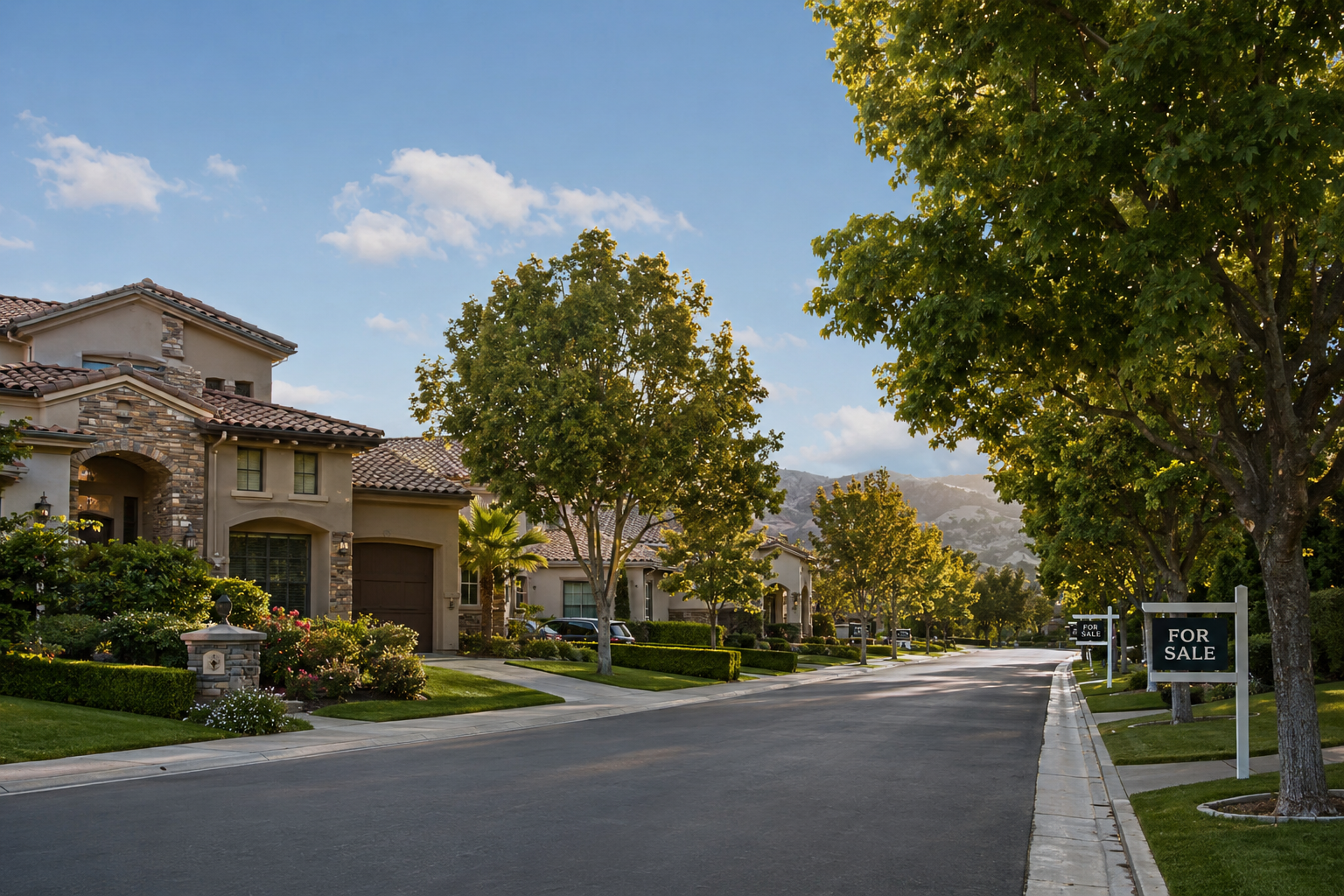 Calabasas 91302's core flatland tier — the $1.3M–$1.7M price band where LVUSD-anchored buyer demand has kept competition steady and negotiating room limited throughout 2026, even as the premium tier above it has softened meaningfully.
The core flatland tier ($1.3M–$1.7M):
- → ⏰ DOM: 20–35 days for correctly priced, well-prepared listings — meaningfully shorter than the premium tier, reflecting the deeper buyer pool at this price point
- → 💰 List-to-close ratio: 97–102% — sellers at correct pricing are still achieving close to or at asking in most transactions
- → 🔄 Market character: Balanced to mildly seller-favorable. The LVUSD demand anchor and the relative accessibility of this price tier (relative to Calabasas's broader range) keep a steady flow of qualified family buyers engaged
- → 🎯 What this means for buyers: If you're shopping this tier, "now" is not meaningfully better or worse than six months ago. You should buy when you find the right home at a price the comps support — waiting for a market shift in this tier is unlikely to produce materially different conditions
The premium and hillside tier ($1.8M–$2.5M+):
- → ⏰ DOM: 45–80+ days, even for well-prepared listings — a meaningfully thinner buyer pool at this price point combined with elevated rate sensitivity on jumbo financing
- → 💰 List-to-close ratio: 91–96% — buyers are achieving real, comp-supported discounts on extended-DOM listings
- → 🔄 Market character: Buyer-favorable. This is the most negotiable Calabasas has been at the premium tier in several years
- → 🎯 What this means for buyers: If you're shopping this tier, now is a genuinely good time to be actively looking, making offers grounded in comp analysis, and using the extended DOM and seller motivation that exists right now — this specific window of leverage is not guaranteed to persist
Why the split exists:
The premium tier's softening is driven by jumbo loan rate sensitivity (loans above the conforming limit carry a rate premium that compounds the broader rate environment), a thinner buyer pool whose qualification math is more exposed to rate movement even among higher-income households, and the simple fact that fewer buyers can absorb a $1.9M–$2.5M purchase regardless of income depth. The core flatland tier doesn't face the same financing friction, and its buyer pool is sustained by LVUSD demand that doesn't evaporate with rate cycles the way discretionary premium-tier demand does.
2. 💵 The Rate Environment — What It Actually Means for a Calabasas Purchase
Mortgage rates are the variable every prospective Calabasas buyer asks about first, and the one most often misunderstood in how it actually applies to this specific market.
Where rates stand in 2026:
Conventional 30-year financing for well-qualified buyers is running approximately 7.0%–7.5% through most of 2026. Jumbo financing — relevant for the majority of Calabasas purchases given the price points involved — typically carries an additional 0.125%–0.375% premium over conforming rates, depending on loan size, down payment, and the specific lender's current jumbo pricing.
What this means in real payment terms:
- → On a $1,650,000 purchase with 20% down ($1,320,000 loan) at 7.375%: monthly P&I of approximately $9,120
- → On the same purchase at a hypothetical 6.0% (a rate-relief scenario): monthly P&I of approximately $7,915 — a $1,205/month difference
- → That $1,205/month gap is meaningful, but it is the kind of gap that a seller-paid rate buydown can substantially close without requiring you to wait for the broader rate environment to shift
Why "wait for rates to drop" is a weaker strategy in Calabasas than in other markets:
In rate-sensitive central Valley markets, falling rates tend to pull more marginal buyers into qualification, which can increase competition and offset some of the payment benefit. In Calabasas, the buyer pool — particularly at the core flatland tier — is less marginal to begin with; LVUSD demand sustains competition regardless of rate direction. That means a Calabasas buyer who waits for rates to drop is more likely to face the same or stronger competition at the core tier, while at the premium tier, rate relief is specifically the variable most likely to bring buyers back into the market and erode the negotiating leverage that currently exists. Waiting for rates to fall in Calabasas does not reliably produce a better outcome the way it might in a market where falling rates and softening prices move together.
The seller-paid buydown alternative:
Rather than waiting for the broader rate environment to move, Calabasas buyers — particularly in the premium tier where sellers are motivated — are increasingly able to negotiate seller-paid 2-1 buydowns that reduce the effective rate in year one and two without requiring the seller to lower the stated sale price. A $25,000–$40,000 seller-paid buydown on a $1.8M–$2.2M Calabasas purchase can reduce year-one effective rate by approximately 2 percentage points, producing payment relief comparable to waiting for a meaningful rate-environment shift — available now, in this specific negotiating window, rather than contingent on a macroeconomic event with no fixed timeline.
3. 🏫 The LVUSD Factor — Why Calabasas Doesn't Behave Like a Purely Discretionary Market
Understanding why "is now a good time" has a different answer in Calabasas than in a comparable-priced luxury market without a school-quality anchor requires understanding what Las Virgenes Unified School District demand actually does to this market's behavior through cycles.
 Las Virgenes Unified School District access — the demand anchor that has historically made Calabasas's core flatland tier more resistant to rate-cycle softening than comparable-priced luxury markets without a comparable school-quality driver. This durability is the central reason the "wait for prices to fall" strategy carries more risk here than in purely discretionary luxury markets.
The historical pattern:
Through the 2022–2023 correction that meaningfully softened pricing across most Los Angeles luxury markets, LVUSD-zone Calabasas properties retraced less in percentage terms and recovered faster than comparable non-school-anchored luxury inventory in the broader region. The reason is straightforward: a meaningful share of Calabasas buyers are not purely discretionary — they are families with a genuine, time-sensitive need to establish residency before a specific enrollment year, and that need does not disappear because rates rose.
What this means for the "wait" strategy in 2026:
A buyer who is specifically motivated by LVUSD access and who decides to wait for a broader price correction is betting against a demand driver that has proven unusually durable through the exact kind of rate-driven softening currently affecting the premium tier. The core flatland tier's resilience this cycle is the live demonstration of this pattern — it has not seen the DOM extension or pricing softness that the premium tier has, specifically because the buyers shopping it are disproportionately LVUSD-motivated.
Where this durability does NOT apply:
The LVUSD demand floor is most powerfully felt at price points where the school-motivated family buyer pool is actually shopping — generally the core flatland tier. Premium and hillside properties at $2M+ draw a buyer pool that is more genuinely discretionary (the home and the view are the primary motivation, with school access as a secondary benefit rather than the driving need), which is precisely why that tier has softened this cycle while the core tier hasn't. Buyers evaluating "is now a good time" should locate themselves honestly within this framework — are you LVUSD-motivated and shopping the tier where that demand is concentrated, or are you shopping the premium tier where the calculus is genuinely different?
4. 🔍 Inventory and Negotiating Conditions — What's Actually Available Right Now
Beyond rates and the LVUSD framework, the practical question of whether now is a good time depends on what's actually on the market and what conditions those specific listings are presenting.
Current inventory character by tier:
- → 📊 Core flatland tier: Inventory is running at or slightly below equilibrium relative to the steady buyer demand — meaning well-prepared, correctly priced listings are not sitting long enough to generate significant negotiating room. Buyers in this tier should expect to compete on quality, decisive offers, and clean transaction terms rather than aggressive price negotiation.
- → 📊 Premium and hillside tier: Inventory is running above equilibrium relative to the thinner buyer pool — multiple listings in this tier are carrying 45+ days of DOM, and several have undergone at least one price reduction. This is the inventory picture that creates genuine 2026 buyer opportunity.
What extended DOM actually signals at the premium tier:
A Calabasas premium-tier listing sitting at 55 days with no offers is not necessarily overpriced relative to its original ambitions — it may simply be priced for a buyer pool that has thinned due to jumbo rate sensitivity. This distinction matters for how you approach the negotiation: the seller is often not unreasonable, just facing a smaller pool of qualified buyers than they expected when they set their price. A well-grounded offer based on accurate sub-neighborhood comps, presented with decisive terms and genuine financing readiness, is frequently received favorably by a seller who has been watching the market quietly pass them by for six to eight weeks.
The seller motivation signals worth watching for:
- → ✅ Listings with one or more price reductions already applied
- → ✅ Listings that have been relisted after an earlier withdrawal (often signaling a seller who tested the market once, didn't get traction, and is now more receptive to realistic offers)
- → ✅ Sellers who are simultaneously purchasing a replacement property and have disclosed a closing timeline need
- → ✅ Estate sales or situations where the listing agent's marketing language signals urgency around timeline rather than price maximization
5. 🧭 The Decision Framework — How to Decide for Your Specific Situation
Bringing the rate environment, the LVUSD durability pattern, and the current inventory picture together, here is the practical framework for deciding whether now is the right time for you specifically.
 The personalized Calabasas timing decision — weighing rate environment, LVUSD motivation, target price tier, and household qualification depth against the specific inventory and negotiating conditions available right now. The right answer to "is now a good time" is always specific to the buyer asking it, not a single market-wide verdict.
Buy now if:
- → ✅ You're shopping the $1.8M–$2.5M+ premium or hillside tier and have genuine financing readiness — the negotiating conditions available right now are the strongest this tier has offered in several years, and they are not guaranteed to persist if rates moderate and premium-tier buyers return to the market
- → ✅ You are LVUSD-motivated with a specific enrollment timeline — waiting for a broader price correction in the core flatland tier is betting against a demand pattern that has proven durable through worse rate environments than the current one
- → ✅ You have stable qualification at current rates and are not stretching to your absolute ceiling — a seller-paid buydown can meaningfully soften the payment impact of today's rates without requiring you to time a macroeconomic shift
- → ✅ You've found a specific home that fits your family's actual needs — in a market this differentiated by sub-neighborhood and school catchment, the right specific property matters more than the abstract question of market timing
Wait if:
- → ⚠️ Your household qualification is genuinely strained at 7.0%–7.5% and you have real flexibility on timeline — but recognize that waiting is a bet on rate relief, not on Calabasas prices falling to meet you, particularly in the LVUSD-anchored core tier
- → ⚠️ You haven't yet completed the comparison against adjacent communities (Woodland Hills 91364/91367, West Hills 91307, Agoura Hills) and want to confirm Calabasas's specific combination of school quality and lifestyle is worth its premium for your situation
- → ⚠️ You're shopping the premium tier specifically hoping prices fall further — extended DOM and seller motivation already reflect meaningful softening; waiting for a larger correction in a market with Calabasas's demand fundamentals is a less reliable strategy than negotiating decisively on what's available now
The honest middle ground:
Most Calabasas buyers in 2026 should focus less on timing the broader market and more on timing their own readiness — completed pre-approval, a clear comp analysis for their specific target sub-neighborhood, and a decisive offer strategy when the right property appears. In a market this bifurcated by price tier, the macro question of "is now good or bad" matters less than the specific question of whether the home in front of you, at the price the comps support, fits what your family actually needs.
🚫 What NOT to Overdo
Don't apply premium-tier negotiating conditions to a core flatland offer. A buyer who has read about the extended DOM and seller motivation at the $1.8M+ tier and brings that same aggressive discount expectation to a correctly priced $1.45M core flatland listing will lose that listing to a buyer who understood the tier-specific dynamics. Know which market you're actually shopping before you calibrate your offer strategy.
Don't wait for both lower rates and lower prices simultaneously in the core tier. This is the single most common Calabasas buyer miscalculation: assuming that if rates fall, prices will also soften, producing a double benefit. In the LVUSD-anchored core flatland tier, rate relief is more likely to bring buyers back into the market and sustain or strengthen pricing than to coincide with a price decline. If you're waiting for both conditions together in this specific tier, you may be waiting for a combination that historically hasn't occurred here.
Don't skip the binding insurance and HOA verification because you're focused on timing the market. The timing decision matters, but it doesn't override the due diligence that any Calabasas purchase requires — verified LVUSD catchment, binding wildfire insurance quotes for hillside and VHFHSZ addresses, and HOA financial health for planned communities. A buyer who rushes to act on premium-tier negotiating leverage without completing this diligence can end up with a different and worse problem than the one they were trying to avoid by waiting.
Don't assume the premium-tier opportunity window is permanent. The negotiating conditions described in this article exist specifically because of the current rate environment's effect on jumbo financing and the thinner premium-tier buyer pool. If rates moderate meaningfully, this is the tier most likely to see buyers return and DOM compress quickly. Buyers who are seriously considering the premium tier and recognize the current window as favorable should not assume it will still be available in twelve months.
🏠 Real-World Scenario — Calabasas 91302
A family with two children, ages 7 and 10, had been searching for eighteen months — initially targeting the $1.5M core flatland tier, specifically motivated by LVUSD access for their older child's upcoming middle school transition. They had lost two offers in 2025 to buyers who offered above asking in multiple-offer situations, and they were beginning to wonder whether they should simply wait for the broader market to soften.
We walked through the tier-specific framework. Their target price point — $1.4M–$1.55M, 4-bedroom, core flatland — was squarely in the LVUSD-anchored tier that had shown no meaningful softening through 2025 and into 2026. The premium-tier softening they had read about in general market coverage did not apply to their specific search.
We adjusted their strategy rather than their timeline: tighter pre-approval with a stronger earnest money commitment, a willingness to move decisively within 48 hours of a new listing rather than taking a full week to schedule a showing, and an explicit comp-grounded offer approach rather than guessing at competitive pricing. Within five weeks of this adjustment, they identified a correctly priced 4-bedroom listing in their target catchment, toured it within 24 hours of listing, and submitted a decisive offer at $3,000 above asking with a 14-day close. They won the home without a bidding war, specifically because their speed and certainty outweighed the marginal price difference for a seller who wanted a clean, fast transaction.
Their conclusion in retrospect: waiting for the core tier to soften would have cost them another year of searching for a market shift that their specific tier was never going to deliver. The right move was adjusting their approach, not their timeline.
🏠 Real-World Scenario — Calabasas 91302
A retired entertainment industry couple, downsizing from a larger property elsewhere in Los Angeles, were specifically targeting the $2.2M–$2.6M hillside tier in Calabasas for the views and the quieter pace — LVUSD access was irrelevant to their decision since their children were grown. They had been casually watching listings for nearly a year without making an offer, generally assuming premium Calabasas pricing was non-negotiable.
We showed them three current premium-tier listings carrying 50, 63, and 71 days of DOM respectively — each with at least one price reduction already applied. We ran the sub-neighborhood comp analysis on the 63-day listing, a hillside property originally listed at $2.55M and reduced once to $2.45M, and found that comparable recent closed sales supported a value closer to $2.28M–$2.34M given current jumbo rate conditions affecting that specific buyer pool.
We offered $2.25M with a 21-day close and a pre-completed inspection to streamline the transaction. The listing agent indicated the seller had received no other offers in nine weeks and was motivated by a job relocation timeline. After one round of counters, the parties settled at $2.295M — approximately $255,000 below the original list price and within the comp-supported range we had identified.
The couple's reflection: they had spent nearly a year assuming the premium tier was simply expensive and non-negotiable, when the actual 2026 conditions in that specific tier were exactly the opposite — genuinely negotiable, with motivated sellers, for buyers willing to act on accurate comp analysis rather than list-price assumptions.
❓ FAQ
Is now a good time to buy in Calabasas in 2026? It depends on which price tier you're shopping. The $1.8M–$2.5M+ premium and hillside tier is offering the most genuine negotiating conditions Calabasas has seen in several years, driven by jumbo rate sensitivity and a thinner buyer pool — this is a good time to act decisively with comp-grounded offers in that tier. The $1.3M–$1.7M core flatland tier, anchored by durable LVUSD demand, has not softened meaningfully and continues to reward buyers who are prepared to move quickly and decisively rather than wait for a market shift that this tier's demand fundamentals make unlikely.
Will Calabasas home prices drop in 2026? The core flatland tier ($1.3M–$1.7M) is unlikely to see a meaningful price decline given the durability of LVUSD-anchored demand through prior rate cycles. The premium and hillside tier ($1.8M–$2.5M+) has already seen meaningful softening reflected in extended DOM and price reductions on individual listings — further declines in this tier are possible if rates remain elevated or rise further, but a rebound is equally possible if rates moderate and premium-tier buyers return to the market.
Should I wait for mortgage rates to drop before buying in Calabasas? Waiting for rate relief is a reasonable strategy if your specific qualification is genuinely strained at current rates and you have real timeline flexibility — but understand that in the core flatland tier specifically, falling rates are more likely to bring buyers back into the market and sustain pricing than to coincide with a price decline, meaning you may face similar or stronger competition with a lower rate rather than a meaningfully better overall outcome. A seller-paid buydown, available now in many premium-tier negotiations, can provide comparable payment relief without requiring you to wait for a macroeconomic shift with no fixed timeline.
Where in Calabasas has the most negotiating room right now? The $1.8M–$2.5M+ premium and hillside sub-neighborhoods are currently showing the most negotiating room, with days on market averaging 45–80+ for even well-prepared listings and list-to-close ratios running 91–96% of asking. Buyers targeting this tier should look specifically for listings with one or more price reductions already applied, properties that have been relisted after an earlier withdrawal, or sellers with disclosed timeline motivations — these are the strongest signals of genuine seller motivation in the current market.
Is Calabasas a safe long-term investment even at current high prices? Calabasas's history of appreciation durability through prior rate cycles — particularly in LVUSD-anchored sub-neighborhoods — suggests it has historically been a more resilient long-term hold than comparable-priced luxury markets without a comparable school-quality demand driver. This durability is most pronounced at the core flatland tier and less guaranteed at the premium and hillside tier, where demand is more genuinely discretionary. Buyers and investors should evaluate their specific target sub-neighborhood's demand drivers rather than assuming uniform durability across the entire Calabasas price range.
🎯 Bottom Line
"Is now a good time to buy in Calabasas?" doesn't have a single honest answer in 2026 — it has two, and which one applies to you depends almost entirely on the price tier you're shopping. If you're targeting the $1.8M–$2.5M+ premium and hillside market, now is genuinely one of the better windows this market has offered buyers in recent years, with extended DOM, motivated sellers, and real negotiating room available to anyone willing to do the comp analysis and act decisively. If you're targeting the $1.3M–$1.7M core flatland tier, the LVUSD demand anchor that has sustained this market through worse rate cycles than the current one means waiting for a broader correction is a weaker strategy than preparing thoroughly and moving fast when the right property appears.
What's true across both tiers: the buyers who do best in this market are the ones who have completed their pre-approval, understand their specific target sub-neighborhood's comp ceiling, and are prepared to act with clarity and speed rather than trying to time a macroeconomic shift that may not arrive on a useful timeline. At Parkway Estate Properties, every Calabasas buyer conversation starts with identifying which of these two markets you're actually in — because the right strategy, and the honest answer to whether now is a good time, depends entirely on that distinction.
📩 Want to Know Whether Now Is the Right Time for Your Specific Calabasas Search?
Tell us your target price range, your school priorities, and your timeline — and we'll give you the honest, tier-specific read on current conditions before you make any decision about waiting or moving forward.
Contact Liana Shersher at Parkway Estate Properties: 📧 liana@parkwayestate.com · 📞 (818) 208-5881 · 🌐 parkwayestate.com 15021 Ventura Blvd., Ste. 510, Sherman Oaks, CA 91403
About the Authors
Liana Shersher Liana Shersher is a licensed real estate agent with Parkway Estate Properties Inc. and an Accredited Buyer's Representative (ABR) serving the San Fernando Valley — with a focus on Sherman Oaks, Encino, Tarzana, Woodland Hills, and Northridge (DRE# 02164224). Liana guides first-time homebuyers through every step of the purchase, from the first showing to the keys in hand, and represents move-up and repeat buyers across the Valley. For sellers, she builds the pricing and marketing strategy that positions a home to sell for top dollar, fast. Buyers and sellers work with Liana for clear communication, sharp local knowledge, and an agent who treats their goals like her own.
Roman Shersher Roman Shersher is the broker-owner of Parkway Estate Properties Inc. and a real estate investor with 18 years of experience in the San Fernando Valley (DRE# 01855095). Roman has personally led or co-led renovations on dozens of properties across the Valley, including recent projects in Northridge (91324) and Woodland Hills (91364). That hands-on renovation and investment experience shapes every pricing conversation and days-on-market strategy at Parkway — sellers get a realistic read on what improvements actually return at resale, and buyers get an expert eye on a home's true condition and upside.
Parkway Estate Properties, Inc. 15021 Ventura Blvd., Ste. 510, Sherman Oaks, CA 91403 · (818) 208-5881 · parkwayestate.com · Broker License #: 01873092 Equal Housing Opportunity. Information herein is general and not legal, tax, or financial advice. Consult qualified professionals for your specific situation.
Categories
Recent Posts











Broker | Realtor ® License ID: 01873092
+1(818) 208-5881 | info@parkwayestate.com