
When Is the Best Time to Sell a Home in Tarzana?

Timing a Tarzana 91356 home sale correctly is one of the most financially consequential decisions a seller can make — and the one most consistently made based on generic SFV market advice rather than the specific forces that drive the Tarzana calendar. Tarzana's selling calendar is shaped by a specific combination of influences that other SFV markets don't have in the same configuration: El Camino Real Charter High School's enrollment cycle that concentrates family buyer urgency in a specific spring window, the move-up buyer pipeline from Reseda 91335 and Canoga Park 91304 that activates with the broader SFV family buyer spring, the western Valley heat pattern that produces a more pronounced summer showing suppression than central Valley markets experience, and the specific Tarzana-Woodland Hills and Tarzana-Encino competitive dynamic at the premium tier that makes fall timing more valuable than in some adjacent markets.
This article gives Tarzana sellers the complete timing picture — what each seasonal window actually produces, why, and what preparation timeline is required to reach each window correctly.
1. 🌸 Spring — The Tarzana Seller's Primary Window
The spring window in Tarzana 91356 is not generic SFV spring activity — it is a specific, calendar-driven buyer activation that produces results meaningfully stronger than the rest of the year and that has a specific shape: early-spring activation driven by ECR enrollment urgency among the most motivated buyer cohort, followed by broad family buyer activation through April and into May, followed by a late-May moderation as school enrollment deadlines resolve and buyer urgency reduces.
Why Tarzana spring is specifically strong:
🏫 El Camino Real Charter enrollment urgency:
El Camino Real Charter High School — one of the western Valley's most consistently strong public high schools — is the school quality anchor that makes Tarzana's spring market behave like Granada Hills's GHCHS-anchored spring but for a western Valley buyer pool. Families with children entering 9th grade in the coming fall and families who specifically targeted Tarzana for ECR access have a genuine, non-negotiable calendar deadline: to establish 91356 residency before the school enrollment date that determines their child's ECR eligibility for the following year.
This deadline-driven buyer doesn't have the luxury that a purely discretionary buyer has — the option to wait for a better rate environment, to let the market soften before acting, to defer until they find something slightly better. Their child's high school enrollment is on the line. They are the buyers who offer quickly, who don't spend three weeks deliberating after a showing, and who produce the first-week multiple-offer dynamics that define Tarzana's spring peak.
👨👩👧 The move-up buyer pipeline:
Tarzana's primary move-up buyer pipeline — families moving up from Reseda 91335, Canoga Park 91304, and West Hills 91307 who are making their first significant equity step into the Tarzana 91356 premium — activates in spring with the same school-calendar urgency that affects the broader SFV family buyer market. These buyers have been saving, have established their financing, and are ready to commit when the right Tarzana home appears. Their spring activation amplifies the ECR-urgency buyer pool to produce the combined demand that makes Tarzana's spring the strongest seller window of the year.
📉 Inventory constraint:
Tarzana's golden handcuff dynamic — long-term owners with sub-4% mortgages who have no financial incentive to sell into a 7%+ rate environment — constrains available supply precisely when spring buyer demand is at its peak, producing the supply-demand imbalance that generates first-week competitive showings and above-asking offer dynamics on correctly priced, well-prepared listings.
Spring DOM and price performance by tier:
- → 🏡 $850K–$1.05M (entry Tarzana, approaching Reseda 91335): DOM 14–22 days for correctly priced improved condition. Most competitive tier — deepest buyer pool, first-time and move-up buyer overlap. Multiple offers common in March–April.
- → 🏡 $1.05M–$1.25M (core Tarzana mid-market): DOM 18–28 days. Primary ECR-urgency family buyer tier. Strong spring conditions with competitive offer dynamics on well-prepared listings.
- → 🏡 $1.25M–$1.5M (premium Tarzana): DOM 22–38 days even in spring. The buyer pool thins at this tier; correctly priced listings still generate showing activity but multiple offers less automatic than in the volume tier.
- → 🏡 $1.5M+ (luxury Tarzana, approaching Encino 91316/91436): DOM 35–65+ days in spring. The most discretionary buyer pool; spring urgency is present but doesn't fully compress this tier's absorption.
The spring preparation timeline:
The sellers who achieve the shortest spring DOM and strongest spring close prices are those who started preparation no later than January for a mid-March launch:
- → 📅 January: Pre-listing inspection ordered, contractor bids received, material selections made (paint colors, flooring samples, hardware). Critical: do this concurrently, not sequentially — don't wait for the inspection report before beginning contractor outreach.
- → 🔨 January–February: Execute the focused improvement scope — interior repaint first, then flooring installation after paint dries, then kitchen cosmetics and bath refresh, then curb appeal package.
- → 📸 Late February/early March: Professional photography and 3D tour. Pre-marketing social campaign, agent network outreach, coming-soon period.
- → 🚀 Mid-March to early April: Active MLS launch with the showing queue that pre-marketing has built.
The Tarzana seller who decides to "list this spring" in late March and schedules photography for the first week of April has missed the ECR-urgency buyer cohort's most active purchasing window and entered the market as spring momentum is already building toward its May moderation.
2. 🍂 Fall — Tarzana's Underrated Second Window
The October re-engagement window in Tarzana 91356 is the most consistently underutilized seller timing opportunity in the western SFV — and the one that produces the most genuine surprise for sellers who expected a soft market and found something closer to spring conditions in specific years.
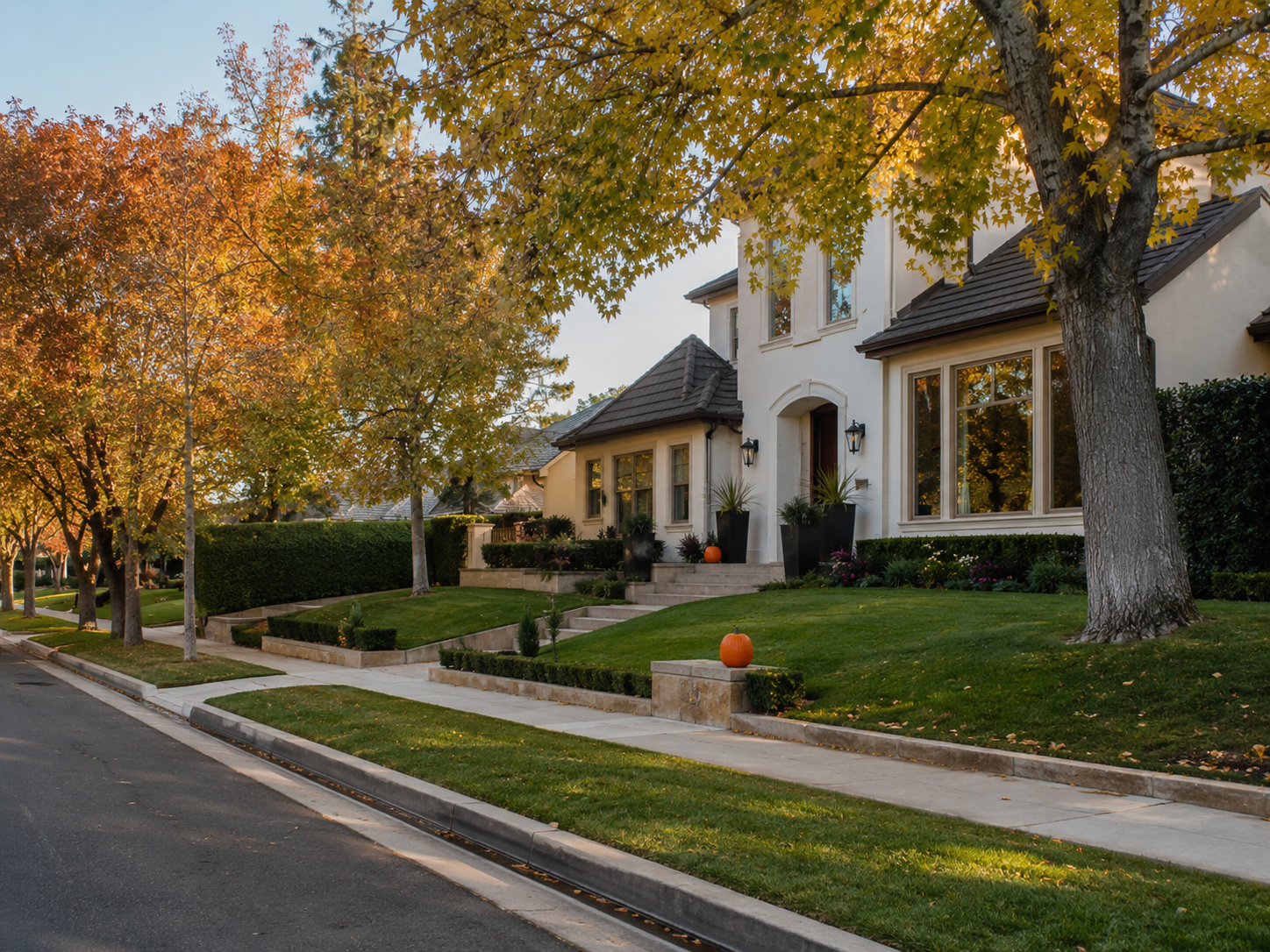 Tarzana 91356 in the October fall re-engagement window — the underutilized seller timing opportunity that produces meaningfully better conditions than most sellers expect. Motivated re-engaged buyers, thinner competing inventory, and year-end financial urgency combine to produce fall results closer to spring than to summer for correctly timed, correctly priced Tarzana listings.
What drives Tarzana's fall re-engagement:
- → 🔁 Re-engaged buyers who missed spring: Tarzana buyers who searched in spring and didn't find the right home — or who found it but lost in a competitive situation — have spent the summer recovering their motivation and commitment. By early October, they're back with a specific additional urgency: if they don't find a home in fall, they face another full year before the next spring window. This urgency is particularly pronounced among ECR-motivated families whose children are now in 9th or 10th grade and for whom one more missed enrollment cycle is genuinely consequential.
- → 💰 Year-end financial event buyers: The Tarzana buyer pool includes a meaningful share of self-employed professionals, entertainment industry above-the-line households, and business owners whose annual bonuses, business distribution timing, and year-end equity events clarify in Q4. Buyers whose down payment capital becomes available in October and November are active in October and November — a capital availability pattern that has no spring equivalent.
- → 📉 Thinner competing inventory: The "spring is the right time to sell" narrative keeps most Tarzana sellers off the fall market — producing inventory levels meaningfully below spring while re-engaged buyer demand is meaningfully above summer. The correctly priced fall Tarzana listing faces fewer competing homes than the equivalent spring listing, giving it a competitive differentiation advantage.
- → 🌡️ Temperature relief: Tarzana 91356's western Valley position produces summer temperatures comparable to Sherman Oaks and Encino — 88–100°F July and August afternoons that suppress showing activity. October temperatures in Tarzana drop to 72–82°F afternoons — genuinely pleasant for showings and open houses. The neighborhood shows better in fall light.
- → 🏫 ECR second-cycle awareness: Some ECR enrollment candidates begin establishing residency in fall for the following year's application cycle — a secondary school-motivated buyer pulse that is smaller than the spring pulse but real.
Fall DOM by tier:
- → 🏡 $850K–$1.05M: DOM 18–30 days — approaching spring conditions for correctly priced, well-prepared fall listings
- → 🏡 $1.05M–$1.25M: DOM 22–38 days — the fall buyer pool at this tier is motivated if inventory is thin; sellers who launch correctly outperform summer significantly
- → 🏡 $1.25M–$1.5M: DOM 30–52 days — fall produces better conditions than summer at this tier, though still below spring's competitive dynamics
The fall timing constraint:
The Tarzana fall window closes sharply. November 15 is roughly the deadline for active fall market momentum — after Thanksgiving, buyer attention competes with holiday planning, year-end travel, and the psychological shift to "January is when I'll get serious." A Tarzana listing that goes active October 1 has 6 full weeks of fall market momentum. A listing that goes active November 5 has 2–3 weeks before the holiday compression begins.
Fall preparation timeline:
To launch in the first week of October:
- → 📅 Mid-August: Pre-listing inspection and contractor outreach begin
- → 🔨 August–September: Execute focused improvement scope (6–8 weeks for a complete Tarzana pre-sale scope)
- → 📸 Late September: Photography and pre-marketing
- → 🚀 October 1–7: MLS launch
3. ☀️ Summer — The Tarzana Window That Requires Honest Adjustment
Summer in Tarzana 91356 is the market's moderation period — but the specific character of Tarzana's summer is worth understanding precisely rather than dismissing with "summer is slow everywhere." Tarzana's summer is more suppressed than comparable central Valley markets like Reseda 91335 or Northridge 91324/91325, and less suppressed than more school-enrollment-dependent markets like Granada Hills 91344. Understanding where Tarzana falls helps sellers who must list in summer calibrate correctly.
Why Tarzana summer is more suppressed than central Valley markets:
- → 🌡️ Western Valley heat: Tarzana 91356's position produces summer temperatures reliably 88–100°F from late June through September — more extreme than the marine-influenced coast but comparable to the broader western Valley. Afternoon showings in unoccupied homes become uncomfortable. Open house attendance drops significantly from spring levels.
- → 🏖️ Summer family distraction: Tarzana's primary buyer pool — move-up families — is uniquely susceptible to summer activity suppression. Children are out of school, family travel is concentrated in summer, and the specific real estate search energy that spring's school enrollment deadline produces is entirely absent. The urgency driver that makes Tarzana spring work is structurally absent in summer.
- → ✅ More resilient than enrollment-pure markets: Unlike Granada Hills where GHCHS enrollment urgency is virtually the only urgency driver and its summer absence is total, Tarzana has some buyer motivation that persists through summer — buyers whose personal timelines (job relocations, lease expirations, financial events) are summer-specific. Tarzana's summer is slow, not dead.
The correct summer strategy for Tarzana sellers who must list:
- → 💰 Price at midpoint, not top of range: The summer buyer pool is smaller and less urgency-driven. The top-of-range spring pricing that competitive offer dynamics supported is not achievable in August. Midpoint of the defensible comp range is the correct summer launch position.
- → 🕐 Morning-only showing windows: All open houses and showing availability should be scheduled before 1 PM. Afternoon Tarzana summer heat in unoccupied homes — HVAC running but not at residential comfort settings — produces showing experiences that don't serve the home well. Morning showings generate better buyer engagement.
- → 💳 Proactive seller-paid buydown marketing: The Tarzana buyer pool is among the most rate-sensitive in the PEP coverage area at the $850K–$1.25M tier — many buyers in this range are at or approaching their qualification ceiling. A seller-paid 2-1 buydown reduces year-one effective rate by 2 percentage points, saving approximately $1,100–$1,400/month at Tarzana price points. Marketing this buydown proactively activates payment-sensitive buyers whose search frequency drops in summer but who respond to a specific payment relief incentive.
- → ⏰ Set realistic DOM expectations: 32–55 days for a correctly priced, well-prepared summer Tarzana listing. The seller who planned for spring results and listed in August without seasonal adjustment will consistently accumulate more DOM than this before the correction brings the listing to where it should have launched.
4. ❄️ Winter — When to List and When to Wait
Winter in Tarzana 91356 — specifically December through early February — is the market's lowest-activity period, and the correct advice for most Tarzana sellers with timeline flexibility is to wait for spring rather than launch in the winter window. That said, winter listings in Tarzana are not universally inadvisable — specific situations produce winter launches that outperform the alternative of waiting.
The January activation — Tarzana's hidden winter opportunity:
While December is definitively the Tarzana market's weakest window, January contains a specific sub-window that sellers sometimes overlook: the pre-approved buyer who has been waiting since fall 2025 and who re-engages with genuine purchasing intent in the second and third weeks of January as the holiday period ends. This buyer pool is small but highly qualified — they have been watching the market for months, have their financing in order, and are specifically ready to act when the right home appears.
The Tarzana seller who launches in the third week of January — with a well-prepared home, correct pricing, and complete professional photography — captures this early-activator buyer pool before the broader spring inventory wave arrives and before competing listings begin to build. This is the "beat the spring rush" window that produces the occasional January close at spring-equivalent pricing for sellers who time it specifically and execute it correctly.
- → ✅ Who should consider a late-January launch: Sellers whose preparation scope will be complete by mid-January, whose timeline makes a February-March close preferable to a March-April close, and whose specific Tarzana sub-neighborhood comp data supports a late-January price at spring-equivalent levels
- → ⚠️ The January launch risk: The pre-approved January buyer pool is thin — if the right buyer isn't in that pool, the listing enters February accumulating DOM before the spring activation arrives. A listing with 25+ days of DOM at spring launch has already absorbed some of the stigma that reduces first-week showing urgency
December — the month to avoid:
December Tarzana listings — unless a genuine timeline requirement makes listing unavoidable — consistently produce the weakest outcomes. Holiday buyer attention compression, the maximum distance from any school enrollment calendar urgency, and the year's highest competing distraction for buyer attention combine to produce both the lowest showing volume and the lowest offer quality of the annual cycle. Sellers who can wait through December should do so universally.
5. 💰 Timing and Pricing — The Interaction That Produces or Destroys Returns
The timing decision and the pricing decision are not independent variables in Tarzana 91356 — they interact in a way that produces very different outcomes depending on whether they are aligned or misaligned. The seller who launches at the right time with the right price produces the strongest result. The seller who launches at the right time with the wrong price or at the wrong time with the right price both underperform what the correct combination would have produced.
 The Tarzana timing-and-pricing alignment — the specific seasonal window combined with the specific comp-supported launch price that produces the strongest seller outcomes. Sellers who get one right and the other wrong consistently underperform the combination, and the gap is measurable in both net proceeds and days on market.
How timing and pricing interact in Tarzana:
Spring + correct pricing = maximum net proceeds:
The spring window's buyer urgency amplifies the effect of correct pricing — a correctly priced spring listing generates the first-week showing traffic that produces competitive offers. The correctly priced spring Tarzana home at $1.09M closes at $1.10M–$1.12M in a competitive situation that the same home at $1.16M (overpriced by 6%) would not have produced. The overpriced spring listing filters buyers at the search level and misses the competitive offer dynamics that spring is specifically designed to produce.
Spring + overpricing = one of the worst outcomes:
A Tarzana listing that launches in March at 8–10% above the comp ceiling has entered the market at the moment when the buyer pool is most active and most likely to form strong first impressions. The buyers who tour and don't offer in week one form a specific opinion: "overpriced" — and they share that opinion with the buyer pool through their agents, through online listing discussion, and through the simple absence of offers that signals the market's response. A spring overpriced listing that reduces to the correct price in May enters the moderation period having burned its spring opportunity and needing to compete with summer conditions.
Summer + correct pricing = acceptable outcome:
Correct summer pricing in Tarzana (midpoint of comp range, proactive buydown marketing, morning showing windows) produces a transaction — 32–55 days, close at 95–98% of list. Not the outcome a spring launch would have produced, but a successful sale.
Summer + spring pricing = the most frustrating outcome:
The Tarzana seller who lists in July at the price that would have been appropriate in April accumulates DOM for 45–60 days before acknowledging what the market has been communicating since week two. They then reduce to a correct summer price and close — having absorbed carrying costs, DOM stigma, and a buyer negotiating leverage that a correctly timed and correctly priced launch would have prevented.
The seasonal price adjustment framework:
- → 🌸 Spring (March–May): 98–102% of comp ceiling for renovated condition; 93–97% for partially updated; 88–93% for original condition
- → 🍂 Fall (October–November): 95–99% of comp ceiling; seasonal adjustment of 1–3% below spring pricing at equivalent condition
- → ☀️ Summer (June–August): 92–96% of comp ceiling; midpoint rather than top of range; proactive buydown incentive
- → ❄️ Winter (December–January): 90–95% of comp ceiling for sellers who must list; January pre-activator window supports the higher end of this range for well-prepared listings
🚫 What NOT to Overdo
Don't mistake El Camino Real Charter enrollment as a demand driver that applies equally across all Tarzana price tiers. The ECR enrollment urgency is most concentrated in the $850K–$1.2M tier where the primary ECR-motivated family buyer pool operates. At $1.4M–$1.65M, the buyer pool is more discretionary and the ECR urgency driver is less pronounced — these buyers have more flexibility in their timeline and are less likely to be specifically constrained by a school enrollment deadline. Sellers at the premium Tarzana tier should not assume the same first-week urgency that the volume tier spring produces will replicate at their price point.
Don't launch in spring without preparation complete. The spring window's buyer urgency is genuinely compressed into a specific time period — the ECR-motivated buyer who needs to close by July for fall enrollment is not going to wait while the seller finishes the renovation or gets better photography. A spring listing that launches with incomplete preparation, iPhone photography, or a home that reads as "needs work" in listing photos misses the urgency-driven buyer whose offer would have produced the spring's best outcomes. Complete the preparation fully before the MLS launch — the spring window rewards this discipline.
Don't confuse the fall re-engagement quality with spring quality. The October window in Tarzana produces meaningfully better conditions than summer — but it does not produce spring conditions. The buyer pool is smaller, the ECR enrollment urgency has resolved for most buyers (with the secondary exception described in Section 2), and the first-week showing traffic will be lower than a comparable spring launch. Sellers who price fall listings at spring-ceiling prices without the seasonal adjustment will accumulate DOM that their spring-equivalent expectation was not accounting for.
Don't let the summer slow market push you into an autumn over-correction. Sellers who struggled with their summer listing and reduced their price under market pressure sometimes enter the October re-engagement window at a price well below the fall-appropriate comp midpoint — having over-corrected from the summer frustration. The fall re-engagement buyer is motivated but not desperate; a correctly priced fall listing at 95–99% of the comp ceiling produces better results than an under-priced listing at 88–91% of the ceiling that signals distress rather than opportunity.
Don't ignore the carrying cost of timing misjudgment. For a Tarzana seller with a $450,000 remaining mortgage at a locked-in low rate, monthly carrying costs typically run $3,500–$4,500 (mortgage + taxes + insurance + utilities). Every unnecessary month of pre-sale preparation or accumulated DOM costs $3,500–$4,500 in carrying costs. A seller who starts preparation in March for what should have been a January start, launching in April rather than mid-March, has absorbed approximately $10,500–$13,500 in unnecessary carrying costs — before counting any pricing impact from a slightly later spring launch.
🏠 Real-World Scenario — Tarzana 91356
A Tarzana 91356 seller had a comprehensively renovated 4-bedroom — kitchen, bathrooms, flooring, and curb appeal all addressed. They had been thinking about selling since summer 2025 but kept deferring the decision. By November they decided to list "right after the holidays" and launched January 22.
First week: 4 showings, no offers. Second week: 3 showings, one exploratory inquiry that didn't advance. Their agent recommended patience — "the market is still waking up." By the end of February, 35 days of DOM had accumulated.
We evaluated the situation in early March. Their home was not mispriced — the comp analysis supported their $1.195M list price. The problem was timing: the pre-activator January buyer pool in Tarzana is thin, and their home had entered the market 4–5 weeks before the ECR-urgency spring activation that their price tier specifically needed to generate competitive showings.
The listing had accumulated 35 days of DOM that the spring buyer pool — arriving in mid-March and April — would now see. The DOM stigma question ("why has this been sitting?") would follow every subsequent showing.
We recommended a listing withdrawal and relaunch. After 14 days off market, the listing relaunched March 10 at the same price with fresh photography (seasonal spring exterior rather than the January photos), a new listing description, and the DOM clock reset. First week post-relaunch: 11 showings. Two offers by day 12. Accepted at $1.208M — $13,000 above the original list price, in a competitive situation produced by the ECR-urgency spring buyer pool that had activated exactly as the relaunch targeted.
The seller who launched January 22 accumulated 35 days of wasted DOM, absorbed carrying costs for the additional 7 weeks, and ultimately closed at $1.208M after a withdrawal and relaunch. Had they launched March 10 from the start — building that as their target date when they made the November selling decision — they would have achieved the same outcome without the DOM accumulation, the withdrawal, and the extra carrying costs.
🏠 Real-World Scenario — Tarzana 91356
A different Tarzana 91356 seller made the opposite timing error — a partially updated 3-bedroom that she needed to sell for estate reasons, timeline-required by July 1. We received the engagement in late May.
The correct assessment: at the end of May, with a July 1 requirement, the seller was entering the summer window rather than the spring peak. The spring had closed for practical purposes. We had approximately 4 weeks to complete preparation and launch, producing a late June listing into the summer market.
The summer strategy we recommended: list at $985,000 — the comp midpoint, not the $1.05M that the spring comp ceiling could have supported. Market a seller-paid 2-1 buydown of $16,500 prominently in the listing. Morning-only showing windows (9 AM–1 PM). Specifically targeted buyer outreach to agents with rate-sensitive first-time and move-up buyer clients who specifically respond to payment relief incentives.
First week showings: 6 — fewer than spring but meaningful for the summer window. Offer at day 16 from a first-time buyer whose agent had specifically flagged the buydown. The buyer's year-one effective rate with the buydown: 5.25% versus the market 7.25%. Their monthly saving: approximately $1,150 in year one.
Accepted at $978,000 with the $16,500 buydown included. Final effective price: $978,000 - buydown attribution = approximately $961,500 net of the buydown cost. Close at day 29 — within the estate's July 1 requirement.
The seller who had to list in summer achieved a successful, clean close by accepting the summer market reality from day one: midpoint pricing, proactive buydown marketing, and morning showings. The seller who launches in summer with spring expectations consistently produces a worse outcome than this disciplined summer strategy delivers.
❓ FAQ
When is the best time to sell a home in Tarzana? Mid-March through late April is the strongest Tarzana seller window — when El Camino Real Charter enrollment urgency, broad move-up family buyer activation, and constrained Tarzana 91356 inventory combine to produce the shortest days on market and strongest close-to-list ratios of the annual cycle. The first two weeks of October represent the second-best window — a fall re-engagement period driven by buyers who missed spring, year-end financial event timing, and thinner competing inventory. Sellers with genuine timeline flexibility should target one of these two windows.
How does El Camino Real Charter School affect Tarzana home sale timing? El Camino Real Charter High School — one of the western Valley's most consistently strong public high schools — creates a specific, non-discretionary buyer urgency in the March–May window. Families who need to establish 91356 residency for ECR enrollment have genuine calendar deadlines that convert showing interest into offers faster than purely discretionary buyers. This urgency compresses Tarzana's spring DOM to 14–28 days at the core volume tier ($850K–$1.25M) and produces the competitive offer dynamics that spring listings specifically benefit from. The same urgency is largely absent in summer and winter, which is the primary reason Tarzana's seasonal variation in seller outcomes is more pronounced than in markets without comparable school quality anchors.
Should I sell my Tarzana home in summer or wait for fall? If you have timeline flexibility and have already missed the spring window, waiting for October is almost always the better choice compared to a summer launch. The fall window — specifically October 1 through November 10 — consistently produces better Tarzana seller conditions than summer: lower heat that improves showing comfort, re-engaged buyers with specific urgency, and thinner competing inventory that gives correctly priced fall listings a competitive advantage they don't have in summer. The exception: sellers with a specific July–August close requirement (estate timelines, replacement property deadlines) for whom the wait is not viable.
How long does it take to prepare a Tarzana home for sale? A complete Tarzana pre-sale preparation scope — pre-listing inspection, interior repaint, main-floor flooring, kitchen cosmetics, primary bath refresh, curb appeal, professional photography, and staging — takes 8–11 weeks from the inspection decision to MLS launch. Sellers targeting the mid-March spring launch should begin in January. Sellers targeting the October fall window should begin in mid-August. Sellers who compress this timeline consistently launch underprepared and produce first-week listing photography that suppresses showing traffic in the critical first week.
What is the average days on market in Tarzana? Tarzana 91356 DOM varies significantly by season and price tier. Spring peak (March–April), core volume tier ($850K–$1.25M), correctly priced: 14–28 days. Summer (June–August): 32–55 days. Fall (October–November): 20–38 days. Winter (December–January): 45–75+ days. Premium tier ($1.25M–$1.65M) in any season: 28–65+ days. Overpriced listings in any season: 55–90+ days — the DOM accumulation that transfers buyer leverage and consistently produces lower net proceeds than correct pricing from launch would have generated.
Should I renovate before selling in Tarzana? Whether to renovate depends on your specific comp gap — the difference between your as-is value and the renovated comp ceiling in your specific Tarzana sub-neighborhood. The focused cosmetic scope (paint, flooring, kitchen cosmetics, curb appeal) at $30,000–$55,000 produces meaningful comp ceiling recovery when the gap supports it. Full kitchen or bathroom renovation rarely pencils at Tarzana's comp ceiling unless the sub-neighborhood and premium tier specifically support the investment. Order the pre-listing inspection and pull the sub-neighborhood comp data before committing to any renovation scope.
🎯 Bottom Line
The best time to sell a home in Tarzana 91356 is mid-March through late April — when the El Camino Real Charter enrollment urgency, the western Valley move-up family buyer activation, and the golden handcuff inventory constraint align to produce conditions that the rest of the year cannot replicate. The preparation that reaches this window correctly begins in January. The pricing that maximizes this window is comp-ceiling pricing for well-prepared homes, not aspirational overpricing that filters the urgency-driven buyer pool that spring specifically produces.
The second-best window is October 1 through November 10 — a fall re-engagement period that most Tarzana sellers underestimate but that consistently produces results meaningfully stronger than summer for sellers who enter correctly prepared and correctly priced.
The timing decision is inseparable from the preparation decision, which is inseparable from the pricing decision. Getting one right and the other wrong produces underperformance relative to what the correct combination delivers. The Tarzana sellers who achieve the strongest outcomes are consistently the ones who made the timing decision in October or November — months before the spring they were planning — and who used those lead months to complete the preparation that produces the photography, the first-week showing traffic, and the competitive offer dynamics that the spring window specifically rewards.
At Parkway Estate Properties, every Tarzana seller conversation begins with the timing question because every other preparation and pricing decision follows from it. Liana's seller strategy experience across Tarzana 91356, Sherman Oaks 91403/91423, Encino 91316/91436, Woodland Hills 91364/91367, and Northridge 91324/91325 means every timing recommendation reflects the specific western Valley market calendar rather than a generic SFV seasonal template.
📩 Want to Know Whether Now Is the Right Time to List Your Tarzana Home — or When You Should Prepare to List?
We'll tell you exactly which window your home should target, what preparation scope you need to reach it, and what the pricing strategy looks like for your specific Tarzana sub-neighborhood and condition tier.
Contact Liana Shersher at Parkway Estate Properties: 📧 liana@parkwayestate.com · 📞 (818) 208-5881 · 🌐 parkwayestate.com 15021 Ventura Blvd., Ste. 510, Sherman Oaks, CA 91403
About the Authors
Liana Shersher is a licensed real estate agent with Parkway Estate Properties Inc. and an Accredited Buyer's Representative (ABR) serving the San Fernando Valley — with a focus on Sherman Oaks, Encino, Tarzana, Woodland Hills, and Northridge (DRE# 02164224). Liana guides first-time homebuyers through every step of the purchase, from the first showing to the keys in hand, and represents move-up and repeat buyers across the Valley. For sellers, she builds the pricing and marketing strategy that positions a home to sell for top dollar, fast. Buyers and sellers work with Liana for clear communication, sharp local knowledge, and an agent who treats their goals like her own.
Roman Shersher is the broker-owner of Parkway Estate Properties Inc. and a real estate investor with 18 years of experience in the San Fernando Valley (DRE# 01855095). Roman has personally led or co-led renovations on dozens of properties across the Valley, including recent projects in Northridge (91324) and Woodland Hills (91364). That hands-on renovation and investment experience shapes every pricing conversation and days-on-market strategy at Parkway — sellers get a realistic read on what improvements actually return at resale, and buyers get an expert eye on a home's true condition and upside.
Parkway Estate Properties, Inc. · 15021 Ventura Blvd., Ste. 510, Sherman Oaks, CA 91403 · (818) 208-5881 · parkwayestate.com · Broker License #: 01873092 Equal Housing Opportunity. Information herein is general and not legal, tax, or financial advice. Consult qualified professionals for your specific situation.
Categories
Recent Posts










Broker | Realtor ® License ID: 01873092
+1(818) 208-5881 | info@parkwayestate.com