
Buying a Home in Reseda as an Investor
Reseda 91335 is the most active and most consistently productive BRRRR market in the PEP SFV coverage area — and has been for the better part of the past decade. The combination of accessible acquisition prices ($650,000–$950,000), predictable 1950s–1970s renovation scopes, a well-established comp ceiling for renovated product ($795,000–$920,000 in the core sub-neighborhoods), consistent rental demand from the central Valley's working-family and professional tenant base, and the specific ADU opportunity that California's permissive legislation has made meaningful at 91335's standard lot sizes produces an investor thesis that is more replicable, more predictable, and more liquid than most SFV investor markets at any price point.
This is not the Tarzana investor's long-hold appreciation play at $950,000–$1.15M with ECR-motivated premium tenants and negative cash flow sustained by household income. Reseda investors operate at $680,000–$820,000 acquisition prices, execute renovation scopes of $45,000–$75,000 that produce renovated product worth $840,000–$920,000, refinance at 75% LTV to partially or fully recover capital, and hold for appreciation and rental income with a cash flow profile that — with an ADU — approaches near-breakeven at current rates rather than the deeply negative positions that higher-price markets produce.
This article gives Reseda investors the complete picture: the BRRRR mathematics at current prices and rates, the sub-neighborhood acquisition targeting framework, the renovation scope calibration, the ADU opportunity analysis, the rental market data, and the honest total return model that allows investors to evaluate Reseda against alternative deployment opportunities with clear, specific numbers.
1. 📊 The Reseda BRRRR Mathematics — Why This Market Works for Investors
The BRRRR (Buy, Renovate, Rent, Refinance, Repeat) strategy in Reseda 91335 produces more consistent, more predictable results than in most SFV investor markets — and understanding specifically why requires examining the four variables that determine BRRRR viability: acquisition price, renovation cost, post-renovation appraised value, and refinance capital recovery.
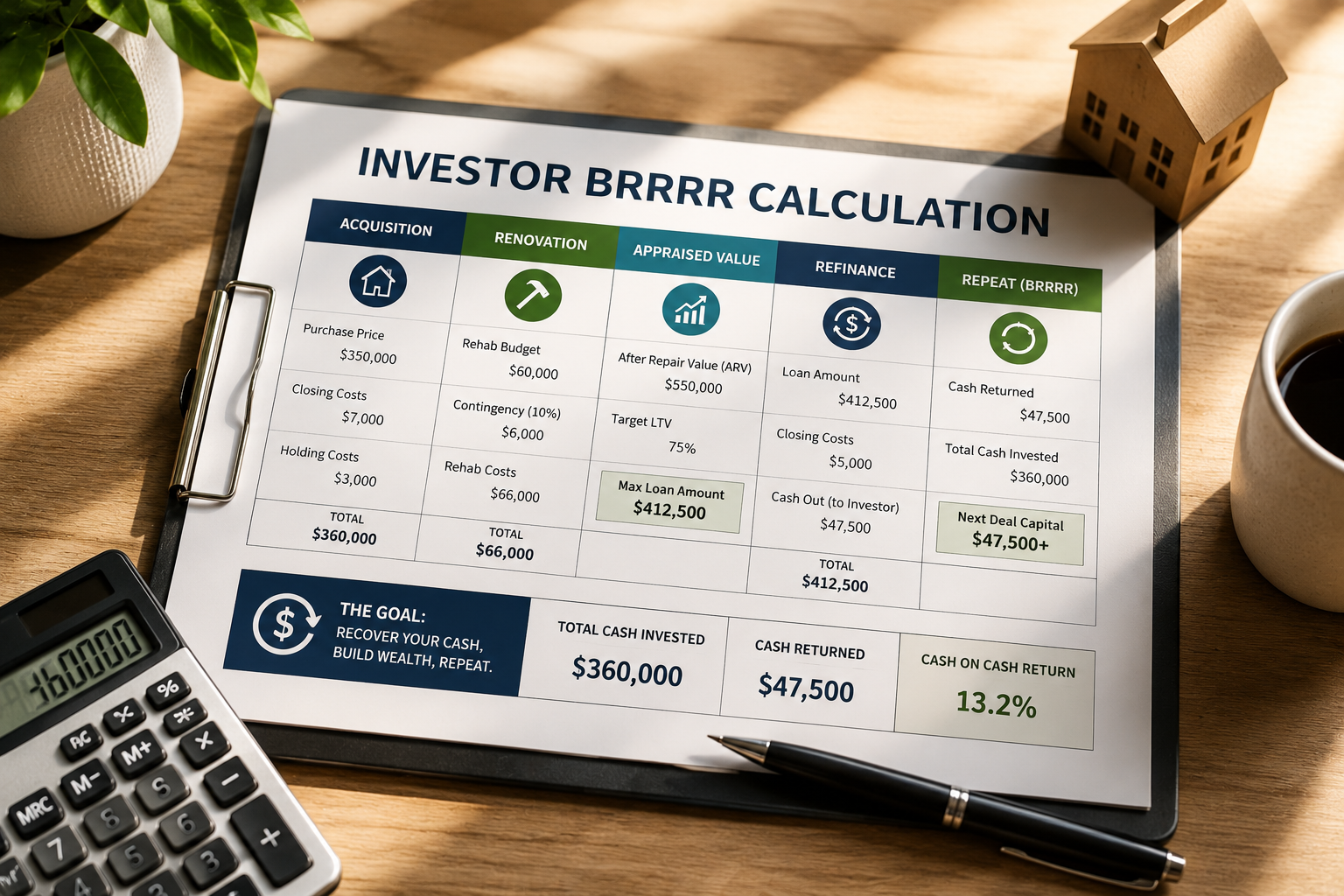 The Reseda BRRRR acquisition target — original-condition 1960s single-family inventory at $680,000–$790,000 that produces the renovation margin and 75% LTV refinance math that defines Reseda's investor thesis. The predictability of the renovation scope (same 1960s housing stock, same predictable deferred maintenance patterns, same finish quality required to reach the Reseda comp ceiling) is the specific advantage that makes Reseda more consistently executable than most SFV investor markets.
The BRRRR math — three representative scenarios:
Scenario 1 — Conservative acquisition, core sub-neighborhood:
- → 🏠 Acquisition: $695,000 (original condition 3-bedroom, 7,200 sq ft lot, core Reseda sub-neighborhood)
- → 💵 Down payment (25%): $173,750
- → 💳 Hard money loan during renovation: $521,250 at 10% interest
- → 🔨 Renovation scope: $58,000 (kitchen cosmetics, primary bath refresh, LVP flooring, interior paint, curb appeal)
- → ⏰ Renovation timeline: 8 weeks
- → 💰 Carrying costs during renovation (hard money interest + utilities): $8,700
- → 📊 Total all-in position: $695,000 + $58,000 + $8,700 = $761,700
- → 🏦 Post-renovation appraised value: $865,000
- → 💳 75% LTV cash-out refinance: $648,750
- → 💰 Capital recovered at refinance: $648,750 - $521,250 (repaying hard money) = $127,500 returned
- → 💰 Capital remaining in deal: $761,700 - $648,750 = $112,950
- → 📊 Capital recycling efficiency: 88% of original equity returned; 12% ($112,950) remains in the deal
Scenario 2 — Midrange acquisition, Balboa-adjacent sub-neighborhood:
- → 🏠 Acquisition: $740,000 (original condition 3-bedroom, 7,800 sq ft lot, Balboa-adjacent premium sub-neighborhood approaching Lake Balboa 91406/91411)
- → 💵 Down payment (25%): $185,000
- → 🔨 Renovation: $65,000
- → ⏰ Carrying costs: $9,500
- → 📊 All-in: $814,500
- → 🏦 Post-renovation appraised value: $905,000
- → 💳 75% LTV refinance: $678,750
- → 💰 Capital remaining in deal: $814,500 - $678,750 = $135,750
- → 📊 Capital recycling efficiency: 83% returned; 17% ($135,750) remains
Scenario 3 — Value-add acquisition with ADU potential:
- → 🏠 Acquisition: $715,000 (original condition 3-bedroom, 8,500 sq ft lot with garage conversion ADU potential)
- → 🔨 Renovation (primary home): $60,000
- → 🏗️ ADU construction (garage conversion): $95,000
- → ⏰ Carrying costs (14 months total timeline): $19,500
- → 📊 All-in: $889,500
- → 🏦 Post-renovation/ADU appraised value: $1,020,000 (primary home $880K + ADU contribution $140K)
- → 💳 75% LTV refinance: $765,000
- → 💰 Capital remaining: $889,500 - $765,000 = $124,500
- → 📊 Capital recycling efficiency: 86% returned; 14% remains
- → 💰 Monthly rental income: $3,400/month primary + $1,850/month ADU = $5,250/month total
Why Reseda produces more consistent BRRRR math than adjacent markets:
- → ✅ Predictable housing stock: The 1950s–1970s single-family homes that dominate Reseda 91335 produce renovation scopes that experienced operators can estimate accurately — the same 1963 ranch layout with the same predictable kitchen, bath, flooring, and curb appeal scope that the operator has executed multiple times before
- → ✅ Well-established comp ceiling: The renovated 3-bedroom comp ceiling in Reseda's core sub-neighborhoods ($840,000–$920,000) has been consistent enough across multiple market cycles that the post-renovation appraisal is predictable within a reasonable range
- → ✅ Active investor comp set: Because Reseda has an active investor market, the renovated product comp set is deep enough that appraisers have abundant recent comparable data — reducing the appraisal uncertainty that thinner markets produce
- → ✅ Accessible acquisition prices: The $680,000–$790,000 acquisition range requires less initial capital than Tarzana or Encino BRRRR acquisitions, allowing investors with $180,000–$220,000 in available equity to participate
2. 💰 The Honest Cash Flow Model — What Reseda Investment Actually Produces Monthly
The honest cash flow picture for a leveraged Reseda investment at current rates requires the same analytical honesty that the Lake Balboa and Tarzana investor articles applied — the recognition that Reseda investment at current rates does not produce positive monthly cash flow without ADU income, and that investors who enter with incorrect cash flow expectations consistently make acquisition decisions their actual monthly obligations cannot support.
The post-BRRRR monthly cash flow model:
Without ADU (3-bedroom renovated, cash-out refinance in place):
Using Scenario 1's numbers ($648,750 refinance loan at 7.50% investment property rate):
- → 💳 Monthly P&I ($648,750 at 7.50%): $4,537
- → 🏛️ Property taxes (1.2% effective on $865,000): $865
- → 🏠 Insurance: $115
- → 🔧 Property management (8% of rent): $272 (at $3,400 rent)
- → 🏡 Maintenance reserve (1% annual): $721
- → 💧 Vacancy reserve (8% annual): $272
- → Total monthly expenses: $6,782
- → 💰 Rental income (3-bedroom renovated Reseda): $3,400/month
- → 📉 Monthly cash flow without ADU: approximately -$3,382/month
With ADU adding $1,850/month:
- → 💰 Total rental income: $5,250/month
- → 📉 Revised monthly cash flow: approximately -$1,532/month
The comparison to other PEP investor markets:
- → 📊 Lake Balboa 91406: -$2,443/month without ADU; -$543/month with ADU
- → 📊 Reseda 91335: -$3,382/month without ADU; -$1,532/month with ADU
- → 📊 Tarzana 91356: -$2,800 to -$4,200/month without ADU
Why Reseda's cash flow is more negative than Lake Balboa despite lower acquisition prices:
The apparent paradox — Reseda has lower acquisition prices but more negative cash flow than Lake Balboa — is explained by the BRRRR refinance structure. The Lake Balboa analysis in the investor guide used a purchase price with conventional financing and no BRRRR recycling. Reseda's model includes the cash-out refinance that increased the loan from a 25%-down acquisition loan to a 75% LTV refinance — substantially increasing the monthly obligation. The BRRRR's capital recycling benefit (returning 83–88% of initial equity) comes at the cost of a higher loan balance and therefore higher monthly payment than a standard purchase-and-hold approach.
The honest Reseda total return model:
Despite negative monthly cash flow, the total return includes:
- → 📈 Annual appreciation (3.5–4.5% on $865,000 asset): $30,275–$38,925/year
- → 💰 Annual principal paydown on refinance loan: approximately $11,800/year in years 1–5
- → 📊 Total annual wealth building: approximately $42,075–$50,725/year
- → 📉 Annual negative cash flow cost (without ADU): approximately $40,584/year
- → 📊 Net annual return without ADU: approximately $1,491–$10,141/year on $112,950 remaining equity = 1.3–9.0% annual return on remaining equity
- → 📉 Annual negative cash flow cost (with ADU): approximately $18,384/year
- → 📊 Net annual return with ADU: approximately $23,691–$32,341/year on $124,500 remaining equity = 19–26% annual return on remaining equity
The ADU transforms the Reseda investment case:
The difference between the without-ADU (1.3–9.0% return) and with-ADU (19–26% return) cases demonstrates why the ADU is not optional for Reseda investors who want the investment to produce meaningful returns at current rates. Without the ADU, the negative cash flow nearly eliminates the appreciation and principal paydown gains. With the ADU, the cash flow improvement transforms the total return into one of the strongest available in the central Valley investor market.
3. 🏗️ The Reseda ADU Opportunity — The Investment Variable That Changes Everything
The ADU (Accessory Dwelling Unit) opportunity in Reseda 91335 is the most significant value-add available to Reseda investors — and the one that separates the Reseda investment that delivers meaningful returns from the one that merely preserves capital while building equity slowly.
The Reseda ADU landscape:
Reseda 91335 is within the City of Los Angeles — one of California's most permissive ADU regulatory environments. The City of LA's ADU ordinance allows:
- → ✅ Detached ADU: A new, separate structure on the lot (up to 1,200 sq ft for lots over 10,000 sq ft; lot-size-dependent smaller for standard lots)
- → ✅ Garage conversion ADU: Converting an existing attached or detached garage to living space — a faster, less expensive option that works well on most standard Reseda lots
- → ✅ Junior ADU (JADU): Converting interior space within the primary residence to a separate unit with its own entrance — the lowest-cost ADU option, typically $35,000–$65,000 in Reseda
- → ✅ City of LA Standard Plan Program: Pre-approved ADU designs that can accelerate the permit timeline from 8–14 weeks to 4–8 weeks
The Reseda ADU math by type:
Detached ADU (1-bedroom, 550–650 sq ft):
- → 💰 Construction cost: $155,000–$195,000
- → 💰 Monthly rental income: $1,750–$2,200/month
- → 📊 Annual yield on construction cost: 13–16%
- → 📈 Appraised value contribution: $110,000–$145,000
- → ⏰ Timeline: 12–18 months from permit application to occupancy
- → ✅ Best for: Lots of 8,000+ sq ft where the detached structure can be positioned without excessive lot coverage
Garage conversion ADU:
- → 💰 Construction cost: $75,000–$115,000 (significantly less than new detached)
- → 💰 Monthly rental income: $1,500–$1,950/month (slightly lower than new detached due to typically smaller size)
- → 📊 Annual yield on construction cost: 17–24% — the highest yield ADU option in Reseda
- → 📈 Appraised value contribution: $85,000–$120,000
- → ⏰ Timeline: 6–10 months
- → ⚠️ Trade-off: Eliminates covered parking — verify that the primary home can accommodate tenant parking needs without the garage
- → ✅ Best for: Reseda lots where the existing garage is detached or positioned favorably, and where the rental market specifically supports a 1-bedroom unit at slightly lower rent
Junior ADU (interior conversion):
- → 💰 Construction cost: $35,000–$65,000
- → 💰 Monthly rental income: $1,200–$1,600/month
- → 📊 Annual yield: 24–33% — the highest yield rate but lowest absolute income
- → ✅ Best for: Investors who want the lowest-cost ADU entry point and whose primary home has interior space that converts efficiently (a master bedroom suite with separate entrance, a bonus room with exterior door potential)
The ADU acquisition strategy:
Investors who are planning ADU construction as Phase 2 of a Reseda BRRRR should specifically target acquisitions with:
- → 📐 Lot size 7,500+ sq ft: The minimum for a comfortable detached ADU without excessive lot coverage
- → 🚗 Detached garage: The most cost-effective conversion opportunity
- → 📐 Lot configuration: Rear-yard depth sufficient for a detached ADU set back from the primary structure — important for privacy and rental quality
- → 📋 Verify City of LA jurisdiction: Some Reseda 91335 addresses fall within unincorporated LA County rather than City of LA — the ADU rules differ between jurisdictions
4. 🗺️ Sub-Neighborhood Acquisition Targeting — Where to Buy in Reseda
Not all of Reseda 91335 is equally productive for investors — and the specific sub-neighborhood targeting that produces the strongest BRRRR outcomes requires understanding which areas of the zip code provide the acquisition prices, the renovation comp ceilings, and the rental demand characteristics that support the investment thesis.
Reseda 91335 investor sub-neighborhood targeting — the geographic distinction between the core central Reseda residential streets (where the BRRRR math and rental demand are strongest), the Balboa-adjacent premium sub-neighborhoods (highest rental rates, strongest comp ceiling), and the Van Nuys transition streets (tightest margins, most acquisition price discipline required). Getting the sub-neighborhood targeting right is the most important acquisition decision in the Reseda investor thesis.
The target acquisition zones:
Zone 1 — Core central Reseda (highest BRRRR consistency):
- → 📍 Location: The established central residential streets of 91335 — the neighborhood's primary transaction volume zone
- → 💰 Acquisition price: $700,000–$775,000 for original condition 3-bedroom
- → 🏦 Post-renovation appraised value: $855,000–$905,000
- → 💰 Rental rate: $3,300–$3,600/month for renovated 3-bedroom
- → ✅ Why this zone: The deepest comparable sale set (making appraisals most reliable), the most consistent buyer and tenant demand, and the most liquid resale market when the investor eventually exits
- → 📊 BRRRR viability: Strong — the comp ceiling is well-established and the renovation scope is most predictable
Zone 2 — Tarzana-adjacent southern Reseda (premium rental zone):
- → 📍 Location: Southern 91335 sub-neighborhoods approaching the Tarzana 91356 zip code boundary
- → 💰 Acquisition price: $730,000–$800,000 — 5–8% premium over core Reseda reflecting the Tarzana adjacency
- → 🏦 Post-renovation appraised value: $880,000–$940,000
- → 💰 Rental rate: $3,500–$3,900/month — the highest in Reseda, benefiting from Tarzana lifestyle adjacency
- → ✅ Why this zone: Higher rental rates and stronger comp ceilings justify the acquisition premium; ECR Charter school catchment eligibility for some addresses adds school-premium tenant demand
- → 📊 BRRRR viability: Strong — the higher comp ceiling and rental rate offset the higher acquisition price
Zone 3 — Balboa-adjacent eastern Reseda (outdoor access premium):
- → 📍 Location: Eastern 91335 sub-neighborhoods approaching the Lake Balboa 91406/91411 boundary
- → 💰 Acquisition price: $695,000–$760,000
- → 🏦 Post-renovation appraised value: $845,000–$900,000
- → 💰 Rental rate: $3,350–$3,700/month — Sepulveda Basin lifestyle proximity premium
- → ✅ Why this zone: The outdoor-access-motivated tenant profile that Lake Balboa produces spills into adjacent Reseda addresses — producing tenant demand from dog-owning households and active-lifestyle families who specifically value Sepulveda Basin proximity
- → 📊 BRRRR viability: Good — requires attention to which Reseda addresses specifically benefit from basin proximity versus those too far from the boundary to capture the premium
Zone 4 — Van Nuys transition streets (tightest margins, most price discipline required):
- → 📍 Location: Northern 91335 sub-neighborhoods approaching the Van Nuys 91401/91405/91406 boundary
- → 💰 Acquisition price: $665,000–$730,000 — the lowest acquisition prices in Reseda
- → 🏦 Post-renovation appraised value: $800,000–$855,000 — also the lowest comp ceiling
- → 💰 Rental rate: $3,100–$3,350/month
- → ⚠️ Why this zone is challenging: The tightest margin between acquisition + renovation and comp ceiling; the Van Nuys adjacency discount that the appraiser applies to some northern Reseda comps; the higher commercial density and lower residential character consistency
- → 📊 BRRRR viability: Marginal — requires the most precise acquisition price discipline; a $20,000 acquisition overpayment at the tight margins of this zone eliminates the BRRRR margin entirely
The acquisition discipline principle:
The most important Reseda investor discipline is maintaining acquisition price targets regardless of how attractive any specific property appears. At a $760,000 acquisition in a zone where the comp ceiling is $870,000: all-in position at $760,000 + $65,000 renovation + $10,000 carrying = $835,000; 75% of $870,000 = $652,500. Capital remaining: $182,500 — 22% of the all-in cost stuck in the deal. This is above the BRRRR's functional efficiency threshold. The $740,000 acquisition in the same zone: all-in $815,000; 75% LTV $652,500; capital remaining $162,500 — 20% in deal. Each $20,000 of acquisition overpayment translates directly to capital remaining in the deal that cannot be recycled.
5. 🏘️ The Rental Market — Who Rents in Reseda and What They Pay
The Reseda 91335 rental market is served by a specific, working-family-oriented tenant profile that produces consistent demand, reasonable payment reliability, and the specific tenant characteristics that single-family rental investors need for manageable portfolio operations.
The primary Reseda tenant profiles:
👨👩👧 Working-family households ($3,100–$3,600/month tier):
The dominant Reseda tenant — a family household of 3–5 people, with combined household income of $90,000–$150,000, working in central Valley employment (healthcare, education, government, retail, skilled trades). This tenant:
- → ✅ Stays: Working-family tenants in Reseda who have children in local schools, established community connections, and stable employment tend toward 2–4 year tenure — significantly reducing the turnover costs that are the primary profitability destroyer in single-family rental portfolios
- → ✅ Pays: The qualifying income threshold at $3,300–$3,600/month rent (2.5–3x rent income rule) of $99,000–$129,600/year annual income is accessible to Reseda's working-family tenant pool — limiting the collection risk that lower-priced rentals with thinner qualifying margins produce
- → ✅ Maintains: Working families with children treat the rental home as their actual family residence — the standard of property maintenance that produces lower turnover maintenance cost than transient tenant profiles
🎓 CSUN-adjacent professional and graduate student households ($3,200–$3,700/month tier):
California State University Northridge's campus in adjacent Northridge 91324/91325 generates a specific professional and graduate student rental demand that spills into eastern Reseda sub-neighborhoods:
- → ✅ Faculty and staff: CSUN faculty and staff households who want affordable, family-appropriate residential quality near the campus — a stable, income-qualified tenant profile
- → ⚠️ Graduate student households: Graduate student households have shorter expected tenure (2–4 years) and sometimes thinner income qualification — the investor should verify income carefully rather than relying on stipend-only income documentation
🏥 Healthcare professional households ($3,400–$3,900/month tier):
The Northridge Hospital Medical Center 91325 and the broader central Valley healthcare employment cluster (Kaiser Permanente Woodland Hills 91367, West Hills Hospital) generate healthcare professional rental demand from nurses, physicians in residency, and allied health professionals who want central Valley residential quality near their workplace:
- → ✅ Strong income qualification: Healthcare professionals qualify well at Reseda's rental rates
- → ✅ Stable employment: Healthcare employment is more recession-resistant than entertainment or retail sector employment — lower collection risk during economic volatility
- → ✅ Variable tenure: Travel nurses and rotating residents have shorter tenure expectations; permanent staff have longer tenure. Distinguish between the two profiles in tenant screening.
Current Reseda rental rate benchmarks (2026):
- → 💰 3-bedroom, standard condition: $3,100–$3,350/month
- → 💰 3-bedroom, renovated, core sub-neighborhood: $3,350–$3,600/month
- → 💰 3-bedroom, renovated, Tarzana-adjacent premium: $3,500–$3,900/month
- → 💰 4-bedroom, renovated: $3,700–$4,200/month
- → 💰 ADU (1-bedroom detached or garage conversion): $1,500–$2,100/month
- → 💰 ADU (Junior ADU): $1,200–$1,600/month
🚫 What NOT to Overdo
Don't apply Reseda acquisition prices to the BRRRR model without accounting for the investment property rate premium. Investment property conventional loans carry an additional 0.5–0.75% rate premium over owner-occupied rates — budget 7.75%–8.0% for the refinance product at current market conditions, not the owner-occupied rate that online mortgage calculators default to. At $648,750 with a 0.5% rate differential (7.50% vs. 7.00%), the monthly payment difference is approximately $220/month — a real ongoing cost that compound over the hold period into tens of thousands of dollars.
Don't underwrite the ADU income before the ADU is permitted and the certificate of occupancy is issued. The ADU income that transforms the Reseda investment return from marginal to strong requires a permitted, occupied ADU. The construction and permitting process in the City of LA takes 6–14 months depending on the ADU type and the permit queue. Investors who underwrite the full combined rental income from day one of acquisition will hold a significantly more negative cash flow position than projected during the ADU construction period. Model the ADU as Phase 2 income beginning at month 10–16 of the hold, not from the acquisition date.
Don't purchase in the Van Nuys transition streets without the most disciplined acquisition price in your Reseda portfolio. The northern Reseda sub-neighborhoods approaching Van Nuys 91401/91405/91406 have the tightest BRRRR margins in the coverage area — the lowest acquisition prices but also the lowest comp ceilings and the lowest rental rates. Every dollar of acquisition overpayment at the Van Nuys transition street level produces more damage to the BRRRR margin than the same overpayment in the core or premium Reseda sub-neighborhoods. Know your zone's comp ceiling before you offer, and do not let competitive pressure push your acquisition price above the BRRRR viability threshold.
Don't use the Reseda comp ceiling for the southern Tarzana-adjacent sub-neighborhood to justify higher acquisition prices in the northern Van Nuys-adjacent sub-neighborhood. The comp ceiling variation across Reseda's sub-neighborhoods is $75,000–$120,000 — a range large enough that using the wrong sub-neighborhood comp set produces fundamental BRRRR math errors. Pull the comp data for the specific sub-neighborhood of any target acquisition, not for "Reseda" as a zip code aggregate.
Don't treat the BRRRR strategy as a short-hold vehicle in Reseda. The BRRRR strategy optimizes for capital recycling at the refinance, but the investment's return is built on the long-hold appreciation and principal paydown that the refinanced position produces over years 3–10. Investors who refinance and immediately sell lose the appreciation compounding that makes the negative monthly cash flow worthwhile over time. Reseda BRRRR investment requires a genuine 5–10 year hold commitment to produce the returns that justify the capital deployment and the monthly cash flow management.
🏠 Real-World Scenario — Reseda 91335
An investor — a dentist with a growing practice in Northridge 91324, strong income ($380,000/year), $240,000 in available equity from the sale of a prior investment property — was evaluating Reseda as his first active BRRRR investment. He had previously held a Chatsworth 91311 condo as a passive buy-and-hold.
His specific questions before committing to Reseda: What is my realistic capital recycling? What is my monthly cash flow commitment? What does the ADU add?
We modeled the three scenarios explicitly for his financial position:
Without ADU:
Acquisition at $725,000 (core Reseda 3-bedroom), $240,000 down, $60,000 renovation, $9,000 carrying. All-in: $794,000. Post-renovation value: $878,000. 75% LTV refinance: $658,500. Capital remaining: $135,500. Monthly cash flow at $3,400/month rent: -$3,150/month. Annual wealth building (appreciation + principal): $46,000. Net annual return: $46,000 - $37,800 cash flow = $8,200 on $135,500 equity = 6.1%.
"Six percent annual return is okay, but I can get 7% in the stock market without managing contractors," he said. Correct assessment.
With garage conversion ADU (existing detached garage on the target lot):
ADU construction: $92,000 (garage conversion). Additional carrying during ADU construction (5 months): $6,500. ADU appraised value contribution: $115,000. New total asset value: $993,000. New 75% LTV: $744,750. Capital remaining after ADU refinance: $150,750. Monthly rental income: $3,400 primary + $1,750 ADU = $5,150. Monthly cash flow: -$1,280. Annual wealth building: $50,800 (4.5% on $993,000 + principal paydown). Net annual return: $50,800 - $15,360 = $35,440 on $150,750 equity = 23.5%.
"Twenty-three percent annual return on a hard asset with a dentist-sustainable monthly commitment. I can manage this."
He acquired in core Reseda at $718,000. Renovation completed in 9 weeks at $57,500. Garage conversion ADU permitted and occupied at month 14. Combined monthly rent: $5,200. Monthly cash flow: approximately -$1,100. He describes the investment as "the one that changed how I think about real estate — I was doing buy-and-hold passively, but this is an actual wealth-building machine when the ADU is in place."
🏠 Real-World Scenario — Reseda 91335
A different investor profile — a real estate wholesaler who had been assigning Reseda contracts to other investors for three years and had accumulated $180,000 in wholesale income she wanted to deploy — was evaluating her first direct BRRRR investment. She knew the Reseda market from the wholesaling side; she had specific sub-neighborhood knowledge but no prior rehabilitation management experience.
Her capital: $180,000. Her concern: was this enough for a Reseda BRRRR?
We modeled the capital requirements. At a $690,000 acquisition with 25% down:
- → Down payment: $172,500
- → Renovation budget: $55,000 (to be funded from the remaining $7,500 plus a short-term renovation credit line)
- → Capital gap for renovation: $47,500 beyond the available $7,500 — requiring either a renovation loan or a hard money bridge structure
The honest assessment: $180,000 was the minimum viable capital for a Reseda BRRRR — achievable but with no financial cushion for renovation overruns, carrying cost extensions, or the specific post-refinance reserve requirements that investment property lenders require at this loan size (typically 6 months of PITI = approximately $40,000–$50,000 in liquid reserves post-refinance).
We recommended she either: (a) wait 6–9 months to accumulate an additional $50,000–$60,000 in capital before executing, or (b) partner with a capital partner for the renovation funding in exchange for a profit share at the refinance or eventual sale.
She chose option (b) — structuring a joint venture with a private money lender who funded the renovation in exchange for 15% of the appreciation at the refinance. The renovation was funded, the BRRRR was executed, and at refinance the lender received 15% of the $140,000 appreciation ($21,000), and she retained the refinanced position with $119,000 remaining equity and an ADU-included investment producing -$1,350/month cash flow on a $4,950/month combined rent.
The investor who had been profiting from other people's Reseda BRRRRs for three years became an active operator — at a $180,000 capital entry point that required creative structure but was achievable. The Reseda BRRRR's accessibility at the lower end of SFV investor capital requirements is one of its most consistent advantages over Tarzana or Encino investor markets.
❓ FAQ
Is Reseda a good place to invest in real estate? Yes — for investors whose investment thesis aligns with what Reseda specifically delivers. ✓ Reseda is the correct investment for: BRRRR operators who want predictable renovation scopes and well-established comp ceilings; investors building ADU income to approach cash flow neutral at current rates; investors with $180,000–$280,000 in available equity who want an accessible central Valley entry point; and long-hold equity builders at the central Valley's most accessible price point. ✓ Reseda is the wrong investment for: investors who need immediate positive cash flow (unavailable at current rates without ADU); investors applying BRRRR models calibrated to lower-price markets (the $500,000–$600,000 markets that no longer exist in the SFV); and short-hold speculators without the 5+ year hold commitment that the negative cash flow requires.
What is the BRRRR strategy and how does it work in Reseda? BRRRR stands for Buy, Renovate, Rent, Refinance, Repeat. In Reseda: ✓ Buy an original-condition 1950s–1970s single-family home at $680,000–$790,000. ✓ Renovate with a focused cosmetic scope ($45,000–$75,000) that produces renovated-condition product reaching the Reseda comp ceiling ($840,000–$920,000). ✓ Rent the renovated home at $3,300–$3,800/month to a qualified tenant. ✓ Refinance with a 75% LTV cash-out refinance that returns 83–88% of the initial equity investment, enabling partial capital recycling. ✓ Repeat the process with the returned capital. The Reseda BRRRR works best when the ADU is added as Phase 2, transforming the cash flow from deeply negative to near-breakeven and transforming the total return from marginal to 19–26% on remaining equity.
What is the average rent for an investment property in Reseda? Current Reseda 91335 single-family rental rates: ✓ 3-bedroom standard condition: $3,100–$3,350/month. ✓ 3-bedroom renovated, core sub-neighborhood: $3,350–$3,600/month. ✓ 3-bedroom renovated, Tarzana-adjacent premium: $3,500–$3,900/month. ✓ 4-bedroom renovated: $3,700–$4,200/month. ✓ ADU 1-bedroom (detached or garage conversion): $1,500–$2,100/month. ✓ Junior ADU: $1,200–$1,600/month. Verify against current active Reseda 91335 rental listings before any acquisition underwriting — rental rates shift with market conditions.
Does an ADU make sense for a Reseda investment property? Yes — for investors with a genuine long-hold horizon and the capital to fund ADU construction as Phase 2 of the investment. The ADU transforms the Reseda investment's total return from 6% (without ADU, at current rates) to 19–26% on remaining equity. The garage conversion ADU produces the highest yield on construction cost (17–24%) and the fastest timeline (6–10 months). The junior ADU produces the lowest cost ($35,000–$65,000) for investors whose target property has interior conversion potential. Build the ADU into the Phase 2 plan from acquisition but do not underwrite Phase 2 income from Day 1 — model the ADU income beginning at month 10–16 of the hold.
What should I look for when buying an investment property in Reseda? The specific acquisition criteria for Reseda BRRRR investments: ✓ Sub-neighborhood verification — core, Tarzana-adjacent, or Balboa-adjacent zones produce stronger BRRRR viability than Van Nuys transition streets. ✓ Lot size 7,500+ sq ft for ADU viability without excessive lot coverage. ✓ Detached garage or interior conversion potential for ADU Phase 2. ✓ Pre-listing inspection to identify deferred maintenance before any renovation commitment — HVAC, roofing, electrical panel, and plumbing are the predictable Reseda 1960s–1970s housing stock issues. ✓ Acquisition price within the sub-neighborhood's BRRRR-viable range — discipline at the offer stage is the most important single decision in the Reseda BRRRR cycle.
How does Reseda investment compare to Tarzana or Lake Balboa? Reseda vs. Tarzana: Reseda produces more consistent BRRRR capital recycling at lower acquisition prices and less negative monthly cash flow in absolute dollars, but lower absolute appreciation and lower rental rate premiums than Tarzana's ECR-motivated tenant premium delivers. Reseda is the better BRRRR market; Tarzana is the better long-hold appreciation market. Reseda vs. Lake Balboa: Reseda's BRRRR math is more consistent because the Reseda comp ceiling is more established; Lake Balboa's ADU yield is comparable; Lake Balboa's Balboa Park-adjacent sub-neighborhoods produce stronger basin-proximity rental demand but at higher acquisition prices in those sub-neighborhoods. The two markets serve different investor profiles — Reseda for the BRRRR operator, Lake Balboa for the buy-and-hold investor seeking lifestyle-premium tenant demand.
🎯 Bottom Line
Reseda 91335 is the most consistently executable BRRRR market in the PEP SFV coverage area — the market where the acquisition prices are most accessible, the renovation scopes are most predictable, the comp ceilings are most well-established, and the capital recycling math is most consistently achievable for investors with $180,000–$280,000 in available equity. It is not the highest-return investor market available — Tarzana's ECR-premium tenant market and Encino's appreciation trajectory produce higher absolute returns for investors with larger capital commitments. But it is the market where the BRRRR cycle executes most reliably, where the renovation scope is most predictable, and where the ADU transformation from marginal to strong total returns is most consistently available.
The Reseda investor who succeeds consistently does three things: maintains acquisition price discipline within the specific sub-neighborhood's BRRRR-viable range; executes the renovation to the Reseda specification (not over or under); and plans the ADU as Phase 2 from the acquisition date — building it into the financial model as a capital commitment and an income transformation that arrives at month 10–16 rather than at month 1.
At Parkway Estate Properties, Roman's hands-on renovation experience across dozens of SFV properties and Liana's buyer representation across Reseda 91335, Lake Balboa 91406/91411, Northridge 91324/91325, and the broader central Valley means every Reseda investor conversation is grounded in the current sub-neighborhood comp data, the realistic renovation scope and cost, and the ADU feasibility assessment that determines whether the specific acquisition produces the return the investor needs.
📩 Want an Investment Analysis for a Specific Reseda Property You're Evaluating?
We'll run the sub-neighborhood comp ceiling verification, the BRRRR capital recycling model at your acquisition price, the ADU feasibility assessment for the specific lot, and the complete cash flow model — so your Reseda investment decision is based on the actual numbers for the specific property rather than market-wide generalizations.
Contact Liana Shersher at Parkway Estate Properties: 📧 liana@parkwayestate.com · 📞 (818) 208-5881 · 🌐 parkwayestate.com 15021 Ventura Blvd., Ste. 510, Sherman Oaks, CA 91403
About the Authors
Liana Shersher is a licensed real estate agent with Parkway Estate Properties Inc. and an Accredited Buyer's Representative (ABR) serving the San Fernando Valley — with a focus on Sherman Oaks, Encino, Tarzana, Woodland Hills, and Northridge (DRE# 02164224). Liana guides first-time homebuyers through every step of the purchase, from the first showing to the keys in hand, and represents move-up and repeat buyers across the Valley. For sellers, she builds the pricing and marketing strategy that positions a home to sell for top dollar, fast. Buyers and sellers work with Liana for clear communication, sharp local knowledge, and an agent who treats their goals like her own.
Roman Shersher is the broker-owner of Parkway Estate Properties Inc. and a real estate investor with 18 years of experience in the San Fernando Valley (DRE# 01855095). Roman has personally led or co-led renovations on dozens of properties across the Valley, including recent projects in Northridge (91324) and Woodland Hills (91364). That hands-on renovation and investment experience shapes every pricing conversation and days-on-market strategy at Parkway — sellers get a realistic read on what improvements actually return at resale, and buyers get an expert eye on a home's true condition and upside.
Parkway Estate Properties, Inc. · 15021 Ventura Blvd., Ste. 510, Sherman Oaks, CA 91403 · (818) 208-5881 · parkwayestate.com · Broker License #: 01873092 Equal Housing Opportunity. Information herein is general and not legal, tax, or financial advice. Consult qualified professionals for your specific situation.
Categories
Recent Posts










Broker | Realtor ® License ID: 01873092
+1(818) 208-5881 | info@parkwayestate.com