
How Much Are Property Taxes in Studio City?
Property taxes on a Studio City 91604 or 91602 home are among the most significant ongoing ownership costs a buyer will carry — and at Studio City's $1.4M–$2.8M+ price band, the annual tax obligation of $18,000–$42,000+ is large enough that buyers who haven't specifically budgeted for it consistently find the first year of ownership more financially demanding than their monthly payment calculation suggested.
The specific mechanics of California property taxation — Proposition 13's purchase-price-based assessment system, the supplemental tax bill that arrives after close, the 1–2% of additional assessments layered on top of the base rate, and the specific Studio City parcel tax and special assessment landscape — require more than a simple "property taxes are about 1.25% of purchase price" answer. At Studio City's price points, the difference between a correctly calculated property tax projection and a simplified approximation is $3,000–$8,000 per year — real money that belongs in the buyer's financial planning before closing, not in the property management surprise category after.
This article gives Studio City buyers the complete property tax picture — the base rate mechanics, the supplemental tax timeline, the special assessments and parcel taxes specific to Studio City's Los Angeles addresses, the Proposition 19 transfer implications for eligible buyers, and the annual dollar amounts at specific Studio City purchase price points.
1. 📊 How California Property Taxes Work — The Proposition 13 Foundation
California's property tax system is fundamentally different from the systems in most other states — and understanding the Proposition 13 foundation is essential for any Studio City buyer calculating their ongoing ownership cost accurately.
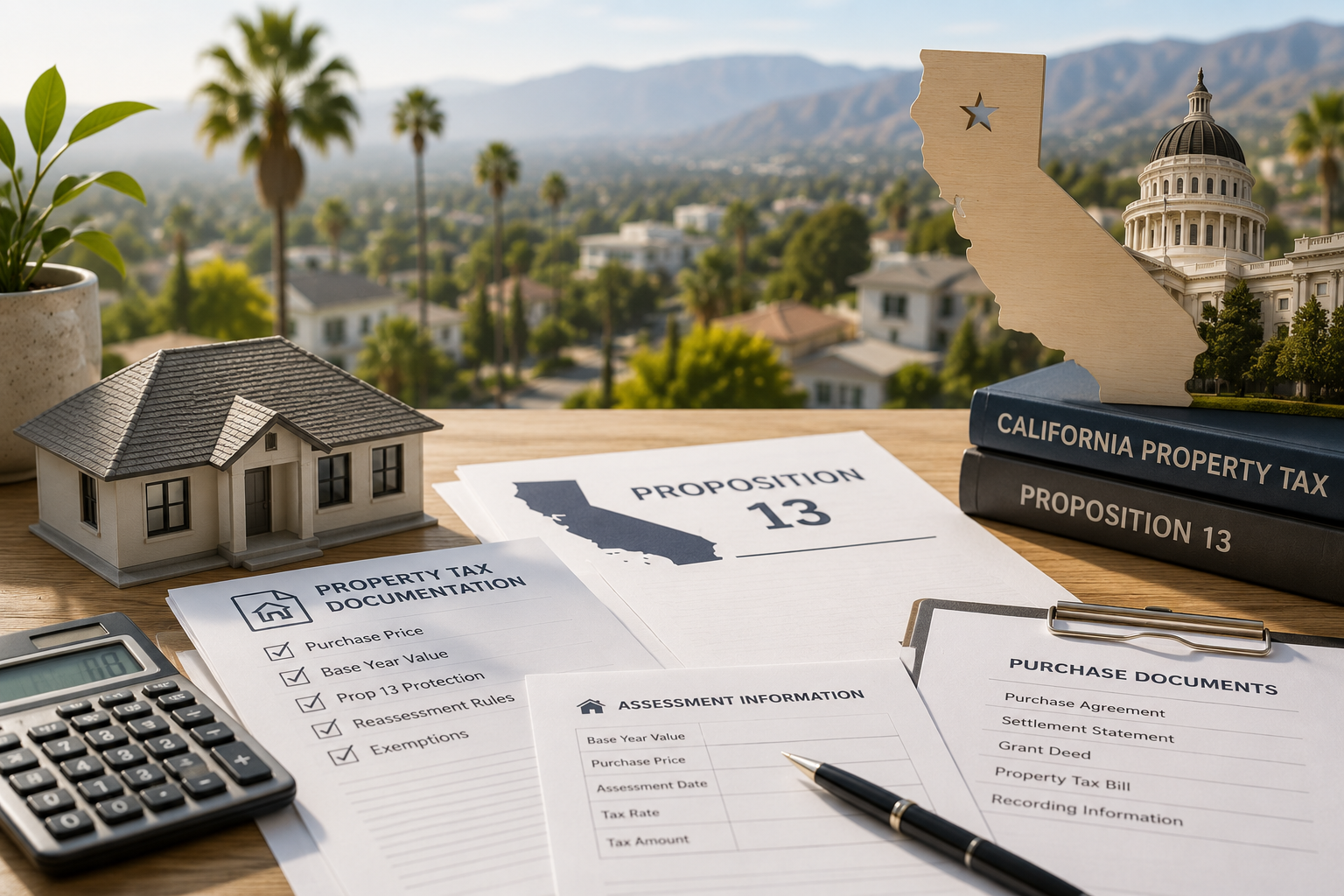 The California property tax education every Studio City buyer needs before close — the base rate, the special assessments, the parcel taxes, and specifically the supplemental tax bill that arrives 6–18 months after closing and that consistently surprises underprepared buyers at Studio City's price points. At $18,000–$42,000+ annually, property taxes are a monthly obligation that belongs in the pre-purchase financial plan, not the post-close discovery category.
Proposition 13 — the foundational rule:
California's Proposition 13, passed in 1978, established three specific rules that define every California property tax calculation:
Rule 1 — Assessment at purchase price: The assessed value of a California property is reset to the purchase price at every change of ownership. A Studio City home that sold in 2018 for $1.4M and that you are purchasing today for $2.1M will be reassessed at $2.1M — your purchase price — regardless of what the seller was paying in property taxes based on their 2018 assessment.
Rule 2 — 1% base rate: The base property tax rate is 1.0% of the assessed value. On a $2.1M Studio City purchase: $2,100,000 × 1.0% = $21,000/year base tax.
Rule 3 — Annual increase cap: After the initial assessment at purchase price, the assessed value can increase by no more than 2% per year regardless of how much the market value increases. This cap — the most significant long-term benefit of Proposition 13 — means that a Studio City buyer who purchased at $2.1M in 2026 and holds for 20 years will have an assessed value of approximately $3.1M in 2046 (at 2% annual compounding), even if the market value has reached $5M or more. The tax savings of this assessment cap compound dramatically over long hold periods.
What Proposition 13 means for the Studio City buyer:
- → ✅ Predictable tax growth: Your base property tax will never increase more than 2% per year from your purchase-price assessment — a fixed-rate quality that provides long-term financial planning certainty
- → ✅ Long-hold advantage: The longer you hold the Studio City home, the more valuable the Proposition 13 assessment cap becomes — the divergence between assessed value and market value grows over time, producing an increasingly large tax savings relative to what assessment at current market value would produce
- → ⚠️ Purchase-price reset: Every purchase triggers a full reassessment — the seller's Proposition 13 tax history provides no benefit to the buyer. Your tax obligation is based entirely on your purchase price.
2. 💰 The Complete Studio City Property Tax Bill — Base Rate Plus Assessments
The 1.0% base rate is the foundation of the Studio City property tax bill — but it is not the complete picture. Every Studio City address carries additional voter-approved assessments, parcel taxes, and special district obligations that bring the effective total rate to approximately 1.15%–1.25% of the purchase price.
The Studio City property tax components:
Base rate (1.000%): The Proposition 13 base rate. On a $2.0M purchase: $20,000/year.
Los Angeles County general obligation bonds (variable, approximately 0.02%–0.05%): County-wide general obligation bonds for infrastructure, hospitals, parks, and other voter-approved obligations. These vary by specific parcel and by the outstanding bond balance in each year. Approximate annual cost at a $2.0M purchase: $400–$1,000/year.
Los Angeles Unified School District (LAUSD) parcel taxes: LAUSD operates multiple voter-approved parcel taxes that apply to properties within LAUSD boundaries — which includes all of Studio City 91604 and 91602. These are fixed per-parcel amounts rather than percentage-based rates.
- → 📋 Measure EE (2019): $0.16/sq ft of building area annually — on a 2,200 sq ft Studio City home: approximately $352/year
- → 📋 Measure RR and other LAUSD bonds: Additional LAUSD bond obligations at the parcel level
- → 💰 Total estimated LAUSD parcel tax impact: $600–$1,200/year for a typical Studio City residential parcel, depending on building square footage and specific bond obligations in effect at the time of purchase. Verify current LAUSD parcel taxes against the specific parcel at purchase.
Los Angeles City special assessments: Studio City 91604 and 91602 are within the City of Los Angeles — subject to City of LA special assessment districts for services including:
- → 🌳 Tree trimming and urban forestry: Approximately $20–$60/year
- → 💡 Street lighting: Approximately $30–$90/year
- → 🛣️ Street sweeping and maintenance: Variable by district
Metro transportation tax: Los Angeles County Metro's voter-approved sales and property tax measures include property-based assessments that apply to Studio City parcels.
The effective total rate — Studio City 91604/91602:
Adding the base rate to all applicable additional assessments produces an effective total property tax rate of approximately:
- → 📊 1.15%–1.20% for most Studio City residential addresses
- → 📊 Up to 1.25% for addresses with specific additional district obligations
Annual property tax at Studio City purchase prices — complete picture:
$1,500,000 purchase:
- → Base tax (1.0%): $15,000
- → Additional assessments (0.15%–0.25%): $2,250–$3,750
- → Total annual property tax: $17,250–$18,750
- → Monthly equivalent: $1,438–$1,563
$1,800,000 purchase:
- → Base tax: $18,000
- → Additional assessments: $2,700–$4,500
- → Total annual: $20,700–$22,500
- → Monthly equivalent: $1,725–$1,875
$2,200,000 purchase:
- → Base tax: $22,000
- → Additional assessments: $3,300–$5,500
- → Total annual: $25,300–$27,500
- → Monthly equivalent: $2,108–$2,292
$2,600,000 purchase:
- → Base tax: $26,000
- → Additional assessments: $3,900–$6,500
- → Total annual: $29,900–$32,500
- → Monthly equivalent: $2,492–$2,708
$3,200,000 purchase (hillside/premium):
- → Base tax: $32,000
- → Additional assessments: $4,800–$8,000
- → Total annual: $36,800–$40,000
- → Monthly equivalent: $3,067–$3,333
3. ⚠️ The Supplemental Tax Bill — Studio City's Most Consistent Buyer Surprise
The supplemental property tax bill is the specific post-close financial surprise that catches more Studio City buyers off guard than any other ownership cost — and at Studio City's $1.5M–$2.6M price band, the supplemental bill is large enough to create genuine financial stress for buyers who weren't specifically prepared for it.
How the supplemental tax works:
When a Studio City home changes ownership, the Los Angeles County Assessor's office reassesses the property to the purchase price. However, the regular annual property tax bill is calculated on the prior fiscal year's assessed value — meaning that the regular tax bill the buyer receives in their first year of ownership reflects the seller's prior assessed value, not the buyer's new purchase-price assessment.
The supplemental tax bill is the correction mechanism — a separate, one-time bill that covers the tax on the difference between the seller's prior assessed value and the buyer's new purchase-price assessment, prorated for the portion of the fiscal year remaining after the close date.
The supplemental tax calculation:
Example: $2.2M Studio City purchase, seller's prior assessed value $950,000:
- → Assessment increase: $2,200,000 - $950,000 = $1,250,000
- → Annual supplemental tax on the increase (1.0%): $12,500
- → Proration (if closed October 1, with 9 months remaining in the fiscal year): $12,500 × 9/12 = $9,375 supplemental tax bill
Example: $1.8M Studio City purchase, seller's prior assessed value $420,000:
- → Assessment increase: $1,800,000 - $420,000 = $1,380,000
- → Annual supplemental tax: $13,800
- → Proration (if closed February 1, with 5 months remaining): $13,800 × 5/12 = $5,750 supplemental tax bill
The supplemental bill timing:
The supplemental bill arrives 6–18 months after the close date — the specific delay that produces the "where did this come from?" reaction from unprepared buyers. The LA County Assessor's supplemental assessment process takes 6–12 months to complete; the supplemental bill is issued after the assessment is finalized and the tax is calculated.
Why Studio City's supplemental bills are particularly significant:
Studio City homes that last sold 10–20+ years ago often have assessed values of $350,000–$700,000 — Proposition 13's annual 2% cap having grown the assessed value from a 2005–2015 purchase price to somewhere in this range by 2026. When a buyer purchases at today's $1.8M–$2.6M Studio City prices, the assessment increase of $1.1M–$2.1M produces a supplemental tax obligation of $8,000–$20,000+ — real money that arrives as a bill separate from the regular property tax installments.
Planning for the supplemental tax:
- → ✅ Estimate the supplemental tax before close: Ask the listing agent for the seller's current assessed value (available on the county assessor's website). Calculate the difference between that value and your purchase price. Multiply by 1.0%. Multiply by the prorated months remaining in the fiscal year after your close date.
- → ✅ Reserve the estimated amount at close: Set aside the estimated supplemental tax amount in a dedicated account at closing — not in the general operating account that the first-year ownership costs will draw from.
- → ✅ Anticipate two supplemental bills: The LA County Assessor may issue two supplemental bills (one for the fiscal year of close, one for the following fiscal year) if the assessment change straddles the fiscal year boundary. Budget for both.
4. 🏛️ Mello-Roos and Special Districts — What Studio City Doesn't Have (and Why It Matters)
One of Studio City's specific property tax advantages relative to newer SFV communities is the absence of Mello-Roos Community Facilities District (CFD) special taxes on most residential parcels — a fact that is worth understanding specifically because Mello-Roos obligations in other markets can add $3,000–$12,000+ annually to a property's tax burden.
What Mello-Roos is:
The Mello-Roos Community Facilities Act (1982) allows local governments to establish Community Facilities Districts that finance public infrastructure (roads, schools, parks, utilities) through special tax bonds. Properties within a CFD are obligated to pay annual Mello-Roos taxes — typically for 20–40 years — to service the bond debt. These taxes are in addition to the regular property tax and are not subject to Proposition 13's assessment or rate limitations.
Studio City's Mello-Roos status:
Studio City 91604 and 91602 are established pre-1982 residential neighborhoods — the Ventura Boulevard corridor development and the surrounding residential fabric predate the Mello-Roos era. As a result, most Studio City residential addresses do not carry CFD special tax obligations.
- → ✅ Most Studio City addresses: No Mello-Roos — the regular property tax bill is the complete tax picture (base rate + standard assessments + parcel taxes)
- → ⚠️ Verify for any specific parcel: While Mello-Roos is rare in Studio City, verify the specific parcel through the Natural Hazard Disclosure (NHD) report and the preliminary title report for any purchase. Some commercial-adjacent or newer infill development parcels may carry specific assessment district obligations.
The Mello-Roos comparison to other markets:
The absence of Mello-Roos in Studio City is a specific financial advantage relative to:
- → 📊 Porter Ranch 91326: Many Porter Ranch addresses carry Mello-Roos obligations of $2,500–$5,500/year
- → 📊 Calabasas 91302/91372 (newer sections): Some Calabasas master-planned community parcels carry CFD obligations — verify per parcel
- → 📊 Chatsworth 91311 (newer development): Some newer Chatsworth development carries Mello-Roos
- → 📊 Stevenson Ranch / Valencia (Santa Clarita Valley): Significant Mello-Roos obligations common
For buyers comparing Studio City to these alternatives, the absence of Mello-Roos in Studio City produces a meaningfully lower effective tax burden despite the higher purchase price — a comparison that belongs in the total cost-of-ownership analysis alongside the purchase price and mortgage payment.
5. 🏠 Proposition 19 — The Tax Transfer Opportunity for Qualifying Studio City Buyers
California's Proposition 19 (passed November 2020) created a significant property tax planning opportunity for qualifying buyers — and at Studio City's $1.5M–$2.8M purchase prices, the potential annual tax savings from a Proposition 19 transfer are large enough to warrant specific attention from eligible buyers.
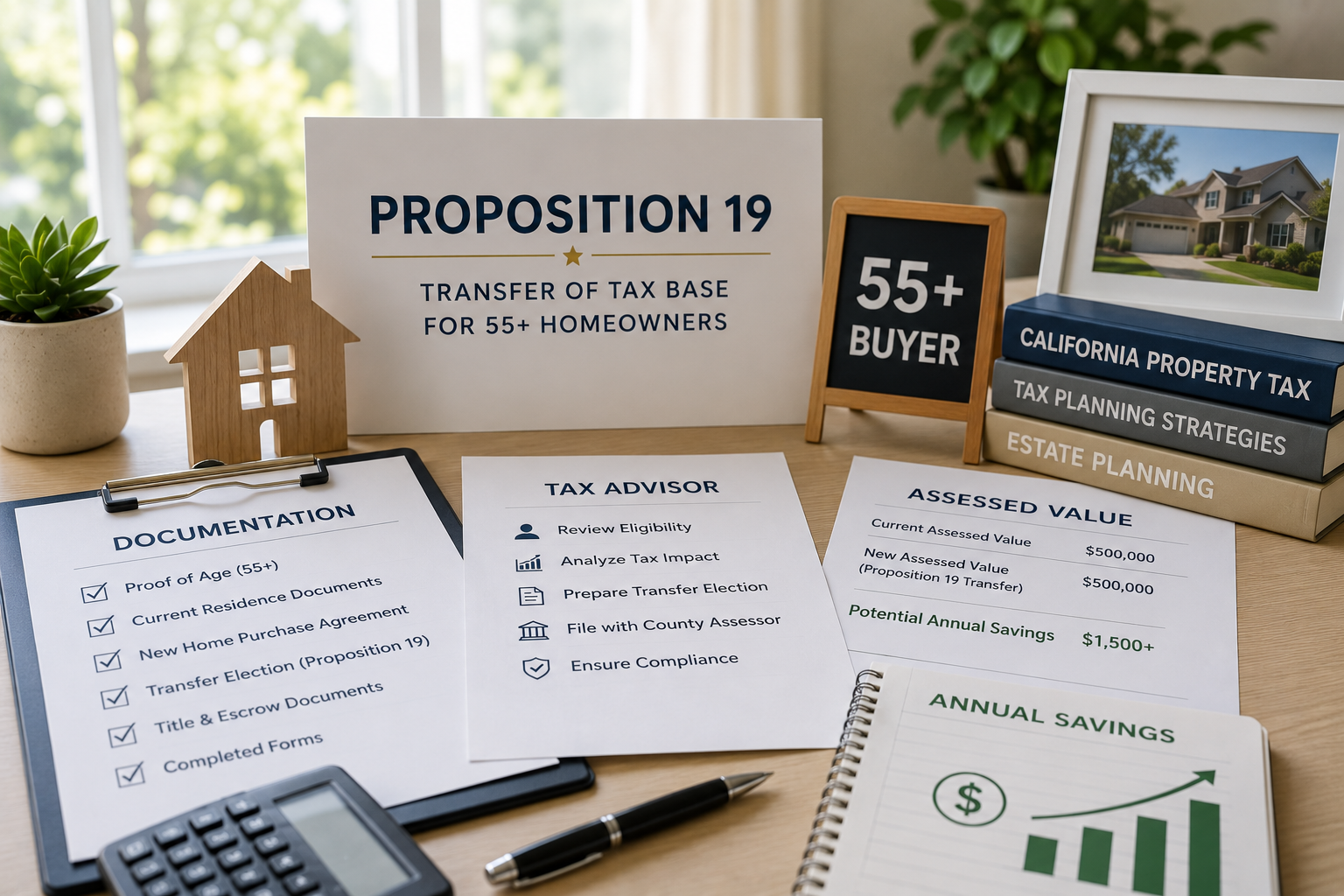 The Proposition 19 property tax planning conversation — specifically relevant for Studio City buyers who are 55 or older, severely disabled, or victims of a natural disaster and who are replacing a prior California principal residence with a Studio City purchase. At Studio City's $1.5M–$2.6M price points, the annual tax savings from a qualified Proposition 19 transfer can range from $6,000–$22,000/year — a financial planning opportunity that belongs in the pre-purchase conversation with a qualified tax professional.
Who qualifies for Proposition 19:
Proposition 19 property tax base transfers are available to:
- → ✅ Homeowners 55 years of age or older
- → ✅ Severely disabled homeowners (as defined by California Revenue and Taxation Code)
- → ✅ Victims of a governor-declared disaster who lost their home in the disaster
How the Proposition 19 transfer works:
A qualifying buyer who sells their prior California principal residence and purchases a replacement home anywhere in California within two years can transfer their current Proposition 13 assessed value to the replacement property — with a specific adjustment formula if the replacement property is more expensive than the sold property.
The Proposition 19 calculation:
If the replacement property (the Studio City home) is more expensive than the sold property:
Transferred base value = Prior home's assessed value + (Replacement home purchase price - Prior home's sale price)
Example — qualifying buyer, age 62:
- → Prior Studio City (or other California) home: assessed value $480,000, sold at $1.6M
- → Replacement Studio City purchase: $2.1M
Transferred base value = $480,000 + ($2,100,000 - $1,600,000) = $480,000 + $500,000 = $980,000
Annual tax without Proposition 19: $2,100,000 × 1.20% = $25,200/year Annual tax with Proposition 19: $980,000 × 1.20% = $11,760/year Annual tax savings: $13,440/year
Over a 20-year hold: approximately $268,800 in cumulative tax savings (before the 2% annual assessment increase cap on the transferred value — actual savings would be higher as the non-transferred assessment would have grown at 2% annually while the transferred value also grows at 2%, maintaining the differential).
Proposition 19 planning notes:
- → ⚠️ Timing requirements: The replacement home must be purchased within two years of the sale of the prior principal residence (or the sale within two years of the purchase)
- → ⚠️ Principal residence requirement: Both the sold property and the replacement property must be or have been the owner's principal residence
- → ⚠️ One-time county limit removed: Proposition 19 removed the prior restriction limiting transfers to the same county and expanded the three-county options from prior law — qualifying buyers can now transfer from any California county to any California county, including from coastal markets to Studio City
- → ✅ Consult a tax professional: Proposition 19 calculations and eligibility are complex. Studio City buyers who may qualify should confirm eligibility and calculate the specific transfer amount with a qualified California tax attorney or CPA before closing — the tax savings at Studio City's price points are large enough to warrant professional advice.
🚫 What NOT to Overdo
Don't use the seller's current property tax bill as your ownership cost estimate. The most consistent property tax planning error among Studio City buyers is using the seller's current property tax bill — which reflects the seller's Proposition 13 assessed value established at their (often much lower) purchase price — as the estimate for the buyer's future tax obligation. If the seller purchased their Studio City home in 2008 for $850,000 and the assessed value has grown to approximately $1.1M by 2026, their annual tax bill is approximately $13,200. Your purchase at $2.2M will produce an annual tax obligation of approximately $25,300–$27,500 — nearly double the seller's current bill. Base your planning on your purchase price, not the seller's current tax document.
Don't close on a Studio City purchase without specifically budgeting for the supplemental tax bill. The supplemental tax bill — arriving 6–18 months after close — is the most consistently cited post-close financial surprise among Studio City buyers. At purchase prices of $1.8M–$2.6M with prior assessed values of $400,000–$900,000, the supplemental tax obligation of $9,000–$18,000+ is a real, specific, and calculable obligation. Calculate it before close, reserve the amount at close, and treat it as a known future expense rather than a surprise.
Don't assume Mello-Roos is present simply because Studio City is in Los Angeles County. Many buyers who have encountered Mello-Roos in newer SFV or Santa Clarita Valley communities assume that all LA County properties carry these obligations. Most Studio City 91604/91602 residential addresses are Mello-Roos-free — the established pre-1982 neighborhood fabric predates the CFD financing mechanism. Confirm through the NHD disclosure and preliminary title report for any specific parcel.
Don't neglect to explore Proposition 19 eligibility if you are 55 or older. The annual property tax savings from a qualified Proposition 19 transfer at Studio City's price points — $8,000–$20,000+/year in many scenarios — are large enough to materially change the financial case for a Studio City purchase for qualifying buyers. Many qualifying buyers are not aware of the opportunity or assume they don't qualify because their prior home was in a different county. Consult a California tax professional before closing on any Studio City purchase if you are 55 or older and are selling a prior California principal residence within the two-year window.
Don't treat property taxes as fixed beyond the 2% annual increase cap. California voters periodically approve new parcel taxes and general obligation bonds that add to the annual property tax bill above the 1% base rate and existing assessments. LAUSD bond measures, county infrastructure bonds, and city assessment district expansions have historically added to the total property tax burden over time. Build a modest contingency (0.05%–0.10% of assessed value annually) into long-term property tax projections to account for the possibility of new voter-approved obligations during the hold period.
🏠 Real-World Scenario — Studio City 91604
A couple — a television writer and a therapist in private practice, combined income $520,000, purchasing a south-of-Ventura Studio City 91604 home at $2.35M — had modeled their monthly ownership costs from the lender's payment disclosure: P&I of $13,265/month (10% down, $2,115,000 loan at 7.25%), plus the lender's escrow estimate for property taxes of $1,800/month, plus insurance of $280/month — for a total PITI of $15,345/month.
The lender's escrow estimate of $1,800/month — $21,600 annually — was based on the seller's current property tax bill, which reflected the seller's 2012 assessed value of approximately $1.1M. The actual property tax obligation on the buyer's $2.35M purchase: approximately $27,025–$29,375 annually ($2,252–$2,448/month).
The difference: $452–$648/month in additional monthly tax cost that the lender's escrow estimate had understated. The annual difference: $5,425–$7,775.
Additionally, the seller's prior assessed value of $1.1M produced a supplemental tax calculation:
- → Assessment increase: $2,350,000 - $1,100,000 = $1,250,000
- → Annual supplemental tax on the increase: $12,500
- → Proration (close in March, 4 months remaining in fiscal year through June 30): $12,500 × 4/12 = $4,167 first supplemental bill
- → Second supplemental bill (full following fiscal year on the assessment increase): approximately $12,500
- → Total supplemental tax obligation in months 6–18 after close: approximately $16,667
When we walked through the complete property tax picture with this couple before close:
- → Corrected monthly property tax escrow: $2,350/month (versus the $1,800 estimate)
- → Supplemental tax reserve at close: $17,000 set aside in a dedicated reserve account
- → Total first-year ownership cost adjustment from property tax correction: approximately $556/month additional recurring + $17,000 one-time reserve
Their response: "We had no idea the escrow estimate was based on the seller's tax rate. We thought we'd already accounted for property taxes. This is real money — we need to adjust our reserves before closing."
They adjusted their close-of-escrow reserve allocation, set aside the $17,000 supplemental estimate, and closed without financial stress. The supplemental bill arrived 11 months after close at $4,050 (first installment) — within their $17,000 reserve. The second supplemental bill arrived 14 months after close at $12,300 — also within their reserve.
The couple who understood the complete property tax picture before close managed the obligation as a planned expense. The Studio City buyer at the same price point who relies on the lender's escrow estimate and doesn't reserve for the supplemental discovers both the corrected escrow amount and the supplemental bill in the same 12-month post-close period — producing the financial stress that specific pre-purchase education prevents.
🏠 Real-World Scenario — Studio City 91604
A buyer — a 58-year-old entertainment industry producer, purchasing her first Studio City home as a replacement for a Santa Monica 90405 condominium she was selling — was specifically eligible for Proposition 19 property tax transfer.
Her Santa Monica condo: assessed value $385,000 (purchased 2006), selling at $1.42M. Her Studio City replacement purchase: $1.95M.
Without Proposition 19:
- → Annual Studio City property tax: $1,950,000 × 1.20% = $23,400/year
- → Monthly: $1,950/month
With Proposition 19 transfer:
- → Transferred base value: $385,000 + ($1,950,000 - $1,420,000) = $385,000 + $530,000 = $915,000
- → Annual property tax on transferred base: $915,000 × 1.20% = $10,980/year
- → Monthly: $915/month
- → Annual savings: $12,420/year
- → 20-year cumulative savings: approximately $248,400 (before the 2% annual growth differential compounding — actual cumulative savings would be larger)
We connected her with a California tax attorney who confirmed her Proposition 19 eligibility, verified the timing (her Santa Monica condo closed 4 months before the Studio City purchase, within the 2-year window), and filed the required Claim for Base Year Value Transfer form with the LA County Assessor's office.
Her annual property tax on the $1.95M Studio City purchase: $10,980/year — effectively the same annual obligation as her prior Santa Monica condo tax (which had been growing at 2% from her 2006 purchase). Her monthly PITI on the Studio City purchase was $1,035/month less than it would have been without the Proposition 19 transfer — a material quality-of-life improvement that was entirely dependent on knowing Proposition 19 existed and specifically applying for the transfer before closing.
The $12,420/year in annual tax savings over a projected 20-year hold: approximately $248,400 in cumulative savings — a financial benefit larger than most buyers would expect from a property tax mechanism.
❓ FAQ
What are property taxes in Studio City? Property taxes in Studio City 91604 and 91602 are calculated at approximately 1.15%–1.25% of the purchase price annually — combining California's Proposition 13 base rate of 1.0% with LAUSD parcel taxes, LA County general obligation bond assessments, and City of LA special district assessments. At Studio City's primary purchase prices: ✓ $1.5M purchase: $17,250–$18,750/year ($1,438–$1,563/month). ✓ $1.8M purchase: $20,700–$22,500/year. ✓ $2.2M purchase: $25,300–$27,500/year. ✓ $2.6M purchase: $29,900–$32,500/year. The assessed value is reset to your purchase price at every change of ownership under Proposition 13.
How does Proposition 13 affect Studio City property taxes? Proposition 13 establishes three rules that govern every California property tax: ✓ Assessment at purchase price — your Studio City home is assessed at your specific purchase price, not at market value in subsequent years. ✓ 1% base rate — the annual base tax is 1.0% of the purchase-price assessed value. ✓ 2% annual increase cap — the assessed value can grow no more than 2% per year regardless of market appreciation. The practical benefit: a Studio City buyer who purchased at $2.0M in 2026 will have a significantly lower tax obligation in 2036 than a hypothetical buyer who purchased in 2026 and was assessed at current market value each year — Proposition 13 locks in the 2026 purchase price as the starting point.
What is the supplemental property tax bill in Studio City? The supplemental property tax bill is a one-time, separate billing that arrives 6–18 months after your close date — covering the tax on the difference between the seller's prior assessed value and your new purchase-price assessment, prorated for the portion of the fiscal year after your close. On a $2.2M Studio City purchase where the seller's assessed value was $900,000: the assessment increase of $1,300,000 produces a supplemental tax of $13,000/year; the proration for the remaining portion of the fiscal year produces a first supplemental bill of approximately $4,300–$10,800 depending on the close date. A second supplemental bill may follow for the subsequent fiscal year. Reserve the estimated supplemental amount at close — the most consistently underprepared Studio City buyer expense.
Does Studio City have Mello-Roos taxes? No — most Studio City 91604 and 91602 residential addresses are Mello-Roos-free. Studio City's established pre-1982 neighborhood fabric predates the Mello-Roos Community Facilities Act, and most residential parcels do not carry Community Facilities District special tax obligations. This is a specific tax advantage relative to newer master-planned communities in Porter Ranch 91326, parts of Calabasas 91302/91372, and the Santa Clarita Valley. Verify for any specific parcel through the Natural Hazard Disclosure report and preliminary title report.
What is Proposition 19 and does it apply to Studio City buyers? Proposition 19 allows qualifying California homeowners — those 55 or older, severely disabled, or disaster victims — to transfer their current Proposition 13 assessed value to a replacement home anywhere in California within two years of selling their prior principal residence. For qualifying Studio City buyers replacing a prior California home, the annual tax savings can be substantial: $8,000–$20,000+/year at Studio City's price points, depending on the prior home's assessed value and the Studio City purchase price. Consult a California tax attorney or CPA before closing if you are 55 or older and are selling a prior California principal residence within the two-year window.
How do I calculate my Studio City property taxes before buying? The calculation process: ✓ Take your purchase price and multiply by 1.0% for the base annual tax. ✓ Add estimated additional assessments (approximately 0.15%–0.25% of purchase price) for LAUSD parcel taxes, county bonds, and city assessments. ✓ Ask the listing agent for the seller's current assessed value (available at the LA County Assessor's website at assessor.lacounty.gov). ✓ Calculate the supplemental tax estimate: (your purchase price - seller's assessed value) × 1.0% × (months remaining in fiscal year after close/12). ✓ Reserve the supplemental tax estimate at close in a dedicated account. ✓ If you are 55 or older and selling a prior California home, consult a tax professional about Proposition 19 eligibility before closing.
🎯 Bottom Line
Property taxes are among Studio City's most significant ongoing ownership costs — and at $17,250–$40,000+ annually depending on purchase price, they are large enough to require specific financial planning before closing rather than post-close discovery. The complete Studio City property tax picture has four specific components that buyers must understand: the Proposition 13 base rate assessment at purchase price, the additional 0.15%–0.25% in LAUSD parcel taxes and county/city assessments that bring the effective rate to 1.15%–1.25%, the supplemental tax bill of $4,000–$18,000+ that arrives 6–18 months after close, and the Proposition 19 transfer opportunity that can save qualifying buyers $8,000–$20,000+/year.
The Studio City buyer who understands all four components before closing — who has estimated the correct annual tax obligation from their purchase price rather than the seller's tax bill, who has reserved the supplemental tax amount at close, who has confirmed the absence of Mello-Roos for their specific parcel, and who has explored Proposition 19 eligibility if they qualify — manages the property tax obligation as a known, planned expense. The buyer who discovers these components after closing manages them as surprises — at Studio City's price points, expensive ones.
At Parkway Estate Properties, Liana's buyer representation across Studio City 91604/91602, Sherman Oaks 91403/91423, Encino 91316/91436, Tarzana 91356, and Woodland Hills 91364/91367 means every buyer consultation includes the complete property tax education — the correct annual estimate, the supplemental tax timing and reserve calculation, and the Proposition 19 eligibility screening — before any offer is written.
📩 Want a Complete Property Tax Calculation for a Specific Studio City Home You're Evaluating?
We'll pull the seller's current assessed value, calculate your specific annual tax obligation, estimate the supplemental tax timeline and amount, and confirm the Mello-Roos status for the specific parcel — before you make an offer.
Contact Liana Shersher at Parkway Estate Properties: 📧 liana@parkwayestate.com · 📞 (818) 208-5881 · 🌐 parkwayestate.com 15021 Ventura Blvd., Ste. 510, Sherman Oaks, CA 91403
About the Authors
Liana Shersher is a licensed real estate agent with Parkway Estate Properties Inc. and an Accredited Buyer's Representative (ABR) serving the San Fernando Valley — with a focus on Sherman Oaks, Encino, Tarzana, Woodland Hills, and Northridge (DRE# 02164224). Liana guides first-time homebuyers through every step of the purchase, from the first showing to the keys in hand, and represents move-up and repeat buyers across the Valley. For sellers, she builds the pricing and marketing strategy that positions a home to sell for top dollar, fast. Buyers and sellers work with Liana for clear communication, sharp local knowledge, and an agent who treats their goals like her own.
Roman Shersher is the broker-owner of Parkway Estate Properties Inc. and a real estate investor with 18 years of experience in the San Fernando Valley (DRE# 01855095). Roman has personally led or co-led renovations on dozens of properties across the Valley, including recent projects in Northridge (91324) and Woodland Hills (91364). That hands-on renovation and investment experience shapes every pricing conversation and days-on-market strategy at Parkway — sellers get a realistic read on what improvements actually return at resale, and buyers get an expert eye on a home's true condition and upside.
Parkway Estate Properties, Inc. · 15021 Ventura Blvd., Ste. 510, Sherman Oaks, CA 91403 · (818) 208-5881 · parkwayestate.com · Broker License #: 01873092 Equal Housing Opportunity. Information herein is general and not legal, tax, or financial advice. Consult qualified professionals for your specific situation.
Categories
Recent Posts










Broker | Realtor ® License ID: 01873092
+1(818) 208-5881 | info@parkwayestate.com