
What's the Average Days on Market in Calabasas?

Days on market in Calabasas 91302 and 91372 is not a single number that applies uniformly across the neighborhood — it is a set of specific, sub-market-differentiated data points that vary dramatically by price tier, condition tier, sub-neighborhood, wildfire insurance status, and seasonal window. A correctly priced, well-prepared home in the core Calabasas flatland at $1.45M during spring peak conditions closes in 18–32 days. A premium hillside home at $2.4M with wildfire insurance complications launched in August closes — if it closes at all in that window — after 65–120+ days and multiple price reductions.
Understanding this variation is the most important market intelligence any Calabasas seller can have before setting a list price, planning a launch timeline, and calibrating their expectations for the negotiation that follows. Sellers who understand that their specific home's DOM expectation is a function of its specific price tier, its specific insurance situation, and its specific seasonal launch window make better pricing decisions and better negotiation decisions than sellers who apply a single "Calabasas average DOM" number to a home that may trade very differently from that average.
This article gives Calabasas sellers the complete DOM picture — by price tier, by season, by insurance status, and by the specific market feedback signals that indicate whether a correction is needed and how quickly.
1. 📊 DOM by Price Tier — The Two-Speed Calabasas Market
Calabasas 91302 and 91372 operate as a two-speed market — a reality documented throughout the PEP Calabasas content cluster and the most important single fact for sellers determining their DOM expectations. The volume tier and the premium tier are not simply different price levels of the same market; they are functionally different markets with different buyer pools, different demand drivers, and different DOM profiles.
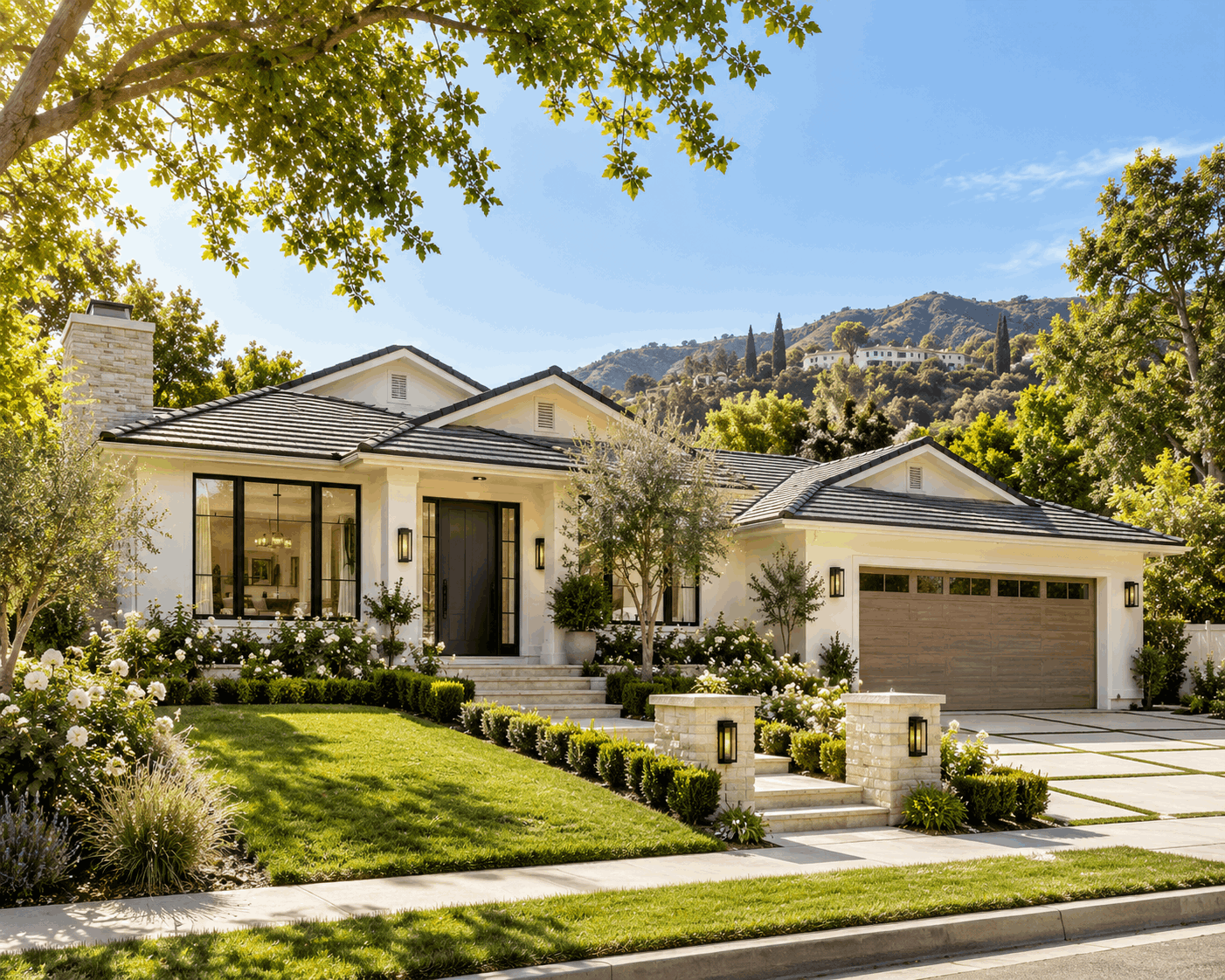 The Calabasas two-speed DOM reality — the core flatland volume tier ($1.3M–$1.7M) that closes in 18–35 days in spring peak conditions versus the premium and hillside tier ($1.8M+) that produces 38–75+ days even at correct pricing. The tier your home occupies determines your realistic DOM expectation more reliably than any other single variable.
The core flatland volume tier ($1.3M–$1.7M):
This is the Calabasas sub-market where seller conditions are strongest — where LVUSD school enrollment urgency drives specific, deadline-motivated buyer demand, where the active buyer pool is deepest, and where correctly priced, well-prepared listings produce the shortest DOM in the 91302/91372 coverage area.
DOM benchmarks by condition and season:
- → 🌸 Spring peak (February–May), renovated condition: 18–28 days — the strongest seller conditions available in the Calabasas market. Multiple offers common for correctly priced renovated homes.
- → 🌸 Spring peak, improved condition: 22–38 days — solid first-week showing traffic; offers typically by days 10–21.
- → 🌸 Spring peak, original condition: 28–48 days — the investor and renovation-ready buyer pool generates activity; correctly priced original-condition homes attract BRRRR and developer interest within this window.
- → 🍂 Fall (October–November), renovated: 25–42 days — approaching spring conditions for correctly priced listings.
- → ☀️ Summer (June–August), renovated: 38–58 days — meaningful slowdown from spring; buydown marketing and midpoint pricing required to generate comparable showing traffic.
- → ❄️ Winter (December–January): 55–85+ days — avoid unless timeline requires.
Why LVUSD drives the volume tier DOM:
Las Virgenes Unified School District's enrollment calendar creates specific, non-discretionary buyer urgency in the spring window — families who need to establish 91302/91372 residency before the school year have genuine deadline pressure that the premium tier's more discretionary buyers don't experience. This urgency compresses DOM for volume tier listings the same way GHCHS enrollment urgency compresses Granada Hills's spring DOM and ECR Charter urgency compresses Tarzana's spring DOM.
The premium and hillside tier ($1.8M–$2.8M):
This is the Calabasas sub-market where buyer leverage is most present — where the 2022–2023 correction has not been fully retraced, where the buyer pool is meaningfully thinner, and where the wildfire insurance complications that affect many hillside addresses add specific friction to the purchase timeline.
DOM benchmarks:
- → 🌸 Spring peak, renovated: 38–65 days — the thinner buyer pool limits first-week showing traffic even in the best seasonal window; competitive offers are less automatic than in the volume tier
- → 🌸 Spring peak, original condition: 55–90 days — the premium tier's investor and spec-builder acquisition buyer pool is smaller than Reseda or Northridge's equivalent, producing slower absorption even for correctly priced original-condition homes
- → 🍂 Fall, renovated: 45–75 days
- → ☀️ Summer, renovated: 65–110 days
- → ❄️ Winter: 80–140+ days
The luxury and gated estate tier ($2.8M+):
- → 📊 All seasons: 55–140+ days for correctly priced listings — the most discretionary buyer pool and the highest rate sensitivity
- → 📊 Overpriced listings: 120–240+ days with multiple reductions — the extended DOM pattern that most consistently produces the lowest final prices relative to original asking
- → ⚠️ The Calabasas luxury reality: The $2.8M+ tier has the least reliable DOM predictability — one extraordinary buyer who specifically wants a specific estate can close in 30 days; the absence of that buyer produces a year of market exposure
2. 🔥 Wildfire Insurance — The Calabasas-Specific DOM Variable
The wildfire insurance complication is the most specific and most consequential DOM variable in the Calabasas market — the one that has no equivalent in most other PEP SFV markets and that sellers must understand and prepare for before listing, not after.
How wildfire insurance affects Calabasas DOM:
California's admitted market insurance carriers have withdrawn from writing new policies for many VHFHSZ (Very High Fire Hazard Severity Zone) designated properties across Calabasas 91302 and 91372. Properties that can no longer access admitted market coverage must use the California FAIR Plan — California's insurer of last resort — which provides more limited coverage at higher premiums and which lenders may not accept without supplemental coverage.
When a buyer's lender requires specific insurance coverage and the only available carrier is the FAIR Plan at a premium or coverage level the lender doesn't accept, the transaction timeline extends — sometimes significantly — as the buyer shops for supplemental coverage, negotiates with the lender's insurance requirements, or ultimately cannot close the purchase.
The DOM impact of wildfire insurance complications:
- → ⏱️ Properties with available admitted market insurance: Standard DOM profile for the price tier and season — no additional timeline friction
- → ⏱️ Properties with FAIR Plan-only access: Approximately 20–45 additional days added to the standard DOM — the time buyers need to navigate the insurance market, understand their lender's requirements, and either obtain the necessary supplemental coverage or make the financing decision to proceed without it
- → ❌ Properties where FAIR Plan + supplemental coverage together don't satisfy the lender's requirements: These properties effectively cannot sell to financed buyers at any price — they are limited to the cash buyer pool, which dramatically reduces buyer competition and produces the extended DOM that comes with a specific, thin buyer audience
What Calabasas sellers should do before listing:
- → ✅ Identify your property's insurance status: Determine whether your specific 91302/91372 address is in a VHFHSZ zone and whether admitted market insurance is available by contacting your current insurer and 2–3 additional admitted market carriers
- → ✅ Obtain a binding insurance quote: The time to discover that your property has insurance complications is before you sign the listing agreement — not during buyer inspection contingency when a financing problem surfaces
- → ✅ Prepare disclosure documentation: California's NHD (Natural Hazard Disclosure) report will identify fire hazard zone status; sellers should also proactively disclose the insurance market situation and any FAIR Plan dependency in the listing disclosures
- → ✅ Pre-market insurance research: Some sophisticated Calabasas listing agents prepare an insurance research packet for buyer agents — identifying available carriers, current FAIR Plan premium rates, and the supplemental coverage options that bring total coverage to lender-acceptable levels. This proactive disclosure reduces the buyer's timeline surprise and compresses the escrow insurance negotiation period
The marketing implication:
Calabasas listings where admitted market insurance is available should specifically market this as a differentiating feature — "admitted market homeowner's insurance available" — because buyers and buyer agents who have encountered FAIR Plan complications in prior Calabasas transactions will specifically filter for this attribute. It is not a marketing gimmick; it is a genuine and specific advantage that compresses the buyer's financing timeline and reduces closing risk.
3. 📅 Seasonal DOM Patterns — The Calabasas Calendar
Calabasas's seasonal market pattern reflects the broader western Valley and SFV calendar but with specific modifications driven by the entertainment industry buyer concentration, the LVUSD enrollment calendar, and the wildfire risk awareness that specifically suppresses showing activity in the peak fire season months.
The Calabasas selling calendar:
🌸 Spring (February–May) — The primary window:
February through May is the Calabasas seller's strongest window — the combination of entertainment industry professional buyer activation (production schedule clarity, income certainty), LVUSD enrollment urgency for family buyers with school-age children, and the seasonal inventory constraint that keeps active listings below spring buyer demand.
- → ✅ Volume tier spring: The strongest conditions available in the Calabasas market. LVUSD-motivated buyers with genuine deadline pressure, correct pricing produces first-week showing traffic, multiple offers on correctly priced renovated homes.
- → ✅ Premium tier spring: The best premium tier conditions of the year — still relatively thin buyer pool but at its annual maximum depth. Midpoint pricing (not ceiling pricing) produces the best results in this tier even in spring.
- → 📅 Preparation timeline: Sellers targeting a mid-March launch must begin preparation in November–December. The entertainment industry professional buyer's peak activation is in February (pilot season) — launching in late March has already missed the peak of this specific buyer cohort.
🍂 Fall (October–November) — The secondary window:
The fall re-engagement window in Calabasas is a genuine second opportunity — re-engaged buyers who missed spring, year-end financial event buyers, and the thinner competing inventory that fall produces.
- → 📊 Volume tier fall: DOM 25–42 days for correctly priced listings — approaching spring conditions in some years when inventory is particularly thin
- → 📊 Premium tier fall: DOM 45–75 days — meaningfully better than summer but significantly longer than spring
- → ⚠️ Fire season overlap: October is peak Southern California fire season — the specific month when fire risk awareness is highest and when buyers evaluating Calabasas hillside properties are most acutely aware of the wildfire risk. Hillside and canyon-adjacent properties may experience additional buyer hesitation in October specifically from fire risk awareness.
- → 📅 The November 10 cutoff: The Calabasas fall window closes sharply. After November 10, buyer attention competes increasingly with holiday planning and the holiday season's reduced real estate focus. A October 1 fall launch has 6 weeks of fall momentum; a November 5 launch has 1–2 weeks.
☀️ Summer (June–August) — The moderation period:
- → 📊 Volume tier summer: DOM 38–58 days — LVUSD enrollment urgency has resolved, entertainment industry above-the-line buyers are in production, showing activity drops 30–45% from spring
- → 📊 Premium tier summer: DOM 65–110 days — the thinner buyer pool shrinks further; summer is when premium Calabasas listings most often accumulate the extended DOM that damages subsequent negotiating position
- → 🌡️ Heat factor: Calabasas summer temperatures (88–104°F) specifically suppress afternoon showings — schedule morning-only open houses and showing windows in July and August
- → ✅ Summer strategy: Seller-paid 2-1 buydown marketed proactively (the specific payment relief that activates payment-sensitive buyers who are still searching in summer), midpoint pricing rather than ceiling pricing, morning-only showing windows
❄️ Winter (December–January) — Avoid unless required:
- → 📊 All tiers: DOM 65–140+ days — holiday compression, minimal buyer pool, the worst conditions for any Calabasas price tier
- → ✅ The January pre-activator window: The last two weeks of January contain a specific pre-activator buyer pool — highly pre-approved buyers who have been waiting since fall and who re-engage in mid-to-late January before the spring inventory wave arrives. A January 20–25 launch targeting this buyer pool is the only winter launch strategy with a realistic chance of spring-equivalent results.
4. 📣 Reading Market Feedback — The Calabasas DOM Signals
Calabasas's thin buyer pool — 20–40 active buyers at any given price tier at any given time — means that week-one market feedback signals are produced by a smaller sample than volume markets, and interpreting them correctly requires understanding what the signal means in this specific thin-market context.
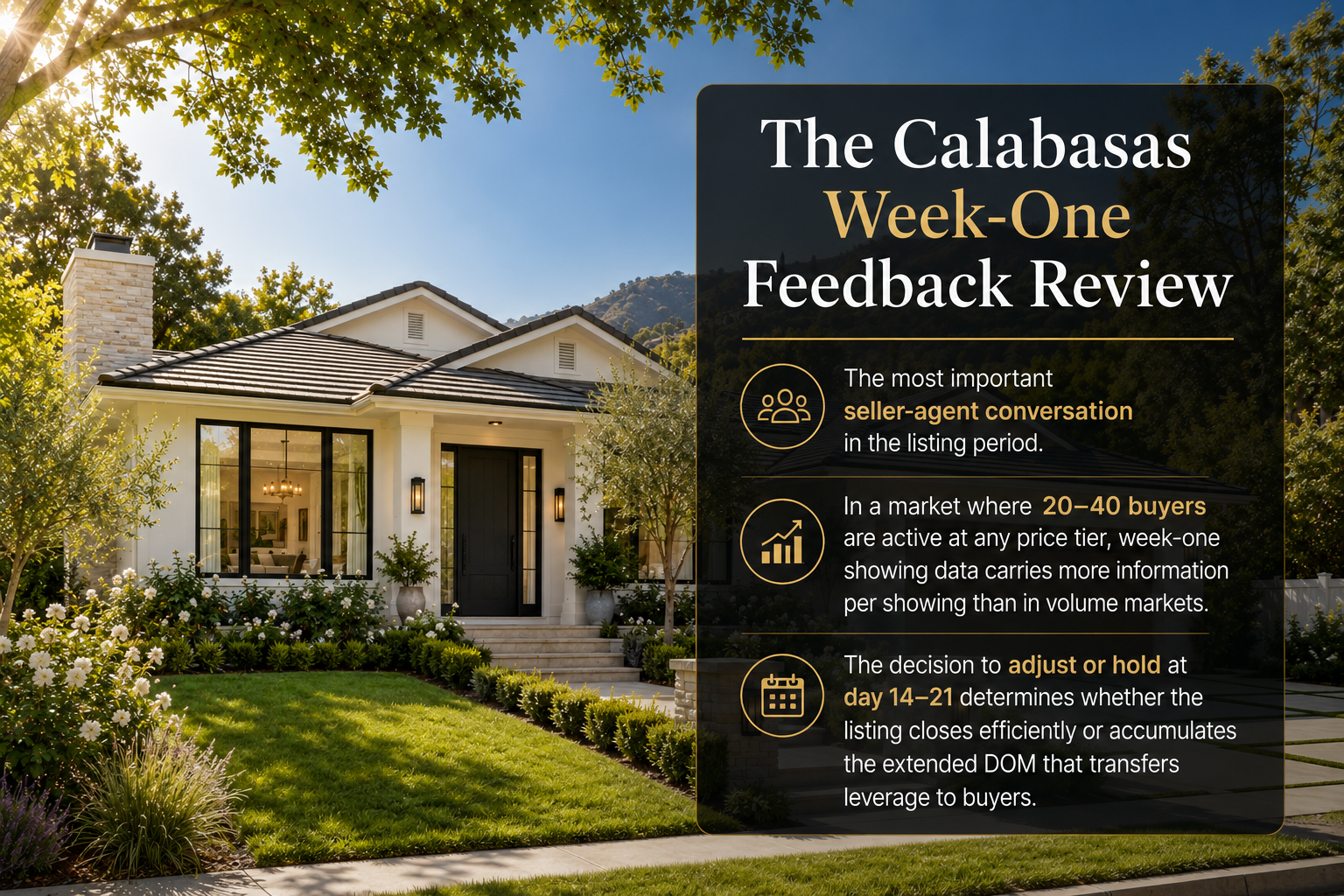 The Calabasas week-one feedback review — the most important seller-agent conversation in the listing period. In a market where 20–40 buyers are active at any given price tier, week-one showing data carries more information per showing than in volume markets, and the decision to adjust or hold at day 14–21 determines whether the listing closes efficiently or accumulates the extended DOM that transfers leverage to buyers.
Week-one feedback signals by tier:
Volume tier ($1.3M–$1.7M) — 20–30 active buyers:
- → ✅ 8–12 showings in week one: Correct pricing. The majority of the active buyer pool engaged. Expect offers by day 10–18 for renovated condition.
- → ⚠️ 4–7 showings: Cautionary. Price may be at the top of buyer comfort. Monitor week two closely before adjusting.
- → 🚨 0–3 showings: Pricing signal. The price has filtered the active buyer pool at the search-filter stage. At this showing level, virtually no buyers are scheduling because the price exceeds their search parameters. Act by day 14.
Premium tier ($1.8M–$2.8M) — 8–15 active buyers:
- → ✅ 5–8 showings in week one: Strong signal for this thin market. The majority of available buyers engaged. Hold pricing and expect offers within the following 2–3 weeks.
- → ⚠️ 3–4 showings: Moderate engagement. At 3–4 showings, approximately 25–40% of the active buyer pool toured — not alarming but not strong. Monitor week two.
- → 🚨 0–2 showings: Serious pricing signal in a thin market. At 0–2 showings, essentially no buyers from the active pool are scheduling — they have evaluated the property against their comp set and assessed it as overpriced before visiting. At this tier, zero week-one showings means the active buyer pool has collectively passed.
Luxury tier ($2.8M+) — 5–10 active buyers:
- → ✅ 3–5 showings in week one: The majority of the available buyer pool engaged. Proceed.
- → ⚠️ 1–2 showings: Standard for this thin market — not a strong signal in either direction. This tier regularly produces sparse early-week showing that resolves into an offer from the one specific buyer whose priorities the listing serves.
- → 🚨 0 showings in week two after 1 showing in week one: Strong signal. The one buyer who toured passed. No new buyers are engaging. Price needs evaluation.
The DOM curve — why early correction matters:
The Calabasas premium and luxury tier DOM curve is the specific reason early market feedback response matters more here than in volume markets. At the volume tier, a price reduction at day 21 resets market engagement because new buyers are constantly entering the active pool — there is a turnover of approximately 20–30% of the active buyer pool monthly. At the premium and luxury tier, buyer pool turnover is slower — it takes 8–12 weeks for meaningful new buyers to enter the active pool. A correction at day 21 in the premium tier can still produce a second-showing wave from the original buyer pool. A correction at day 60 arrives after the original buyer pool has moved on and the re-listed listing carries the DOM stigma of a failed first attempt.
The meaningful adjustment standard:
When feedback signals a pricing correction in Calabasas:
- → 💰 Volume tier: 3–5% adjustment — $45,000–$80,000 on a $1.5M listing — the reduction that moves the listing from one buyer pool search tier to another
- → 💰 Premium tier: 4–6% adjustment — $80,000–$150,000 on a $2.0M–$2.5M listing — the reduction that changes which buyers see the listing in their search filters and which signals to buyer agents that the seller is serious about transacting
- → 💰 Luxury tier: 5–8% adjustment — $150,000–$250,000 on a $3M listing — the reduction that demonstrates to the thin, patient luxury buyer pool that the seller has recalibrated to market reality
5. 💡 DOM and Net Proceeds — Why Correct Pricing Produces Better Outcomes
The relationship between DOM and net proceeds in Calabasas is the central argument for correct pricing from launch — and it is a relationship that most sellers intuitively understand in the abstract but consistently underestimate in the specific dollar consequences.
The Calabasas DOM-to-net-proceeds relationship:
Volume tier case study at $1.5M:
A correctly priced Calabasas 91302 volume tier listing at $1.49M in spring peak:
- → DOM: 22 days
- → Close: $1.51M (2 competing offers, above-asking resolution)
- → Carrying costs during listing: 22 days × $7,800/month = $5,720
- → Net proceeds: approximately $1.41M after commission and closing costs
The same home at $1.62M (9% overpriced):
- → Week one: 2 showings, no offers
- → Day 28: price reduction to $1.56M
- → Week six: 3 showings, one offer at $1.47M
- → Counter-accepted at $1.49M at day 52
- → Carrying costs: 52 days × $7,800/month = $13,520
- → Close: $1.49M — $20,000 less than the correctly priced alternative
- → Net proceeds: approximately $1.38M — $30,000 less than correct pricing, despite closing at essentially the same price, because of 30 additional days of carrying costs
Premium tier case study at $2.2M:
A correctly priced premium Calabasas listing at $2.15M in spring:
- → DOM: 58 days
- → Close: $2.09M (one offer, modest negotiation)
- → Carrying costs: 58 days × $11,200/month = $21,700
- → Net proceeds: approximately $1.94M
The same home at $2.45M (14% overpriced):
- → Week one: 1 showing, no offer
- → Day 35: reduction to $2.35M — still above the correct ceiling
- → Day 72: reduction to $2.19M — approaching the correct level
- → Day 88: offer at $2.05M from a buyer using 88 days of DOM as negotiating leverage
- → Counter-accepted at $2.10M at day 94
- → Carrying costs: 94 days × $11,200/month = $35,200
- → Close: $2.10M — comparable to the correctly priced outcome
- → Net proceeds: approximately $1.92M — $20,000 less despite comparable close price, due to carrying cost differential and a buyer who used 88 days of DOM leverage to extract every dollar
The Calabasas carrying cost reality:
At Calabasas's price points, monthly ownership costs — mortgage (if leveraged), property taxes, insurance, utilities, and HOA (for gated communities) — run $8,000–$18,000/month depending on the price tier. Every unnecessary month of market exposure costs:
- → 💰 Volume tier ($1.3M–$1.7M): $7,500–$9,500/month in carrying costs
- → 💰 Premium tier ($1.8M–$2.8M): $9,500–$14,000/month
- → 💰 Luxury tier ($2.8M+): $13,000–$20,000+/month
For a premium tier seller whose carrying cost is $11,200/month: the difference between a 35-day close and a 90-day close is $12,040 in additional carrying costs. The overpriced listing that "holds firm" for 55 additional days while the seller waits for the market to validate their price has spent $20,350 on carrying costs that correct pricing from launch would not have produced.
🚫 What NOT to Overdo
Don't anchor your list price to the 2022 peak — Calabasas's premium tier is still 8–15% below it. The 2022 peak in Calabasas was produced by a specific, temporary combination of sub-3% rates, pandemic-driven space demand, and the resulting buyer pool that included buyers who could stretch further than current rate environments allow. The premium and luxury tier ($1.8M+) has not retraced to 2022 peak pricing as of 2026. Sellers who price to the 2022 peak experience the extended DOM that the current buyer pool's purchasing power cannot support — accumulating the 90–120+ day listings that define the Calabasas premium tier's most frustrated seller experiences.
Don't assume the LVUSD school quality anchor drives buyer urgency at all price tiers equally. The LVUSD enrollment urgency that compresses volume tier DOM ($1.3M–$1.7M) to 18–35 days in spring is driven by the family buyer who needs to establish residency for their school-age children. The premium tier buyer ($1.8M–$2.8M) is less often motivated by immediate enrollment urgency — they have more timeline flexibility, more alternatives to evaluate, and more discretionary motivation. The school quality premium that makes Calabasas worth more than Woodland Hills is present at both tiers; the urgency driver is concentrated at the volume tier.
Don't list in summer without the seasonal pricing adjustment and the proactive buydown marketing. The Calabasas seller who lists in July at the price appropriate for March has mismatched their pricing to the buyer pool available in July. Summer in Calabasas is measurably more suppressed than spring — the entertainment industry buyer is in production, the family LVUSD buyer has resolved the enrollment deadline, and the afternoon heat specifically reduces showing comfort at open houses. Summer requires midpoint pricing (not ceiling), morning-only showing windows, and the seller-paid buydown as a proactive marketing tool to activate the remaining payment-sensitive buyer.
Don't underestimate the wildfire insurance DOM extension for properties with FAIR Plan complications. The specific 20–45 day DOM extension that wildfire insurance complications add to the Calabasas timeline is not a theoretical risk — it is a documented and consistent outcome for properties where buyers encounter insurance market complexity mid-escrow for the first time. Sellers who identify and disclose the insurance situation before listing, who prepare the insurance research packet proactively, and who adjust pricing to reflect any insurance premium differential compress this DOM extension significantly compared to sellers who allow buyers to discover the situation during their contingency period.
Don't confuse showing traffic with buyer qualification. Calabasas attracts a specific category of showing-without-offer buyer — the aspirational browser who schedules showings at prices beyond their actual qualification ceiling, who provides enthusiastic verbal feedback, and who never submits an offer. At Calabasas's price points, identifying genuine buyer qualification from the initial showing inquiry is more important than in lower-price markets. The listing agent should verify that showing requests come with documented pre-approval at the relevant loan amount — particularly at the premium and luxury tiers where the cost of hosting unqualified showings (staging maintenance, seller inconvenience, inflated showing count) can mislead the seller about actual market engagement.
🏠 Real-World Scenario — Calabasas 91302
A Calabasas 91302 seller had a comprehensively renovated 4-bedroom in the core flatland volume sub-neighborhood — LVUSD-verified address, renovated kitchen to the current Calabasas specification, primary and secondary bath renovations, wide-plank flooring, full exterior update. List price recommendation from their prior agent: $1.89M, based on a comp set that included two premium hillside Calabasas properties.
The correct comp set for their specific home — flatland, 11,500 sq ft lot, renovated condition, core LVUSD-anchored sub-neighborhood — produced closed sales of $1.62M, $1.65M, $1.68M, $1.71M, and $1.74M over the prior 90 days. Renovated comp ceiling: $1.74M. The $1.89M recommendation was $150,000 above the comp ceiling — produced by using hillside comps for a flatland home.
They listed at $1.89M in April. First week: 3 showings, no offers. Week two: 2 showings, one buyer who offered $1.62M (essentially the as-is baseline, using the 14 days of DOM as evidence that the market had rejected the listing). Seller rejected. Day 28: reduction to $1.79M — still $50,000 above the correct ceiling. Week five: 4 showings from new buyer pool entrants (spring was ending). One offer at $1.68M. Counter at $1.74M. Accepted at $1.72M on day 42.
Close: $1.72M — $20,000 below the renovated comp ceiling they would have achieved with correct spring pricing and 42 days of DOM versus the 22 days a correctly priced spring listing would have produced. Carrying costs for the 20 additional days: $9,600. The seller who used hillside comps for a flatland listing ultimately closed at $29,600 less (carrying cost plus below-ceiling close) than correct pricing would have produced.
🏠 Real-World Scenario — Calabasas 91302
A premium tier Calabasas 91302 seller — a 5-bedroom hillside home on a 22,000 sq ft lot, partially renovated, VHFHSZ-designated address — listed in September at $2.85M. First week: 2 showings. Week two: 1 showing, one inquiry that asked about insurance availability and went silent when informed the property was FAIR Plan-only.
At day 30: 0 additional showings. The showing silence was not primarily a pricing signal — it was an insurance access signal. The seller had not researched the insurance situation before listing and had not prepared disclosure documentation. Each buyer who inquired about the property independently discovered the FAIR Plan-only status mid-inquiry and withdrew without scheduling a showing.
We were engaged at day 38. Our assessment: the pricing was within range (premium tier comp ceiling for this sub-neighborhood in fall conditions was approximately $2.65M–$2.75M — the $2.85M listing was 4–7% above the ceiling, an addressable gap). The insurance situation was the more specific problem.
We recommended: withdraw the listing, complete an insurance research packet (identifying all supplemental coverage options that combined with the FAIR Plan to produce lender-acceptable total coverage, with current premium quotes), reduce to $2.72M at re-launch, and proactively provide the insurance research packet to every buyer agent showing inquiry.
Re-launch at $2.72M with full insurance disclosure and the research packet ready at inquiry. First week post-relaunch: 6 showings — more than the prior 38 days combined. Buyers who had previously been deterred by the insurance uncertainty found the research packet specifically addressed their concern. Offer at day 11 post-relaunch at $2.60M. Counter-accepted at $2.65M. Close at day 34 post-relaunch.
Total: $2.65M close price at 72 total days (38 original + 30 withdrawal + 4 days to offer). The wildfire insurance complication — not the pricing — was the primary DOM driver. Correctly disclosing and researching the insurance situation before listing would have produced the same $2.65M outcome in approximately 35 days from a properly prepared launch.
❓ FAQ
What is the average days on market in Calabasas? Calabasas 91302/91372 DOM varies significantly by price tier, condition, season, and insurance status. The most active transaction tier — 4-bedroom improved-to-renovated condition in core LVUSD-anchored flatland sub-neighborhoods ($1.3M–$1.7M) — closes in 18–35 days during spring peak conditions. The premium tier ($1.8M–$2.8M) averages 38–75 days for correctly priced spring listings. The luxury and gated estate tier ($2.8M+) averages 55–120+ days. These are correctly-priced benchmarks — overpriced listings at any tier produce extended DOM that can reach 90–240+ days before correction closes the listing.
Why is my Calabasas home sitting on the market without offers? The three most common causes of extended DOM in Calabasas: ✓ Overpricing above the sub-neighborhood, condition-tier, and seasonal-calibrated comp ceiling — the most common cause across all Calabasas price tiers. ✓ Wildfire insurance complications not disclosed or researched before listing — buyers who discover FAIR Plan-only status mid-inquiry consistently withdraw without scheduling. ✓ Wrong sub-market comp set — using hillside or gated community comps for a flatland non-gated property, or using spring peak-equivalent pricing in a summer or fall market. Run the current sub-market-specific comp analysis, verify the insurance situation, and make the necessary adjustment by day 14–21 rather than waiting for the market to change its mind.
What is the best time to sell a home in Calabasas? February through late April is the Calabasas seller's strongest window — LVUSD enrollment urgency drives family buyer urgency in the volume tier, entertainment industry professional buyer activation produces the largest buyer pool of the year, and inventory constraint keeps competition for buyers below demand. October through November 10 is the second-best window. Summer requires midpoint pricing and proactive buydown marketing. December and January are the weakest conditions. Sellers targeting the February–April window must begin preparation in October–November.
How does wildfire insurance affect the sale of my Calabasas home? VHFHSZ-designated Calabasas properties where admitted market carriers have withdrawn from writing new policies must rely on the California FAIR Plan — California's insurer of last resort. This adds approximately 20–45 days to typical DOM as buyers navigate the insurance market, their lender's requirements, and the supplemental coverage options that combine with the FAIR Plan to produce adequate total coverage. Sellers who identify the insurance situation before listing, prepare a research packet identifying available supplemental carriers and current premium costs, and proactively disclose the situation in listing materials compress this DOM extension significantly versus sellers who allow buyers to discover the situation mid-inquiry.
How many showings should I expect in the first week in Calabasas? First-week showing expectations vary significantly by tier. Volume tier ($1.3M–$1.7M) in spring: 8–12 showings for correctly priced renovated listings. Premium tier ($1.8M–$2.8M) in spring: 5–8 showings. Luxury tier ($2.8M+) in spring: 3–5 showings. Summer and fall windows reduce these benchmarks by 30–50%. 0–2 showings in week one is a strong pricing signal at the volume tier; it is less immediately alarming (though still significant) at the luxury tier where the buyer pool is so thin that first-week showing silence is possible even for correctly priced listings.
Should I reduce my Calabasas listing price if it hasn't sold? Yes — if week-one and week-two feedback confirms a pricing problem. The reduction must be meaningful (3–5% at the volume tier, 4–6% at the premium tier), timely (executed by day 14–21 rather than after 45–60 days of accumulated DOM), and comp-grounded (bringing the listing to where the sub-market comp analysis actually supports, not to a position that is still above the ceiling but by less). The seller who reduces incrementally, always remaining above the comp-supported price, accumulates DOM through multiple reductions rather than correcting once to the right number.
🎯 Bottom Line
Days on market in Calabasas 91302 and 91372 is a function of specific, identifiable, controllable variables — price tier, seasonal window, condition, and wildfire insurance status — that sellers who understand them can specifically manage to produce the shortest possible DOM and the strongest possible net proceeds.
The volume tier seller who launches in the spring window at the correct comp-ceiling price with a well-prepared home and no insurance complications achieves 18–35 day DOM and frequently closes above asking. The premium tier seller who launches at the correct midpoint price (not the 2022 peak, not the ceiling), discloses the insurance situation proactively, and responds to week-one feedback with a meaningful correction by day 14–21 achieves the 40–75 day outcome that correctly priced premium Calabasas transactions produce. The seller who misprices, underprepares the insurance disclosure, and waits for the market to change its mind achieves 90–240+ day DOM, multiple price reductions, and a final close price that is consistently lower than correct-from-launch pricing would have produced at a fraction of the DOM.
At Parkway Estate Properties, Liana's seller representation across Calabasas 91302/91372, Woodland Hills 91364/91367, Tarzana 91356, Encino 91316/91436, and Sherman Oaks 91403/91423 means every Calabasas seller conversation includes the sub-market comp analysis, the insurance situation assessment, the seasonal calibration, and the market feedback response framework that produces the shortest possible DOM at the highest achievable net proceeds.
📩 Want to Know Your Specific Calabasas Home's Realistic DOM Expectation — and the Pricing Strategy That Produces the Best Outcome?
We'll run the sub-market-specific comp analysis for your address, evaluate your insurance situation, identify the correct seasonal launch window, and give you the honest DOM expectation alongside the pricing strategy that produces the strongest net proceeds.
Contact Liana Shersher at Parkway Estate Properties: 📧 liana@parkwayestate.com · 📞 (818) 208-5881 · 🌐 parkwayestate.com 15021 Ventura Blvd., Ste. 510, Sherman Oaks, CA 91403
About the Authors
Liana Shersher is a licensed real estate agent with Parkway Estate Properties Inc. and an Accredited Buyer's Representative (ABR) serving the San Fernando Valley — with a focus on Sherman Oaks, Encino, Tarzana, Woodland Hills, and Northridge (DRE# 02164224). Liana guides first-time homebuyers through every step of the purchase, from the first showing to the keys in hand, and represents move-up and repeat buyers across the Valley. For sellers, she builds the pricing and marketing strategy that positions a home to sell for top dollar, fast. Buyers and sellers work with Liana for clear communication, sharp local knowledge, and an agent who treats their goals like her own.
Roman Shersher is the broker-owner of Parkway Estate Properties Inc. and a real estate investor with 18 years of experience in the San Fernando Valley (DRE# 01855095). Roman has personally led or co-led renovations on dozens of properties across the Valley, including recent projects in Northridge (91324) and Woodland Hills (91364). That hands-on renovation and investment experience shapes every pricing conversation and days-on-market strategy at Parkway — sellers get a realistic read on what improvements actually return at resale, and buyers get an expert eye on a home's true condition and upside.
Parkway Estate Properties, Inc. · 15021 Ventura Blvd., Ste. 510, Sherman Oaks, CA 91403 · (818) 208-5881 · parkwayestate.com · Broker License #: 01873092 Equal Housing Opportunity. Information herein is general and not legal, tax, or financial advice. Consult qualified professionals for your specific situation.
Categories
Recent Posts











Broker | Realtor ® License ID: 01873092
+1(818) 208-5881 | info@parkwayestate.com