
Is Now a Good Time to Buy a Home in Tarzana?

The answer to "is now a good time to buy in Tarzana?" depends less on what the Tarzana market is doing in aggregate and more on who is asking. The rate environment in 2026 is what it is — conventional 30-year rates in the 7.0%–7.5% range that produce payments substantially higher than the pre-2022 environment that shaped most buyers' payment expectations. The Tarzana market has partially recovered from its 2022–2023 correction — the volume tier ($850K–$1.15M) is operating in seller-favorable conditions with DOM of 18–32 days for well-prepared listings, while the premium tier ($1.2M–$1.5M) is more balanced with occasional buyer opportunities. And the ECR Charter school quality anchor — the specific enrollment urgency driver that compresses Tarzana's spring market — is as present as ever, producing the buyer urgency that makes correctly priced Tarzana homes competitive regardless of the rate environment.
The buyer who is asking this question in 2026 is usually asking one of two specific versions: "Should I buy now or wait for rates to drop?" or "Is the Tarzana market currently favorable to buyers or sellers?" This article answers both versions specifically, with the Tarzana market data, the rate analysis, the sub-neighborhood conditions, and the buyer decision framework that produces the correct answer for each buyer's specific situation.
1. 📊 The Tarzana Market in 2026 — Specific Conditions by Sub-Neighborhood
Understanding whether now is a good time to buy in Tarzana requires more granularity than a zip code-level market summary provides — because the conditions in the volume tier and the premium tier are genuinely different in ways that produce different buyer opportunity levels.
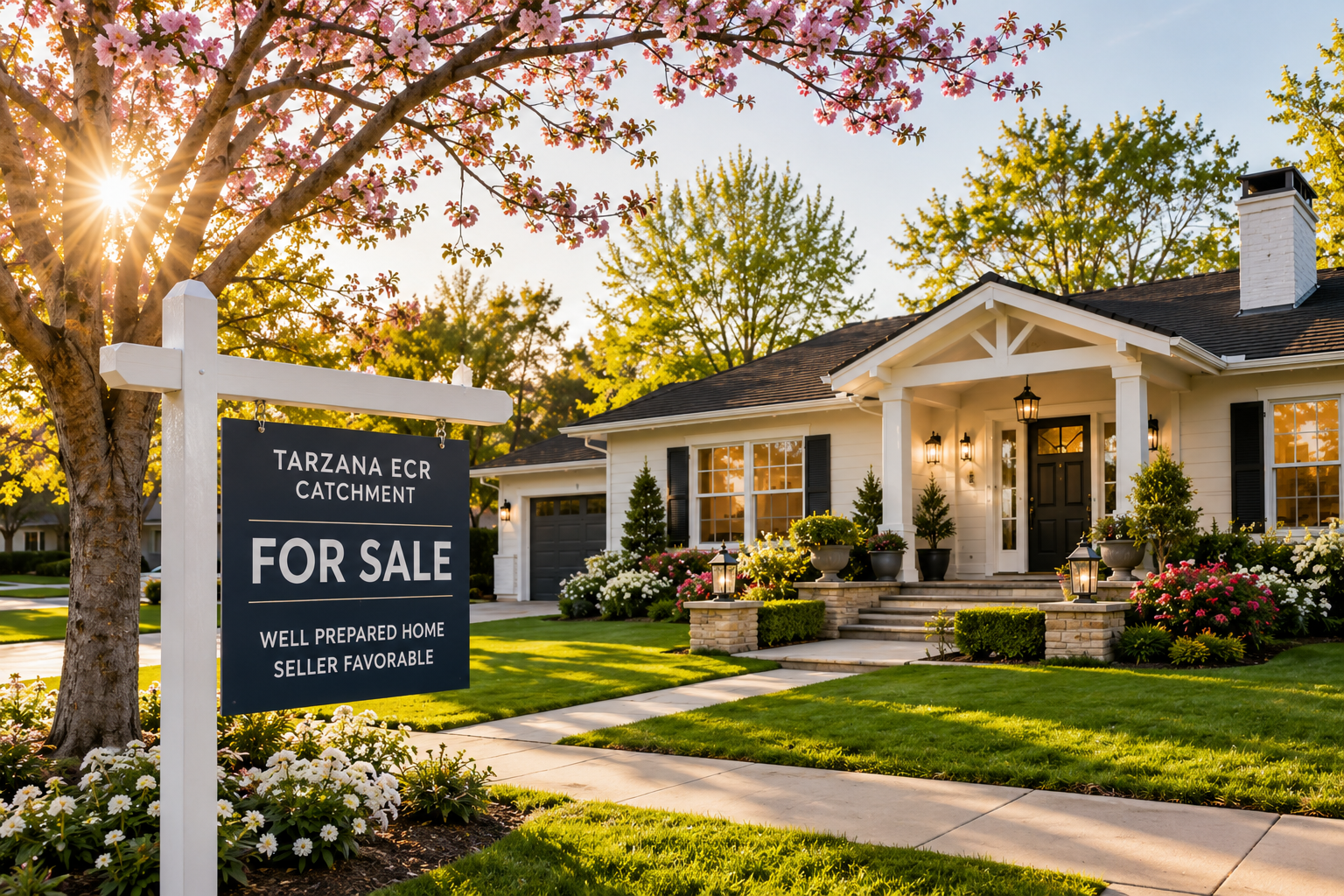 The Tarzana 91356 market in spring 2026 — the ECR Charter-catchment core sub-neighborhoods operating in seller-favorable volume tier conditions (DOM 18–32 days, multiple offers on renovated homes) alongside the premium tier approaching Woodland Hills 91364 and Encino 91316 that provides more buyer opportunity. Understanding which sub-neighborhood your target home occupies is more important than knowing the zip-code-level market average.
The volume tier ($850K–$1.15M) — seller-favorable:
The primary Tarzana transaction tier — 3-bedroom homes in ECR-catchment sub-neighborhoods — is operating in seller-favorable conditions in 2026 spring and fall peak windows. The demand floor in this tier is specifically durable because it is anchored by ECR Charter enrollment urgency that is present regardless of rate levels.
- → 📊 DOM: 18–32 days for correctly priced renovated homes in spring; 28–45 days for improved condition
- → 💰 Pricing: At or approaching the comp ceiling for renovated inventory — $1.05M–$1.35M for 3-bedroom renovated in core ECR-catchment sub-neighborhoods
- → 🏆 Competing offers: Multiple offers common on correctly priced renovated spring listings — the ECR buyer urgency that produces the "I need this specific address by the enrollment deadline" motivation drives competitive behavior
- → ⚠️ Buyer conditions: Limited — the buyer who can wait for a better deal in the volume tier will wait a long time; the correctly priced home that comes to market in spring does not accumulate DOM waiting for a below-asking offer
The premium tier ($1.2M–$1.55M) — buyer-balanced:
The Tarzana premium tier — the larger homes approaching Woodland Hills 91364 and the higher-end ECR-catchment addresses — is more balanced in 2026. The premium tier buyer is more rate-sensitive, more patient, and has more alternatives (including Woodland Hills and Encino) to compare against.
- → 📊 DOM: 35–65 days — meaningful patience available
- → 💰 Pricing: Approximately 5–10% below the 2022 peak — creating the specific buyer opportunity that has not closed in the volume tier
- → 🏆 Negotiating room: More present than in the volume tier — motivated sellers at 45+ DOM have demonstrated willingness to negotiate on price, credits, and seller-paid buydowns
- → ✅ Buyer conditions: Moderate — the buyer who can qualify at the premium tier and who has the patience to find the right listing at the right DOM point has genuine opportunity in 2026
The original-condition inventory — the most specific buyer opportunity:
Within both tiers, the original-condition Tarzana inventory — the 1960s–1970s homes in dated condition that the renovation-ready or investor buyer can access at below-comp-ceiling prices — represents the most specific current buyer opportunity:
- → 💰 Pricing: $820,000–$980,000 for original-condition 3-bedroom in the volume tier — $150,000–$250,000 below the renovated comp ceiling
- → ✅ The buyer opportunity: The buyer who can execute the renovation scope described in the Tarzana home improvements article ($70,000–$110,000 to the correct Tarzana specification) at current prices acquires the comp ceiling recovery that produces $150,000–$250,000 in equity on completion — a specific return on renovation investment that is available because the current rate environment has thinned the renovation-ready buyer pool slightly
2. 💰 The Rate Reality — Honest Analysis of What 7.0%–7.5% Means for Tarzana Buyers
The rate environment is the most consistently cited reason for buyer hesitation in Tarzana — and the honest analysis of what current rates actually mean for a Tarzana buyer's total financial picture is more nuanced than the "rates are high, wait" narrative suggests.
The monthly payment reality at Tarzana's price points:
At a conventional 30-year rate of 7.25% (the approximate mid-point of the current range):
$850,000 purchase (10% down, $765,000 loan):
- → 💳 P&I: $5,221/month
- → 🏛️ Property taxes (1.2%): $850/month
- → 🏠 Insurance: $110/month
- → Total PITI: approximately $6,181/month
- → 💰 Income required (28% front-end DTI): approximately $264,000/year gross household income
$950,000 purchase (10% down, $855,000 loan):
- → 💳 P&I: $5,835/month
- → 🏛️ Property taxes: $950/month
- → 🏠 Insurance: $125/month
- → Total PITI: approximately $6,910/month
- → 💰 Income required: approximately $296,000/year gross
$1,150,000 purchase (20% down, $920,000 loan):
- → 💳 P&I: $6,279/month
- → 🏛️ Property taxes: $1,150/month
- → 🏠 Insurance: $145/month
- → Total PITI: approximately $7,574/month
- → 💰 Income required: approximately $324,000/year gross
The honest rate comparison — current vs. the 2020–2021 environment:
At the 2021 peak-market rate of 3.0% on the same $855,000 loan:
- → P&I: $3,604/month — $2,231/month less than today's payment
This payment difference is real and significant — it represents the genuine affordability compression that current rates have produced versus the environment in which many buyers formed their payment expectations. The buyer who planned a Tarzana purchase in 2021 expecting a $3,600/month P&I and who now faces $5,835/month has experienced a $2,231/month payment increase on the same purchase — a change that has eliminated or significantly reduced the affordability for some buyer profiles.
The honest case for buying now despite current rates:
The refinance option — marry the home, date the rate:
The rate environment in 2026 is not permanent — it is the rate available today, not the rate available in 2027, 2028, or 2029. Historical rate cycles suggest that a meaningful rate decline from current levels is more likely than not within a 5-year horizon. When rates decline, Tarzana homeowners who purchased in 2026 will refinance:
- → 💡 If rates decline to 6.0%: The $855,000 Tarzana buyer's monthly P&I drops from $5,835 to $5,123 — a $712/month improvement from refinancing
- → 💡 If rates decline to 5.5%: P&I drops to $4,855 — a $980/month improvement
- → 💡 If rates decline to 5.0%: P&I drops to $4,590 — a $1,245/month improvement
- → ⚠️ The locked-in rate risk: The buyer who waits for lower rates to buy and rates decline as expected — but Tarzana prices recover further in the meantime — may discover that the lower rate on a higher purchase price produces a comparable monthly payment to the higher rate on today's price, plus the missed appreciation during the wait period
The rent vs. buy comparison at Tarzana's price points:
The alternative to purchasing in Tarzana is renting — and the rent vs. buy analysis in 2026 Tarzana is specific:
- → 💰 Market rent for a 3-bedroom in Tarzana 91356: $3,800–$4,600/month
- → 💰 PITI on $950,000 Tarzana purchase (10% down): $6,910/month
- → 📊 Monthly cost differential: $2,310–$3,110/month more to own versus rent at current rates
- → ✅ What ownership adds that renting doesn't: Principal paydown ($1,100–$1,200/month in year one on $855,000 loan), property tax deductibility (value varies by household tax situation — consult a tax professional), appreciation on the asset, and the fixed-payment certainty that rent escalation eliminates
The rent-vs.-buy math in Tarzana at 2026 rates does not produce the dramatic ownership advantage that 2020–2021 rates created. It does not produce the "renting is obviously better" outcome either. For buyers with a 7–10 year hold horizon, the appreciation, principal paydown, and inflation-hedge value of ownership consistently exceeds the cost differential over the hold period. For buyers with a 3–5 year horizon, the math is less clear.
3. 🏫 The ECR Charter Factor — Why School-Motivated Buyers Have Different Timing Logic
The buyer whose Tarzana purchase is specifically motivated by El Camino Real Charter High School enrollment eligibility operates with a fundamentally different timing logic from the investment-motivated or lifestyle-motivated buyer — and this timing logic often resolves the "is now a good time?" question differently than rate analysis alone suggests.
How ECR Charter enrollment drives Tarzana buyer urgency:
El Camino Real Charter High School — consistently rated among the top public high schools in the Los Angeles area — requires verified residency in its catchment area for enrollment. Families who need ECR Charter enrollment for a child entering 9th grade in the following September have a specific, non-deferrable deadline: establish residency in the ECR catchment area before the enrollment verification period.
This deadline creates a buyer profile that is specifically less rate-sensitive than the general buyer:
- → ✅ The ECR family's calculation: If the family rents in an ECR-catchment address to establish residency while waiting to purchase, they are paying Tarzana's rental rates ($3,800–$4,600/month for a comparable 3-bedroom) without building equity. If rates decline and they purchase in year 2 or 3, they have paid $45,600–$110,400 in rent without equity accumulation during the waiting period.
- → ✅ The school quality premium calculation: The ECR-catchment address premium in Tarzana — approximately $75,000–$125,000 above comparable non-ECR-catchment addresses — is a permanent, built-in feature of the home's value that is not going away when rates change. The family that purchases an ECR-catchment address at today's prices is acquiring both the home and the school access; the family that waits may find that a rate decline has brought more buyers into the market, increasing competition for the same limited ECR-catchment inventory.
The enrollment deadline timeline:
Families whose oldest child needs ECR Charter enrollment in September 2027 have a residency establishment deadline that typically runs late-2026 to early-2027. This specific timeline creates a Tarzana buyer with a concrete "act by" date — one for whom the "wait for rates to drop" strategy may cost the enrollment opportunity rather than save on payment costs.
Verifying ECR Charter catchment:
The ECR Charter catchment is address-specific — verify any target address through LAUSD's school finder (lausd.net/schoolfinder) and directly with the ECR Charter enrollment office before making any purchase decision specifically based on school access. The catchment boundary runs through specific street-level addresses in Tarzana, and proximity to the catchment area does not guarantee enrollment eligibility.
4. 🔮 The Case for Waiting — When Tarzana Buyers Should Hold Off
An honest "is now a good time to buy" article must present the case for waiting as clearly as the case for buying. The Tarzana buyer for whom waiting is the correct decision exists — and the analysis that identifies them is as important as the analysis that identifies who should act now.
The Tarzana rate vs. price timing analysis — the specific financial comparison that determines whether a buyer's hold horizon, current qualification position, and rent vs. buy situation supports purchasing in the 2026 Tarzana market or waiting for improved rate conditions. The answer is buyer-specific — not a uniform "buy now" or "wait" recommendation.
The case for waiting — specific buyer profiles:
The marginal qualification buyer:
The buyer whose qualification at current rates is at or near the ceiling of what lenders will approve — DTI above 43%, reserves below lender minimums, credit profile that is borderline for the best available rate tier — should not stretch to purchase in the current Tarzana market. The marginal qualification buyer who closes on a Tarzana home at maximum DTI has no financial cushion for the small maintenance items, property tax increases, or income interruptions that the first years of homeownership typically produce.
- → ✅ The waiting path: Spend 12–18 months improving credit, reducing other debt, building reserves, and qualifying at a more comfortable DTI before returning to the Tarzana market. The Tarzana home that is unaffordably stressful at maximum qualification is affordable and enjoyable when the same payment is 30% rather than 43% of gross income.
The short-hold buyer:
The buyer who plans to hold a Tarzana home for fewer than 5 years faces a specific mathematical challenge at current prices and rates. The transaction costs of purchase (approximately 2–3% of purchase price, or $17,000–$28,500 on a $950,000 Tarzana home) combined with the cost of sale (approximately 5–6% for commission and closing) mean that a Tarzana buyer who sells in 3–4 years must achieve approximately 8–9% appreciation just to break even on the transaction costs — before accounting for the monthly cost differential between owning and renting.
- → ✅ The waiting path or alternative: Either extend the hold commitment to 7–10 years before purchasing, or evaluate whether renting in Tarzana while waiting for a genuine long-hold commitment opportunity is financially preferable.
The buyer expecting significant price declines:
Some buyers are waiting for Tarzana prices to decline meaningfully from current levels before purchasing. This strategy requires specific conditions to produce the expected outcome: a meaningful increase in available inventory, a deterioration of the ECR Charter school quality anchor that drives volume tier demand, or a broader economic event that produces forced selling in the working-family and professional household segment that anchors Tarzana's buyer pool.
- → ⚠️ The honest assessment: The volume tier ($850K–$1.15M) demand floor in Tarzana is durable — the ECR Charter enrollment motivation creates demand that persists through rate cycles. Meaningful price declines in this tier would require the ECR Charter to lose its premium reputation (not currently indicated) or a broader economic event that produces the kind of forced selling that Tarzana's working-family owner profile doesn't typically generate. Buyers waiting for a 15–20% correction in the Tarzana volume tier are waiting for an outcome that current market structure makes unlikely.
- → ✅ Where the price decline case is stronger: The premium tier ($1.2M–$1.5M) that is still 5–10% below 2022 peak has more downside risk than the volume tier — buyers at the premium tier waiting for additional softening have a more defensible wait thesis than volume tier buyers expecting dramatic corrections.
5. 🛠️ The Seller-Paid Buydown — How Smart Buyers Are Reducing 2026 Payment Pressure
The seller-paid rate buydown — described in the Tarzana seller-paid rate buydowns article from the seller's perspective — is the specific tool that makes the 2026 Tarzana market more accessible than the note rate alone suggests for buyers who know how to negotiate for it.
How buyers access the buydown:
The 2-1 buydown is most accessible in:
- → ✅ Summer and fall listings: Sellers whose homes have been on market 30+ days in the summer or fall are specifically motivated to add a buydown rather than reduce price — a buyer who identifies these listings and specifically requests a buydown credit as part of their offer is negotiating for a benefit that the seller is often already considering
- → ✅ Premium tier listings at 45+ DOM: The Tarzana premium tier seller with 45 days of accumulated DOM has demonstrated that the listing has not generated competitive pressure — the buyer who offers at or slightly below asking with a specific buydown request in the financing package is negotiating from the buyer's most favorable position in the Tarzana market
- → ✅ New listings that specifically market a buydown: Some Tarzana sellers (as described in the buydown article) proactively market the 2-1 buydown — these listings present the year-one payment illustration that makes the financial decision transparent
The buydown impact at Tarzana's price points:
At a $950,000 Tarzana purchase with 10% down ($855,000 loan):
- → 💰 2-1 buydown cost (2.15% of loan): approximately $18,382 — paid by seller as a closing credit
- → 📅 Year 1 effective rate (5.25%): P&I = $4,721/month — versus $5,835 at 7.25%
- → 💰 Year 1 monthly savings: approximately $1,114/month
- → 📅 Year 2 effective rate (6.25%): P&I = $5,267/month
- → 💰 Year 2 savings: approximately $568/month
- → 📊 Total 24-month savings: approximately $20,424
The $1,114/month year-one savings from a seller-paid buydown is the specific payment relief that converts the "7.25% is too high for me" buyer into a buyer who can afford the Tarzana home they want at a payment that is genuinely manageable in year one — while qualifying at the full 7.25% rate and building equity from day one.
🚫 What NOT to Overdo
Don't wait for rates to hit a specific target before purchasing if you have an ECR Charter enrollment deadline. The buyer who says "I'll buy when rates hit 5.5%" and whose child needs 9th grade ECR enrollment in September 2027 may discover that rates reach 5.5% in Q3 2027 — after the enrollment window has closed and after the child has started high school elsewhere. The rate target that misses the enrollment deadline is the rate target that was never worth pursuing in the first place.
Don't assume that lower rates will produce lower Tarzana purchase prices. The most common "wait for rates" logic error is the assumption that the lower-rate environment will allow the buyer to purchase the same home at a lower price. History consistently demonstrates that lower rates expand the buyer pool — more buyers can qualify at lower rates, which increases competition for Tarzana's limited ECR-catchment inventory, which pushes prices up. The lower-rate Tarzana may produce a lower monthly payment on the same home, or it may produce the same monthly payment on a higher-priced home. The net payment benefit of waiting for lower rates is frequently smaller than buyers expect.
Don't purchase in the premium Tarzana tier at maximum qualification assuming the rental income from an ADU will bridge the payment gap. Some premium tier buyers in Tarzana at $1.2M–$1.5M are underwriting the purchase with an expected ADU rental income that has not been confirmed, permitted, or even verified as feasible for the specific lot. The ADU rental income that bridges the payment gap from "stressful" to "manageable" is only available after the ADU is permitted, constructed, and occupied — a 10–18 month timeline after purchase. Underwriting the purchase on the assumption of ADU income from month one is the specific qualification error that produces the financially stressed homeowner rather than the comfortable one.
Don't skip the pre-approval before touring Tarzana homes at current prices. The buyer who tours Tarzana homes without a current pre-approval has no basis for evaluating whether the specific homes they are emotionally engaging with are affordable at today's rates. The pre-approval conversation — which includes the specific payment, the required income, the reserve requirement, and the rate lock options — is the financial reality check that should precede any Tarzana home tour, not follow it.
Don't use the 2020–2021 Tarzana purchase as the reference point for your payment expectation. The neighbor who bought in 2021 at 3.0% and pays $3,600/month P&I on a comparable home to the one you are evaluating at 7.25% and $5,835/month is not in the same financial position — and their payment is not available to a 2026 buyer at any price point within Tarzana's current comp ceiling. The correct reference point for 2026 Tarzana payment expectations is 2026 Tarzana rates on 2026 Tarzana prices — not the rate environment that no longer exists.
🏠 Real-World Scenario — Tarzana 91356
A couple — both teachers at LAUSD schools in the central Valley, combined income $182,000, one daughter beginning 8th grade in September 2026 — had been researching Tarzana for 14 months. Their motivation was specifically ECR Charter enrollment for the daughter's 9th grade year beginning September 2027. Their budget: $920,000. Their hesitation: the payment at 7.25% ($6,181/month PITI on $850,000 with 10% down) was $1,800/month more than they were paying in rent in Van Nuys 91401.
We walked through the specific analysis for their situation:
The enrollment timeline: ECR Charter enrollment for September 2027 required residency establishment by January–February 2027. Their window to purchase and establish residency: the fall 2026 market window — October through December 2026.
The rent vs. buy at their specific budget: Van Nuys rent: $2,850/month. Tarzana PITI: $6,181/month. Monthly cost differential: $3,331/month. Annual additional cost of owning over renting: $39,972.
What they get for the $39,972 annual premium:
- → 📈 Annual appreciation (3.5% on $850,000): $29,750
- → 💰 Annual principal paydown: approximately $9,800 in year one
- → 🏫 ECR Charter enrollment for their daughter — the specific school quality that motivated the purchase
- → 🔒 Fixed payment certainty — Van Nuys rent had increased 4% annually for 3 consecutive years
The net first-year cost of ownership over renting: $39,972 annual additional cost - $29,750 appreciation - $9,800 principal paydown = $422 net first-year premium for ownership versus renting, after accounting for equity building.
The first year of Tarzana ownership — which they had framed as "$3,331/month more expensive than renting" — was actually producing approximately $35/month in net premium when appreciation and principal paydown were included. The payment was higher; the total financial picture was comparable.
We added the seller-paid 2-1 buydown component: in the fall market window they were targeting, the seller-paid buydown was achievable as part of a negotiated offer. A $1,114/month year-one payment reduction from the buydown would put them $692/month ahead of renting on a total return basis in year one.
They purchased in core ECR-catchment Tarzana 91356 in October 2026 at $908,000 with a seller-paid 2-1 buydown. Year-one effective P&I: $4,721/month. Year-one PITI: $5,581/month. Monthly cost differential above Van Nuys rent: $2,731/month — manageable on their combined teaching income.
Daughter enrolled at ECR Charter for 9th grade in September 2027. Close call on the enrollment timeline — but they made it.
🏠 Real-World Scenario — Tarzana 91356
A different buyer — a 38-year-old nurse practitioner at a Woodland Hills 91367 medical group, purchasing alone, income $165,000 — had a different specific question: not whether to buy in Tarzana (she had decided to buy) but whether to buy now in the premium tier at $1.15M–$1.25M (her preferred size and condition) or buy now in the volume tier at $880,000–$950,000 (more affordable but less of what she specifically wanted).
Her timeline: no school enrollment urgency, 10-year hold minimum, focused on the right home for the long term rather than the fastest path to ownership.
We modeled both options honestly:
Volume tier at $900,000 (10% down, $810,000 loan):
- → PITI: $5,868/month — 42.6% of her gross monthly income ($13,750). At the upper edge of lender comfort.
- → 3-bedroom, 1,400–1,500 sq ft, the size that meets her living requirements but not her preference
- → 5-year appreciation projection (3.5%): $163,350 on the $900,000 asset
Premium tier at $1.2M (20% down, $960,000 loan):
- → PITI: $7,176/month — 52.2% of her gross monthly income. Above conventional lender DTI limits without additional qualifying factors. Requires jumbo financing.
- → 4-bedroom, 1,800–2,000 sq ft, specifically what she wanted
- → 5-year appreciation projection (3.5%): $217,800 on the $1.2M asset
The honest assessment: The premium tier at $1.2M was not affordable for her on a single income at current rates — 52.2% housing DTI is above lender qualification thresholds without compensating factors. The volume tier at $900,000 was at the upper edge of lender comfort but achievable.
The recommendation: purchase in the volume tier now, building equity over the 10-year hold. If rates decline to 5.5%–6.0% over the hold period and the equity position grows, she would have the option to sell the volume tier home and move up to the premium tier with a larger down payment that makes the premium tier affordable at those conditions.
She purchased in the Tarzana 91356 volume tier at $887,000 in spring 2026. PITI at the negotiated terms (including a $17,200 seller-paid buydown for year one): $5,167/month PITI year one — 37.6% of her gross income. Manageable.
Her 10-year plan: hold the volume tier home through a rate decline cycle, refinance when rates normalize, build equity through principal paydown and appreciation, and make the premium tier decision with additional equity and a stronger financial position.
The buyer who wanted the $1.2M home and waited 18 months for rates to decline before purchasing found that when rates declined to 6.2%, Tarzana volume tier prices had recovered further — and the $887,000 home she had purchased was now worth approximately $965,000. The equity she had built in 18 months of ownership was the down payment enhancement that was moving the premium tier from "unaffordable" to "achievable."
❓ FAQ
Is now a good time to buy in Tarzana? For most buyers with a 7–10 year hold horizon and stable household income, the honest answer is yes — with appropriate rate expectations. The Tarzana volume tier ($850K–$1.15M) is seller-favorable and unlikely to produce dramatic price declines given the ECR Charter demand floor. Buyers who wait for lower rates may find that rate declines bring more buyer competition and higher prices, partially offsetting the payment benefit. ECR Charter-motivated families with enrollment deadlines have an additional urgency factor that makes waiting specifically costly if the enrollment window closes before purchase.
Will Tarzana home prices drop in 2026? The volume tier ($850K–$1.15M) price decline scenario requires conditions — ECR Charter quality deterioration, significant inventory increase, forced selling from working-family owners — that are not currently present. The volume tier demand floor is durable. The premium tier ($1.2M–$1.5M) has more softness — still approximately 5–10% below 2022 peak — and could see additional modest softening in summer or fall if rate conditions persist and inventory increases. A 10–15% correction in the Tarzana volume tier is not a realistic 2026–2027 base case scenario.
How much income do I need to buy a home in Tarzana? At current rates and Tarzana's primary price points: ✓ $850,000 purchase (10% down, $765,000 loan): approximately $222,000–$264,000 gross household income. ✓ $950,000 purchase (10% down, $855,000 loan): approximately $248,000–$296,000. ✓ $1,150,000 purchase (20% down, $920,000 loan): approximately $270,000–$324,000. ✓ $1,350,000 purchase (20% down, $1,080,000 loan): approximately $317,000–$380,000. These ranges reflect different lender DTI requirements (28%–36% housing ratio). Verify with a lender for your specific credit profile, loan type, and current rate.
Should I wait for interest rates to drop before buying in Tarzana? The waiting strategy has merit for buyers with no time-sensitive motivation (no ECR enrollment deadline, no lease termination pressure) and a genuine belief that rates will decline meaningfully within their waiting horizon. The specific risk of waiting: Tarzana prices may recover further as rate declines bring more buyers into the market, partially offsetting the monthly savings. For ECR-motivated families with enrollment deadlines, waiting for lower rates risks missing the enrollment window. For buyers in stable rental situations without urgent motivation, a 12–18 month wait to see rate direction is defensible.
What is the best time of year to buy in Tarzana? Summer (June–August) and fall (October–November) produce the best buyer conditions in Tarzana — reduced competition from other buyers, potential for seller-paid buydowns and other concessions from motivated sellers, and the specific opportunity of correctly priced listings that haven't generated spring peak offers. Spring (February–April) is the most competitive season — the ECR enrollment urgency and broad buyer activation produce seller-favorable conditions that give buyers the least negotiating room. ECR-motivated families whose enrollment deadline falls in January–February must purchase in fall, which fortunately aligns with more buyer-favorable conditions than spring.
Can I negotiate below asking price in Tarzana in 2026? It depends on the sub-market and the specific listing. Volume tier listings correctly priced in spring: limited negotiating room, often closing at or above asking. Premium tier listings with 35+ DOM in summer or fall: meaningful negotiating room — 3–6% below asking is achievable on correctly identified motivated sellers. Original-condition inventory at any time: the most consistent below-asking opportunity, with the renovation scope providing an additional negotiating tool (seller-credit for estimated renovation costs). The buyer who identifies the summer or fall premium tier listing with 45+ DOM and no recent price reduction has found Tarzana's most buyer-favorable negotiating position.
🎯 Bottom Line
The Tarzana 2026 buying opportunity is real — and it is buyer-specific in a way that makes a uniform "yes buy" or "no wait" answer genuinely unhelpful. The ECR Charter-motivated family with a September 2027 enrollment deadline should act in fall 2026, using the seller-paid buydown to manage year-one payment pressure and accepting that the volume tier's seller-favorable conditions don't allow for patient below-asking offers. The investor-minded buyer with a 10-year horizon should evaluate the original-condition inventory for the renovation equity opportunity that current market conditions create. The premium tier buyer with no enrollment urgency has genuine opportunity to negotiate in the summer and fall windows where 35–65 day DOM listings provide real motivation for seller concessions.
What the Tarzana market in 2026 does not offer: dramatic price declines from current levels in the volume tier, the payment environment of 2020–2021, or the uncomplicated buyer-favorable conditions that some buyers are waiting for. What it does offer: a durable demand floor anchored by ECR Charter enrollment motivation, a premium tier with specific softness that patient buyers can access, original-condition inventory with genuine renovation equity opportunity, and the specific year-one payment relief that seller-paid buydowns provide to buyers who know how to negotiate for them.
At Parkway Estate Properties, Liana's buyer representation across Tarzana 91356, Sherman Oaks 91403/91423, Encino 91316/91436, Woodland Hills 91364/91367, and Northridge 91324/91325 means every Tarzana buyer conversation is grounded in the current sub-neighborhood comp data, the rate environment's specific impact on their qualification and payment, and the honest timing analysis that produces the correct purchase decision for their specific situation.
📩 Want an Honest Assessment of Whether Now Is the Right Time to Buy in Tarzana for Your Specific Situation?
We'll evaluate your timeline, your qualification position, your enrollment urgency if applicable, and the current Tarzana sub-neighborhood conditions — and give you the honest answer for your specific situation, not a generic market recommendation.
Contact Liana Shersher at Parkway Estate Properties: 📧 liana@parkwayestate.com · 📞 (818) 208-5881 · 🌐 parkwayestate.com 15021 Ventura Blvd., Ste. 510, Sherman Oaks, CA 91403
About the Authors
Liana Shersher is a licensed real estate agent with Parkway Estate Properties Inc. and an Accredited Buyer's Representative (ABR) serving the San Fernando Valley — with a focus on Sherman Oaks, Encino, Tarzana, Woodland Hills, and Northridge (DRE# 02164224). Liana guides first-time homebuyers through every step of the purchase, from the first showing to the keys in hand, and represents move-up and repeat buyers across the Valley. For sellers, she builds the pricing and marketing strategy that positions a home to sell for top dollar, fast. Buyers and sellers work with Liana for clear communication, sharp local knowledge, and an agent who treats their goals like her own.
Roman Shersher is the broker-owner of Parkway Estate Properties Inc. and a real estate investor with 18 years of experience in the San Fernando Valley (DRE# 01855095). Roman has personally led or co-led renovations on dozens of properties across the Valley, including recent projects in Northridge (91324) and Woodland Hills (91364). That hands-on renovation and investment experience shapes every pricing conversation and days-on-market strategy at Parkway — sellers get a realistic read on what improvements actually return at resale, and buyers get an expert eye on a home's true condition and upside.
Parkway Estate Properties, Inc. · 15021 Ventura Blvd., Ste. 510, Sherman Oaks, CA 91403 · (818) 208-5881 · parkwayestate.com · Broker License #: 01873092 Equal Housing Opportunity. Information herein is general and not legal, tax, or financial advice. Consult qualified professionals for your specific situation.
Categories
Recent Posts










Broker | Realtor ® License ID: 01873092
+1(818) 208-5881 | info@parkwayestate.com